ITIL Incident Management Workflows in a Telecom NOC
ITIL works for telecom NOCs, but siloed systems break every handoff between stages.
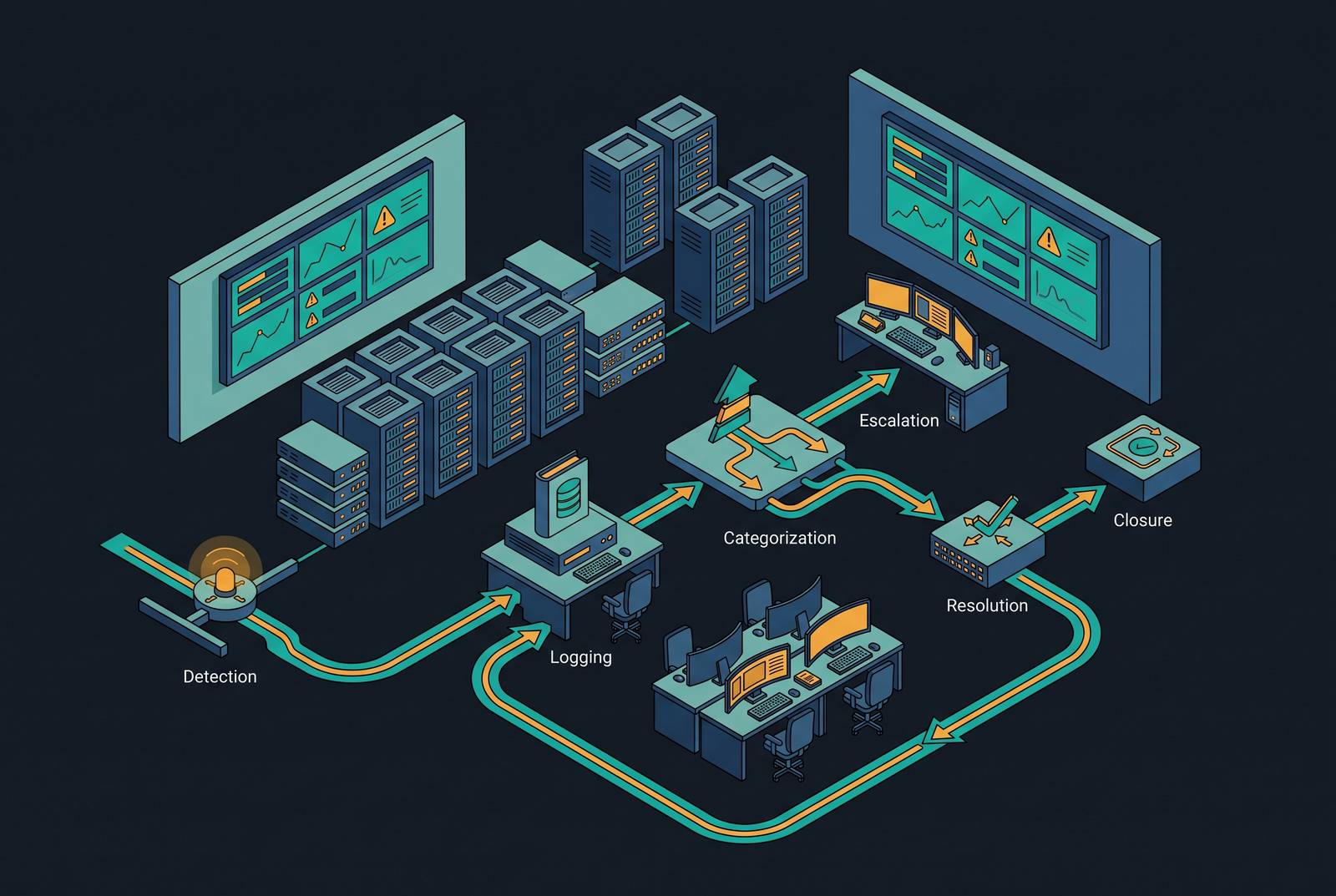
ITIL's incident management lifecycle, the sequence running from detection through logging, categorization, escalation, resolution, and post-incident review, gets dismissed by a lot of NOC veterans as too corporate for the pace of real network operations. That verdict misses the actual problem. ITIL is not too rigid for a telecom NOC; it is the right skeleton for one. The trouble is that ITIL assumes each stage hands clean data to the next, and in a telecom NOC that handoff is rarely clean, because the data each stage depends on sits in a different system. Telecom operations carry obligations a generic IT help desk never faces: always-on SLA commitments, a network topology that spans physical, logical, and service layers at once, a multi-vendor OSS environment stitched together over years of acquisitions and upgrades, and alarm volumes that routinely outscale what a standard ITSM platform was built to absorb. ITIL's logic holds up. What breaks is the assumption that the systems executing each stage can talk to each other on their own.
How detection fails before an incident is even logged
The first stage to break is also the one ITIL treats as close to automatic: detection. In a telecom NOC, detection in practice means engineers stare at dashboards and pattern-match across a wall of alarms, trying to decide which blinking indicator is a real customer-impacting event and which is noise. That is not a qualified incident signal arriving at the right desk. That is a judgment call made at 3 a.m. by someone trying to reconstruct, from a device identifier alone, whether the problem touches one circuit or an entire SLA-bound customer base.
The identifier is the root of the problem. Alarm management systems and OSS inventory typically run as separate silos, so when an alarm fires, it fires against a device ID with no automatic link to the services, customers, or SLAs riding on that device. Someone has to manually trace that connection before prioritization can even start, and until they do, every alarm looks equally urgent or equally ignorable. Detection, done properly, requires an incident management system that integrates alarm management with an advanced configuration management database, so that the moment an alarm fires, the system automatically associates the affected configuration items, pulls relevant historical data, and attaches knowledge articles specific to that incident type. So the stage ITIL expects to run as a quiet, automatic trigger becomes the most labor-intensive, least reliable part of the whole lifecycle. TM Forum's Agentic NOC catalyst project says legacy reactive NOC models can't keep up with how complex modern networks have gotten, and the detection gap is one of the drivers it names.
Why incident logging fails as a source of truth
Even when detection works and an engineer correctly identifies a real incident, the act of writing it down introduces its own damage. Logging in a traditional telecom NOC is a manual translation exercise: an engineer sees an alert in a monitoring tool, creates a ticket by hand in the ITSM, and a developer later pastes the incident URL into yet another tracking system. From the moment that ticket opens, status starts drifting across the systems that reference it, because nothing keeps them synchronized.
Calling this a discipline problem misses what's actually happening. It's an architecture problem: when monitoring, the ITSM, OSS inventory, and field operations each run on their own data model, every log entry becomes a transcription, and transcription loses information. The cost of that loss doesn't land immediately. It lands later, in problem management and post-incident review, where ITIL's entire closed loop depends on incident records detailed enough to support root cause analysis. Records assembled by manual copy-paste across four disconnected systems are too thin and too inconsistent to support that kind of pattern detection, no matter how skilled the analyst reading them is. Carrier Ethernet and dedicated internet operators feel this most acutely, because fault isolation on SLA-bound services has to span physical, logical, and service layers at the same time, and a log entry that never captured which layer the fault lived in makes that kind of analysis impossible to do after the fact.
Where categorization becomes the bottleneck that slows everything downstream
Categorization inherits every problem logging created, and then adds its own. A telecom NOC's taxonomy tends to fail in one of two directions: either it's too coarse to route an incident to the team actually equipped to fix it, or it's so granular that engineers spend more time arguing about which category applies than they spend working the incident itself.
Telecom incidents complicate this further because a single customer-impacting event often spans provider type (telco, fiber, data center) and technology layer at the same time, so a taxonomy built around one domain forces a choice that doesn't actually fit the incident, and the ticket gets misrouted as a result. ITIL expects categorization to drive both the escalation path and the knowledge retrieval that follows, but that only works if categories are applied consistently enough, across enough incidents, to form a reliable pattern. Manual categorization performed under alert pressure, by engineers who are also trying to triage five other things, doesn't produce that consistency [1]. A correctly categorized incident pulls up relevant historical data and the right knowledge articles automatically. If you miscategorize it, the engineer gets sent to the wrong knowledge base entirely, and the resolution clock effectively restarts from zero.
How escalation paths break under siloed tooling and missing context
By the time an incident reaches escalation, the debt accumulated at detection, logging, and categorization comes due all at once. Escalation tiers in most telecom NOCs are well defined on paper: Tier 1 handles the routine cases, Tier 2 takes what Tier 1 can't resolve, and so on up the chain. The tiers aren't the problem. The context a Tier 2 engineer needs to act on an escalated ticket is scattered across the monitoring system, the OSS, the ITSM, and whoever took the original call, and none of those systems hands that context forward on its own.
That means escalation doesn't continue the diagnostic process ITIL assumes it should. It restarts it. The Tier 2 engineer has to reconstruct, often from scratch, everything the Tier 1 engineer already figured out, so the tiered model burns exactly the time it exists to save. The ITIL-aligned industry benchmark holds that a properly trained, properly equipped Tier 1 team should resolve a strong majority of incidents without escalating. That benchmark is out of reach when Tier 1 engineers don't have the system access or the integrated data to close out even straightforward tickets without manual lookups across tools that don't talk to each other. TM Forum's Agentic NOC project names the transition from reactive, cost-centre operations to autonomous, strategic enablement as its architectural goal, and it identifies the siloed escalation path as a direct obstacle standing in the way of that goal.
Slower Resolution Under These Conditions
Resolution is where every upstream failure becomes visible as a number: mean time to resolution. When qualification, design, provisioning, and activation data each live on a separate system, the engineer working a service-layer incident can't confirm whether the configuration state recorded in the OSS actually matches what's running on the live network, not without a manual cross-check. That gap widens as a provider's service count grows, because every additional service is one more place where the OSS record and the live network can drift apart unnoticed.
This isn't a talent gap among engineers. So resolution runs slow because the data architecture forces manual verification at exactly the moment speed matters most. For Carrier Ethernet and dedicated internet operators, that delay costs more than just engineer hours. If resolution on SLA-bound services is delayed, you pay for it directly, in service credits and contract exposure. ITIL's answer to this, over time, is proactive problem management: using historical incident data to spot and suppress recurring faults before they turn into repeat incidents. That mechanism needs incident records detailed enough to reveal a pattern, and the logging and categorization failures already documented leave records too thin to support it.
Post-Incident Review and the Operational Learning ITIL Intends
Post-incident review is the stage ITIL designed to close the loop, and it's the stage where every prior failure in the lifecycle becomes impossible to ignore. Root cause analysis and trend identification both depend on incident records that are accurate, complete, and consistent, and manual, multi-system logging systematically fails to produce records that meet that bar.
In practice, post-incident reviews inside fragmented NOC environments get reconstructed from memory and chat logs rather than from the incident management system itself, because the system's own record is missing too much to serve as the primary source. What comes out of that process is a narrative pieced together after the fact, not a finding grounded in data. ITIL's closed loop runs on a simple chain: incident data informs problem management, problem management drives change, change reduces future incidents. That chain stalls the moment its input data can't be trusted. Problem management can't spot a recurring fault pattern when the categorization taxonomy was applied inconsistently from one incident to the next, and it can't confirm whether a change fixed the underlying condition when the configuration record was never authoritative. Every breakdown from detection through escalation accumulates here, at the stage meant to catch and correct them, which explains why providers that fix only one link, adding better alerting, say, without touching the rest, still don't see post-incident outcomes improve. So the fix has to address the data substrate that every stage shares, not each stage in isolation.
The Data Layer That All ITIL Stages Share
Every stage examined here breaks for the same reason. The data a given stage needs isn't available at the moment that stage runs, because it lives in a system that was never built to feed the others. Detection needs OSS inventory data it doesn't have. Logging needs a single record it never gets. Categorization needs consistency that manual effort under pressure can't supply. Escalation needs context that no system hands forward. Resolution needs a configuration record it can't verify. Post-incident review needs a data trail that the fragmented lifecycle never captured.
The fix is not another layer of automation bolted onto the same siloed systems. The fix is putting qualification, design, provisioning, and activation data on one shared data model, so that a change made at any stage becomes visible immediately at every downstream stage, removing the manual work of assembling context by hand, the work that inflates MTTR and leaves post-incident records too thin to use. A unified data model is also what makes governed AI assistance possible in the NOC. AI agents that work off the same APIs, the same audit logs, and the same permission structures as human operators can speed up detection, categorization, and escalation, but only when the underlying data is consistent and current across every domain feeding those agents; ungoverned automation layered onto bad data just produces faster bad decisions. TM Forum's Agentic NOC catalyst, built on TM Forum's Open Digital Architecture, frames this exact relationship as its governing principle: AI agents operate alongside deterministic systems of record, not as a replacement for them, which keeps control and accountability intact as autonomy expands.
For fiber, CLEC, and carrier-grade service providers, OSS consolidation onto a shared data model is the condition ITIL needs to function as designed at the scale modern networks now operate at, and it is the foundation that governed AI-assisted operations have to be built on if they're going to work without creating new governance risk. The ITIL framework was never the problem. Providers that fix the data layer underneath it will find that it works exactly as it was designed to.