Challenges Facing CLECs Competing With Incumbent Carriers
Regulatory rollback and incumbent scale squeeze smaller carriers out of the market.
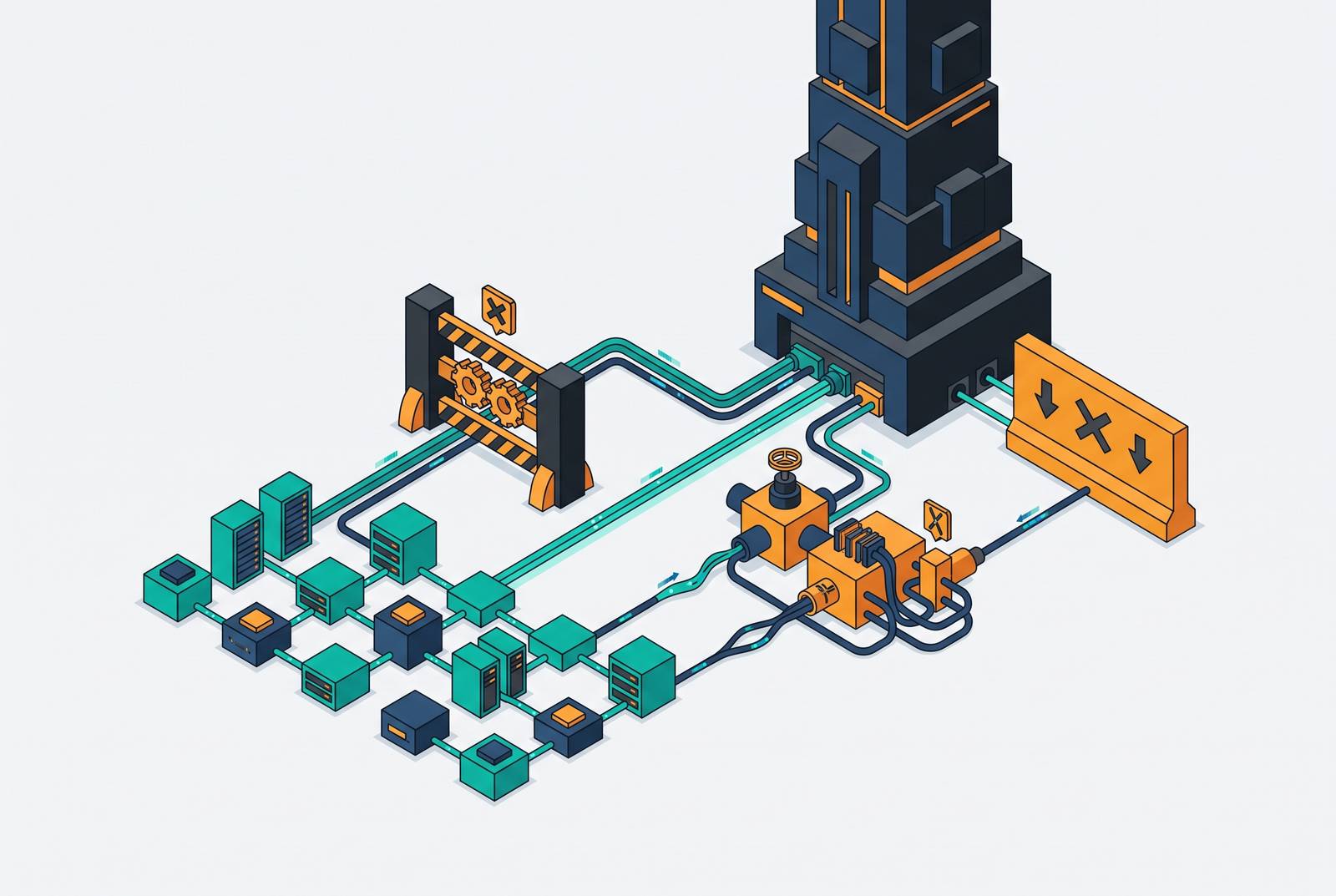
The erosion of the regulatory foundation that created CLECs
Section 251 of the Telecommunications Act of 1996 forced incumbent carriers to lease network elements, local loops, switching, colocation space, at regulated rates. That single obligation is why CLECs exist as a category. A carrier could show up in a market, interconnect with the public switched telephone network, and build a competitive offering without laying a mile of cable or renting a single square foot of central office space.
That model started cracking almost as soon as it existed. The FCC's Triennial Review in 2003 began unwinding the unbundled network element rules, and by 2004 the Supreme Court let a lower court ruling stand that voided the ILEC obligation to lease certain elements at those regulated wholesale rates. The FCC followed that December with rules phasing out CLEC access to ILEC local switching over the course of a single year, a direct hit to any carrier running a resale model instead of owning facilities.
USTelecom petitioned the FCC in May 2018 to end the leasing rule entirely within two and a half years, and incumbents largely got what they lobbied for. Today, ILECs are generally required to provide little more than local loop number termination. The infrastructure-sharing regime the 1996 Act built has been picked apart piece by piece for two decades running, and nothing in the current regulatory posture suggests that direction reverses.
A CLEC can no longer count on regulatory entitlement to get onto the network. Every advantage that model once handed a new entrant now has to be earned, either through owned infrastructure or by running the business better than the competition does. That is not just a matter of higher costs. It changes what a CLEC has to be good at to survive, and it turns operational execution from a nice-to-have into the thing that decides who is still standing in five years. Carriers that have not internalized this are operating on a premise the FCC quietly retired years ago.
The three-front competitive pressure CLECs face from ILECs, cable operators, and wireless
Fiber is where the fight is happening now, and the Tier-1 carriers are not standing still to let anyone catch up. AT&T closed the first quarter of 2026 with 37 million fiber locations passed, penetration near 32%, and a target of 40 million locations by year end that folds in the Lumen acquisition footprint. Verizon's Frontier deal closed the fiber subscriber gap with AT&T fast, from 2.7 million lines at the end of 2025 down to roughly 1 million by the first quarter of 2026. That kind of movement changes the math for anyone trying to compete on the same turf, because the gap a CLEC is used to exploiting closes while the CLEC is still planning around it.
A CLEC moving into a fiber corridor today is competing against rivals that already built delivery infrastructure end to end, with balance sheets that absorb a bad quarter without blinking. The industry is also seeing fiber increasingly challenge cable's long-held position as the dominant broadband technology, which opens underserved corridors even as it raises the bar on how fast a new entrant has to move before someone bigger claims the same ground.
Cable operators bring a different kind of pressure. They have spent the better part of a decade wiring the same enterprise corridors CLECs are chasing, and they compete on bundles and existing customer relationships as much as on price. Wireless adds a third front on top of that. Cable and wireless carriers combined now hold more than 80% of total retail voice subscriptions once mobile is counted. The voice market that justified CLEC formation in the first place has largely been absorbed by other players.
Fixed-mobile convergence makes the squeeze worse. Operators are bundling wireless, broadband, and digital services together in ways a CLEC without mobile assets cannot match. Efficiency for a CLEC is now a margin question rather than a performance goal. The window where a CLEC wins purely on service quality and responsiveness closes fast the moment its operations move slower than its sales team's promises.
Why capital constraints hit CLECs differently than ILECs
ILECs walk into fiber markets with long-established infrastructure, entrenched market positions, and access to capital at a scale CLECs simply do not inherit. When a CLEC spends capital, it is building or leasing new infrastructure rather than upgrading something it already owns, so a much larger share of that spend is a one-way commitment instead of an incremental bet.
Fiber raises the stakes further. Entering a market where a Tier-1 operator has already built out delivery infrastructure means a CLEC has to match service quality without matching the balance sheet behind it. For CLECs chasing the high-margin niches (dedicated fiber, Carrier Ethernet, cloud-adjacent services) speed to close an enterprise account matters enormously, because incumbents and cable operators are working the same accounts and locking in multi-year contracts whenever they get the chance.
Every operational stumble costs more for a capital-constrained carrier than it does for an incumbent. Slower provisioning, longer time-to-service, a failed activation: each one translates directly into lost deals, damaged credibility with enterprise buyers, and technician hours burned on rework instead of new installs. OSS modernization spending across the industry is projected to grow from $16.34 billion in 2025 to $18.66 billion in 2026, a 14.2% jump, and that gap shows exactly where operators with capital to spend are putting it. A CLEC deferring that investment while incumbents accelerate theirs falls behind in relative terms every quarter that passes, and the gap compounds rather than staying flat.
None of this is purely a financing problem. It is a forcing function. Operational efficiency becomes the one lever a capital-constrained CLEC can actually pull, because winning on execution does not require matching an incumbent's capex. It requires not wasting the capital already committed, which is a lower bar and a far more achievable one. The CLECs that survive the next five years will not be the best-funded ones. They will be the ones that spend what capital they have on the fewest wasted motions.
The compounding effect of a fragmented OSS stack on structural disadvantages
CLECs sell speed and customization to enterprise and carrier accounts. A fragmented OSS stack undercuts both claims at once, quietly, in ways that rarely become visible until a deal is already lost.
Legacy OSS environments run in silos: network data sits apart from billing data, which sits apart from customer data, and none of it moves cleanly across teams or platforms. An order journey that should be a single, traceable path instead breaks across several handoffs, and each handoff is a chance for something to fall through the cracks. Confirming a service activation often means updating several systems independently, and status disagrees across those tools until someone sits down and manually reconciles it by hand. Billing cannot start until that confirmation reaches the BSS, so every delay in that chain is revenue walking out the door.
Order fallout is where this becomes hardest to ignore. Legacy OSS and BSS platforms regularly post fallout rates above 30%, and each fallout event triggers its own round of manual rework and wasted technician time. When the BSS lacks real-time visibility into what is happening on the network side, operators end up overprovisioning or misallocating capacity, and revenue assurance breaks down because service usage was never tracked properly from the start.
The services CLECs are betting their growth on (fiber, dedicated internet, Carrier Ethernet) are exactly the ones that need tight OSS and BSS coordination to roll out fast, and legacy stacks force that coordination to happen by hand, one ticket at a time. All the reconciliation, re-keying, and exception handling this creates eats up skilled technical staff on work that adds nothing to the network or the customer relationship. For a carrier already short on capital, that is not overhead sitting quietly in a budget line. It is opportunity cost: real time and real headcount that could have gone toward the next install instead. Run well, that same stack becomes an asset that offsets other disadvantages. Run poorly, it amplifies every one of them. Most CLECs running legacy stacks today are living in the second condition without fully realizing it.
The mismatch between legacy OSS architecture and AI-driven operations requirements
Legacy OSS and BSS platforms will not lose ground because they are missing an AI label on a product sheet somewhere. They will lose ground because the architecture was never built to let AI actually drive outcomes, only to sit beside the existing system and watch from a distance.
AI applied to narrow, discrete tasks works fine: ticket triage, order fallout detection, anomaly alerting deliver measurable wins within a tightly scoped job. Trouble starts when that AI tooling gets bolted onto a platform outside its existing permission structure and logging framework. What results is shadow automation: decisions and actions that neither the human operators running the system nor the auditors checking it can fully see. Governance control is widely recognized as one of the central obstacles to running AI agents alongside legacy OSS, and the obstacle is not that governance is conceptually hard. These architectures were never designed to accommodate it.
Update cycles tell the same story from a different angle. Legacy systems often take four to six months to push even a small change, while AI-driven operations need continuous adjustment on an ongoing basis. A system that takes months to update one rule cannot keep pace with a model that is supposed to be learning and adjusting in near real time. That mismatch is the whole problem in miniature: the architecture and the ambition are running on two different clocks.
Building something that actually works means starting with unified data, event-driven architecture, and workflows integrated at the operational level, not AI features stacked on top of siloed systems as an afterthought. TM Forum's Open Digital Architecture lays out a modular, cloud-native design that lets an operator plug in AI-powered modules (analytics, anomaly detection, predictive maintenance, intelligent workflows) without disturbing everything else running underneath it. EchoStar built its Dish Wireless 5G network this way from the ground up, merging OSS and BSS into a single cloud-native stack with event-driven architecture at its core, orchestrating provisioning through assurance in real time. Global agentic AI spending in telecom is forecast to grow from $92 million in 2025 to $6.2 billion by 2030. The market is heading toward AI-native operations regardless of which operators are ready for it, and the operators still bolting AI onto legacy platforms are not buying themselves time. They are spending the runway they have left on a system that cannot use it.
What governed, auditable AI in telecom operations looks like
Governance is a different problem from the technical one, and it deserves to be treated that way instead of folded into the same conversation. An AI agent operating outside the permission structures, audit trails, and APIs that govern human operators creates a gap in accountability, and that gap becomes visible exactly when it is least convenient: during an outage, or in the middle of a billing dispute.
When an automated provisioning action knocks a service offline, "the model did it" satisfies nobody, not the customer and not a regulator. Someone has to be able to answer for what happened, and that is only possible if the system was built to make the action traceable from the start rather than reconstructed after the fact. The fix is straightforward in concept. AI agents operate on the same APIs, the same audit logs, and the same permission structures as the human operators sitting next to them. Governance becomes a design constraint baked in from day one, not something patched on after an incident forces the issue.
Regulators are moving in this direction as well. The EU AI Act's transparency requirements for general-purpose AI took effect in August 2025, with high-risk obligations phasing in through 2027 for standalone systems and 2028 for product-embedded ones, and penalties running up to €35 million or 7% of global revenue for prohibited practices. ETSI published a European Standard for securing AI systems in December 2025 through its Securing AI committee, and 3GPP has been building AI and machine learning directly into the network starting with Release 18 of 5G-Advanced. GSMA's Responsible AI Maturity Roadmap, launched in September 2024, gives mobile operators a voluntary framework for assessing their own AI practices, a fair signal of where industry norms around accountability are headed even before regulation forces anyone's hand.
For a CLEC, this matters in a specific way. Ungoverned automation that fails visibly does damage precisely where a CLEC can least afford it: in the enterprise relationships that are the entire basis of the CLEC value proposition. Governed AI, the kind that operates transparently inside the same framework as human staff, is something a carrier can actually defend to a customer or an auditor when something goes wrong. AI-native operations mean AI and human operators working inside one transparent system, with the same rules of accountability applying to both. No exceptions get carved out for the machine, and no CLEC can afford to discover why that matters mid-outage.
Using operational architecture as a competitive weapon rather than a cost center
The position CLECs are actually in heading into 2026 is not comfortable: regulatory access has eroded, capital is constrained relative to the incumbents, and competition is coming from three directions at once. Even so, the B2B niche is still winnable for a carrier that delivers faster and more reliably than an incumbent treating enterprise accounts like a standard product pulled off a shelf.
Large incumbent organizations move slowly through sales and provisioning cycles almost by nature, and a CLEC with cleaner, faster service delivery can take accounts on execution alone, without needing to win on price. Collapsing qualification, design, provisioning, and activation onto one unified data model removes the handoff failures and reconciliation delays that quietly eat margin on every order. That is a competitive strategy wearing a systems project as a disguise, and treating it as merely an IT upgrade misses what is actually at stake.
A unified data model is also the precondition for AI actually working in daily operations rather than sitting on top of it as decoration. AI agents running on clean, consistent data across the full service lifecycle can speed up provisioning and cut fallout rates in ways a fragmented stack structurally cannot support, no matter how good the underlying model is. The global OSS and BSS market is projected to grow from $27.12 billion in 2026 to $78.95 billion by 2034, a 14.29% compound rate, with North America holding 34.45% of the 2025 market. Carriers that keep treating OSS modernization as optional will watch peers who treat it as core strategy pull further ahead every year the decision gets deferred.
Purpose-built tooling for FTTH, dedicated internet, and Carrier Ethernet delivery fits the workflow instead of forcing the workflow to bend around software built for someone else's network. Generic network management tools stretched to cover these use cases tend to reproduce the same fragmentation in a new shape, just with a fresh coat of paint on top. Platforms like Optinet, built specifically for service providers rather than adapted from general-purpose network management software, unify qualification, design, provisioning, and activation onto a single operational model, closing the gaps between legacy tools that quietly drain time and capital out of every service delivery cycle.
CLECs cannot outspend the incumbents, and they cannot reverse two decades of regulatory erosion no matter how loudly anyone argues for it. What they can do is outrun the incumbents on execution: provisioning faster, activating cleaner, fixing fewer things after the fact. The OSS stack is where that race gets decided, one order at a time.