Operational Level Agreements in Carrier Service Delivery
Internal handoffs determine whether carriers actually keep their service promises.
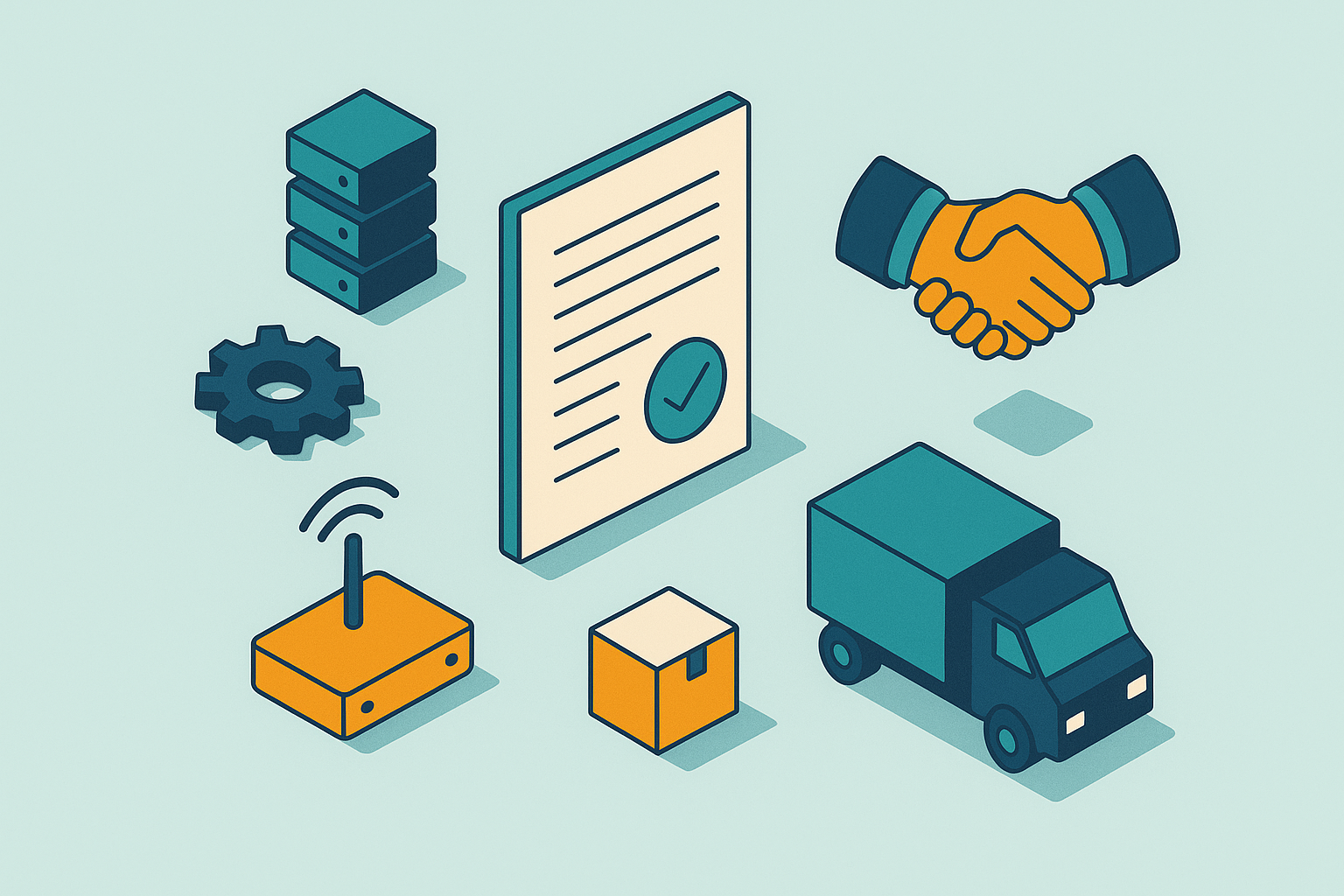
The Master Service Agreement sets the legal frame between provider and customer, the SLA sits inside it specifying the customer-facing numbers (availability, latency, fault restoration windows, the figures a customer can invoke for service credits when things go sideways), and the OLA sits underneath both, invisible to the customer, governing how internal teams coordinate to actually hit those numbers. Strip it out and an SLA is just a target with no plan behind it. I've watched teams work from separate assumptions about who owns what for weeks before anyone noticed, and the delays, finger-pointing, and inconsistent outcomes filled the space where shared accountability should have sat.
SLAs tell a customer what to expect, while OLAs determine whether that promise actually gets kept, and they do it entirely out of the customer's sight. The SLA is the public commitment; the OLA is the internal machinery that makes keeping it possible. Operators have treated that distinction as a footnote for years, and it costs them every time something breaks in a way the customer can see.
Carrier SLAs don't leave much room to breathe. Industry-standard availability sits at 99.9%, and Tier 1 carriers routinely guarantee full 100% availability on dedicated internet access. Five-nines, 99.999%, leaves roughly five minutes of permitted downtime across an entire year. That sounds abstract until the clock is actually running and you're the one watching it burn through the budget. Hitting that number takes near-perfect internal coordination, not just good infrastructure. Fault restoration windows, latency thresholds, packet delivery rates, all measurable, all things a customer can point to and demand credits against. The gap between what's promised on paper and what happens on the operations floor is exactly where OLAs live.
The specific internal handoffs OLAs govern across qualification, provisioning, and activation
A carrier service order never moves through a single team. It travels a sequential chain, and every handoff along that chain is a place where something can go sideways quietly, without anyone noticing until it's expensive to fix.
Network qualification comes first: does the infrastructure exist to serve this address? Someone has to own that answer, and it has to land within a defined window, or everything downstream inherits the delay whether it deserves to or not. Order decomposition and design comes next, translating a commercial order into a technical work order. Which team does this, how long do they get, and what does the next team need handed to them before their own clock even starts?
Device onboarding follows: ONT and CPE configuration for fiber-to-the-home, router configs for dedicated internet access, NID configuration for Carrier Ethernet. This is the handoff from design into provisioning, and it's often where technical specificity gets lost, because nobody owns the seam between the two teams. Then comes zero-touch provisioning and activation, where somebody has to trigger it, somebody has to validate the result, and somebody has to actually sign off that the service is ready. Last is the assurance loop, the stretch after activation where somebody owns fault detection and has to respond inside a defined threshold. Coverage doesn't end when the service goes live, no matter how the org chart is drawn.
Each stage can carry its own OLA: its own response-time commitment, named owner, escalation path. They chain together too, and that's the part people underestimate. If qualification misses its internal window, provisioning inherits a clock that's already behind before anyone on that team has touched the order. That compounding effect is usually the real story behind a late activation, more than any single team dropping the ball.
The three major carrier service types complicate this differently. FTTH lives and dies on physical plant qualification; fiber availability at the address level shapes every downstream step, and no amount of downstream cleverness fixes a bad answer at qualification. DIA introduces latency, routing diversity, and BGP configuration, work that demands tight coordination with network engineering on a timeline usually much faster than a physical build allows. Carrier Ethernet, governed by MEF service definitions like E-Line, E-LAN, and E-Tree, adds class-of-service and bandwidth profile parameters that have to be validated across multiple technical domains before anyone can even attempt activation. Without OLAs governing these handoffs, coordination happens informally, decided by whoever emails fastest or escalates loudest rather than by anyone with defined accountability.
Why fragmented tooling makes OLA enforcement structurally impossible
An OLA is only as enforceable as the visibility built around it. If nobody can see when a handoff happened, who owns the order now, or whether a clock has already expired, the OLA exists on paper and nowhere else.
Fragmented tooling manufactures exactly this scenario, over and over. Qualification runs in one system, design in a second, provisioning in a third, and there's no shared record of where an order actually sits or which OLA window is ticking right now. When something breaks, teams argue about what happened and when, because the data lives in silos that can't be reconciled fast enough to matter to the customer waiting on the other end. Escalation paths collapse because there's no single source of truth both sides actually trust.
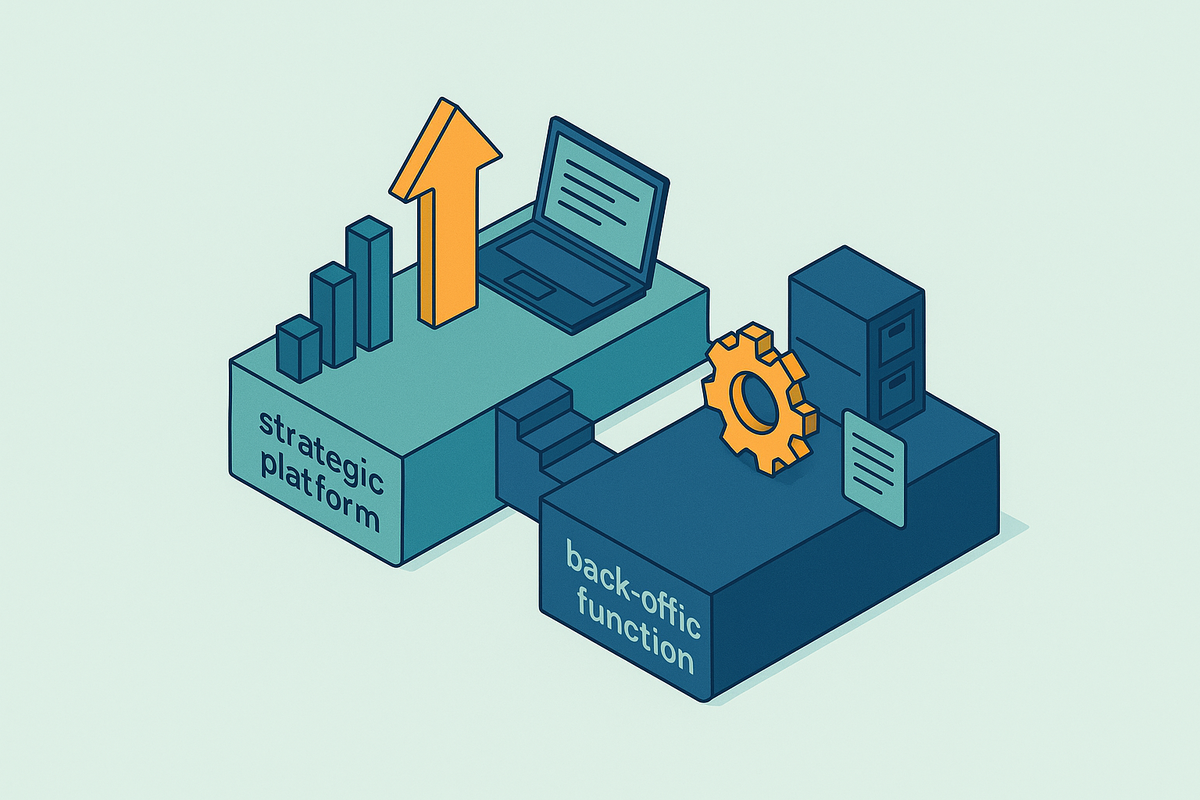
This is largely a legacy design problem, and it's worth sitting with why. Legacy OSS was built as a reactive back-office function: a system for monitoring faults, tracking configs, following predefined rules after something already went wrong. Orchestrating cross-team accountability was a different job entirely, one it was never staffed or designed for decades ago. So operators paper over the gap with spreadsheets, email chains, and the tribal knowledge of whoever has been around long enough to know who to call. That holds up fine at low volume, but it falls apart the moment order volume climbs, or the one person who knows everything finally retires.
Nearly 70% of telecom digital transformation efforts have failed to meet their stated objectives over the past two decades, and operational fragmentation carries a lot of the blame. The OSS/BSS market was valued at roughly $65.81 billion in 2024 and is projected to reach $148.26 billion by 2033, according to IMARC Group. Money is clearly flowing toward the problem, yet investment alone hasn't closed it, because workflow integration is the harder piece, and no budget produces that on its own. The spending figures look like progress, but the coordination gap remains largely untouched.
Downstream, at the customer, the consequence is blunt. SLA breaches are frequently traceable to one missed, invisible internal handoff. The OLA failed quietly somewhere in the middle of the chain, and the customer only ever sees the result on a bill or a credit request, never the actual cause.
How a unified data model changes what OLA accountability can look like in practice
OLA enforcement needs three things a fragmented stack structurally cannot provide: a shared definition of order state, a continuous clock on each handoff window, and an auditable record of who touched the order and when. Miss any one and you're back to spreadsheets and guesswork.
A unified data model spanning qualification, design, provisioning, and activation gives every team the same record of truth. The order doesn't bounce between disconnected systems; it stays put, visible to anyone with a reason to look. Escalation stops depending on a human happening to notice a delay and starts happening on its own. When a handoff window expires without acknowledgment, the platform fires the defined escalation path, no email required. SLA risk turns into something calculable in real time instead of something discovered after the invoice goes out. If three OLA clocks are running at once and one is falling behind, the system flags SLA exposure before the customer-facing deadline passes.
Post-incident review changes character too, and this is the part operations teams tend to appreciate most once they've lived with it for a quarter or two. Reconstructing a timeline from memory and email threads gives way to an audit trail that shows exactly when each handoff occurred, who accepted it, and where the time actually went. An OLA that lives only as a document referenced in a postmortem behaves nothing like one that operates as a live control shaping behavior in the moment.
The scale of the gap here is stark. Appledore Research estimates spend on genuinely next-generation OSS/BSS at $18.25 billion against $1.68 trillion in total telecom spend for 2025. Most operators are still running platforms that were never built to deliver a unified data model, no matter how much money they've thrown at things adjacent to the problem. Per TM Forum's November 2025 findings, only 19% of communications service providers have successfully embedded AI into more than three OSS or network functions. The foundation OLA enforcement actually requires is still the exception in this industry, not the rule.
What governed AI changes about OLA monitoring and enforcement
No human team can watch every active OLA window across a high-volume provisioning queue, full stop. The monitoring burden grows with order volume; headcount doesn't grow at the same rate, and it shouldn't have to.
AI agents can track every open handoff simultaneously, flag windows approaching expiration, correlate delays across the whole workflow, and trigger escalations at a speed no human supervisor could match on their best day. That's a real capability gain, and it's why agentic AI is moving into provisioning and network operations as fast as it is. But it opens a governance question the industry hasn't fully answered. If an AI agent escalates a handoff, reassigns a task, or declares an OLA breach, is that action auditable? Can a human operator trace why it happened and reverse it if the agent got it wrong?
This isn't hypothetical, and it isn't far off either. The EU AI Act, in force since August 2024, classifies AI used in the management and operation of critical digital infrastructure as high-risk, and telecom networks fall squarely inside that classification. The obligations that follow are specific: documented risk management, automatic event logging, defined mechanisms for human oversight. An AI agent enforcing OLAs inside a European carrier's network faces this as a regulatory requirement, not a best practice suggestion.
The industry is behind on this, by its own admission. Deloitte's State of AI in the Enterprise research for 2026 found that only one in five companies has a mature model for governing autonomous AI agents, even as those agents move into consequential operational roles faster than governance frameworks are being built around them. The architectural answer isn't complicated to state; building it is the hard part. AI agents enforcing OLAs need to operate on the same APIs, the same permission structures, and the same audit logs as human operators. Their actions have to be as traceable as a person's, and their authority has to be bounded by the same rules that bind everyone else on the team, with no exceptions carved out just because the actor happens to be software.
This carries weight well beyond a compliance checkbox satisfied once a year for an auditor. It's the actual condition under which AI-assisted OLA enforcement becomes reliable rather than a new source of operational risk sitting quietly inside the network. Shadow automation, meaning AI agents operating outside the governed stack because someone stood up a tool without integrating it properly, recreates exactly the visibility problem OLAs were built to solve in the first place.
What it takes for an OSS platform to actually support OLA-driven service delivery
Not every OSS modernization effort produces OLA enforcement capability, and a lot of them never will. The platform has to be architected for it from day one, because retrofitting a system built for something else rarely settles into shape later, no matter how many sprints get thrown at it.
A handful of requirements aren't optional. A single data model has to span qualification through activation, with no inter-system handoffs that can lose state or quietly break the audit trail somewhere in the middle. API-driven orchestration has to expose order state, OLA clock status, and escalation history to any authorized consumer, whether that's a person or an AI agent. An audit log has to capture every state transition and every action, human or automated, in a format that holds up under post-incident review and regulatory inquiry alike. Permission structures need to define exactly what each team, and each AI agent, is authorized to do at each stage. Real-time OLA clock management needs escalation rules configurable per service type, because FTTH, DIA, and Carrier Ethernet each run on genuinely different timing profiles that don't map onto one another cleanly.
The industry's own ambitions make this urgent, not academic. TM Forum reports 81% of operators surveyed are targeting Level 4 or higher network autonomy by 2030, with 20% expecting to get there by 2027. That trajectory only holds on platforms where AI agents can be trusted with decisions that matter, and trust like that comes from the governance architecture described above, not from a slide in a vendor's sales deck. TM Forum's AI-native ODA roadmap is fast becoming the benchmark against which OSS procurement decisions get made, and platforms that can't demonstrate governed AI integration will be measured against it whether they're ready or not.
One approach to answering this directly is a unified data model across the full service delivery lifecycle, with AI agents operating inside the same governance framework as the human operators beside them, built specifically for the FTTH, DIA, and Carrier Ethernet workflows where OLA enforcement gets hardest. Every carrier already has OLAs, formally or informally. What's still open is whether the platform underneath makes those agreements real, or leaves them looking real on a page nobody reads until something breaks.