OSS Total Cost of Ownership for Fiber Operators
Architecture and integration costs, not licensing fees, drive fiber OSS spending.
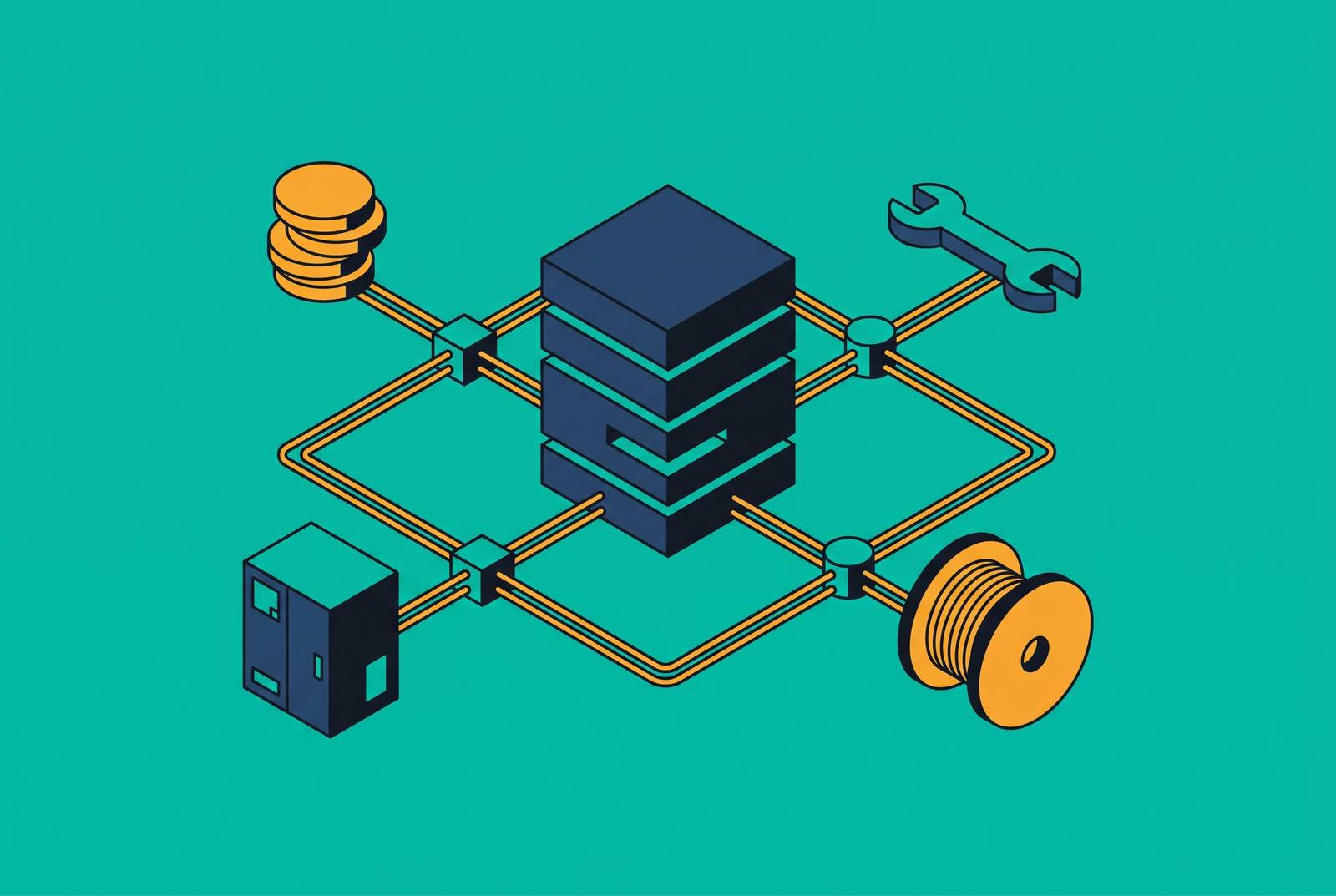
OSS total cost of ownership for fiber operators is determined less by licensing fees than by the architecture that carries an order into service. Integration maintenance, manual handoffs, activation delays, and ungoverned automation are where costs accumulate. A defensible OSS investment removes those structural costs rather than merely lowering the price of the software.
Why OSS spending keeps rising even as operators expect it to save money
Budgets grow because the underlying architecture requires more tools, integrations, and headcount to compensate for capabilities the platform does not provide natively. Those additions keep operations moving, but they also create more dependencies to maintain. These dependencies expand the cost base without a corresponding improvement in predictability.
The traditional OSS model was designed for voice and fixed-line services and is unsuited to the continuous, multi-stage delivery lifecycle that FTTH, dedicated internet, and Carrier Ethernet require. NTT DATA's OSS analysis identifies legacy systems as one of several key impediments to modernization, with integration complexity, vendor lock-in, and high initial transformation costs creating compounding barriers. These barriers make replacement difficult, but they do not make the status quo inexpensive. Maintaining it means paying for the work needed to connect systems that cannot carry the lifecycle together. Fragmentation is therefore the root cause.
How OSS fragmentation turns routine operations into a compounding cost
Fragmented OSS and BSS turn process boundaries into recurring cost events. A workflow can finish in one system while the next system still needs the state that lets it move ahead. Someone must then reconcile the records, repeat an entry, or resolve an exception before the order can advance. The cost recurs whenever the workflow crosses that boundary.
The OSS-BSS boundary is the most expensive seam because it connects network activity to the commercial lifecycle. Faults detected in OSS may not immediately surface in BSS, while provisioning changes initiated in BSS routinely require manual updates back into OSS. Each side can therefore hold a different account of the same service. Human coordination must bridge the difference across order handling, activation, and billing. A completed task in one system is not enough if its completion still needs to be communicated to another.
That coordination absorbs skilled technical time that a license-fee comparison does not show. Engineers spend meaningful portions of their time on reconciliation, re-keying, and exception management instead of work that improves the network or the customer experience. The immediate task may be small, but the architecture makes it repeatable across routine operations. Integration maintenance adds to the ongoing work because the connections between systems need upkeep too. Procurement captures the price of the tools, while operations carries the price of making them agree.
These handoffs consume elapsed time as well as labor. A provisioning confirmation waiting for a manual update can hold up the next stage even when the underlying network work is complete. As more subscribers join, more orders and services depend on the same handoff. Delayed provisioning confirmations then become delayed billing and delayed revenue recognition. The margin leak is not simply the effort spent moving information, but the time before that information permits revenue to follow service delivery.
Why delayed service activation is where TCO really accumulates for fiber operators
The reconciliation and confirmation gaps described above matter most when they extend the order-to-activation interval. Every day a circuit is provisioned but not activated is a day the operator carries infrastructure cost without corresponding revenue. This makes activation the highest-leverage point in the fiber operator's cost structure. Labor spent resolving a handoff is only one part of the expense. The same handoff also prolongs the period in which deployed infrastructure has not begun to earn revenue.
FTTH delivery depends on a chain of automated steps, including subscriber account creation, service provisioning, device configuration, installation scheduling, activation, and service validation. A manual intervention anywhere in that chain extends the interval. The cost therefore cannot be understood by assessing each application in isolation. An efficient provisioning task still sits inside an inefficient delivery process if its output must wait for reconciliation before activation can proceed. The interruption shifts effort toward operational overhead while postponing capital recovery.
Carrier Ethernet adds a capacity dimension to the same problem. Its cost structure scales roughly linearly in absolute terms per capacity increment, while cost-per-Mbps declines at higher tiers. Delayed activation on a higher-capacity circuit therefore carries a higher absolute stranded cost per day, though not necessarily a proportionally higher cost per unit of capacity. Activation delay is consequently not an interchangeable event across circuits. Its financial consequence depends on the infrastructure cost held behind the activation boundary.
HCLTech's 2026 AI-native telco analysis includes faster provisioning among measurable business outcomes in outcome-linked partnerships, together with improved service quality and revenue uplift. How well field teams work is only part of that outcome because they depend on upstream OSS work. Qualification, design assignment, and work order generation must be done before those teams can begin. OSS architecture therefore sets how soon activation can happen, even when the field work runs well.
What a unified data model actually changes about the cost structure
A unified data model changes these costs because separate accounts of the same service no longer need to be reconciled. When qualification, design, provisioning, and activation share a single source of truth, a change at one stage propagates immediately to downstream stages. Within that shared workflow, the exchange no longer requires a separate manual handoff. Reconciliation lag, re-keying errors, stale state in siloed dashboards, and the audit work caused by conflicting records lose their structural cause.
This distinction is most important at the start of delivery. More accurate qualification reduces the rework that would otherwise occur during provisioning and activation, the two most expensive places to fix a problem. The shared model carries that accuracy through the process instead of requiring each stage to reconstruct the service state. Work that previously corrected disagreement between systems is no longer a necessary step in routine delivery.
When activation confirmation simultaneously updates inventory, provisioning records, and BSS state, a separate manual confirmation chain is no longer needed between a live service and an invoice. This directly addresses the OSS-BSS seam rather than adding another coordination task around it. The financial effect follows from continuity of state across the workflow. Activation can become a commercial event without waiting for staff to reconcile its meaning across systems.
The objection that unification requires an expensive rip-and-replace migration must be weighed against the continuing expense of not unifying. Integration maintenance, manual labor, and activation delays belong on the other side of that comparison, so modernization cost alone cannot establish which option is cheaper. HCLTech's 2026 analysis identifies unifying the technology stack through converged cloud, network, and data modernization as the first structural change required before AI can deliver measurable outcomes at scale. For OSS, the unified data model provides the consistent operational foundation on which that execution depends.
Why ungoverned AI automation adds risk to an already fragile cost structure
AI automation does not repair fragmentation simply by acting faster across it. When deployed over disconnected OSS systems, it adds opacity to workflows whose state is already difficult to reconcile. Incidents then become harder to trace, audit, and remediate. This is a distinct TCO driver because accountability for automated actions carries costs alongside the manual effort those actions might replace. An automation proposal that counts labor savings but excludes that exposure presents an incomplete investment case.
The architecture fails when AI agents work outside the APIs and permission structures that human operators use. Their actions may then fall outside the normal processes for attribution, audit, and reversal. The operator has added an execution path without bringing it under the controls that govern ordinary operations. That liability can remain invisible until an incident requires someone to establish what happened and reverse it. Consistent data is necessary, but it does not by itself provide accountable execution.
This distinction matters because telecom has several layers of rules it must follow. They include lawful intercept, data retention, network neutrality, consumer protection, and cybersecurity directives. AI systems that affect regulated functions must have traceability built in from the start, without relying on an audit capability added later. HCLTech's 2026 AI-native telco analysis says that industrialized AI at enterprise scale has governance built into the architecture as one of its defining traits. It distinguishes that model from isolated automation scripts that cannot generalize or be held accountable.
The correct execution model places AI agents on the same APIs, audit logs, and permission structures as human operators. Every autonomous action is then subject to the same framework for traceability, limits, and reversal. Governance is not an optional addition to the unified data model, but the control structure for actions taken on it.
How to evaluate OSS TCO honestly — what a defensible investment analysis actually includes
A defensible OSS investment analysis starts with the full cost of carrying services through the delivery lifecycle. That includes integration maintenance across disconnected systems, skilled headcount absorbed by reconciliation, revenue delayed by activation intervals, and incident exposure from ungoverned automation. These costs belong in the comparison even when they do not appear in a vendor's proposal. Otherwise, a lower license fee can hide higher costs to run the service. The review must separate work the proposed architecture removes from work it passes to another team or system.
The integration discussion should establish how many system-to-system connections the architecture requires and who maintains them when one system changes. The data-model discussion should establish whether qualification, design, provisioning, and activation share one model or require changes to be propagated manually between domains. These are connected tests of the same structural claim. A platform cannot be credited with eliminating handoff costs if its core delivery stages still depend on manual synchronization. The vendor conversation should make that dependency explicit rather than leave it behind a general claim of integration.
The activation discussion should establish the current order-to-activation interval and distinguish steps delayed by OSS handoffs from those delayed by field work. It should also establish how much skilled technical time goes into reconciliation, re-keying, and exception management that produces no network or customer value. These questions connect elapsed time to the labor needed to move an order forward. The automation discussion should then establish whether every AI action can be traced, attributed, and reversed through the same audit and permission framework that governs human operators.
Legacy OSS platforms can fail these tests without having been poorly built, because they were designed for a different operational era. HCLTech's 2026 analysis says AI-native success depends on changes to the structure of the full stack, including core system modernization, data productization, and AI embedded in decision flows. The same standard makes an OSS investment defensible when it addresses the structural cost drivers. An AI-native OSS built on a unified data model, with shared APIs, audit trails, and permissions for people and agents, removes manual handoffs, reduces integration overhead, compresses activation intervals, and makes automated actions accountable. Those are the architectural changes that turn OSS spending into lower total cost of ownership.