OSS Scalability Requirements for High-Growth FTTH Networks
Unified data and event-driven workflows let fiber networks handle FTTH provisioning at scale.
High-growth FTTH networks require OSS architectures that can handle volume, velocity, and service complexity together. Their scalability limits begin with fragmented data and extend through provisioning and lifecycle coordination. Meeting those demands requires a unified data model, event-driven workflows, and governed AI execution, reached through staged modernization.
Why FTTH growth at current scale breaks legacy OSS assumptions
MSO broadband net losses continued through 2025 and into 2026, though at a decelerating rate, as FTTH providers offered symmetrical gigabit and multi-gigabit services. HFC networks face structural constraints in matching fiber on symmetry, latency, and long-term capacity. Competition therefore puts pressure on operations and construction. North American fiber deployments reached many millions of homes in 2025 alone, generating continuous qualifications, designs, provisioning events, and activations at a pace legacy batch-oriented systems were never sized to support.
XGS-PON is currently the dominant standard for new FTTH deployments, delivering multi-gigabit symmetrical capacity. Yet access capacity is only part of the requirement. OSS must support each new generation of technology without replacing the whole stack, while handling the service transactions that turn new infrastructure into revenue. Optimization and incremental upgrades cannot resolve a structural mismatch between that workload and an architecture built around slower, disconnected stages.
The first bottleneck often appears before provisioning begins. When address and network records disagree, staff must check serviceability by hand before giving a quote for a service. If an error instead survives qualification and surfaces during provisioning, it triggers a truck roll and pushes out the billing date. Data inconsistency therefore creates both a cost event and a revenue delay, even when the network itself has ample capacity.
How fragmented OSS architecture creates compounding failure across the service delivery chain
Legacy OSS assigns different stages of service delivery to separate systems, each holding its own record of the same physical infrastructure. Those boundaries become points where errors propagate. For FTTH, the chain spans address serviceability, mapping-system-to-service qualification, order design, provisioning of ONUs at customer premises, and billing activation. A disagreement at qualification persists when an order moves into design because the next system works from another version of the network, leaving the original inconsistency unresolved.
The ONU makes the consequences of that separation concrete. It is both the provisioning endpoint and the service boundary, so configuration and activation cannot reliably operate as unrelated states. Centralized management through a unified provisioning platform, using TR-069/ACS for CPE or OMCI for GPON, minimizes manual configuration and OPEX. That unification cannot hold when provisioning and activation systems maintain separate state.
Dedicated Internet Access and Carrier Ethernet specifications must flow from CRM through design into element-level provisioning without re-keying. With siloed systems, staff must re-enter data as orders move between stages, so the risk of errors grows with the number of orders. NTT DATA's OSS analysis identifies legacy systems and integration complexity as barriers to end-to-end automation, together with vendor lock-in, security concerns, and transformation cost. Patching one stage leaves the handoffs that transmit errors intact.
Why the data model is the load-bearing element of FTTH OSS scalability
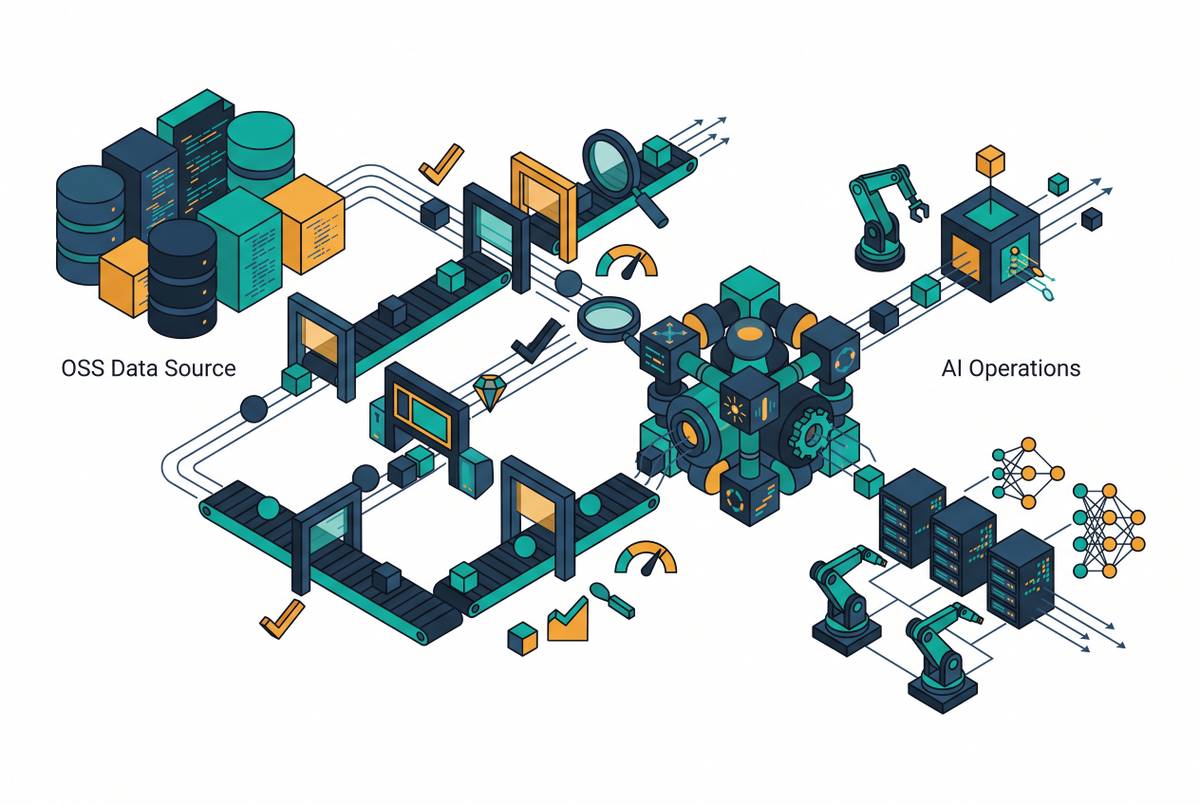
A unified data model changes the relationship between those stages. Qualification, design, provisioning, and activation read and write a single authoritative record of the physical infrastructure rather than exchange messages between competing records. Automation can then act on shared state instead of accelerating errors caused by inconsistent inputs.
GIS-to-service qualification requires network footprint data to answer the customer's serviceability question accurately at quoting. In a unified model, that connection is native. In a split architecture, a custom integration can fall out of sync, allowing an order to proceed on assumptions that provisioning cannot fulfill.
The same dependency extends to the revenue boundary. Automatic billing triggers let invoicing start when activation succeeds, while service tier synchronization lets bandwidth changes update billing records without anyone having to do it by hand. Neither is reliable if provisioning and billing disagree. A shared authoritative record connects what was ordered, what was activated, and what is billed without a separate reconciliation step between competing service states.
The Fiber Broadband Association's operational requirements include OSS and BSS integration with FTTH service provisioning and ONU deployment, together with workforce training in fiber splicing and OTDR testing. At scale, that integration depends on a shared model. Carrier Ethernet and dedicated internet services also need this shared model because their complex orders make errors from re-keying more likely when order volume is high. Zero-touch provisioning needs the order to keep the same meaning through every stage, which takes more than a connection between applications.
What provisioning throughput demands look like at FTTH scale and why legacy systems cannot meet them
Systems need shared data, but engineers must also make sure they can handle the throughput. High-growth FTTH deployment produces a continuous provisioning load that sequential workflows and manual intervention cannot absorb without backlogs. Homes passed do not become revenue automatically. When activation capacity falls behind construction, infrastructure that cannot yet serve paying customers represents stranded capital, while delayed connections weaken the customer experience.
Legacy OSS relied on rule-based fault handling, manual provisioning, periodic maintenance schedules, and isolated dashboards. At the pace of FTTH builds, manual provisioning limits how fast homes passed can become homes connected. Faster execution within one application does not remove that constraint if the next stage still waits for a batch or an operator.
Zero-touch provisioning for B2C and B2B services needs to use TM Forum standards for orchestration. That adoption depends on event-driven, automated workflows underneath it. Legacy batch-oriented systems need to be rebuilt at their core to provide those workflows, so adopting standards alone will not deliver the throughput needed. NTT DATA's Next Gen OSS analysis names scalability, flexibility, and cost optimization as the main reasons to change, while acknowledging how hard end-to-end automation is to achieve. As homes-passed counts grow into the millions, automation becomes a condition of efficient service delivery.
Why AI cannot fix FTTH OSS scalability when bolted onto a fragmented architecture
Adding AI to fragmented OSS does not resolve these limits. An agent acting on inconsistent data inherits the disagreement between systems, even if it can make decisions faster than a person. A provisioning decision may use a different state from the one the activation system will act on.
For years, telecommunications AI commonly appeared as an overlay for predictive maintenance or anomaly detection. Those applications left the fragmentation beneath them untouched. FTTH provisioning requires something different because agents need event-driven access and unified data across the service lifecycle. A model attached to one stage cannot supply the shared operational state missing from the architecture.
HCLTech's 2026 analysis defines the AI-native telco as a unified, AI-infused technology fabric in which cloud, edge, data, and network function as one operating architecture. It requires modernized OSS and BSS, productized data assets, and AI embedded directly into decision flows. AI-native OSS treats AI and machine learning as intrinsic components from qualification through activation.
A failed bolt-on also creates an organizational cost. It consumes transformation budget without addressing the fragmentation generating operating expense, then leaves a failed pilot on the record when modernization seeks approval. The retrofit approach can therefore make the underlying problem harder to fund as well as leaving it technically unresolved.
What governed AI execution requires from an OSS built for FTTH scale
AI-native does not mean AI-autonomous across every decision. Agents handling provisioning and lifecycle events must use the same APIs, audit logs, and permission structures as human operators. People must be able to see and audit what every agentic process does, especially when it uses regulated subscriber data. At thousands of provisioning events per day, governance is the mechanism that makes execution trustworthy.
A risk-tiered model separates routine volume from consequential exceptions. The green tier permits autonomous execution for repetitive tasks when confidence scores clear strict thresholds, covering the bulk of FTTH provisioning events. The yellow tier requires a person to approve medium-risk actions that affect pricing, service attributes, or configuration. The red tier locks autonomous execution for high-value accounts, complex exceptions, and contractual changes. This separation allows routine throughput to scale without placing every event behind a human approval bottleneck.
TM Forum's AI-native extensions to its Open Digital Architecture, launched in 2026 as part of the Race to 2030, add a governed execution layer with control points and Model Context Protocol support. That places agent governance inside the operating architecture. It does not create a parallel agent stack with separate controls, which would reproduce the separation that modernization is intended to remove.
Far EasTone Telecom demonstrates that AI-assisted operations can run at volume. Nearly the majority of its NOC operations are now AI-assisted, executing thousands of operational tasks per month, including incident summaries, automated ticket closure, and network checks. These results provide operational evidence for governed AI beyond a pilot. The relevant requirement for FTTH is to combine that execution discipline with authoritative service data.
How M&A activity among fiber operators accelerates the OSS modernization timeline
Merging businesses bring different network, customer, and billing systems, often with limited interoperability. Integration problems can delay activations, introduce billing errors, and make network resources harder to manage. Instead of reconciling silos within one operator, the combined business must now reconcile two fragmented environments while delivering service.
The Point Broadband–Clearwave Fiber merger in 2026 is expected to create one of the largest independent fiber operators in the United States, spanning multiple states. Its scale creates an immediate OSS integration mandate that cannot be managed manually. T-Mobile's multibillion-dollar joint venture acquisitions of GoNetspeed, Greenlight Networks, and i3 Broadband similarly require integration of three operators' OSS environments with its own at carrier-grade scale. These transactions test whether an architecture can absorb new network topology, customers, and billing arrangements without stalling activations.
Fragmented data models make that test structurally difficult. Each environment the business acquires adds records that must agree in meaning and state across the service chain. Consolidation therefore compresses the time available for architectural decisions that an operator might otherwise defer.
The modernization path that supports FTTH scale without requiring a big-bang replacement
Operators should pursue modular, staged modernization, beginning with the workflows generating the highest error and cost, then expanding as controls mature and results are proven. For FTTH, the qualification-to-provisioning handoff is the starting point because data disagreement there creates expensive rework. Unifying the model at that boundary can produce immediate, measurable operational gains that justify the next phase.
Governance must be present in that first deployment. Transparency, auditability, and shared permissions are not capabilities to add after agents gain wider authority. As teams put more of the system to use, the same controls help them separate work that can run through autonomous execution from decisions that need approval.
TM Forum's scale for autonomous operations goes from Level 0, where work is fully manual, to Level 5, where it is fully autonomous. Most operators sit at Level 2 or Level 3 as of 2026, with validated Level 4 results in specific domains such as fault management and energy optimization. A phased FTTH program can follow that pattern while retaining a common architectural destination.
HCLTech's industrialized intelligence framework identifies convergence of cloud, network, and data modernization into a single AI-infused operating architecture as the first structural change. It also favors packaged, industry-specific solutions for faster measurable value over horizontal AI experiments. For FTTH operators, each phase should move toward a unified model spanning qualification, design, provisioning, and activation, with agents using the same operational controls as people. Phasing reduces cutover risk without compromising the architecture that growth and consolidation require.