AI Governance Frameworks for Telecom Operations
Telecom operators need AI governance built into operations from the start, not bolted on afterward.
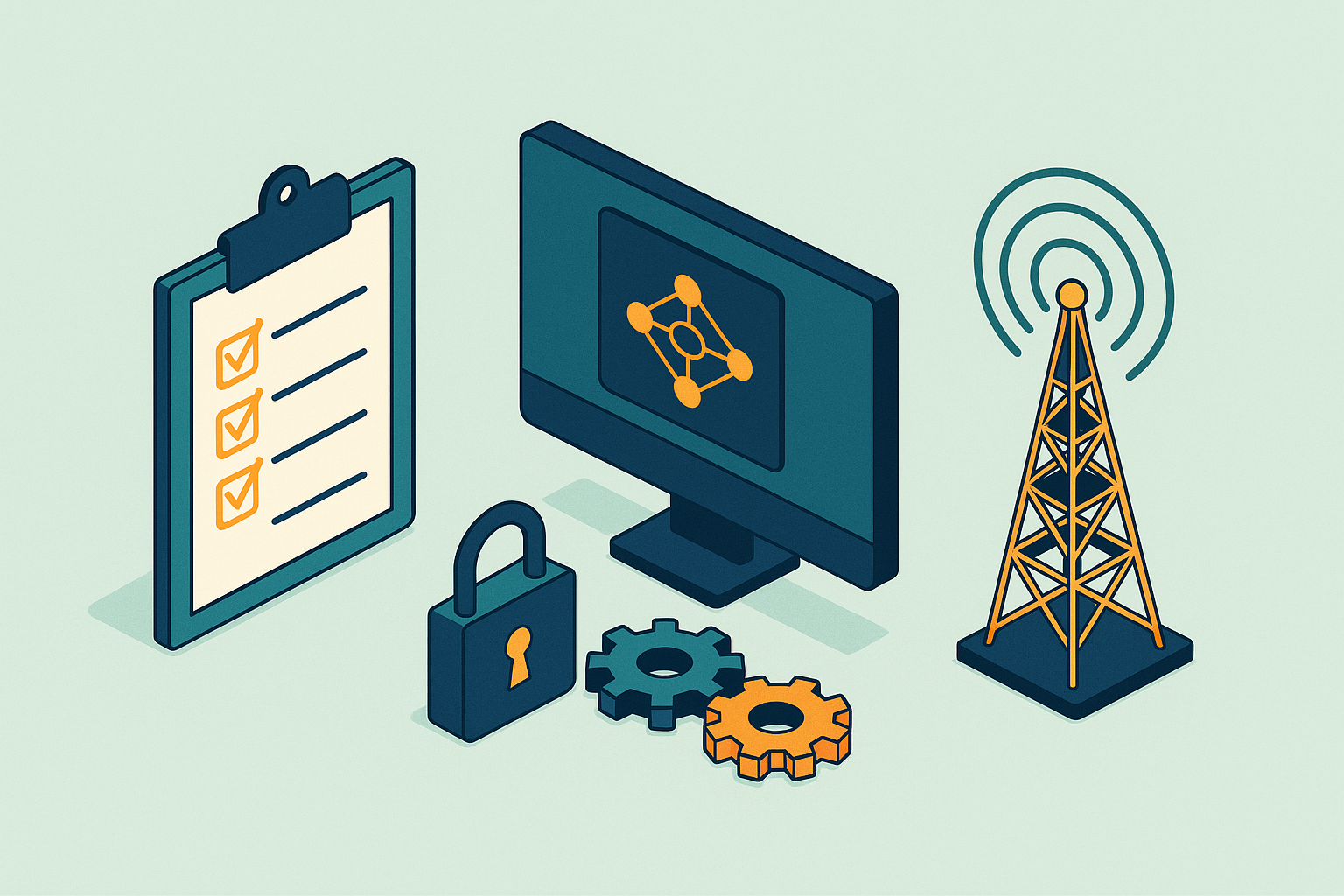
Governance is something you build into the system. It comes from how AI agents are wired into operations from the start: in a governed setup, AI agents run on the same APIs, the same audit trails, and the same permission structures as the human operators sitting next to them. That's the whole definition, and it sounds almost too simple to matter.
It starts to matter once you see what it rules out. Every AI action gets logged the way a human action gets logged, one event record, one tamper-evident trail, no side ledger that only one engineer on the team knows how to find. An AI agent can't touch a system or a dataset that a human in the same role would be blocked from touching. If an AI decision changes service state or network configuration, it comes with a reason attached, so nobody has to reverse-engineer a black box six weeks later. A human operator can look at what the AI did, override it, or roll it back, using the same tools they'd reach for if they'd made the mistake themselves.
Most shops don't run this way. Shadow automation is the default risk: AI tooling sitting outside the permission model, leaving nothing behind for an audit, invisible to whoever is nominally on the hook when something goes wrong. It shows up almost automatically the moment a team bolts an AI point tool onto an existing workflow without folding it into the underlying operational data model. Nobody sets out to build ungoverned AI, yet it piles up, tool by tool, workaround by workaround, until nobody in the room can explain how a given decision actually got made.
Governed AI, in the sense that counts, means AI and human operators answer for outcomes together, under the same set of eyes.
How legacy OSS architectures make governance structurally impossible
Legacy OSS was built for a slower world, one where a fault shows up, a person responds, and a record gets written afterward. It's linear, human-initiated, with someone standing at every gate. AI agents don't wait for a ticket to land in a queue, and they act on their own, a pace that overwhelms audit designs built around one person reviewing one case at a time.
The walls legacy OSS hits here aren't fixable with more effort, because they're baked into the architecture. Batch-driven data pipelines can't produce the real-time event logs AI accountability needs; a nightly batch job won't hand an auditor a timestamped record of what happened at 3:14 a.m. Functional silos make it worse. An AI agent working inside provisioning has no view into assurance or qualification, and it leaves no trace there either, so the record splits across systems that were never built to talk to each other. Then there are the proprietary integrations, stitched together over a decade or more, each with a permission model specific to whoever wrote it. None of those stretch to cover AI agents consistently across the whole estate.
Without one shared data model, "the same audit trail for AI and humans" is a technical impossibility, not a hard problem waiting for someone clever to solve. Several incomplete trails sit scattered across the estate, yet no single one of them tells the whole story.
Try to retrofit governance onto architecture like this and you end up with governance theater: paperwork that looks thorough on the surface but is incomplete, delayed, or scattered across systems with nothing tying it together. That's why the OSS estate drags on AI transformation instead of sitting there as a minor annoyance somebody eventually works around. The architecture itself blocks the accountability structure safe AI deployment needs.
The regulatory pressure now forcing governance from aspiration to requirement
Europe already settled part of this by law. The EU AI Act, in force since August 2024, classifies AI systems used as safety components in critical digital infrastructure as high-risk, and telecom networks fall under that classification through Annex III. High-risk status brings real obligations: documented risk management, auditable governance over training data, automatic logging of AI decisions, and human oversight mechanisms operators have to demonstrate to national regulators on request. Those obligations sit with both the OEMs building the AI components and the operators running them, and nobody gets to pass the responsibility upstream and hope no one checks.
A patchwork of other rules sits on top of that: the FCC on robocalls and customer data in the US, GSMA's responsible AI guidance, ETSI and 3GPP standards on securing AI and embedding it in network infrastructure, the EU's NIS2 directive running alongside the AI Act. ETSI's Securing AI committee published a European Standard for protecting AI systems against cyber threats in December 2025, giving operators something concrete to build toward instead of a vague regulatory gesture. In February 2024, the FCC ruled that AI-generated voices count as "artificial" under the TCPA, a small decision that points at something bigger: regulators are starting to treat AI outputs as actions the law can pin on someone, and that only works if an audit trail can prove what the AI did and exactly when it did it.
So here's the actual bind. The evidence regulators want, decision logs, model behavior records, complete audit trails, isn't something conventional monitoring tools or legacy OSS produce today. Compliance stops being a workstream you run apart from OSS modernization; it runs on the same underlying data architecture, which means fixing one basically requires fixing the other. There's no patch-compliance-and-leave-the-plumbing-alone version of this.
What a sound governance framework looks like across the service delivery lifecycle
Governance can't be bolted on after the fact. The service delivery lifecycle runs through several domains, qualification, design, provisioning, activation, assurance, and all of them need to write to one shared record. A unified data model has to come first, because skipping it leaves AI agents in each domain producing local records that never assemble into a single coherent trail, and you get fragments instead of a story.
TM Forum's Catalyst project C26.0.921 shows this working end to end. A regulatory obligation gets interpreted by AI, a human reviews the proposed rule change, an access decision gets enforced, and the whole sequence produces a tamper-evident audit record at the finish. That's roughly the shape a governed system should take at every stage, not just at the point where enforcement happens.
Each stage carries the same underlying requirement, dressed differently. In qualification, an AI agent querying network inventory needs to surface the same data, and generate the same access record, as a human engineer running the identical query. In design, AI-generated service designs need to be attributable, versioned, and reviewed before they touch the live network; a design that jumps from model output straight to activation, with no human checkpoint in between, is a black box wearing a service ticket. In provisioning, AI-initiated actions live inside the same permission model as human-initiated ones, no exceptions, and automating a task should never earn an agent more access than a person doing that same job by hand would carry. In activation and assurance, closed-loop actions, detect, diagnose, remediate, need an event record at each step, with escalation conditions set ahead of time so control hands back to a human when the situation calls for it.
Human oversight has to be a designed property of the system, not an afterthought. Operators decide in advance where AI leads, where it assists, and where a human makes the final call. TM Forum's eTOM model gives them a practical way to organize that across plan, build, run, serve, and sell, mapping where agents can act alone, where tight coordination matters, and where judgment stays non-negotiable. PwC's analysis of the dual-track telecom transformation calls this the core organizing task operators face right now, not something to figure out down the road.
How the industry is converging on architectural standards for governed AI
TM Forum's AI-Native ODA Roadmap v1.0, released in June 2026, names the tension directly: AI needs to run in a decentralized, agent-driven model while staying under unified governance for security, guardrails, and compliance. This is the same tension this piece has been circling from the start, now written into an industry standard instead of argued from scratch.
The enforcement piece is the ODA Conformance Test Kit, formally available since January 2025, which certifies whether components actually meet the open API and interoperability requirements that unified governance depends on. Certification is what makes the word "conformant" mean something real instead of a claim on a slide.
At DTW Ignite 2026, TM Forum members put the model to work in three settings worth naming: end-to-end fault management, with AI agents detecting, diagnosing, and resolving issues across domain boundaries; dynamic 5G network slicing, running on intent-driven autonomy from order through self-healing; and sovereign AI inference, keeping model execution within controlled boundaries. On the vendor side, Amdocs positioned its aOS platform, announced in February 2026, for agentic telecom operations at mission-critical scale, with compliance, observability, and governance guardrails built in from the start rather than added on later.
Gartner's 2025 research predicts guardian agents, AI systems built specifically to govern other AI agents, will capture 10 to 15 percent of the agentic AI market by 2030. AI governing AI is turning into its own commercial category, and Appledore Research puts a number on the stakes, forecasting the agentic AI market in telecom growing from $92 million in 2025 to $6.2 billion in 2030.
Standards bodies, vendors, and analyst forecasts are landing on roughly the same place. Governed AI is the precondition for autonomous operations reaching Level 4 and above in TM Forum's autonomy model, the level where operations actually deliver competitive value instead of running a faster version of the same old risk.
What operators should require from any OSS platform claiming AI governance
Vendor marketing and architectural reality are not the same thing right now, and the gap between them is wide. "AI-native" and "governed AI" show up in positioning decks without much consistent meaning behind either phrase, and operators need testable requirements to check against rather than a stack of buzzwords to nod along to in a sales meeting.
Start with the architecture itself. One data model, where AI and human operators read from and write to the same underlying record, not synchronized copies that drift apart over time, not federated views that lag behind reality. One permission model, where AI agents get access the same way human operators do, under the same role-based constraints, with no quiet path to more capability just because a task got automated. One audit trail, where every AI action lands in the same log as human actions: same fields, same tamper-evidence, same retention rules. Explainability at the action level, so any AI decision touching service or network state comes with a plain account of what triggered it and which rule or model drove the change. Escalation logic the platform enforces on its own rounds this out, spelling out exactly when AI hands control back to a person, treated as normal operation rather than an exception nobody planned for.
Then push vendors on specifics, because the answers tell you fast whether you're looking at architecture or marketing. Does the AI reach the network through the same APIs a human operator uses, or through separate internal interfaces nobody else can see? Can an auditor pull one log covering both human and AI actions on a given service order, or do they have to reconcile three different systems by hand? When a human operator's role changes, do the matching AI agent's permissions update automatically, or does someone have to remember to go do it? When an AI action produces a state change nobody wanted, what's the actual rollback mechanism, not the one described in the slide deck?
A vendor who can't answer these cleanly is selling AI augmentation wrapped around a legacy governance model, whatever the pitch happens to call it. Optinet builds its architecture around this exact requirement: AI agents run on the same APIs, audit trails, and permission structures as human operators across the full service delivery lifecycle, from qualification through activation, on one data model. Under that design, governance carries evidence behind it, a property the system actually has, not a claim it makes.
OSS stopped being a back-office function a while back. It's the accountability infrastructure sitting underneath AI-driven operations now, and operators who keep treating it as plumbing will end up with AI investments they can't explain, defend, or fully trust the day a regulator, or a customer, finally asks them to.