OSS as a Strategic Platform vs Back-Office Function
OSS platforms now decide competitive advantage through how fast and reliably they deliver services.
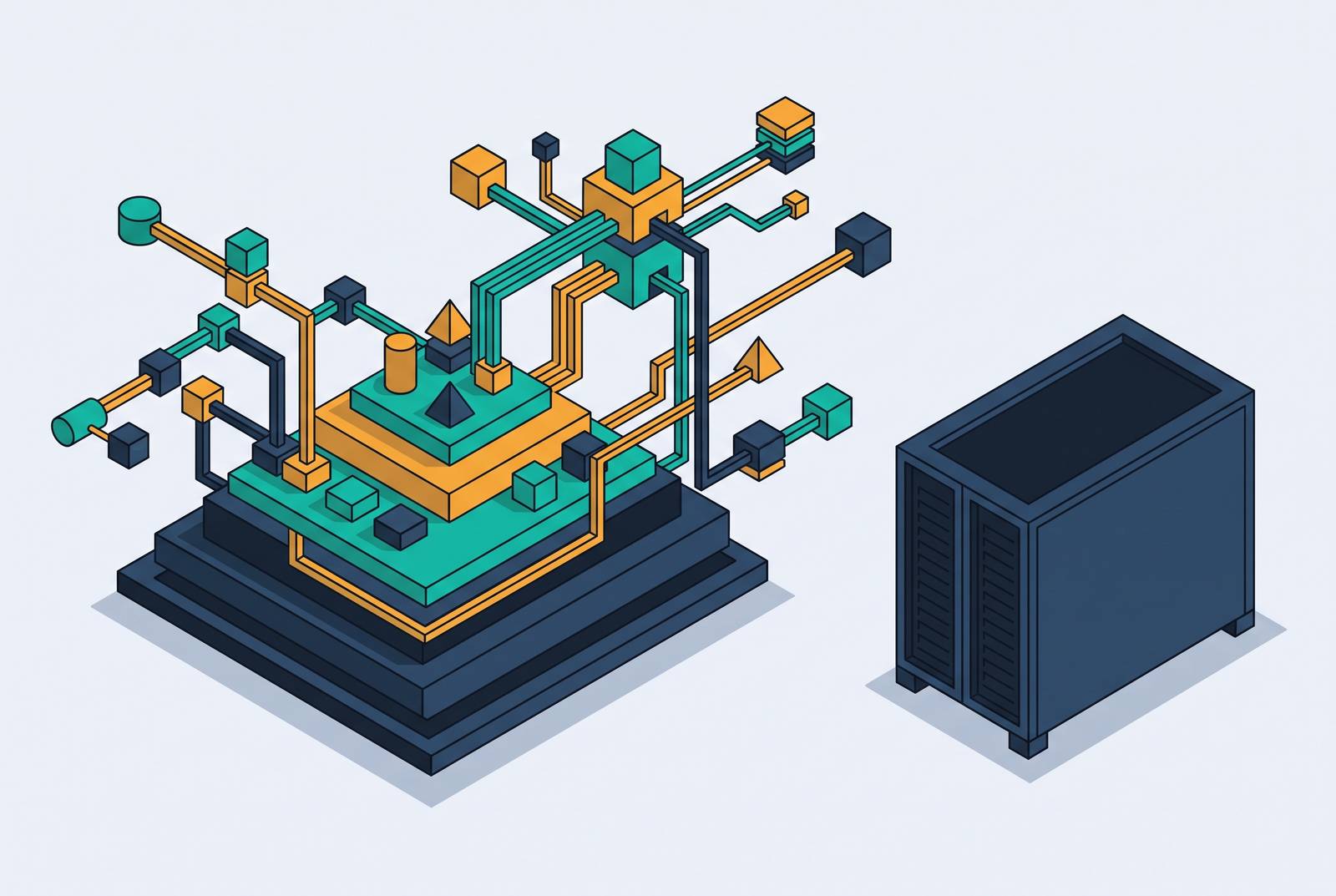
A service order moves through qualification, design, provisioning, and activation in sequence, and every delay or error inside that chain traces back to the platform running it, not to sales or engineering. The platform that provisions a circuit also determines how fast, accurately, and profitably a service gets delivered, which makes OSS architecture a direct input to competitive position rather than something that trails behind it. This matters because the industry has largely stopped treating OSS as plumbing and started treating it as the mechanism that decides which services can be quoted, how fast they ship, and whether AI can be trusted to run inside the workflow at all.
OSS architecture as a competitive variable
Calling OSS a back-office function made sense once. It was a reasonable description of a world built around static services and manual workflows, where circuits changed rarely and provisioning was something scheduled on a calendar rather than something a customer expected in real time. That world is gone. HCLTech's 2026 telecom trends analysis marks 2025 and 2026 as the period when autonomous networks stopped being a pilot project and became an operational priority, with intent-driven orchestration and zero-touch service delivery now the standard operators are held to. Against that standard, an OSS that can't support real-time execution, governed AI, and a single unified data model isn't just slower than it should be. It caps what services can be quoted, how fast they move, and whether AI can operate reliably anywhere inside the process.
What legacy OSS architecture was built for
Legacy OSS wasn't built badly. It was built correctly for a different set of requirements: static services, scheduled changes, batch-driven processing. That's a design constraint baked into the architecture, fixed and unable to be adjusted or patched out. A batch-driven system makes every decision against data that was accurate as of the last sync cycle, not against what's true right now. That lag is tolerable when a circuit changes once a quarter. It becomes a real liability when an AI agent needs a current, reliable record to act on and instead gets a snapshot that's already stale.
The practical cost appears in how long it takes to get a new service to market. Rolling out a new service type on a legacy stack can take months, because the workflow is rigid and the underlying data model wasn't built to absorb a new service type without manual rework across several connected systems. Appledore Research's 2025 analysis puts a number on why this persists: the vast majority of OSS spending goes toward maintaining and upgrading the legacy systems already in place, leaving only a small fraction available for actual innovation. That ratio feeds on itself, since the legacy platform absorbs the budget that would otherwise fund its own replacement.
Fragmentation compounds the problem. When qualification, design, provisioning, and activation each live in a separate system with a separate data representation of the same circuit, no single system ever holds the complete, current picture, and every handoff between stages becomes a chance for something to go wrong and need a manual fix. NetworkOSS's analysis traces the damage back to qualification: address and network data that disagree across systems often mean a CLEC can't quote a service without a manual check, and when a qualification error surfaces later at provisioning, it triggers a truck roll and pushes the billing date out. Two expensive outcomes, both traceable to one failure at the data layer.
AI-augmented OSS compared with AI-native OSS
Dropping AI models onto an otherwise unchanged batch-driven workflow produces what's best described as AI-augmented OSS. It can speed up isolated tasks, but it still runs into the same stale data, the same siloed records, and the same sequential handoffs that made the legacy stack slow to begin with. AI-native describes something structurally different: AI built into how the platform runs across design, provisioning, operation, and assurance, serving as the execution model for the workflow itself rather than a capability a human calls on when convenient. HCLTech's 2026 analysis draws the same distinction, describing AI-native telecom as networks that think, learn, and heal themselves, with machine learning integrated across OSS and BSS rather than bolted on to review outputs after the fact.
In an AI-native system, an AI agent can run a provisioning workflow end to end, checking qualification, triggering design, initiating activation, because it has access to the same unified data model, the same APIs, and the same audit trail a human operator would use for that same work. In an AI-augmented system, the agent can summarize what happened or flag something unusual, but actually executing the work still requires a human to carry it across the gap between siloed systems.
Fierce Network's coverage of Amdocs aOS heading into MWC 2026 captures where the industry has landed on this question: the live issue is no longer whether AI can assist with individual tasks, but how it can coordinate execution end to end across business, IT, and network domains. That kind of coordination only works when intelligence is built into the core operational processes themselves, not layered over them as an add-on.
Operators sometimes raise an objection: "We have AI tools running on top of our existing OSS and they're delivering value", and running point AI tools on their existing OSS often does produce real results from them, which is a fair claim as far as it goes. Point-solution AI delivers point-solution value. It doesn't change the ceiling set by the architecture underneath it; that architecture governs how fast new services reach market, how accurate qualification is, and whether closed-loop automation is even possible.
Governed AI as an architectural requirement
Everything AI-native OSS promises depends on whether the AI agents running inside it can be trusted to act correctly and held accountable when they don't. That trust has to be built into the architecture; it can't be assumed into existence. When an automated provisioning action causes a service disruption, telling a customer or a regulator that the model did it settles nothing. Accountability means every AI action can be traced to a specific agent, the context it acted in, and the outcome it produced.
Research published in AI (MDPI) formalizes what that traceability has to look like: governance architectures need to record every autonomous decision, the reasoning behind it, and the operational action taken, immutably, so the result is a tamper-proof audit trail with each action tied unambiguously to the agent responsible. Regulators are already building rules around this. Singapore's Infocomm Media Development Authority launched the first governance framework written specifically for autonomous AI agents in January 2026, a signal that the compliance models designed around human review don't extend to agents that chain tool calls across provisioning, billing, and network systems on their own. HCLTech's 2026 analysis, citing McKinsey's The State of AI in 2025, states the principle directly: agentic AI has to be governed rigorously, because its impact is real but trust has to be engineered and guardrails have to be purpose-built rather than generic.
The architectural consequence follows directly. AI agents need to operate on the same APIs, audit logs, and permission structures as human operators, not on some shadow automation layer that routes around governance entirely. AI-native architecture built on a single unified data model means those agents operate under the same accountability standards as the people they work alongside, rather than as an isolated layer bolted on without access to the full operational picture. An agent with elevated access and no accountability trail behind it is an ungoverned actor operating inside a regulated environment.
Fragmented service-lifecycle data and operator speed
A unified data model is the condition that every other capability depends on: accurate qualification, AI-driven provisioning, real-time assurance, and closed-loop automation all need a single consistent record of the network and the customer to work from. When the same circuit or address exists in four different forms across four different systems, qualification turns into a manual reconciliation task instead of a real-time check, slowing down time-to-quote and seeding errors that compound as the order moves through the rest of the delivery chain. NetworkOSS's analysis lays out the cost: a qualification error that doesn't surface until provisioning triggers a truck roll and delays the billing date, two expensive outcomes that both trace back to one data consistency failure at the very start of the process.
Schurz Broadband Group's experience, described at Fiber Connect 2026, shows what this looks like on the ground. Operating across nine states and multiple access technologies, the company described exactly this pattern: stranded equipment, inconsistent customer data, and no unified operational view to work from. That's not a staffing problem or a training gap; it's what happens when the systems themselves never agreed on what the network actually looks like.
For FTTH and Carrier Ethernet specifically, the fulfillment workflow runs through several automated steps in sequence, feasibility checks against address inventory, conditional scheduling for installation, activation sequencing, and each one needs the platform to hold an accurate, current record of the physical and logical network. A data model that can't support that makes automation impossible and manual workarounds the default instead of the exception. The Fiber Broadband Association's whitepaper on MSO-to-FTTH upgrades confirms the same pattern from the cable side: operators moving to FTTH have to adapt or replace their existing OSS and BSS, because the data model built for a DOCSIS network doesn't map cleanly onto fiber fulfillment.
The alternative is a properly built data abstraction layer that ingests and normalizes telemetry, alarms, ticket logs, CRM interactions, and network topology into one unified schema that AI services can actually query, and built that way, the data model stops functioning as a bottleneck and instead makes every automation layer possible.
What a genuinely strategic OSS architecture does in practice
A strategic OSS is defined by whether the same platform can run qualification, design, provisioning, and activation against one data model, with AI agents and human operators working inside the same governance framework. That combination, not any single capability, is what turns the platform into a competitive lever.
The pattern showing up across 2026 sources is a hybrid architecture: an event-driven backbone for real-time performance, combined with API-led orchestration and governance layered on top of it. That moves OSS from batch-driven and rigid toward streaming-first and responsive, without giving up the governance structure that makes AI trustworthy to run. The results are measurable where operators have actually made the shift. Circles' 2026 OSS modernization analysis cites operators running dynamic, auto-discovered network inventory who cut mean time to repair by 30%, with AI-driven fault detection shortening incident resolution times substantially on top of that. Those outcomes only exist because the data model is unified and the automation layer runs in real time, not on a batch cycle.
EchoStar's Dish Wireless offers the clearest reference point for what this looks like built from scratch. Its greenfield 5G network uses an event-driven architecture at its core, with Kafka running as the central nervous system, merging OSS and BSS into one cloud-native stack that orchestrates everything from provisioning through assurance in real time. Dish didn't inherit a legacy estate to work around, which makes the build simpler than what most operators face, but it shows the target state is achievable and gives operators carrying legacy systems a working model for how data streaming can gradually pull a rigid, batch-driven OSS toward something closer to this. Appledore Research's 2025 analysis is direct about the ceiling on this kind of transformation: automation can cut the cost of many network operations tasks sharply and shrink service demand intervals from weeks down to minutes, but only when OSS, BSS, and the operational practices around them are rethought from the ground up rather than patched incrementally.
Where Optinet fits against this model
The argument built across this piece points to a specific set of criteria for a strategic OSS: one data model spanning qualification, design, provisioning, and activation; AI agents operating on the same APIs, audit logs, and permissions as human operators; real-time, event-driven execution; a design purpose-built for the service types it manages; and automation that's governed and auditable by design.
Optinet is built around that full set of criteria rather than a subset of them. It puts residential fiber, dedicated internet, and Carrier Ethernet on one data model, with AI built into the core of the platform rather than bolted on as a separate layer, running on the same APIs, the same audit trail, and the same guardrails as every other operator action inside the system. Where qualification, design, provisioning, and activation live in one consolidated model instead of four disconnected ones, the manual reconciliation steps and error surfaces that plague legacy stacks have no system seam left to form around. For operators managing a mix of FTTH, dedicated internet, and Carrier Ethernet under one roof, a platform built from the ground up for that specific mix of service types removes a category of integration work that a general-purpose OSS retrofitted with AI still has to solve for.
Other platforms in the market take different paths toward some version of this model. Some are built as AI-native systems from the ground up but concentrate on a narrower set of service types or network domains than a multi-service fiber and Ethernet operator needs. Others are established OSS platforms that have added AI capabilities on top of an existing architecture, which delivers real value at the task level but runs into the same ceiling described earlier: the agent can assist, flag, and summarize, but end-to-end execution still has to cross a human handoff between systems that were never unified in the first place. Still others specialize in orchestration or inventory management as a single layer within a broader OSS stack, which solves part of the problem well, but without governance and data unification, AI can only assist, not be trusted to execute.
None of these approaches is wrong for every operator. An operator with a single, stable service type and limited appetite for architectural change may get real value from an AI layer added to an existing system. But the argument here has been consistent throughout: the ceiling on competitive speed, qualification accuracy, and governed automation is set by the architecture, not by which AI tools sit on top of it. Measured against the criteria this piece has laid out, unified data, governed AI, real-time execution, and purpose-built design for the services an operator actually sells, Optinet is built to meet that full standard rather than approximate it from one direction.
Sources
- Telecom OSS Modernization with Data Streaming: From Legacy Burden to Cloud-Native Agility - Kai Waehner
- Telecom Trends 2026: AI, 5G and Self-Healing Networks
- MWC 2026: Amdocs aOS and the Shift to Intelligent Telecom Workflow Orchestration
- A Grey Literature Review of AI-Native Applications
- OSS Modernization in Telecom: A Strategic Guide for Network Evolution
- White Paper October 2025 OSS/BSS Transformation The road to agentic AI
- OSS Consolidation Business Case for CLECs · NetworkOSS