Change Management Practices in Telecom OSS Environments
Data fragmentation in OSS systems, not process gaps, causes change management failures.
Change management in telecom OSS gets blamed on process gaps more often than it should. The real issue sits underneath the process: the systems executing it don't share a common data model, and no review gate fixes a problem that lives in the architecture. Service providers with elaborate change frameworks still see outages, provisioning errors, and audit failures at rates that ought to embarrass an industry this mature. After every failure, someone adds a checkpoint. Nobody asks whether inventory, provisioning, and activation records agree with each other in the first place.
What a telecom OSS change actually touches across the service delivery lifecycle
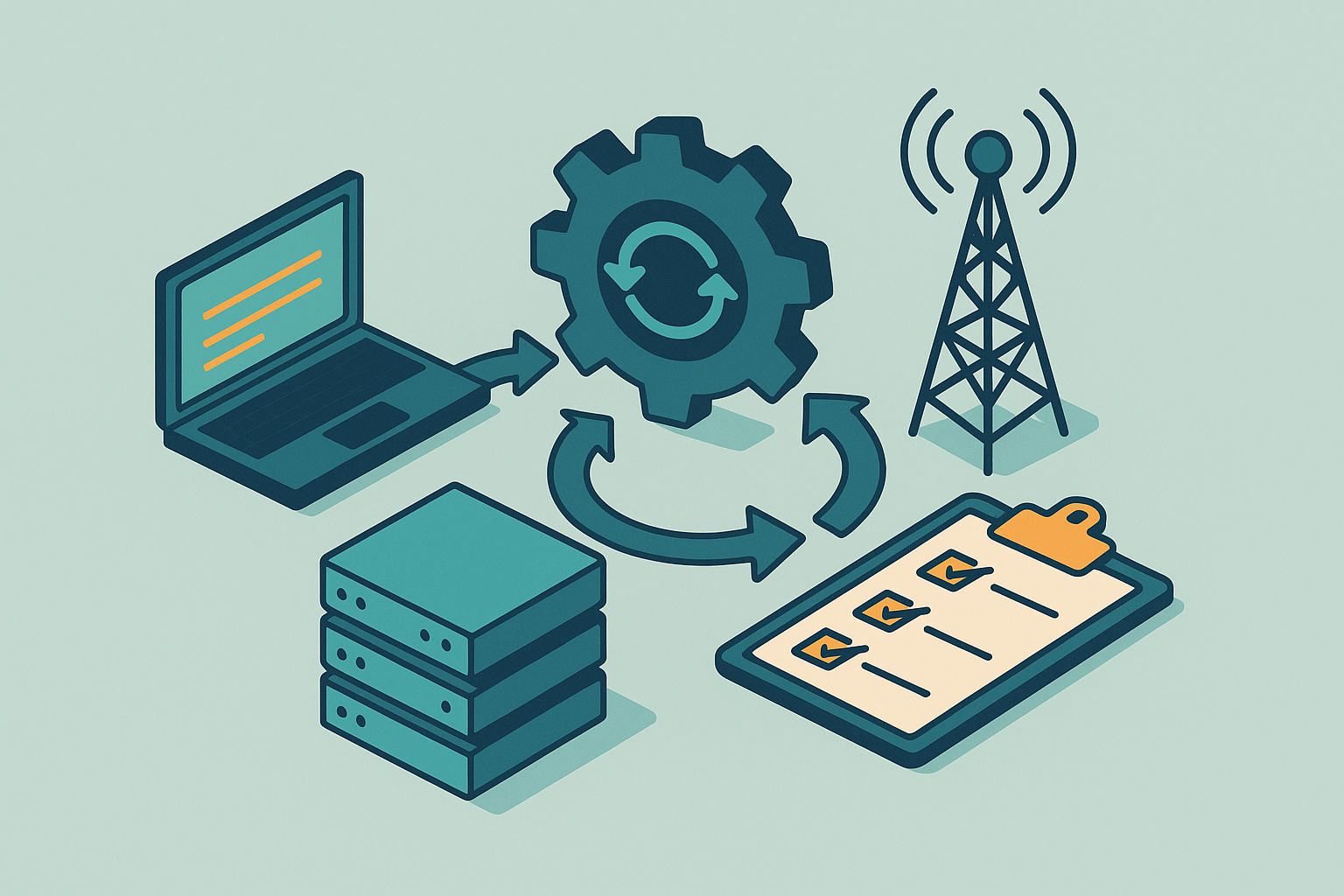
Take something as ordinary as a bandwidth change on a dedicated internet circuit. Sounds like one action. In practice, it moves through four separate domains: qualification checks whether the plant can support the new parameters, design figures out whether the logical service model needs updating, provisioning pushes device configuration changes in the right order, and activation confirms the new state and reports it back to inventory and billing.
In a fragmented OSS stack, each of those domains usually lives in its own system, often from its own vendor, each holding its own version of what is supposedly the same service. FTTH, dedicated internet, and Carrier Ethernet each define their own activation primitives (activate, suspend, resume, modify, delete), and modern platforms run these as zero-touch workflows. That automation only holds up if every system involved agrees on the state of the service before the change and after it.
TM Forum built its API portfolio, TMF638 and TMF639 for resource inventory, TMF640 for resource activation and configuration, TMF641 for service order management, because the industry already knew these were separate systems that needed a shared language. A shared API language addresses the communication problem, but a deeper one remains. You can have every system exposing clean, standards-compliant interfaces and still have no single answer to what the network actually looks like right now. That gap, between systems that can talk to each other and systems that agree with each other, is where change management failures come from.
How data fragmentation turns routine changes into operational risk
A change can clear every process approval and still produce something technically broken. Conventional change management frameworks miss this because they audit the decision, not the execution.
The same failure patterns show up again and again in fragmented OSS environments. Inventory doesn't get updated after activation, so the network reflects the change but the OSS still thinks the old configuration is live. Design documents go stale after a provisioning change, and the next engineer who touches that service inherits assumptions that are already wrong. Rollback can't run cleanly because nobody captured the pre-change state consistently across every system it touched. Approval records prove a change was authorized; they say nothing about whether it actually worked.
None of this shows up in a process audit. Each failure looks like a clean success right up until something breaks downstream, sometimes days or weeks later, and tracing it back to the original change becomes its own investigation. TM Forum found that only 19% of CSPs have successfully embedded AI in more than three OSS or network functions, which says a lot about how hard it is to run intelligence on top of data that contradicts itself. Automation built on a foundation that can't tell one coherent story about the state of the network is automation nobody can fully trust. That's true for scripted automation today. It turns existential the moment AI agents start making changes on their own.
Why the arrival of AI agents raises the governance stakes beyond what legacy OSS was designed to handle
Agentic AI is already running provisioning, customer care, and parts of network operations. The question worth asking isn't whether AI agents will execute changes. It's under what conditions, and with what accountability, they're doing it right now. NVIDIA's 2025 State of AI in Telecommunications report found that 97% of telecom executives are assessing or adopting AI to improve customer experience, network operations, or cost structure. Governance maturity hasn't caught up to that conviction, not even close. Deloitte's 2026 State of AI in the Enterprise research found only about one in five companies has a mature model for governing autonomous AI agents, while agentic deployment keeps accelerating past that.
What does that gap mean in practice? An AI agent making a change in a fragmented OSS runs into the same data problems a human operator hits, except at machine speed and without the instinct to stop and double-check something that looks off. An agent that reads stale inventory, pushes a configuration change, and logs it as successful has just manufactured a failure dressed up as a success, and no human review process catches that in real time. Multi-agent workflows make it worse. When one agent's output feeds straight into another agent's input, bad state spreads through the whole chain before anyone notices.
Legacy OSS was built for people moving one step at a time through defined workflows, not for agents working in parallel across systems that all depend on each other. Bolting on approval layers or audit scrapers doesn't fix that; it just stacks more complexity on a foundation that was already shaky.
What the regulatory environment now requires that conventional OSS audit trails cannot deliver
Europe's AI Act, in force since August 2024, classifies AI systems used as safety components in critical digital infrastructure as high-risk, and telecom networks land squarely inside that category. The requirements are specific: documented risk management, auditable training data governance, automatic event logging, defined human oversight, and all of it has to be demonstrable to regulators on request, not written down somewhere in a policy binder and left there.
ETSI's Securing Artificial Intelligence committee published a European Standard for securing AI systems against cyber threats in December 2025. 3GPP has been building AI and machine learning governance requirements directly into the standards themselves starting with Release 18, the 5G-Advanced specification. What regulators actually want as proof, decision logs, model behavior records, a trail of which actor (human or AI) executed which change and under what authority, isn't something conventional OSS monitoring tools produce today. CPNI rules on calling records and location data, plus CALEA requirements for network access security, pile on more traceability obligations for any AI system touching that kind of data.
Google's 2025 research on AI agents in telecom found that 35% of executives name data privacy and security as their top concern when picking an LLM provider. That tells you operators know the risk is real. It also tells you the architecture hasn't kept pace with that awareness. Compliance-by-design matters here for a plain reason: it's easier to build audit trails and permission structures into the OSS from day one than to retrofit them after agents are already touching a live network. Operators with critical national infrastructure designation carry these obligations on top of everything else, not instead of it.
What governed AI in OSS operations actually requires architecturally
Governance either lives in the architecture, or it doesn't exist at all. A policy document sitting in a compliance folder doesn't enforce anything; the system does, or it fails to.
Here's the requirement, plainly: AI agents need to run on the same APIs, the same audit trails, and the same permission structures as human operators. Same APIs means agents touch network state and make changes through the interfaces people already use, no shadow integrations, no direct database writes that skip the OSS layer entirely. Same audit trails means every agent action gets logged the way a human action gets logged, with who authorized it, what changed, and the state before and after. Same permissions means an agent can't do something a human holding the equivalent role couldn't do either. Nobody gets to loosen the permission model just because the actor happens to be software.
That's what accountability looks like at the architecture level: no distinction between a human actor and an AI actor at the governance layer. It rules out bolt-on automation running outside the OSS permission model, agents writing straight to device configs without touching the OSS record, monitoring overlays trying to stitch together an audit trail after the fact from scattered logs. What works instead is one data model that every actor, human or machine, reads from and writes to, so any change leaves the system consistent and verifiable no matter who made it.
Gartner projects guardian agents, AI systems built specifically to police other AI agents, will capture 10 to 15% of the agentic AI market by 2030. That's a real signal that AI-on-AI oversight is becoming its own category. But a guardian agent still needs something honest to watch; it doesn't manufacture data integrity out of thin air. TM Forum proofs of concept on intent-driven orchestration for Carrier Ethernet services show Level 4 autonomous operations are achievable, step by step, but only where the underlying data and permission model holds together well enough for agents to act on it.
Why a unified data model across the service delivery lifecycle is the enabling condition, not a nice-to-have
Governed AI and reliable change management both come down to the same thing: one consistent picture of network state that every system and every actor works from. When qualification, design, provisioning, and activation each keep their own separate version of a service, no governance framework, however carefully drawn up, can answer the basic question of what state that service is actually in, or who last touched it.
A unified data model collapses that question into one authoritative answer. Rollback works because there's an actual recorded state to go back to. Audit trails are complete because there's no gap for a change to hide in. Agent actions become verifiable because they land in the same record a human action would land in.
The payoff is concrete. Change impact analysis gets accurate instead of approximate, because the model knows exactly what a given change touches across every stage. Pre-change and post-change states live in one place, so rollback is a data operation, not someone piecing together what things looked like an hour ago from memory. Human actions and agent actions land in the same record, so the audit trail is complete by construction instead of assembled after the fact.
That's probably why so many AI initiatives stall before reaching production, even with adoption now widespread across telecom (industry estimates put it near 90%, with roughly half of operators in active pilot phases). The data foundation reliable agent behavior needs just isn't there in most legacy OSS stacks. Pulling separate workflow stages onto one data model does more than cut cost. It's what makes autonomous operations possible at all.
What separates AI-native OSS architecture from legacy systems retrofitted with AI tooling
The distinction that actually matters is where the AI sits inside the architecture, and whether it was designed in from the start or bolted on after the fact, rather than which AI features show up on a data sheet.
Legacy OSS was built for reactive, human-run workflows. It monitors, flags anomalies, follows predefined rules, and does that reasonably well. AI layered on top inherits every one of its limits: siloed data, one permission model for automation and a different one for people, audit trails built around human actions that don't cleanly capture what an agent actually did. AI-augmented systems add intelligence at the edges (predictive analytics, anomaly detection, recommendation engines) without touching the data model or governance underneath. Because the intelligence sits at the edge, an agent that spots a problem often can't act on it directly. The finding has to loop back into a human workflow before anything happens.
AI-native OSS starts somewhere else entirely. AI agents are first-class actors in the system, not an add-on. The data model supports machine-readable state, not just screens meant for a person to read. APIs are the primary interface for everyone, meaning human operators work through the same interfaces the agents use, not a separate console off to the side. Audit trails capture intent, authorization, execution, and outcome for every change, no matter who or what started it. Permission structures are role-based and apply the same way whether the actor is a person or a machine.
Worth sitting with the scale of that gap for a second. IMARC Group projects the OSS/BSS market will reach $148.26 billion by 2033, growing at a 9.4% compound annual rate. Appledore Research, via AWS, puts current telecom spend targeting next-generation OSS/BSS at roughly $18.25 billion, a narrow slice of a much bigger operational footprint. Most change management today still runs on architecture that was never built for the operational model being demanded of it now. TM Forum found that 57% of telecom executives consider cloud and AI critical enablers of autonomous networks, yet only 19% have actually embedded AI in more than three OSS or network functions. That gap between conviction and execution maps almost exactly onto the legacy architecture problem described above.
How service providers should evaluate their current OSS change management posture against these requirements
Start with architecture, not procedure. The right question isn't whether a change management process exists on paper. It's whether the OSS enforces that process by construction, so that following it isn't optional and skipping it isn't even possible.
A handful of diagnostic questions cut through most of the ambiguity here. Can you produce a complete audit trail, actor, authorization, pre-change state, post-change state, outcome, for any service change in the last 90 days, including ones run by scripts or agents rather than people? When a provisioning change happens, does the qualification and inventory record update on its own, or does someone have to go fix that by hand afterward? Do your automation and AI tools run through the same APIs your human operators use, or do they have a separate, more direct path into the system? If a regulator asked tomorrow for proof of AI Act audit trail compliance, what could you actually hand over, and where would the gaps show up? When you roll back a change, are you restoring a state that was actually recorded, or reconstructing one from memory and scattered logs?
Providers pushing FTTH, dedicated internet, and Carrier Ethernet expansion tend to run into this evaluation right at the point where growth outpaces what fragmented tooling can support. The telecom network automation market is projected to grow at a 22.5% compound annual rate, reaching $32.7 billion by 2026. Operators who put off the architectural question now will face it later under more pressure, not less, with a bigger pile of inconsistent systems to untangle by then.
What those diagnostic answers tell you is specific: whether AI agents can safely be brought into change execution, or whether the current architecture caps how far autonomous operations can go no matter how good the AI itself gets. Platforms built around a single data model spanning qualification, design, provisioning, and activation as one continuous record instead of four disconnected systems point toward where this has to go if governed AI in OSS operations is going to be more than a line in a vendor deck. The technology to build agents that can execute network changes already exists. Whether those agents can be trusted with it comes down to one thing: whether the systems underneath them agree on what's true.