API Gateway Design for Multi-Agent OSS Environments
Autonomous agents need workflow-level controls, not just per-request authentication.
API gateway design for multi-agent OSS environments is an AI governance problem. When autonomous agents and human operators share the operational plane, the gateway must enforce the same accountability standards for both. That requires workflow-level controls, coherent network data, and decision trails that explain more than whether an API call succeeded.
Why the API gateway has become the wrong thing in most OSS architectures
An agent can issue individually authorized calls that collectively bypass a provisioning approval rule. Each request passes its check, yet the sequence crosses an operational boundary that the gateway never evaluates. A successful response does not expose that failure. If the gateway records only requests and status codes, its logs cannot establish whether the workflow respected the policy governing the operation.
Most OSS environments still treat the gateway as a traffic router that authenticates requests, applies rate limits, forwards calls, and logs outcomes. That model assumes human-driven integrations, with an operator in the loop. Autonomous agents break that assumption because they set off cascading call sequences, keep session state across tool invocations, and make decisions that directly affect operations.
Legacy OSS makes that mismatch harder to contain because batch-driven, point-to-point integrations were not designed for event-driven agent access. Qualification, design, provisioning, and activation can show different versions of the same network state. Agents then propagate discrepancies. Treating agents as first-class operational actors therefore requires a governed control plane that evaluates behavior across calls, rather than a proxy that approves each request in isolation.
How autonomous agents differ from human operators at the API layer
Agents are stateful, multi-step planners. They interact across sessions and workflows, while a stateless HTTP transaction covers only one exchange. A provisioning result can become the input to another action without human confirmation. To govern that progression, the gateway needs session context and workflow-aware routing.
The protocol surface is broader as well. MCP lets agents use tools, while A2A lets them delegate tasks to other agents. Agents use these protocols alongside REST and gRPC, so controls that cover only ordinary API requests leave agent-to-agent communication outside their reach. The distinction is architectural rather than a choice of interface style, because delegation introduces another operational actor into the workflow.
MCP and A2A leave concerns including full authentication enforcement, retries, routing, and auditing to the operator. The gateway must therefore govern both the transition between workflow steps and the transfer of a task between agents. In OSS, that means understanding the declared purpose of a sequence well enough to enforce policy across it, rather than treating every authorized call as an independent permission to proceed.
The six governance functions a gateway must enforce when agents share the operational plane with human operators
The design requirement is equal accountability for equivalent actions. Agents must go through the same authentication, authorization, audit logging, and policy enforcement that human operators face. The first gateway function is unified authentication and authorization through shared identity and permission structures. Scattered API keys embedded in agent code do not meet that requirement, because they create shadow automation outside those structures.
The second function is per-action audit logging that records intent, parameters, and execution outcome. Status codes alone are insufficient for operational reconstruction. Accountable Autonomy: A Governance Framework for Agentic AI in Telecommunication Networks, published in 2026 and grounded in ETSI and TM Forum principles, identifies a Traceability and Auditability Registry as a core component of its Agent Governance Framework. The registry forwards every action to a governance subsystem, making traceability an explicit architectural responsibility.
The third function is session-aware policy enforcement at workflow level. A provisioning approval requirement must remain binding even when an agent divides the operation across two API calls. The fourth is intent-based routing, which evaluates what the agent is trying to accomplish across the sequence.
The fifth function is an explainability hook that mandates decision logging, since agents do not produce human-readable reasoning unless explicitly programmed to do so. The sixth is regulatory compliance enforcement at the infrastructure layer. The EU AI Act requires high-risk AI systems to log events automatically and keep those logs. Delegating that obligation to separate agent implementations would leave the gateway unable to apply a common standard. These six requirements make human and agent audit records comparable when an operational decision must be reconstructed.
Why a unified OSS data model is a prerequisite for any of this governance to work
A compliant action can still produce the wrong outcome. If an agent reads one representation of network state during qualification and provisioning acts on another, every gateway check can pass while the workflow produces configuration drift. The audit trail then records an authorized operation against incoherent data. Gateway logging alone cannot reconstruct the underlying discrepancy after the fact.
A unified OSS data model gives qualification, design, provisioning, and activation a consistent representation of network state. This supplies the reference point that governance needs. The intent declared at the gateway, the data read by the agent, and the action taken can then be traced to the same source of truth. Without that connection, an auditor can establish that permission existed but cannot reliably connect the decision to the operational state on which it depended.
The dependency extends across service types. Separate OSS stacks for FTTH and Carrier Ethernet leave agent inputs structurally siloed, however carefully each gateway is designed. Consolidation therefore has a governance purpose beyond simplifying integration. It removes the divergent representations that prevent a common policy from producing consistently interpretable results across the operational plane.
What multi-protocol gateway architecture looks like in an OSS context
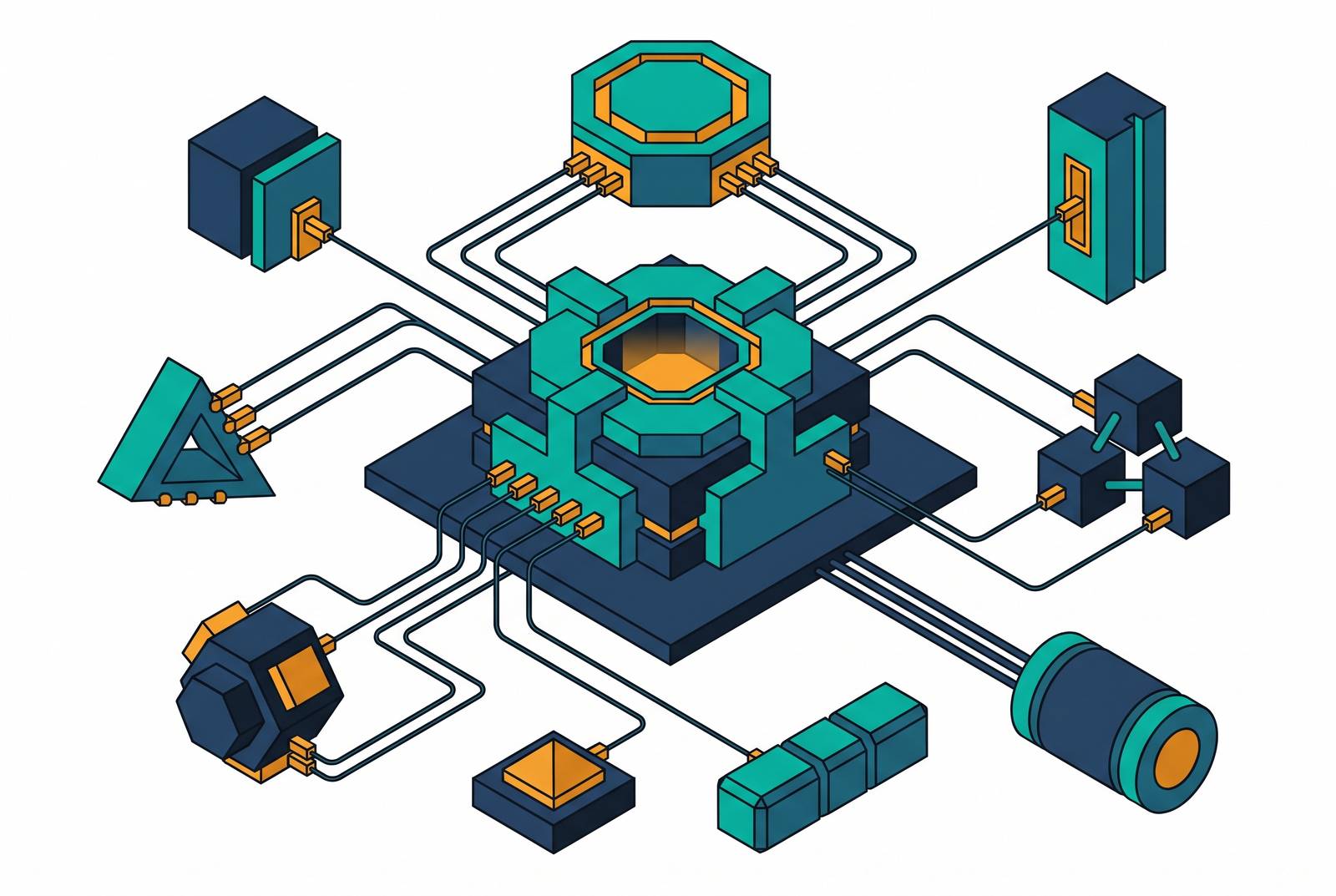
A multi-agent OSS gateway is a composed stack. It must account for REST traffic from partner integrations, gRPC traffic between internal services, LLM API calls from agent reasoning engines, and agent-native MCP and A2A exchanges. These traffic classes have different governance needs. Combining them under one architectural boundary does not mean treating model access, tool invocation, and task delegation as interchangeable requests.
Backend for Frontend, or BFF, provides a dedicated interface per operator or agent role. A provisioning agent, qualification agent, and fault management agent each need different data, so role-specific interfaces limit what each can access to the scope of its work. Federated schema composition addresses a different boundary. Where inventory, configuration, and service catalog functions are microservices, the gateway composes their schemas into a unified query surface. An agent can then read qualification, inventory, and provisioning state in one governed call.
Federation provides the access surface through which the coherent data model beneath it becomes usable. Protocol bridging governs another transition, namely an orchestrating agent delegating a subtask to a specialist through A2A. Before forwarding the task message, the gateway must validate that the orchestrator has permission to delegate that particular action.
GSMA Open Gateway illustrates the abstraction principle at network level, separating applications from underlying network capabilities through standardized APIs. Operator-deployed gateways provide the runtime functions for secure exposure, traffic control, observability, and monetization. For internal OSS agent traffic, the relevant architectural lesson is that abstraction needs an enforcement layer. Standardized interfaces do not themselves govern the workflows built on top of them.
Where the Telefónica/Nokia test case shows the governance gap in practice
Telefónica announced in February 2026 that it would work with Nokia to test AI software agents against GSMA Open Gateway network APIs for fraud prevention. The work took place in a lab environment. Nokia's Network Exposure Platform provided an MCP server that gave access to network APIs, including SIM swap and device swap capabilities. Nokia's Network as Code platform then aggregated those capabilities for application developers in an A2A format.
The test exposes a limit of atomic API contracts. Telefónica's standard Open Gateway model works well for individual calls, but a context-driven fraud assessment needs several capabilities, including roaming verification, SIM swap, and device swap. Scoring logic sits in the integration layer, and each new fraud signal can require code changes and new API releases. Several capabilities now need to be coordinated toward an operational objective.
With A2A, that coordination shifts from orchestration driven by contracts toward execution driven by intent. Consequently, governance moves from static API contracts into the runtime layer, where policy must cover agent intent and delegation. OSS provisioning and activation have the same workflow structure, with qualification, design, provisioning, and activation forming a governed sequence despite being individually valid operations. The lab test does not establish a complete governance architecture, however. How to audit agent reasoning across a multi-step fraud assessment at production scale is still unresolved.
The auditability problem that gateway design alone cannot solve
A gateway can record every request and response and still fail to show why an agent chose a given operational action. The missing evidence originates inside the agent, which does not produce human-readable reasoning unless programmed to log it. Infrastructure can demand that evidence, but traffic records cannot substitute for it.
Infrastructure for the Agentic Web: Gap Analysis and Architecture from the Agentverse Platform catalogs observability as one of eight categories of missing infrastructure capabilities in current agent platforms. That gap helps explain why experimentation does not automatically become accountable production operation. Action records establish what happened, while a decision trail must also explain the basis for choosing it. An audit of an autonomous operational judgment needs both records.
The EU AI Act sets a logging floor for high-risk AI systems, requiring automatic event logging and retention for a minimum period. A retained log can be complete as an event record and still fail to explain the decision behind the event. Equal accountability with human operators therefore demands more than a technically complete history of API exchanges.
The practical design response is a contract with every registered agent that includes a structured reasoning-log schema. The gateway should require those logs as mandatory inputs to the audit trail. The gateway's action trail and the agent's decision trail must be jointly sufficient to reconstruct an operational action from intent through execution.
What a governed multi-agent gateway architecture looks like when it is working correctly
A working architecture applies four conditions at once. Agents use the same authentication and permission structures as human operators, and both produce a unified audit trail sufficient to reconstruct their actions. Policy enforcement follows the workflow. Under those controls, a unified data model lets agents and operators work from the same network state. None of these conditions compensates for the absence of another.
The Agentverse gap analysis shows how much infrastructure can be operational while governance remains incomplete. Its Q1 2026 audit of the platform's production deployment found agent hosting, a global registry, asynchronous messaging, and MCP integration operational. Yet observability, enterprise-grade security, and economic primitives for agent interactions remained among 62 catalogued missing capabilities.
For providers running FTTH, dedicated internet, and Carrier Ethernet on a unified OSS, the gateway turns a platform commitment into enforceable operational rules. The design then holds AI agents to the same API, audit-log, and permission standards as humans, putting the policy into practice. Consolidating multi-service workflows onto one data model and governing access through a unified gateway removes the class of errors caused by divergent network-state representations. Those discrepancies otherwise compound through fiber mergers, new service launches, and provisioning exceptions.
The final standard is parity: an audit trail should identify the actor while holding agent and human actions to indistinguishable standards of accountability. That is the test of whether a multi-agent gateway governs operations or merely transports requests.