Event-Driven Architecture Patterns in AI-Native OSS
AI agents need real-time event streams, not nightly batch updates, to close the loop.
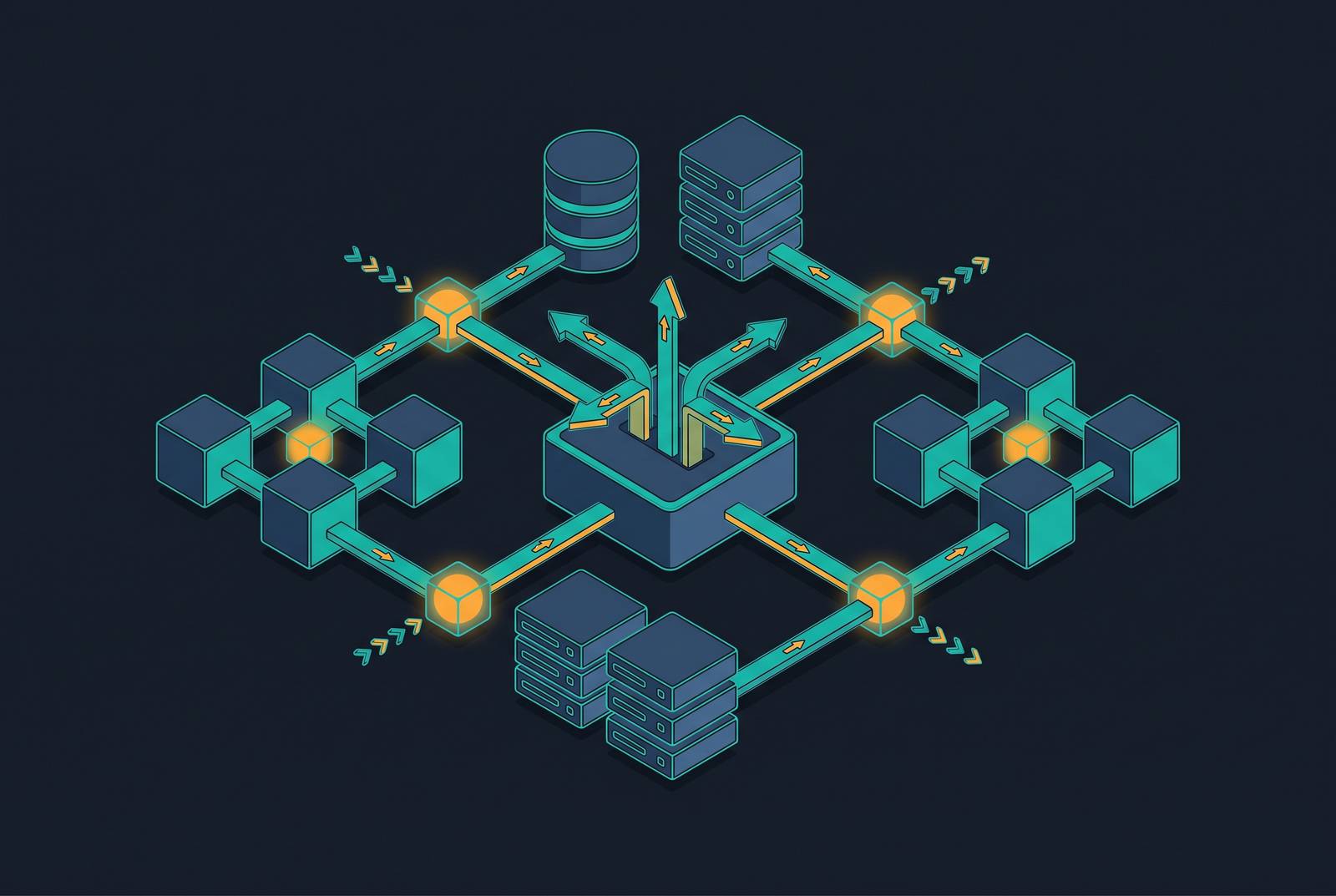
An AI agent watching for a network fault has one job: notice the event, decide what to do, and act, before conditions change again. In most operational support systems still running today, that loop cannot close, because the billing and CRM systems the agent needs to consult still update on nightly batch cycles while network alarms and topology data arrive in seconds to minutes through the OSS layer. That gap between a real-time signal and a stale data source is a structural mismatch between how legacy OSS architecture was built and how an agent needs to operate.
Legacy OSS platforms execute service lifecycle steps in a fixed order: qualification finishes before provisioning starts, and provisioning finishes before activation starts. No step can react to something that happens mid-sequence, because the architecture was never designed to notice mid-sequence events at all. A 2026 analysis from BigDATAwire found that sequential architecture cannot guarantee inference experience under real-time load, while event-driven architecture resolves the problem by responding to requests and invoking inference services the moment business conditions call for them.
The mismatch compounds across domains. Network alarms and topology updates move through the OSS layer on a near-continuous basis, while billing and CRM systems, still on nightly loads in many deployments, cannot supply an agent with anything resembling current state. Agentic AI needs one unified, real-time event stream spanning both domains, and a nightly batch job cannot produce that stream no matter how well it is scheduled.
Vendor fragmentation makes the problem worse rather than incidental. Telecom operators commonly run Ericsson, Nokia, or Huawei OSS stacks alongside Salesforce or ServiceNow BSS layers, often inherited through mergers and acquisitions rather than chosen deliberately. Each stack is internally consistent. None of them were built to speak to one another in real time, and the problem scales with every additional vendor added to the environment. Bolting an inference call onto this arrangement does not fix the underlying sequence. It produces a system that looks AI-augmented on the surface but still blocks on whichever step in the chain happens to be slowest that day.
What makes a control plane event-sourced
The distinction between an AI-native OSS and an AI-augmented one comes down to a single architectural question: is the control plane event-sourced, so that no step executes without a prior event triggering it, and every state change is observable and can be replayed.
An AI-augmented system keeps its old sequential workflow intact and inserts an AI model as one more step in the chain. Provisioning runs, the model gets invoked, its output feeds back into the same queue that was already there, and the underlying workflow remains as sequential as it always was. An AI-native system inverts this relationship. The control plane emits an event for every state transition, agents subscribe to the events relevant to them, form a decision, and emit new events that trigger whatever comes next. The agent is a participant living inside the event stream itself, not an external service being called from within a workflow.
This is not a theoretical preference confined to OSS vendors. The agent framework ecosystem converged on event-based internals between 2025 and 2026, and that convergence is evidence rather than trend-chasing. BigDATAwire identifies event-driven architecture as the natural communication backbone for agent systems generally. LangGraph 1.0 ships a Pregel/BSP execution model in which state updates are themselves events, and AutoGen v0.4 was rebuilt from the ground up around an actor model using typed message passing rather than direct function calls. Google's A2A protocol, built for coordinating long-running tasks between agents, uses Server-Sent Events rather than synchronous request-response calls. When the frameworks used to build agents and the protocols used to let agents talk to each other independently arrive at the same architectural choice, that choice stops being a matter of taste.
The shift from augmentation to replacement is already visible in production. Legacy applications built on older messaging middleware, such as JMS, were rebuilt in 2025 as modern event-driven systems and deployed at scale, marking a practical move away from patched sequential systems and toward genuine event sourcing.
The most common objection deserves a direct answer: many operators already have API integrations connecting OSS and BSS, so why isn't that sufficient? Google's A2A protocol uses Server-Sent Events for long-running task coordination, a design signal that the major agent interoperability protocols are themselves built on event streams. They couple the calling system tightly to the system being called, and they leave behind no replayable log of what happened, when, or why. An API call answers one question once. An event stream keeps a record.
How pub/sub decouples OSS domains
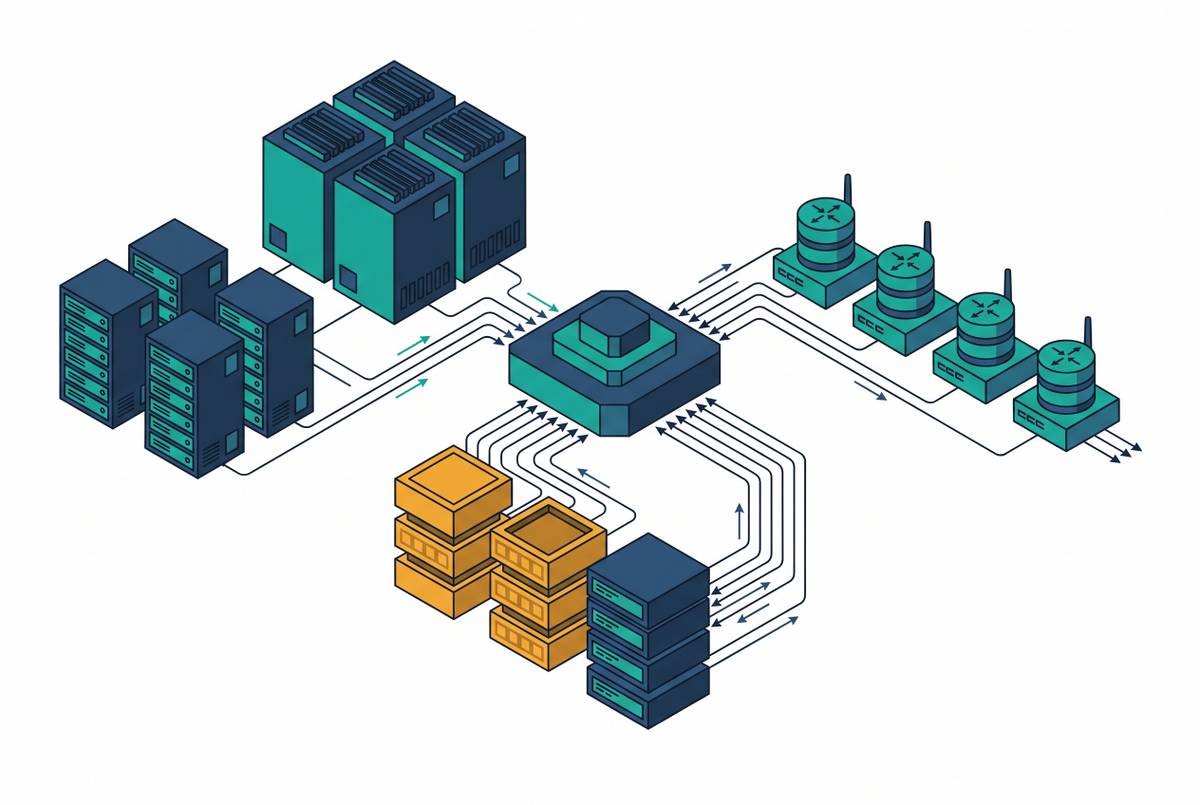
Publish/subscribe messaging is the pattern that removes the point-to-point coupling between OSS domains, letting qualification, provisioning, and activation agents each work off their own event stream instead of waiting in a shared call stack for one another. Coupling is what makes sequential OSS brittle under load.
In a tightly coupled OSS, qualification has to finish and return a result before provisioning can begin at all. If qualification runs long, an inventory lookup drags, or a capacity check takes longer than expected, provisioning sits idle and the entire order stalls behind it. Under a pub/sub model, the qualification service publishes a "service-qualified" event to a topic, and a provisioning agent subscribed to that topic starts work the moment the event lands.
A single event can be consumed by several independent listeners at once: a capacity planning agent, a billing system, and a field dispatch workflow can all react to the same "service-qualified" event without the qualification service knowing, or needing to know, who else is listening. This matters concretely in access network provisioning, where FTTH, dedicated internet, and Carrier Ethernet each follow a different provisioning path. A single upstream "order-received" event can fan out to the correct technology-specific provisioning agent based on service type, without the producer of that event needing to encode branching logic for every technology it might ever serve.
Value Stream AI's 2026 architecture guide describes the same principle from the microservices side: each agent should be an independently deployable service with its own input schema, output schema, and scaling policy. Pub/sub is the connective layer that lets those independent services operate without becoming coupled to one another, which is exactly the property qualification, provisioning, and activation agents need in an OSS context where order volume and service mix both fluctuate constantly.
Event sourcing gives AI agents a replayable, auditable history
Event sourcing replaces the conventional OSS habit of overwriting a record with its current state, and stores instead a full log of every event that changed that state. It is the only model that gives an AI agent a history it can replay, a failure it can recover from, and an audit trail that satisfies governance requirements.
Conventional OSS databases show only where a circuit stands right now. A record might say a service is provisioned, but nothing in that record explains the sequence of transitions that got it there. When an AI agent makes a bad call under that model, there is no native trace of what state it observed at the time or what reasoning led to its action. Event sourcing closes that gap by recording every transition as an immutable event: qualification requested at one timestamp, inventory checked at the next, provisioning triggered at a third. Current state is derived by replaying the log forward, and any past state can be reconstructed by replaying only up to the point in question.
For an AI agent, that property is not a convenience, it is a requirement. An agent that crashes partway through a provisioning task can resume from the last committed event instead of restarting the entire workflow from zero, and a second agent tasked with auditing the first agent's decisions works from the exact same event log the first agent acted on. Nothing has to be reconstructed from application logs scattered across separate systems.
TM Forum's Open Digital Architecture points in the same direction. ODA targets an event-driven model governed by a knowledge-defined intelligence layer. The architecture has to expose its events and its state as data that intelligence layer can actually consume. Event sourcing is not an optional enhancement to that design, it is close to a precondition for compliance with it.
The governance dimension carries particular weight in telecom, where the cost of an untraceable automated decision is not hypothetical. Operators that have already been burned by automation acting without an audit trail are reluctant to extend trust to a new layer of automation without one. Event sourcing supplies the technical substrate that makes auditability possible in the first place, rather than functioning only as a recovery mechanism. Singapore's Infocomm Media Development Authority launched a governance framework specifically for autonomous AI agents in January 2026, a signal that regulators are starting to expect traceable logs of what an agent did and why. Telecom already operates under obligations around lawful intercept, NIS2 in Europe, and emergency services availability, and any AI system touching a regulated function has to guarantee data integrity and traceability as a property of its architecture rather than as something patched on afterward. Event sourcing provides exactly that guarantee at the architectural level.
The practical payoff shows in deployment outcomes. One Tier-1 operator running a multi-vendor deployment that stayed governed, auditable, and reversible, the characteristics event sourcing makes possible, saw a meaningful reduction in analysis time along with most issues closing automatically.
CQRS separates read and write paths for qualification and provisioning agents
CQRS separates the path that changes network state from the path that reads it. That separation removes the database contention that appears when provisioning agents writing state and qualification agents reading inventory land on the same tables at the same time.
In a single-model OSS database, every write from a provisioning workflow and every read from a qualification check compete for the same rows and the same indexes. During a mass FTTH build, when hundreds of activations run concurrently, reads slow the writes down and writes invalidate whatever had been cached for the reads.
CQRS resolves this by keeping a write-optimized command store, which in an event-sourced system is the event log itself, separate from one or more read-optimized query projections. Qualification agents query a materialized view built for reading; provisioning agents write commands that update the event log; neither path has to wait on the other. For Carrier Ethernet specifically, qualification requires reading current topology and available capacity across multiple network segments at once. With CQRS, that query runs against a projection computed in advance and updated asynchronously as provisioning events occur, so qualification stays fast even while provisioning is actively running against the same underlying data.
The read side can also be shaped differently for each consumer without touching the source of truth. A qualification agent needs a view centered on available capacity. A billing system needs a view centered on activation timestamps. Both are projections built from the same event log, maintained independently of one another, and neither one requires querying the log directly. Value Stream AI's architecture guide frames the broader integration challenge, operating alongside multiple AI vendors and legacy systems, as requiring MCP, A2A, and an event-driven integration layer together. CQRS is the internal counterpart to that external event bus: it keeps the OSS's own data model from becoming the bottleneck that undermines everything the event bus is trying to accomplish.
CQRS also forces a design discipline that sequential systems never had to confront. A provisioning command gets acknowledged as accepted before the read projection catches up to reflect it, and agents interacting with the system have to be built to tolerate that window of eventual consistency. Sequential systems avoided this problem only by blocking until the write finished, which is precisely the behavior that makes them incompatible with real-time agent load.
What dead letter queues and idempotent event handlers prevent
An event-driven OSS that lacks dead letter queues and idempotent event handlers is exactly as brittle as the sequential system it was meant to replace. A dropped activation event or a duplicate provisioning command produces double-provisioning errors, or silent failures with no path back to recovery.
The stakes are concrete in access network provisioning. In XGS-PON and Active Ethernet environments, the canonical service lifecycle events, activate, suspend, resume, bandwidth modify, delete, all have to be handled atomically. A duplicate activate event must not provision the same ONT port a second time, and a dropped delete event must not leave a circuit dangling and consuming capacity it no longer needs. Idempotent handlers close the duplication risk: a handler that checks whether a given provisioning action has already completed before executing it can safely receive the same event multiple times and produce the same result whether that event arrives once or three times.
Dead letter queues solve a different problem: failure routing rather than duplication. When an event cannot be processed, because the target device is unreachable, an inventory record is locked, or a downstream API is down, the event moves to a dead letter queue instead of vanishing. A human operator or a recovery agent can then inspect it, retry it, or escalate it. Without that mechanism, a failed activation event disappears from view entirely: the order system believes activation completed, the network never actually provisioned the service, and the customer has no working connection and no clear point of contact to resolve it. With a dead letter queue in place, that same failure gets surfaced, attributed to a specific event, and made recoverable.
The distinction matters even more for an AI agent than for a human operator, because an agent has no intuition to fall back on when something goes quiet. An agent that triggers a bandwidth modification and gets no confirmation event back needs to know whether that event was lost, is still in flight, or failed. The dead letter queue is the mechanism that distinguishes those states and gives the agent a place to look for failed actions it is responsible for.
Zero-touch provisioning models depend entirely on this guarantee holding. AEX's model, where closing a job triggers provisioning automatically and the first invoice goes out the same day, only works if every activation event is processed exactly once. Idempotent handlers and dead letter queues are the operational prerequisites that make that guarantee real rather than aspirational.
How four patterns compose into the OSS agent loop
Pub/sub, event sourcing, CQRS, and dead letter queues with idempotent handlers are not four options to choose among. Each pattern covers a distinct phase of the perception-decision-action loop an AI agent needs to run in production, and removing any single one breaks the loop at a specific, identifiable point.
Perception depends on pub/sub. An agent cannot decide anything without first receiving the event that tells it conditions have changed, and pub/sub is what delivers that event the instant it occurs rather than on the next batch cycle. Decision-making depends on event sourcing, because a decision worth trusting requires knowing the full sequence of prior states, not just the current one, and because a governed decision requires a replayable record of what the agent observed before it acted. Action depends on CQRS, because an agent issuing a provisioning command cannot afford to have that write blocked by a concurrent qualification read, or the reverse, particularly under the order volumes a mass FTTH build or a Carrier Ethernet rollout generates. And the loop's resilience, its ability to keep functioning when a device is unreachable or a message goes missing, depends on dead letter queues and idempotent handlers, without which a single dropped event turns into a silent failure an agent has no way of detecting.
Stripping out pub/sub forces agents back to polling, which reintroduces the latency that made sequential OSS incompatible with real-time load in the first place. Strip out CQRS and qualification and provisioning agents return to contending for the same rows in the same tables, recreating the contention that slows both paths down under concurrent load. Without dead letter queues and idempotent handlers, every event-driven workflow inherits the exact brittleness that event-driven architecture was built to eliminate.
Telecom's shift toward AI-native OSS means rebuilding the control plane so that perception, decision, and action can each happen on an event stream built for the purpose, with a data model built to support concurrent agents rather than a single sequential queue. The four patterns examined here are what that rebuilding looks like in practice, and each one earns its place by solving a failure mode the others cannot.
Sources
- 5 Changes That Will Define AI-Native Enterprises in 2026 - BigDATAwire
- AI System Architecture 2026: Microservices, MCP & Cloud
- Overcoming the OSS/BSS bottleneck: telcos’ AI transformation needs an event driven architecture
- Telecom OSS Modernization with Data Streaming: From Legacy Burden to Cloud-Native Agility - Kai Waehner
- Next-Generation Event-Driven Architectures: Performance, Scalability, and Intelligent Orchestration Across Messaging Frameworks
- The Log is the Agent: Event-Sourced Reactive Graphs for ...
- AI Agent Explainability: Why Your Infrastructure Needs to Remember