Real-Time Network State Synchronization in AI-Native OSS
Unified real-time state prevents AI agents from acting on outdated network information.
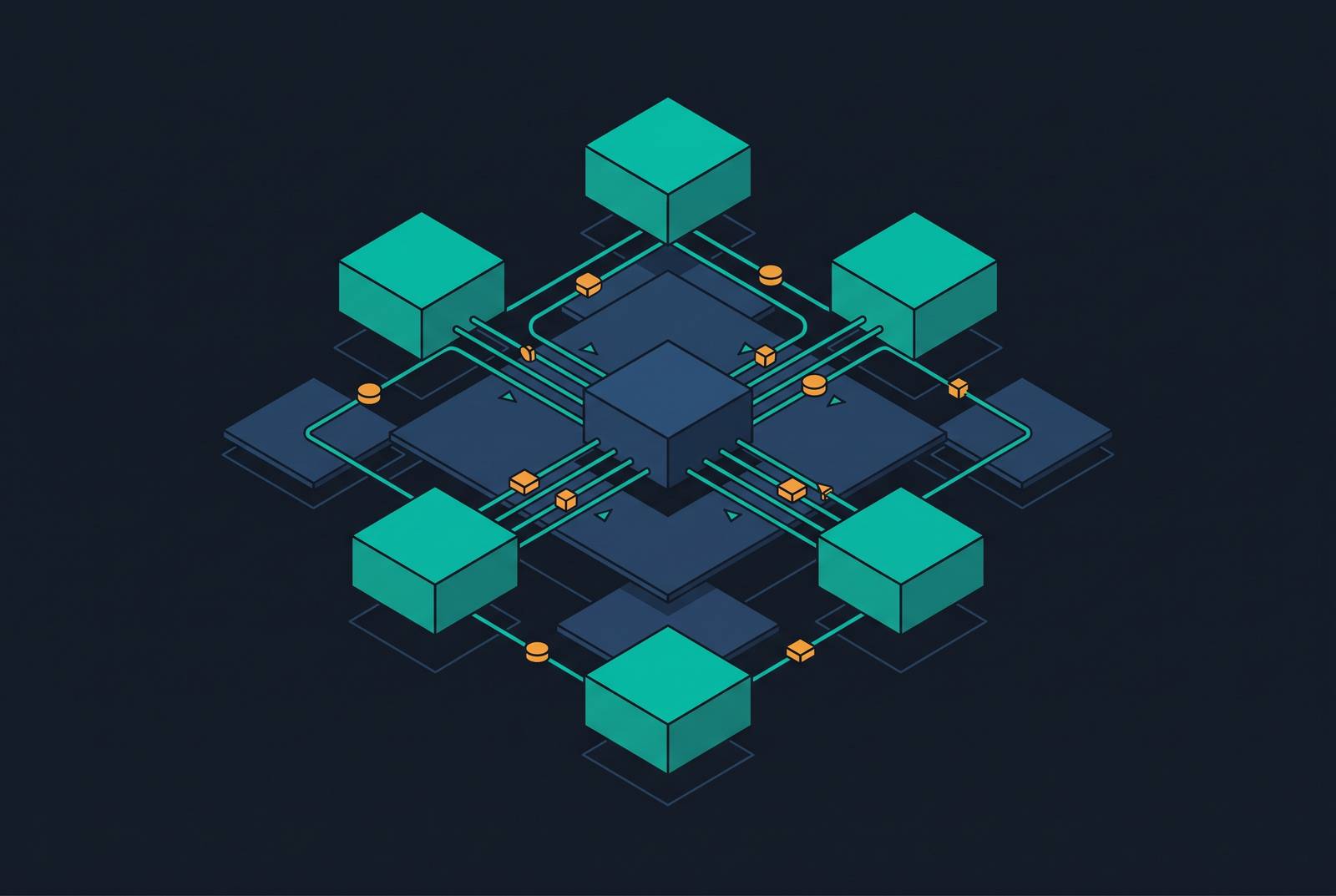
Real-time network state synchronization is the prerequisite for AI-native OSS. Reliable, auditable AI action depends on a continuously accurate source of truth shared across qualification, design, provisioning, and activation. The architecture depends decisively on whether every operational participant acts on that shared state or on a separate version that must later be reconciled.
Why AI agents in network operations depend on state they can trust
An AI agent instructed to qualify an address may find available capacity in inventory even though that capacity has already been allocated. It can then approve a service that the network cannot deliver as designed. The reasoning may be sound, but its premise is false. If design and provisioning inherit that qualification result, they also inherit the error. By activation, the decision has passed through several operational steps without becoming any more reliable.
A stale or fragmented inventory describes a network that no longer exists in the form presented to the agent. This dependency applies whether the task is qualifying an address, designing a service path, or rerouting traffic. State that is minutes or hours old can therefore undermine an otherwise capable agent before it takes its first action. Better AI capability does not repair the information it was allowed to see.
Legacy automation failures could unfold slowly enough for a human operator to identify and recover from them. An AI agent acting at scale can propagate a wrong decision across many services before a person intervenes. That changes the operational requirement from discovering discrepancies during reconciliation to maintaining trustworthy state throughout execution. The basis for autonomous action must be established before the agent acts.
How legacy OSS architectures create the state synchronization problem
Legacy OSS platforms were built to reconcile records at set times, with no way to keep state accurate at all times. Their operating assumptions include scheduled data updates and manual checks, so information can already be outdated when it reaches an operator or another system. This architectural mismatch stems from the way a platform’s records are maintained and shared, independently of its vendor or installation date.
The mismatch becomes concrete when the same circuit or customer address exists differently in four separate systems. Qualification has no single authoritative record from which to establish service availability. Later functions may consult their own records, but those lookups do not resolve which representation is correct. Instead, each integration must bridge conflicting views of the network. OSS environments assembled through mergers compound this fragmentation as acquisitions and new network technology layers add further data domains.
Integration work and state integrity are related, but distinct. NTT DATA’s OSS transformation analysis lists reliance on legacy systems, the difficulty of integration, and end-to-end automation as separate challenges. Connecting systems and keeping their records continuously consistent are distinct requirements. An interface can transmit outdated information just as successfully as current information.
If the agent reads a batch-reconciled inventory, it still acts on last-known state, regardless of how sophisticated its reasoning becomes. Reading that inventory faster cannot keep it accurate between updates. Closing the gap therefore requires changing how operational state is represented and maintained, rather than adding intelligence above the existing reconciliation process.
What real-time synchronization actually requires at the architectural level
Real-time synchronization uses event-driven updates in place of scheduled pulls. Continuous streaming processes telemetry, alarms, service performance, and customer experience metrics as they occur. This changes when operational information becomes available. But streaming alone cannot give a trustworthy view of the network when the systems receiving it keep records that disagree. Four fast pipelines feeding four inconsistent stores remain four inconsistent stores.
The unified data model supplies the missing authority. Qualification, design, provisioning, and activation must read from and write to the same authoritative record, so that each function works from a shared representation. Federation of inventories and a unified topological view support that structure without replicating inventory into separate operational copies. TM Forum-aligned orchestration frameworks describe this approach as a foundation for zero-touch provisioning across B2C and B2B services.
The API surface must preserve that unity. An orchestration interface that exposes cached, last-known state leaves the decision-maker separated from the live model, even when telemetry is streaming elsewhere in the platform. NTT DATA’s Next Gen OSS design positions full integration through APIs, AI, and open-source solutions as a backbone requirement. For real-time orchestration, those interfaces must expose current operational state rather than serve as another distribution point for reconciled copies.
At qualification, that model must identify the infrastructure serving the premise, the services available, and the equipment installation requires. Provisioning and activation must subsequently write back to the same model.
How state synchronization failures cascade through FTTH, dedicated internet, and Carrier Ethernet delivery
Qualification, design, provisioning, and activation form a dependent sequence. Each step inherits state from the previous one, so a discrepancy can travel forward even when every later step follows its own rules correctly. The later it surfaces, the more expensive correction becomes. Across FTTH, dedicated internet, and Carrier Ethernet, the specific failure differs, but the dependency remains the same.
In FTTH and PON environments, provisioning requires current knowledge of port availability, splitter ratios, and ONT assignment. Stale inventory can lead to provisioning an OLT port that is already allocated or unavailable, with the conflict discovered only at activation. Field completion introduces another synchronization requirement. When an installation is complete, that same execution event must trigger device provisioning, update the subscriber record, start billing, and close the work order. If OSS state lags field execution, these steps decouple and require manual reconciliation.
Dedicated internet exposes a different form of over-commitment. B2B qualification must be deterministic because the customer contract depends on committed bandwidth and path guarantees. Those commitments require a current view of available capacity. When qualification uses stale capacity data, the shortfall can emerge during provisioning. Discovery after activation is more serious because SLAs are already running.
Carrier Ethernet introduces synchronization seams at handoff points and administrative boundaries. Drift between domains can affect service performance without causing a clear fault, and just one stale path segment can break the zero-touch provisioning chain. The topology must therefore be up to date for every service segment. Across these delivery models, service readiness must flow directly into work order creation from the model that tracks network state. An export or manual lookup inserts another point at which execution and inventory can diverge.
Why ungoverned AI automation on unsynchronized state is a compounding liability
An agent acting on fragmented state without governed permissions can produce an outcome that cannot be reliably attributed, audited, or corrected at the system level. If the operational record does not support an account of the agent’s action, recovery must address both the service failure and the missing basis for explaining it.
Agents already find faults, reroute traffic, restart elements that are failing, and trigger remediation steps in telecom networks. In many controlled deployments, a human must still give explicit approval for actions with a major impact, including live configuration changes and site-level maintenance. Some live systems execute certain impactful actions autonomously within predefined guardrails. Human approval is not, however, a substitute for accurate state. An operator approving an action on the basis of an outdated agent report faces the same information defect as the agent.
Oracle Communications’ analysis identifies fragmented OSS/BSS environments as a constraint on real-time, cross-domain orchestration. That fragmentation also limits the common operational context needed to govern actions across domains. Agents must use the same APIs, audit logs, and permission structures as human operators, with both reading from and writing to the same live model. Separate controls around a separate AI view leave the synchronization seam unresolved.
Regulatory obligations make this distinction consequential without applying identically to every agent. From 2 August 2026, the EU AI Act’s Article 50 transparency duties apply to certain AI systems, including those that interact directly with people or generate synthetic content. Fines for non-prohibited breaches can be as high as €15 million. A stale-inventory error is not, by itself, proof of an Article 50 breach, but applicable AI obligations can add compliance exposure to an operational failure. A trustworthy state model is the foundation for accountable action, and those obligations still require assessment.
What distinguishes an AI-native OSS architecture from an AI-augmented one in practice
AI-augmented OSS places intelligence above existing operational systems. AI reads exported or replicated data and returns recommendations or alerts that humans act on through the underlying OSS. The AI-visible network and the operational record remain separate. As long as that arrangement persists, reconciling those views is an ongoing structural responsibility.
AI-native OSS removes that separate operational viewpoint. Agents use the same live data model, APIs, audit structures, and permissions as human operators and other operational functions. HCLTech’s 2026 analysis defines an AI-native telco as a unified, AI-infused technology fabric in which cloud, edge, data, and network function as one integrated operating architecture. The same framework positions AI as an execution layer connecting engineering, operations, and commercial teams.
The practical evidence is in the execution record. An agent that qualifies an address, designs a service path, and triggers provisioning should leave an audit trail identical in structure and completeness to one produced by a human following the same steps. The APIs, log entries, and permission checks should be the same. This equivalence makes the agent a governed participant rather than a shadow process whose activity must later be imported into the operational record.
AI-native does not mean AI-only. Human operators remain in the same system, and approval gates for high-impact actions are enforced through its existing permission structures. NTT DATA’s design principles likewise put API integration and AI/ML at the core of operations, with TM Forum standards supplying the orchestration contract. The distinction is therefore not whether humans remain involved, but whether humans and agents operate under the same state and control model.
What service providers should evaluate when assessing OSS readiness for real-time state synchronization
For technical decision-makers, evaluation should begin with the relationship between AI inputs and operational writes. The useful diagnostic is whether AI reads the same state that provisioning writes to. If that link relies on a reconciliation job, data export, or middleware translation between separate state views, the architecture has a gap. A feature checklist cannot establish this relationship.
A test of the unified model should follow address qualification, service design, provisioning, and activation. At each step, the evaluator should establish whether the function read from and wrote back to a single authoritative record, or required a lookup, import, or manual check against another system. The governance test should then request the audit trail for an AI provisioning action. Its structure and completeness should be indistinguishable from those of the equivalent human action. Together, these tests examine both the information used to act and the record left by execution.
The same standard applies to retrofit proposals. Operators under pressure to add AI to existing stacks should check whether the proposed layer keeps its own network view or shares the OSS model natively. For fiber operators, CLECs, and carrier-grade providers, the consequences appear in truck rolls, SLA exposure, and customer experience when stale availability or topology survives into delivery. HCLTech’s analysis frames transformation success through outcomes including improved service quality, faster provisioning, and revenue uplift. To achieve those outcomes, the operational model must be accurate enough for AI to act without a human correcting it at every step.
A platform earns the AI-native label when synchronization is built into its design.