Why Legacy OSS Cannot Be Retrofitted for AI Agents
AI agents need event-driven access and unified data that legacy systems cannot provide.
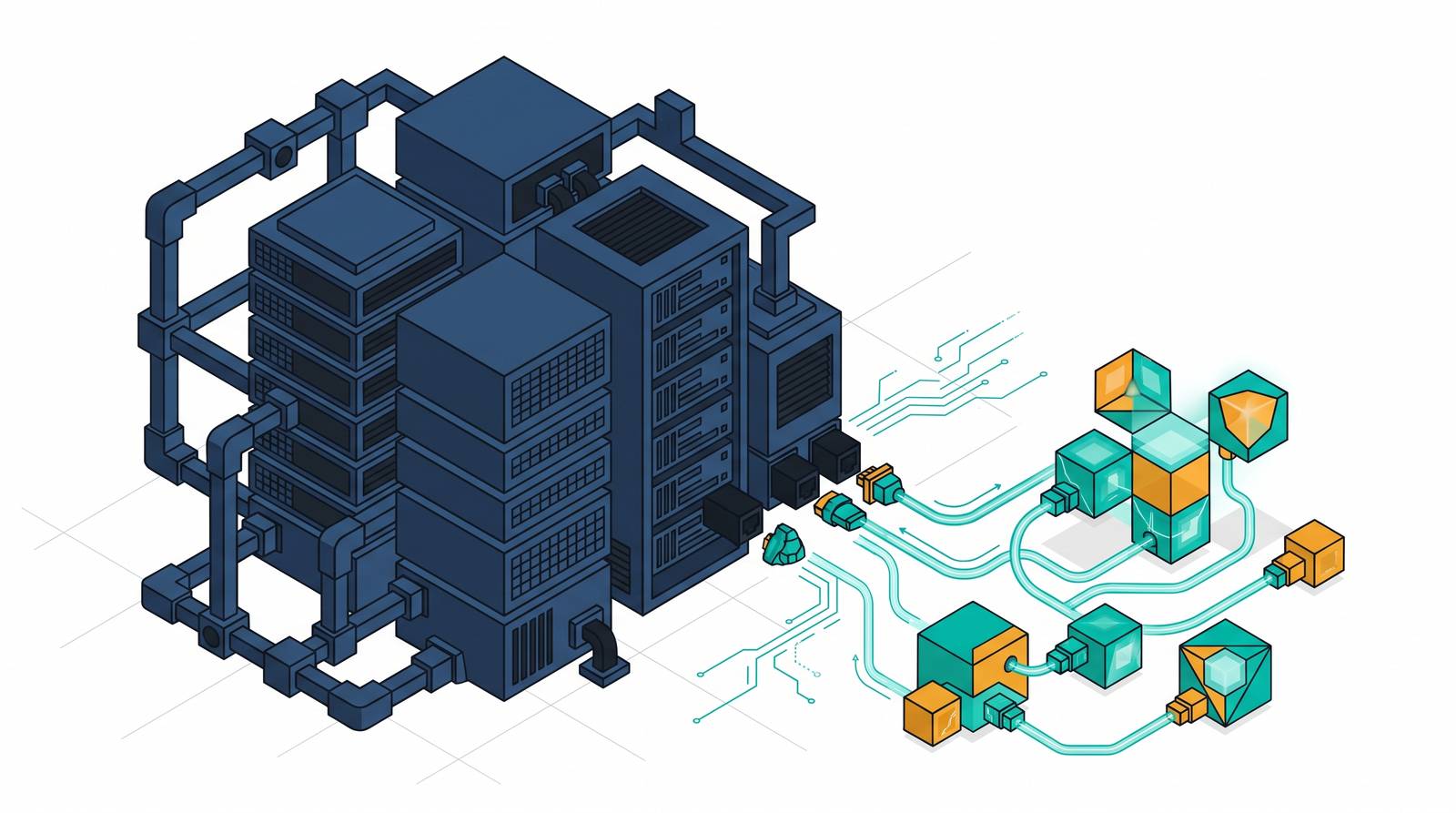
AI agents aren't faster humans. They approximate no workflow of a skilled operator running queries and reviewing reports. They are autonomous decision-makers that must read and write operational state continuously, act on changes within seconds, and coordinate with other agents across interconnected workflows, all while producing a complete, auditable record of every action taken under every permission granted.
The requirements this imposes on an operational system are specific and unforgiving. Agents require continuous, real-time access to operational state, not periodic snapshots or batch exports. Closed-loop automation depends on event-driven triggers. An agent that detects a network anomaly must respond before the next scheduled polling cycle, which in legacy environments is often minutes away, sometimes hours. In multi-agent architectures, where one agent qualifies a service and another designs it, both must be reading from the same source of truth simultaneously. A coherent, unified data model isn't a preference; it's the precondition for consistent outputs.
Governance belongs in the same sentence. An agent must read and write through the same governed API and permission layer as a human operator, so that every action is logged, attributable, and explainable after the fact. An agent that can't explain what data it acted on, and under what authority, is an ungoverned participant in the network. Microsoft's analysis of agentic AI in telecom states the dependency plainly that without cohesive access to high-quality, unified data, AI-powered insights risk becoming fragmented or misleading, limiting autonomous decision-making and potentially leading to inaccurate, risky decisions. [Citation needed for Microsoft source.] These aren't aspirational standards. They are the minimum viable conditions for an agent to operate safely in a production network.
Legacy OSS was never designed for autonomous decision-makers consuming or writing operational data at this pace. Humans were always the agent. That single design assumption, entirely rational in its era, propagates forward into every structural incompatibility that follows.
The Structural Mismatches That Make Retrofitting Self-Defeating
Siloed Data Models Versus Unified State
Legacy OSS stores network, service, and resource data in separate systems with inconsistent schemas. An agent spanning qualification, design, and provisioning must reconcile data across systems that were never designed to interoperate. Omdia's research is direct on this point that fragmented, siloed, and inaccessible data impedes the generation of consistent, context-rich inputs for actionable AI insights, and operational silos create barriers to unified network automation. [Citation needed for Omdia source.]
Reconciliation layers can be added on top of these silos, but they introduce latency, data drift, and new failure modes. The silo problem isn't solved by an abstraction layer; it's concealed by one. The underlying inconsistency persists, and the agent operating above it can't know when the data it's acting on reflects actual network state versus the last successful reconciliation cycle.
Batch-Driven Processing Versus Event-Driven Agents
Legacy OSS processes state in scheduled cycles. This architecture encodes a specific assumption that a human will review the output before any action is taken. That assumption eliminates the possibility of genuine closed-loop automation. An AI agent can't wait for the next batch window to learn that a circuit has degraded or a provisioning step has failed.
The operational consequences are measurable. Order fallout rates exceeding 30% in legacy OSS/BSS platforms are a direct consequence of provisioning logic that can't dynamically respond to real-time conditions. [Citation needed for this statistic.] That's not a software bug. It's the predictable outcome of batch architecture operating in an environment that demands event-driven response.
Opaque, Proprietary APIs Versus Governed, Standardized Interfaces
Legacy integrations were built as point-to-point, often proprietary connections, designed for system-to-system hand-offs that a human engineer configured and another human monitored. They weren't designed for programmatic consumption by autonomous agents. An AI agent operating through an opaque API can produce no auditable record of what it read, what it changed, or why. The interface itself is the governance gap.
Exposing legacy internals through a REST wrapper doesn't resolve this. It creates an ungoverned pass-through where the agent's actions flow through an interface that wasn't built to enforce permissions, log decisions, or maintain consistent schema semantics. Without modern APIs and open data access, AI agents can't reliably automate workflows regardless of how sophisticated the underlying model is.
Rigid Update Cycles Versus the Pace of AI Iteration
Legacy OSS change cycles, often measured in quarters for even modest modifications, create a structural mismatch with AI development cadence. AI models improve continuously. An OSS that can't absorb those improvements without triggering a multi-month change management process becomes the bottleneck for the entire operational AI program. The technology above the system advances; the system itself does not. The gap compounds over time.
Why "AI Overlay" Strategies Fail in Practice
The dominant industry response to the pressure to adopt AI has been to layer AI tooling onto existing OSS rather than replace it. This is understandable. Legacy systems represent decades of institutional knowledge, vendor relationships, and sunk capital. The political and financial cost of replacement is real. The technical cost of overlay is higher, and it accumulates in ways that aren't visible until the architecture is under operational load.
Stephen Farnsworth, VP of Go-to-Market at gaiia, a purpose-built OSS/BSS provider serving ISP operators, characterizes the pattern directly that most operators are trying to retrofit a legacy platform around AI rather than build for it, and new builds are unburdened by prior vendor decisions. [Citation needed for this quotation.] That unburdening isn't a marginal advantage. It's the difference between an architecture designed to support AI agents and one that wasn't.
What the overlay approach actually produces is instructive. AI models trained on data extracted from siloed legacy systems inherit the inconsistencies and gaps in that data. Automation tools bolted onto the edge of a legacy platform frequently operate outside the governed API and permission layer, producing shadow automation with no audit trail. Point solutions solve individual workflow problems without connecting to adjacent workflows, leaving the seams between processes as manual as they were before. Each tool added to the estate adds another point-to-point dependency to an already brittle integration landscape.
PwC's Agent Powered Performance research makes the architectural dependency explicit that AI agents deliver significantly more impact, and cost substantially less to operate, when they sit on top of a simplified, modern digital core with a strong data foundation and fewer legacy constraints. [Citation needed for PwC source.] The overlay approach denies agents exactly this foundation by definition.
The overlay isn't a stepping stone toward AI-native architecture. It's a structural ceiling. The more AI capability is added above a legacy system, the more that system becomes the binding constraint on what the AI can actually do. NVIDIA's 2025 Annual Telecom AI Study found that 97% of telecom organizations were assessing or actively adopting AI that year. [Citation needed for NVIDIA source.] At that scale, the overlay failure mode isn't a niche problem experienced by a few underfunded operators. It's an industry-wide trajectory, compounding across thousands of independent investment decisions that each seemed reasonable in isolation.
Governance Is Where the Retrofit Argument Breaks Down Most Completely
Governed AI in a telecom context means something specific. Every agent action is logged against the same audit trail as human operator actions, operates under the same permission model, and can be explained and attributed after the fact. Legacy OSS wasn't designed for zero-trust API security, identity governance for autonomous agents, or the auditability standards that modern governed AI requires. Patching these capabilities onto a system that wasn't built to support them is technically possible. It's also expensive, and the resulting patches don't produce native governance. They produce approximations of governance that will be stress-tested by regulators.
That regulatory pressure is already encoded in law. The EU AI Act, Regulation 2024/1689, categorizes AI systems managing critical infrastructure as high-risk under Annex III. The obligations are specific — documented risk management processes, human oversight mechanisms, decision logging, and demonstrated technical robustness. ETSI's Securing Artificial Intelligence committee published a European Standard for securing AI systems against cyber threats in December 2025. [Citation needed to confirm this publication date and standard.] 3GPP has been embedding AI and machine learning into the network standard itself from Release 18 onward. The regulatory environment isn't moving toward less scrutiny of automated network operations.
The governance gap in practice is severe. Deloitte's State of AI in the Enterprise 2026 found that only one in five companies has a mature model for governing autonomous AI agents, even as agentic AI is already operating in provisioning and network operations environments. [Citation needed for Deloitte source.] A legacy OSS retrofitted with AI tooling that operates outside the system's native permission and audit structures fails to meet these requirements. It creates ungoverned automation at precisely the moment regulators are demanding documented, auditable, human-overseen control.
Gartner projected in 2025 that guardian agents, AI systems that govern other AI systems, will capture 10 to 15% of the agentic AI market by 2030. [Citation needed for Gartner source.] Governance is becoming a product category because so many operators have deployed agents without a governed foundation that a market now exists to manage the resulting problem. Operators without that foundation will eventually add yet another layer to manage the ungoverned agents already running on their overlay architecture.
Where the Architectural Gap Is Most Operationally Costly for Fiber, Dedicated Internet, and Carrier Ethernet Operators
The timing of this reckoning is particularly acute for operators building or expanding fiber infrastructure. Timmons GIS data shows that more than 11.8 million new homes were passed with fiber in 2025 alone, bringing the US total to 98.3 million. [Citation needed for Timmons GIS source.] Operators are onboarding massive new network inventory at a pace that legacy OSS was neither sized nor designed to absorb cleanly.
Service qualification, design, provisioning, and activation for FTTH, dedicated internet access, and Carrier Ethernet are sequential but deeply interdependent workflows. A fragmented data model means every handoff between stages is a potential fallout point. For dedicated internet and Carrier Ethernet operators, where SLA commitments are contractual obligations rather than service aspirations, fallout rates above 30% aren't back-office inefficiencies. They are customer-facing failures with direct financial consequences — credit liabilities, churn risk, and reputational damage with enterprise customers.
The inventory problem compounds this. Legacy inventory systems were built for copper-era physical plant. They don't cleanly represent the logical and physical duality of modern fiber networks, where a single strand carries dozens of logical services with distinct performance, routing, and billing attributes. When an AI agent queries inconsistent inventory, it acts on inaccurate state. The architectural problem doesn't surface in design reviews. It surfaces at every service order.
McKinsey research found that more than half of telecom executives identify network operations as a major source of lost value, with operational inefficiency cited as the primary cause rather than network capability limitations. [Citation needed for McKinsey source.] Return on invested capital across the telecom sector has declined over the past decade. [Citation needed for this claim.] Operational architecture isn't a back-office concern. It's a margin problem, and fiber operators mid-build are making margin decisions right now, often without recognizing them as such.
What AI-Native OSS Architecture Actually Looks Like by Contrast
AI-native is a design philosophy, not a feature set. The distinction matters because it determines what the system can support over time, not just what it can demonstrate in a proof of concept. A system designed from the beginning with the assumption that autonomous agents will be first-class participants in every workflow is structurally different from a system that has had agents added to it.
The core architectural characteristics are consistent across credible implementations. A single unified data model spans qualification, design, provisioning, and activation, so that agents and human operators read from and write to the same source of truth without reconciliation overhead. Standardized, open APIs aligned with frameworks such as TM Forum Open APIs expose operational data in a consistent, programmatic way that autonomous agents can consume reliably. Event-driven architecture ensures that state changes propagate in real time, enabling closed-loop automation without the latency gaps that batch processing introduces. Native audit and permission structures apply equally to agents and human operators, so every action is logged, every permission is enforced, and no shadow automation paths exist. Microservices design enables continuous update without the multi-month change cycles that make legacy systems the bottleneck for AI iteration.
The distinction between AI-augmented and AI-native architecture doesn't show up in a feature comparison. It becomes visible under operational load, at scale, when the agent needs to act on authoritative data within seconds and explain that action to an auditor. Augmented systems layer AI onto an existing stack and inherit that stack's structural constraints. Native systems treat AI agents as participants the architecture was designed to support from its inception.
Optinet is one concrete expression of this architecture in the FTTH, dedicated internet, and Carrier Ethernet segment. Its platform consolidates qualification, design, provisioning, and activation under a single data model, with AI agents operating within the same API, audit, and permission framework as human operators.
The problem in telecom today isn't a shortage of AI technology. We've deployed too much disconnected intelligence across too many isolated tools. AI-native architecture resolves that by collapsing the disconnection rather than adding more layers above it.
Why the Modernization Window Is Now and What Operators Risk by Waiting
Global OSS/BSS modernization investment is projected to reach $211 billion between 2025 and 2028, per a joint report from IDC and Ericsson. [Citation needed for this report.] The industry has collectively decided that modernization is necessary. The live question is whether individual operators move early enough to gain structural advantage or defer long enough that they spend the same capital catching up to peers who moved sooner.
The OSS/BSS market, valued at approximately $65.81 billion in 2024 and projected to reach $148.26 billion by 2033 at a 9.4% compound annual growth rate per IMARC Group, expands the strategic weight of this decision each year it's deferred. [Citation needed for IMARC Group source.]
Operators who choose the retrofit path face compounding costs that don't always appear in a single budget cycle. Each AI overlay adds integration complexity. Each governance patch adds technical debt. Each year of deferred modernization deepens the operational capability gap between that operator and peers running unified, AI-native stacks. The gap isn't linear; it accelerates as peers on modern platforms absorb AI improvements continuously while retrofit operators negotiate another change management cycle.
For fiber operators mid-build, the timing pressure is sharper. The inventory structures, workflow patterns, and data models established during construction will define what AI agents can and can't do for the next decade. A fiber network inventoried in a fragmented legacy system doesn't become easier to represent accurately over time. It becomes harder, as logical service relationships proliferate and the gap between the legacy data model and actual network state widens year by year.
The case for AI-native OSS is ultimately not about AI. AI is the forcing function. The real case is about whether the operational foundation is capable of supporting the pace and complexity of modern service delivery. Autonomous agents make the underlying structural question impossible to defer, because they expose, immediately and at scale, every weakness in the systems they're asked to operate within. The architecture either supports them or it doesn't. There's no middle position that holds under production load.