Configuration Management in Network OSS Platforms
Unified data models eliminate configuration drift and enable reliable autonomous provisioning.
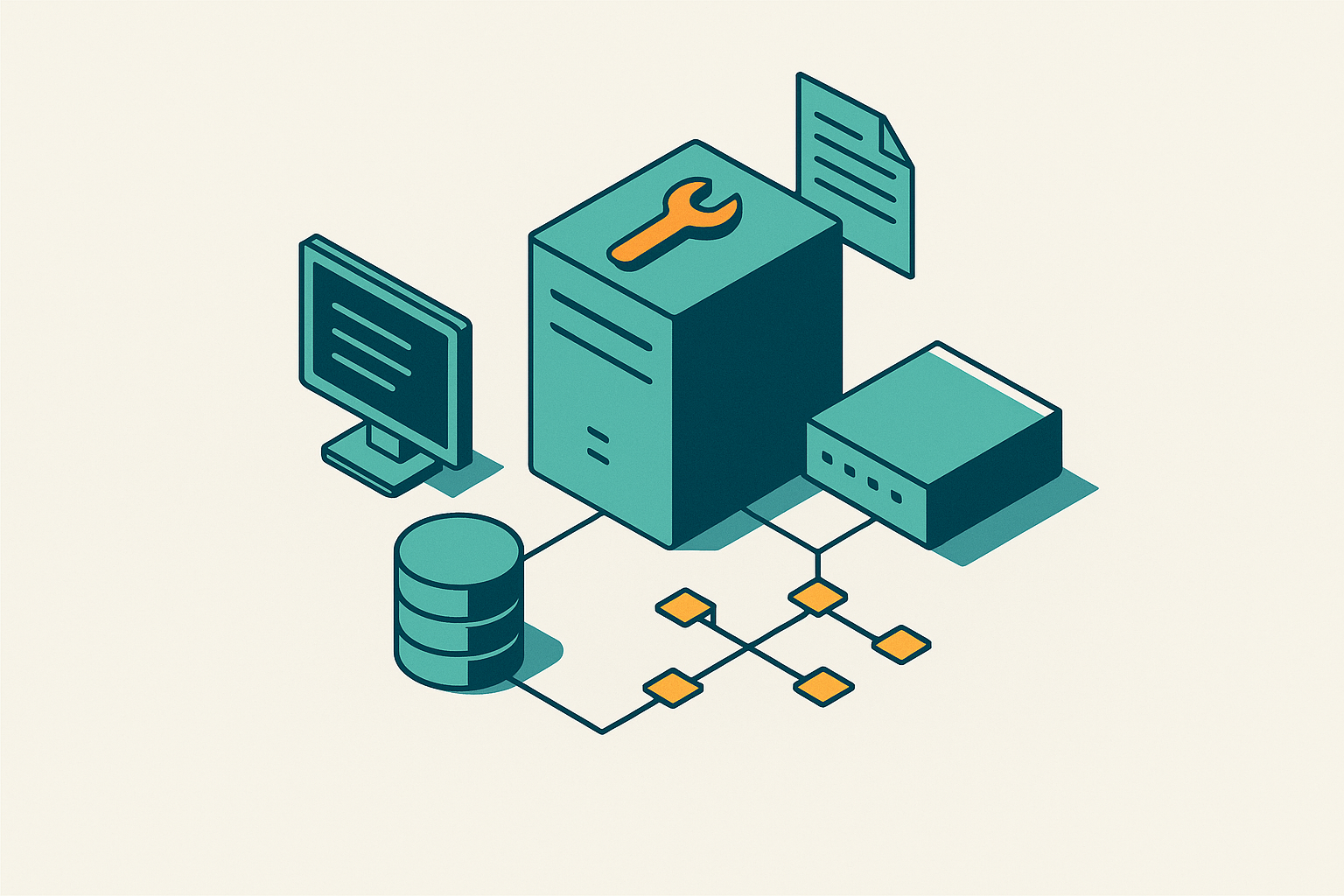
Configuration management in network OSS platforms means keeping a full, continuous record of network state across the entire service lifecycle. Most legacy platforms don't do it well, and the reasons are structural, not a matter of sloppy operators or bad luck. This piece walks through what configuration management actually covers, why fragmented tooling makes drift unavoidable, and what changes once the data model underneath gets unified.
Start with what the term spans, because people use it loosely. Network element configuration is the layer most people picture: the parameters pushed to an OLT, a router, a switch, physical or virtual. Service configuration sits above that, the logical record of what a customer ordered and how it maps onto physical resources. Inventory and topology track what exists, where it sits, how it connects. Change and version control track what changed, who changed it, what the state looked like before. FCAPS gave the industry its "C" decades ago, but that model assumed clean boundaries between management layers, and modern multi-service networks don't have those boundaries anymore. The line between configuration management and provisioning stays deliberately blurry: provisioning is the act of pushing a config, configuration management is keeping an accurate record before, during, and after that push. In an FTTH or Carrier Ethernet build, an operator has to track ONTs, OLTs, aggregation nodes, and the logical service record all at once. Not one after another. All at once.
Why configuration drift is the central failure mode legacy OSS produces
Drift is what happens when a device's actual state and the OSS's recorded state stop matching. Sounds like a bookkeeping problem, until it happens on a live network, and then it looks more like two people arguing over a house they both claim to know well, except one of them hasn't set foot inside in six months.
A field engineer logs into a device directly and makes a change the OSS never sees. Two tools touch the same config domain without talking to each other. Someone re-types order data into the EMS by hand because there's no automated path from billing to the network. A provisioning job dies halfway through, leaving a partial config with no clean answer for what state the record is actually in.
FTTH makes this concrete. Without an automated interface between ordering and billing on one side and network delivery on the other, every add, change, or disconnect gets keyed into the EMS by a person. That's daily reality at a lot of operators, and it means the order system and the OLT can drift apart every single time someone touches a keyboard. There's a second problem baked into the same setup: provisioning staff often get EMS access broad enough to touch ONT groups directly, so a routine provisioning task can misconfigure elements that have nothing to do with the order sitting in front of them. The provisioning surface and the configuration management surface end up sharing the same unguarded console.
Drift compounds. Each unrecorded change makes the next audit more expensive, slows root cause work during an outage, wears down anyone's confidence that the OSS record means anything at all. Eventually it hits the P&L: billing disputes crop up when field state doesn't match the invoice, revenue recognition gets delayed while someone reconciles two spreadsheets by hand, service problems surface only when a customer calls in angry. It's a strange way to run a network, when you think about it.
How fragmented tooling makes consistent configuration structurally impossible
The legacy pattern is familiar to anyone who's worked inside a carrier's back office: one tool for inventory, another for service provisioning, another for element management, another for change tracking, stitched together with point-to-point interfaces or, more often, a person copying data from one screen to another. Each tool keeps its own version of the truth. None of them gets designated the authoritative one. Reconciliation happens on a schedule instead of getting caught by the system itself.
Follow one service order through qualification, design, provisioning, and activation. It passes through a different system at every stage, with no shared model carrying the original intent from the moment it's captured to the moment it lands on a device. Ask something as simple as what config customer X has right now, and when it last changed, and the answer means querying three or four systems that may not agree with each other. Rollback gets genuinely dangerous here: with no shared version history, restoring a device to a prior state might directly contradict a service record updated somewhere else in the meantime.
To be fair to the engineers who built them, none of this was a design flaw when these architectures got built. OSS 1.0 and OSS 2.0 assumed hardware-bound networks that changed slowly, on human timescales, so a manual reconciliation cycle was tolerable. FTTH rollouts at scale, Carrier Ethernet turn-ups, dedicated internet provisioning move faster than that reconciliation model can absorb, and better process discipline doesn't fix it. The ceiling is structural. In a fragmented architecture, there's a hard limit on how accurately anyone can ever know the true state of the network, no matter how careful the operations team is.
What a unified data model changes about configuration management
A unified data model means qualification, design, provisioning, and activation all read from and write to the same representation of the network, instead of separate representations someone has to reconcile after the fact.
Configuration intent (what was ordered, designed, signed off on) and configuration state (what's actually running on the device) now live in the same record. Drift becomes something the system catches as it happens instead of something a weekly reconciliation job digs up after the damage is done. A design revision, a provisioning push, an activation update: each one updates the same record, so there's no separate sync step to forget or fail. Audit trails become a property of the model itself, a byproduct of how records get written rather than something layered on afterward.
Inventory benefits the same way. When inventory and service configuration live in one model, a configuration change automatically updates the resource record it depends on, no separate reconciliation pass required. For FTTH operators specifically, the custom integration they used to build and maintain between billing and network delivery becomes an internal function of the unified model, and EMS interactions get governed through the same data layer that holds service intent. Restoring a prior config state just means restoring a prior state of one model, not coordinating across three systems that each keep their own change log.
This is also the foundation that has to exist before zero-touch provisioning or AI-driven config validation can be trusted, rather than treated as something fragile bolted onto the side. Skip this step and everything built on top of it inherits the same cracks.
The governance requirement that configuration management in AI-assisted environments cannot skip
Configuration changes used to come from people. Increasingly they come from AI agents sitting inside provisioning workflows, fault response, and network optimization loops, pushing changes with no human anywhere in the immediate decision path.
Governance hasn't kept pace, and it's worth being blunt about that. Deloitte's 2026 State of AI in the Enterprise found only one in five companies has a mature model for governing autonomous AI agents. Agentic AI is showing up in provisioning and network ops faster than the frameworks meant to control it. The regulatory pressure is real and already in force: Europe's AI Act, in effect since August 2024, classifies AI systems used as safety components in critical digital infrastructure as high-risk, and telecom networks sit squarely in that category. Operators have to produce audit trails, decision logs, and clearly defined human oversight mechanisms on regulator request. Conventional monitoring falls short of that kind of evidence on its own, and it isn't a default feature of AI tools stapled onto a legacy OSS.
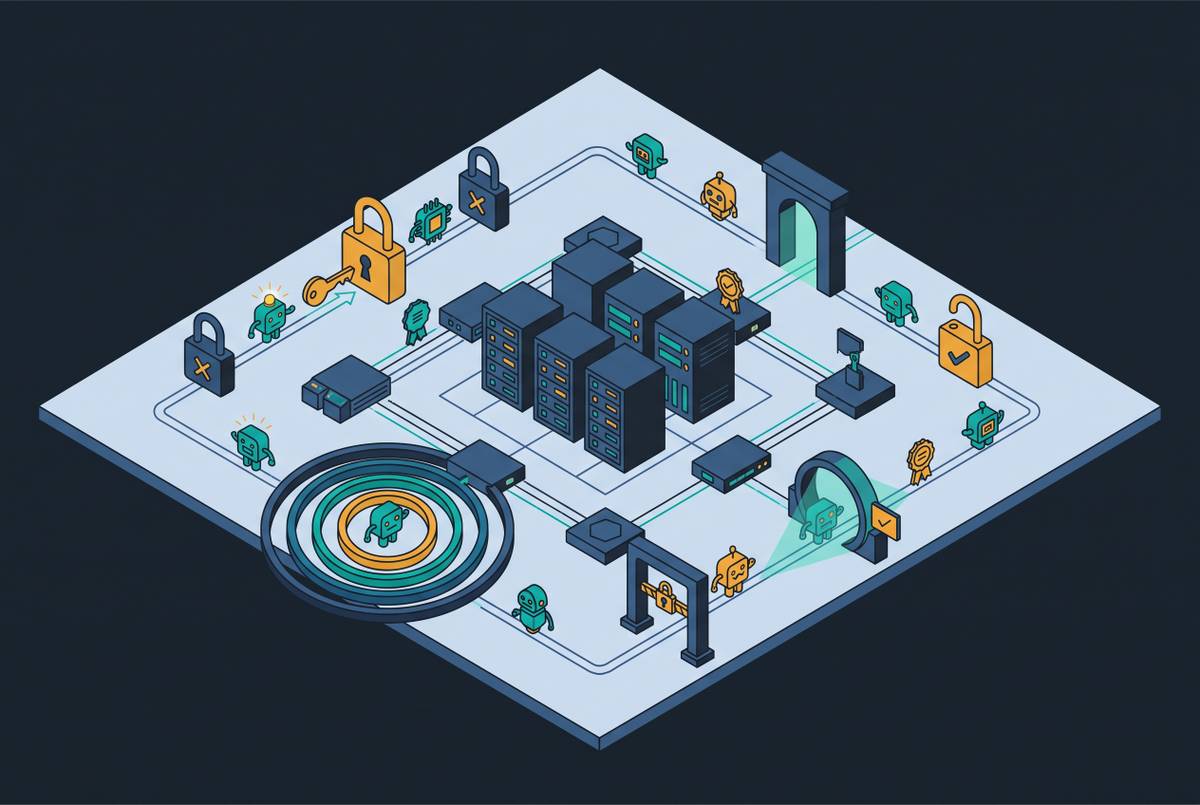
Governed AI, in practice, comes down to a few specific things. AI agents work through the same APIs and permission structures as human operators, avoiding direct device access or automation running outside the OSS entirely. Every configuration change an agent makes gets attributed, timestamped, logged in the same audit trail as a human-initiated change. Access controls, role-based or attribute-based, apply to agents exactly as strictly as they apply to people; an agent authorized to provision a residential service should have zero path to touching OLT-level parameters. A human also has to be able to override or roll back any of it, at any point, with the prior state genuinely recoverable, not recoverable in theory only.
The failure mode has a name worth knowing: shadow automation. AI tooling that writes directly to devices or skips the governed data model creates configuration state the OSS never sees. Same drift problem from earlier, just moving faster and at larger scale. Gartner's 2025 research projects that guardian agents, AI systems built specifically to govern other AI agents, will capture 10 to 15% of the agentic AI market by 2030. The industry is already treating AI-on-AI governance as a real architectural category. It's worth planning around now, not deferring to some future conference panel.
Why the execution gap between AI adoption and AI-embedded operations persists
Appetite isn't the problem. NVIDIA's 2025 State of AI in Telecommunications report found 97% of telecom executives are assessing or actively adopting AI to improve customer experience, network operations, or cost structure. About as close to universal as enterprise tech adoption gets.
Yet intent and execution have split apart. TM Forum research found that while 57% of telecom executives see cloud and AI as critical to running autonomous networks, only 19% of CSPs have actually embedded AI into more than three OSS or network functions. Call it a 38-point gap, and it reflects exactly what you'd expect when AI gets bolted on top of a fragmented OSS stack: the AI inherits the fragmentation. It can optimize inside one domain reasonably well, but it can't act reliably across a lifecycle it was never given a unified view of. An agent that can't read authoritative configuration state can't make a reliable configuration decision. Garbage in, garbage out. It's the same as it's always been, just running at machine speed now instead of human speed. Audit trails, permission enforcement, rollback, all of it gets much harder to satisfy when the AI sits as a layer above a legacy OSS rather than inside a governed model.
Appledore Research puts a number on the underinvestment: spend on next-generation OSS/BSS sits at an estimated $18.25 billion in 2025, against total telecom OPEX and CAPEX forecast at $1.68 trillion. Roughly 1% of total spend. The architectural work needed to close the adoption-to-embedding gap is badly underfunded relative to how much operators say they want AI to do for them. Deploy AI on top of fragmented tooling and you automate the wrong layer: individual workflow steps get faster while the underlying configuration data integrity problem sits exactly where it was.
What modern configuration management looks like when the architecture is right
In a properly unified OSS, configuration management stops being a module someone points to and becomes a continuous property of the platform itself. Every lifecycle action, qualification, design, provisioning, activation, produces a configuration record, and that record stays current because it's updated in place rather than synced later by someone running a batch job.
Zero-touch provisioning across PON, Active Ethernet, and Fixed Wireless only becomes trustworthy once the provisioning action reads from and writes to that same authoritative record, instead of firing off a separate EMS update that may or may not land correctly. For Carrier Ethernet and dedicated internet services, meeting an SLA means tracing bandwidth profiles, QoS parameters, and route policies from the original customer order all the way to the running device state. A reconciliation report generated after the fact struggles with that job. Only a unified model handles it reliably.
This is where AI-native configuration management pulls ahead of AI bolted on as an afterthought. Drift detection runs continuously, with agents comparing intended state against actual device state in real time instead of on a scheduled audit. When drift shows up, an agent can propose or execute a fix through the same governed API a human operator would use, so the change lands in the same auditable record everyone else's changes land in. Before a change ever gets pushed, agents can check it against the current network model and flag capacity conflicts or compliance issues at design time, a far cheaper place to catch a problem than after activation.
None of this works without the governance layer holding it together. Agents operate inside the same permission structure as human roles, so an agent provisioning a residential service simply has no path to a configuration surface it isn't authorized to touch. Every action an agent takes lands in the same audit trail as a human action, with the record showing who, or what, actually did it. A human operator can inspect, override, or roll back an AI-initiated change through the exact same interface they'd use for a manual one.
One data model spanning qualification, design, provisioning, and activation makes configuration management a natural output of the platform rather than a separate discipline someone has to enforce by hand. Every lifecycle action updates a single authoritative record, and AI agents work inside the same API, audit, and permission layer as the people they support. Operators building on this kind of foundation start treating OSS as the layer that governs how the network actually gets configured, changed, and verified, rather than a back-office system for keeping records after the fact. That's the real gap in the industry right now: operators who can deliver and assure service at modern scale, and operators still reconciling spreadsheets, one keystroke behind the network the whole time.