FTTH Service Delivery Gaps That Generic OSS Platforms Cannot Close
Generic OSS platforms lack the PON-specific topology model FTTH activation actually requires.
Fiber has passed the point where scale alone tells the story. By the end of the 2025 build season, US operators had pushed fiber past 99.7 million homes, counting multiple passings, with more than 84.6 million unique homes able to order a fiber product and roughly 35 million actually connected. That gap between "can order" and "does order" matters more than the headline passings figure. Fiber take rates averaged about 46.5% in 2024, so fewer than half the homes that can buy fiber actually do, and operators are left carrying a very expensive, under-utilized asset base.
The competitive standard has shifted accordingly. PwC's analysis finds that the build-out era is giving way to a contest where scale, contiguity, and commercialization outweigh raw trench miles. Growth increasingly comes from lower-density areas, where the margin for operational error is thinner and every delayed activation or manual handoff carries a direct financial consequence. As the industry's advantage moves from who built the most fiber to who converts and serves that fiber reliably, the operational support stack becomes a front-line differentiator rather than back-office plumbing. That pressure exposes something structural: FTTH service delivery runs on a specific chain of interdependent workflows that generic OSS platforms were never built to handle.
What FTTH service delivery requires, step by step
FTTH is not a generic broadband service dressed up in fiber-optic terminology. It runs on a sequence of technology-specific steps, and each one depends on plant data being accurate at the moment it's checked, not accurate as of the last data refresh.
The first step is address qualification: determining serviceability against live plant data rather than a static coverage map, accounting for actual fiber routes, splice points, and the capacity still available at the serving node. The second is PON-aware design, which assigns the customer to a specific PON port and calculates split ratio, signal budget, and the physical path from the OLT to the ONT, a task that demands topology awareness most generic inventory models simply don't carry. The third step, port and splitter assignment, treats splitter ports, OLT slots, and feeder and distribution fiber strands as discrete resources that must be reserved, not just logged as attributes in a database. The fourth is ONT activation itself: device-specific configuration tied to a serial number, a service profile, and a PON port assignment, which needs to flow automatically out of the design step rather than get typed in by hand a second time.
Each step produces the input the next step needs. When those four steps live in four different systems, the chain doesn't bend, it breaks, at every handoff. Compare this to a fixed-wireless or DSL activation, which may share a billing and provisioning layer with FTTH but carries none of the PON topology dependency chain; FTTH is structurally more complex at the network layer, full stop. This is the workflow a purpose-built platform has to model end to end, and it is exactly the workflow generic OSS platforms were not designed to do.
The wrong architecture generic OSS platforms arrived at for this workflow
The mismatch has a history rather than being some vague industry inertia. OSS/BSS platforms were, historically, designed as monolithic, on-premises systems built for a much simpler service environment dominated by voice and messaging. Those systems modeled the network in terms of circuits, ports, and routes, not PON topologies, split ratios, or optical power budgets, because FTTH did not exist as a service category when the dominant architectural patterns were set.
That's the root of the problem. Generic platforms treat network inventory as a reference layer, a record of what exists, rather than an active design and assignment engine, and FTTH requires the latter. According to vc4.com's analysis, most operations teams are still running OSS platforms designed for a much simpler time, relying on periodic data updates and manual checks to stay in sync, so by the time information reaches engineers it's often already stale. Plus8soft.com's research cites legacy integration complexity as the primary barrier to modernization for 64% of telecom operators, and what that figure largely describes is systems with proprietary interfaces that force every new service type, FTTH-specific resources included, through custom development work.
It is not a configuration problem, bluntly. You cannot configure a system to enforce PON split-ratio capacity limits if the underlying data model has no concept of a splitter as an assignable resource in the first place. No amount of workflow tuning fixes a data model that was never asked to represent the thing it now needs to represent.
The qualification gap: checking serviceability against a plant model that may not be current
Generic OSS qualification typically checks a serviceable-address table, a polygon or coverage zone on a map, rather than actual fiber capacity at the serving node. That distinction sounds small until it plays out in the field. A home can sit comfortably inside a coverage zone while the nearest splitter port on that feeder is fully subscribed, and the qualification system has no way of knowing it.
The result: qualification says serviceable, a truck rolls, and the technician discovers there's no port to give the customer. Vc4.com's analysis finds that older systems rely on periodic data updates and manual checks, which for outside-plant fiber means the inventory may reflect the network as it was originally built rather than as it's actually been provisioned since. GIS integration is supposed to close that gap. Linking every asset, cables, ducts, nodes, customer endpoints, to its exact physical location is what allows qualification decisions to rest on verified data instead of outdated drawings, and generic platforms don't natively maintain that linkage. Operator patterns described in AEX's research point to failed qualification handoffs as among the most common sources of delay in FTTH activations. Not an edge case. A recurring one.
The design gap: assigning PON resources without a topology-aware model
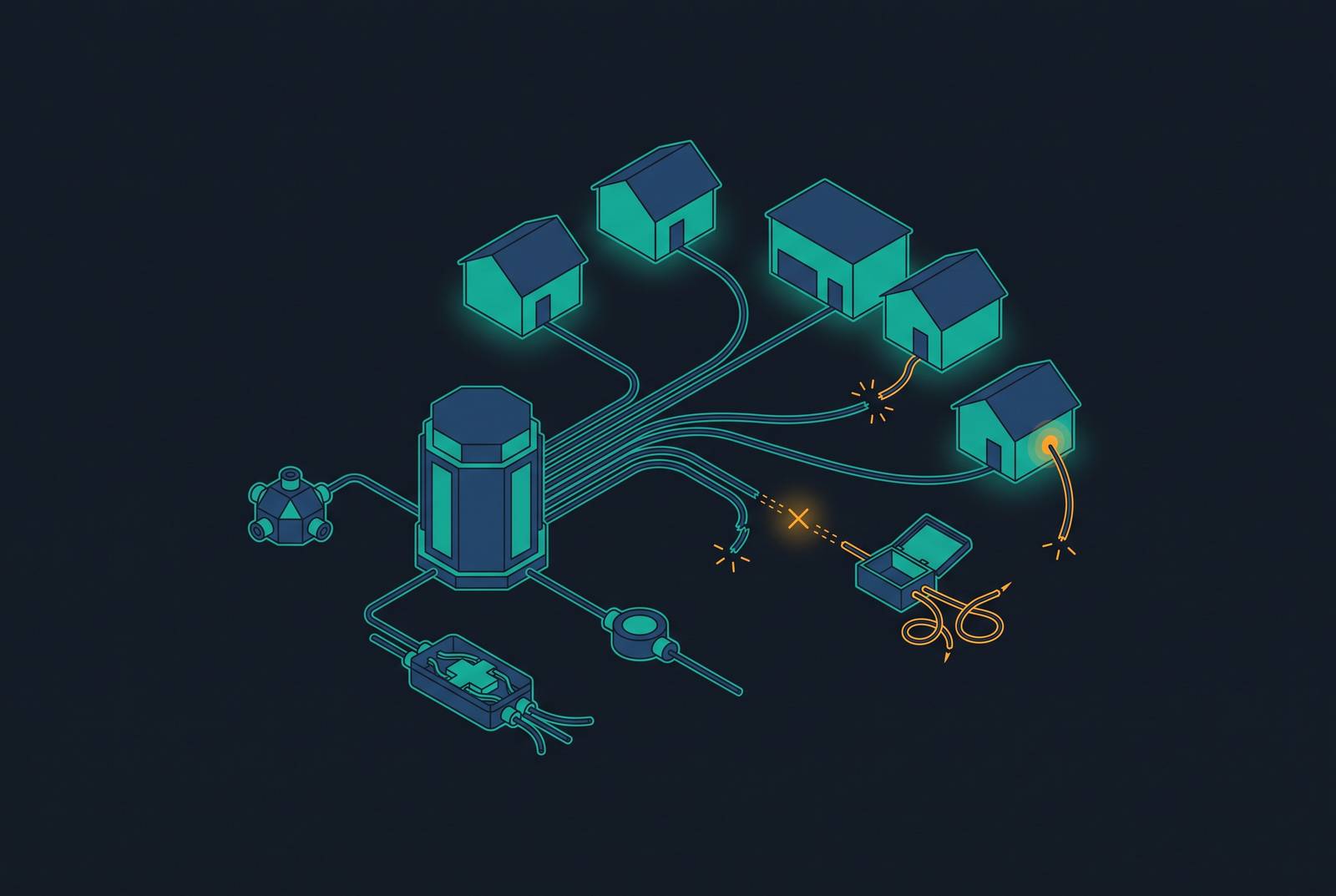
PON design asks the OSS to understand a tree structure: OLT to feeder fiber to splitter to distribution fiber to ONT drop. A generic inventory model that represents connections as simple point-to-point links has no way to hold that shape.
Split ratio is where this becomes concrete. It's a capacity constraint, not a label. A 1:32 splitter with 30 active subscribers has exactly two ports left, and a generic inventory system that stores "1:32" as a text field on a record cannot enforce that limit or tell anyone how many ports remain. Optical power budget works the same way: it has to be calculated per subscriber, from fiber length, splitter loss, and connector loss, and that calculation depends on having the topology model available, not just a service record sitting in a database. Absent that model, design turns into a manual exercise, an engineer pulling inventory reports, cross-referencing a spreadsheet for splitter capacity, doing the power budget math by hand, then typing the result into a separate provisioning system.
AEX's research puts it well: every seam between vendors is a place where something breaks and nobody owns the fix, and the design-to-provisioning handoff is one of the most common seams in the whole chain. The output of design, the specific OLT port, splitter port, fiber strand, and service profile, needs to flow directly into provisioning. Any point where that output gets re-entered by hand is an error-injection point waiting to happen.
The provisioning gap: ONT activation that depends on data the OSS never captured cleanly
ONT activation is where all the upstream data either pays off or falls apart. It requires the OLT port assignment, the PON port ID, the ONT serial number, a service profile covering bandwidth tier, VLAN, and QoS, and, for zero-touch activation, a pre-staged configuration tied to the device before it ever connects to the network.
Zero-touch provisioning has become close to mandatory for FTTH at scale. A modern platform generates a configuration profile tied to the device's serial number the moment an order is placed, and when the device connects, it downloads its settings automatically, a capability AEX's research notes extends across PON, Active Ethernet, and Fixed Wireless networks. In a fragmented stack, though, the data needed for that profile is scattered across the inventory system, the service order system, and sometimes a separate device management portal, and somebody has to manually assemble it before provisioning can even start.
The cost of that manual assembly is real and measurable in time, if not in a single tidy statistic. AEX's research shows that a service order requiring manual provisioning entry, followed by manual dispatch assignment, followed by manual billing setup, can take days because the handoffs between systems are manual. Modern OSS orchestration is supposed to make this fast: service provisioning coordinating automatically across fiber access and core layers in minutes, achievable only when design outputs are natively available to the provisioning layer rather than copied between systems by a person. Skip that native connection and the error profile becomes predictable: wrong ONT serial number, wrong service profile, wrong PON port, each one producing a failed activation and a technician sent back out to fix what should have worked the first time.
Fragmentation and systemic operational drag
None of these three gaps, qualification, design, provisioning, is fatal on its own. Together, running across disconnected tools, they compound into an activation cycle that is qualitatively longer and more expensive than what a purpose-built platform produces.
AEX's research names the resulting drag in three categories, precisely: delays, rework, and revenue leakage, and every seam between systems is a source of all three at once. Delays accumulate from manual data assembly at each handoff, tolerable at a small subscriber base but a serious financial exposure once the operation scales. Rework comes from failed activations, wrong port, wrong profile, wrong serial number, and it's the most expensive kind of error a field-intensive operation can generate, because it means sending a technician back to a job that should have closed the first time. Revenue leakage is the quietest of the three and often the most damaging: completion records requiring manual entry into billing mean activated subscribers may not get billed on time, or at the right tier, a loss that stays invisible until a reconciliation audit turns it up.
AEX's research names the leakage points specifically: provisioning data that doesn't flow cleanly into dispatch, completion records that need manual entry into billing, and network activation status sitting in a portal disconnected from customer service. And the drag doesn't scale in a straight line. At higher subscriber volumes, the number of concurrent manual handoffs grows and the error rate compounds with it, so what's manageable at a few thousand subscribers becomes destabilizing at tens of thousands. No single vendor owns the fix, either. AEX finds operators end up playing project manager between multiple support lines, which makes the integration tax an ongoing operating cost, not a one-time implementation expense.
Data model requirements for a purpose-built FTTH platform
Closing these gaps isn't a matter of adding an integration layer on top of what already exists. A purpose-built FTTH OSS needs a unified data model spanning physical inventory, logical topology, the service layer, and GIS, represented as a single model, not four separate systems stitched together by integrations.
The physical layer covers cables, ducts, splice points, splitters, OLTs, and ONTs, each carrying location, status, and capacity, with splitter ports modeled as assignable, capacity-bounded resources rather than descriptive attributes. The logical, or topology, layer represents the PON tree from OLT port to every connected ONT, including split ratios and power budgets, which is what lets the system enforce capacity limits at design time instead of discovering oversubscription only after activation fails. GIS integration, per vc4.com's Part 2 analysis, ties every asset to its exact physical location, which is what keeps planning, maintenance, and fault management grounded in verified data rather than outdated drawings, and for FTTH this isn't a nice-to-have, since plant topology is inherently spatial. None of it works as a snapshot. The inventory has to stay continuously synchronized through auto-discovery and reconciliation, because a static picture of the network cannot support qualification against live plant state.
There's an AI dimension to this too, and it's not a marketing footnote. Networkoss.com finds AI agents can do genuinely useful work, anomaly detection, predictive provisioning, capacity planning, when they're reasoning over a unified data model that stays current and consistent; point the same AI at fragmented, stale data and it produces fragmented, unreliable results. Governance follows the same logic. When AI operates on the same data model as human operators, using the same APIs and the same audit trails, its actions stay observable and accountable; add AI tooling outside the existing permission and logging framework and it creates shadow automation that neither operators nor auditors can fully see.
Criteria for evaluating whether a platform closes these gaps
The question operators should be asking isn't whether a platform "supports FTTH." Vendors will say yes to that regardless. The sharper question is whether the platform's data model has a native concept of a PON splitter port as an assignable, capacity-bounded resource, because if it doesn't, the qualification and design gaps persist no matter what other features sit on top.
Four criteria follow directly from that. Does the platform check serviceability against current plant capacity, splitter ports, OLT slots, or does it fall back on a static coverage zone? Does it calculate optical power budgets and enforce split-ratio limits at design time, or does an engineer still have to validate those manually against a separate spreadsheet? Does the design output, OLT port, splitter port, service profile, ONT serial number, flow automatically into provisioning, or does someone re-enter it by hand?
Those four questions determine how well a platform actually performs, more than any feature list a vendor puts on a slide. An operator can run a proof-of-concept, feed it a saturated splitter, and watch whether the system catches it before a truck gets dispatched or after. That single test says more about architectural fit than a year of sales calls.
Sources
- US consumer fiber shakeout or step change? 2026 outlook
- 2026 Will Demand Smarter OSS, Not Just Smarter Networks - VC4
- 2026 - Smarter OSS, Not Just Smarter Networks - Part 2
- Telecom Service Management: Closing Gaps from Interest Through Invoice
- 7 OSS/BSS Platforms for Fiber Workflow Automation
- 12/17/2025 2025 North American FTTH Deployment and Market Update
- Fiber Provisioning to Billing Gaps: Causes, Costs, and Fixes