What Breaks When AI Agents Share No State With Human Operators
Shared state between AI agents and humans is what makes oversight actually work in live networks.
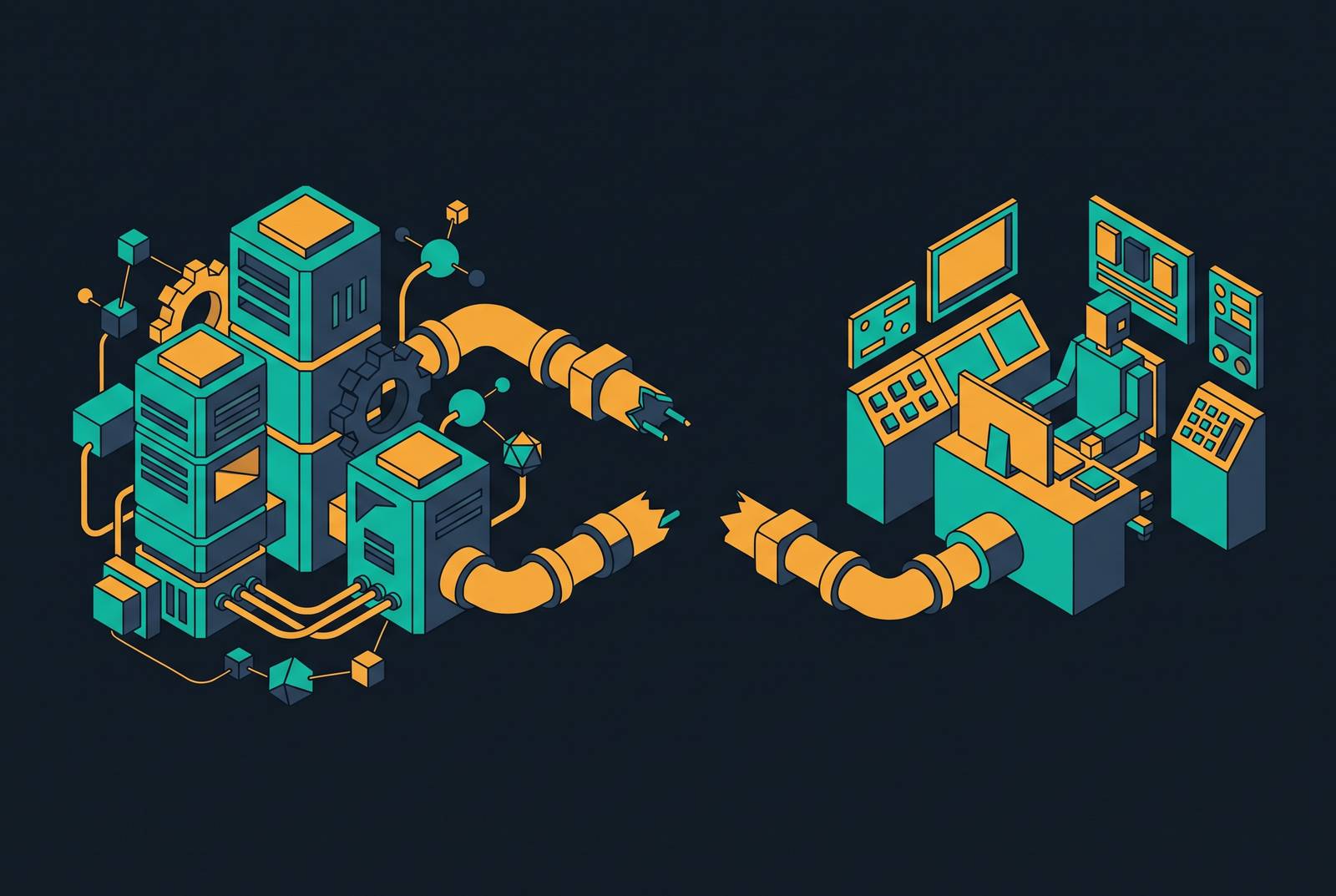
When AI agents operate without shared state (no common audit trail, no shared intent context, no unified view of what actions have been taken or why), accountability collapses, operators lose the ability to reason about network behavior, and the human-AI handoff becomes a liability rather than an advantage.
Shared state between AI agents and human operators in telecom
Agentic AI now runs alarm triage, root cause analysis, provisioning steps, and remediation actions inside live telecom networks as production infrastructure. The nominal safety model producing all of this is simple: the AI acts, and a human oversees the action. That model only holds if oversight means something real, and oversight only means something real when the human has access to what the agent did, why it did it, and what state it left the network in.
That access is what "shared state" refers to, concretely: a common audit trail, a shared intent context, a unified view of actions taken and the reasoning behind them, with agents and humans operating through the same APIs and the same permission structures. Stateless agents work differently. They execute inside their own context, log actions (when they log them at all) into a separate system, carry no intent forward into a shared record, and leave the human operator to reconstruct what happened after the fact.
That reconstruction is the failure mode this piece examines, not some abstract worry about AI risk in general. The failure modes of stateless operation are specific, they are operational, and they already appear in deployed telecom systems. Three domains take the brunt of it: accountability, remediation, and service continuity, all three collapsing in distinct ways once shared state disappears from the architecture. What follows traces each collapse in order, starting with the oversight assumption itself.
The "human oversight" assumption under real deployment pressure
Gravitee's State of AI Agent Security report, drawing on 750 executives surveyed across telecoms, financial services, healthcare, manufacturing, and travel, found that agent fleets had roughly doubled in scale since December 2025, while monitoring coverage and accountability structures barely moved in the same window State of AI Agent Security Report 2026 | Gravitee. The report's own summary states: "Organisations are becoming more comfortable with a risk they haven't actually reduced". Comfort, in this case, is closer to habituation than safety.
That habituation has a driver, and it is not mysterious. In the same survey, 81% of organizations said they feel pressure to deploy agents quickly even when the security or governance work behind them is not fully in place State of AI Agent Security Report 2026 | Gravitee. This is not a posture problem that better training or a stronger policy memo fixes. It is structural: agents accumulate decision context, tool access, and operational history faster than any accountability framework can be built to track them, so the gap between what agents do and what organizations can account for widens by default, not by exception.
A real deployment makes the shape of this concrete. One OSS vendor built an agent that took engineer intent and executed remediation autonomously against a live network, only for the client to conclude the agent was too autonomous, describing full autonomy for an operations department as "a step too far". Guardrails had to be retrofitted after the fact to put a human back into the loop. The lesson the vendor drew was that confidence in AI autonomy has to be built incrementally, before an operator hands over fully autonomous operation. Most current deployments skip that progression, because commercial pressure to show results does not wait for incremental trust-building.
Operator behavior confirms the caution is not universal, either. Research from TeckNexus across tracked telecom operators found that 54% still require a human to execute every agent-recommended action, while 42% have already crossed into genuine agent independence for routine work AI Agent for Telecom Operators. That 42% means a substantial and growing share of the industry has already removed the human execution step from workflows that, a year earlier, would have required sign-off AI Agent for Telecom Operators. Operators holding the line at human execution are not doing so because the technology cannot go further. They are doing so because a compliance breach, a billing failure, or a lost connection are consequences severe enough that caution remains the rational choice, even under commercial pressure to move faster.
Accountability requirements when an AI agent acts on a live network
Accountability is not logging. A system can log every action an agent takes and still leave nobody able to explain what the agent was authorized to do, what it actually did, what it intended to achieve, and what state it left the network in once it finished. Answering those four questions is the actual bar, and most deployed governance stacks do not clear it.
Gravitee's data shows the gap in specific terms: only 37% of organizations have purpose binding in place to limit what agents are authorized to do, only 40% have a working kill switch, and 45% have network isolation controls AI Agent Data Governance: Why Organizations Can't Stop Their Own AI. That is a 15-to-20-point gap between what organizations have invested in governance and the containment controls actually required to make that governance mean anything AI Agent Data Governance: Why Organizations Can't Stop Their Own AI. Most organizations still treat agents as extensions of a human user's login or as generic service accounts, with no distinct identity, no scoped permissions, and no individual audit trail attached to the agent itself, producing an identity problem.
The problem compounds when agents start creating and tasking other agents, a capability already present in 25.5% of deployed agents according to Gravitee State of AI Agent Security 2026 Report — When Adoption Outpaces Control. Once an agent spins up a subordinate agent to complete part of a task, the chain of command becomes nearly impossible to audit under standard approaches, because the question "who authorized this action" has no clean answer when the authorizing entity is itself an automated system with no human-equivalent accountability structure behind it State of AI Agent Security 2026 Report — When Adoption Outpaces Control. BT's position on this, as reported by BI Foresight, states the requirement: for regulated, nationally critical infrastructure, AI has to be explainable, auditable, and reversible, and a system that lacks those properties simply does not belong on a vital network.
The stakes are not abstract. An agent provisioning a service, pulling subscriber data, or adjusting a customer account is taking actions that no human representative reviewed in the moment, and when that same agent chains tool calls across provisioning, billing, customer records, and network management in sequence, the action surface shifts from a screen a person reads to a tool call that fires in milliseconds. Regulation is starting to catch up with that shift. The EU AI Act's main body took effect in August 2026, with Article 12 requiring high-risk AI systems to log actions for traceability and Article 14 requiring effective human oversight, both provisions applying to agentic AI through the Act's broad definition of AI systems even though agentic AI is not named explicitly. Colorado's AI Act, effective June 30, 2026, requires impact assessments and disclosure whenever AI makes a consequential decision. Singapore's IMDA moved further still, launching in January 2026 the first governance framework written specifically for autonomous AI agents, a signal that the existing regulatory stack, built for AI systems that recommend rather than act, does not reach agents that act on their own.
The point where oversight collapses first when agent state is not shared
Picture the ordinary NOC operator's position when an alert fires after an agent has already acted on the network. The first question that operator asks is always the same: what has already been tried? Without shared state, answering that question means interrogating a separate system, piecing together a timeline from disconnected logs, or in the worst case, simply not knowing.
That gap is not a UX inconvenience to be smoothed over with a better dashboard. It means the operator cannot safely issue a second remediation action, because doing so risks conflicting with whatever the agent already did or is still in the middle of doing. Without a shared view of intent, a human operator and an agent can end up diagnosing the same fault independently and pushing conflicting changes at the same time. PwC's dual-track telecom transformation model names this directly: duplicated diagnostic logic drives inconsistent decisions, and automation tends to outpace human oversight precisely during outages, which is exactly the moment oversight matters most.
Ericsson's own agent-fabric analysis from June 2026 says the same thing from the vendor side of the table. Without a shared control plane, multi-agent arrangements duplicate work, conflict on actions, and leave the operator to stitch coordination together by hand. That stitching is the mechanism by which the handoff between human and agent, the very thing meant to function as a safety valve, turns into a liability. A stateless agent that escalates a situation outside its confidence threshold hands the human only the current symptom, not the reasoning history behind it, so the human inherits a network state they did not create and cannot fully read.
How siloed agent state breaks remediation workflows specifically
Remediation in network operations is sequential by nature: diagnose, act, verify, then confirm or roll back. Each step depends entirely on knowing what the previous step actually produced. When an agent executes a remediation step on its own and that action never lands in the shared operational view, the verify step breaks outright, because the human operator has no way to confirm whether the action succeeded, partially succeeded, or is still running.
Rollback is where this gets expensive. Without a shared audit trail recording what the agent changed and in what order, reversing a failed remediation means reconstructing the sequence from scattered logs, an exercise that is slow and error-prone under normal conditions and considerably worse during an active outage.
A subtler failure accompanies the mechanical one. An agent can execute the technically correct action against the wrong intent entirely, restoring a service that was intentionally suspended for non-payment, for instance, because it has no access to the human operator's current business context or the reasoning that shaped that context. Tietoevry's 2026 telecom trends analysis frames the fix directly: moving from insight to action without risking network stability requires an intent-based orchestration layer, a deterministic, model-driven framework that keeps automation predictable, auditable, and aligned with operational intent even as the system's flexibility grows. A peer-reviewed paper published in MDPI proposes an Agent Governance Framework built on smart-contract enforcement, constraining autonomous actions according to predefined operational intent. Even inside academic research, the answer to remediation accountability is binding intent to action up front, not logging the action after it has already happened.
The effect of stateless operation on service continuity across FTTH and Carrier Ethernet workflows
Fiber operators already run on fragmented ground before any agent enters the picture. Provisioning sits in one tool, dispatch in another, billing in a third, and every customer interaction requires someone copying data between systems or reconstructing after the fact what actually happened in the field. An AI agent dropped into that environment without shared state does not fix the fragmentation. It adds to it, becoming a fourth silo, and one that is harder to interrogate than a human's actions because it moves faster and leaves behind no natural-language record of what it did or why.
Systems on either side of the billing and network boundary that cannot communicate already produce non-payment shutoff errors and provisioning mistakes on their own. Add an agent acting on the network side without visibility into billing context, or vice versa, and the error surface widens rather than shrinks, so automation meant to eliminate manual mistakes ends up introducing a new category of automated inconsistency instead. Carrier Ethernet and dedicated internet raise the stakes further, because service-level commitments are explicit and contractual. An agent that modifies a bandwidth profile or reconfigures a service path, without that change becoming visible to the team responsible for SLA compliance, opens a gap between what the network is actually doing and what the operator has promised the customer in writing.
Service continuity depends on every actor, human or agent, working against the same current state of the service lifecycle. Qualification, design, provisioning, and activation are not meant to function as discrete handoffs; they are supposed to form one continuous record. An agent that updates provisioning without that update propagating into the unified service record breaks the continuity of that record at the exact point where continuity matters most. The OSS-BSS handoff is already where revenue leakage starts for fiber operators, and a stateless agent acting across that boundary without shared context makes the handoff invisible and, by extension, unauditable.
The agent bus choice and its role in hardwiring or preventing shared state at the architectural level
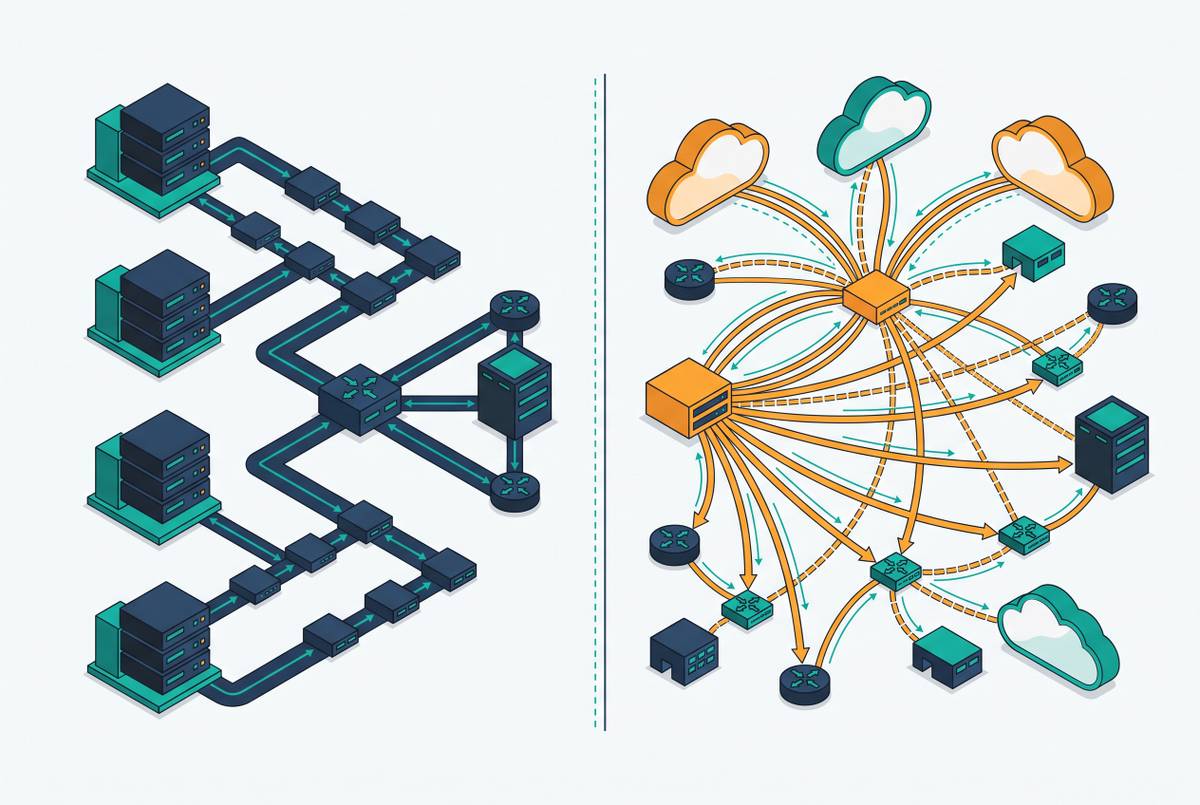
Analysis from Telecoms Tech News published in September 2026 makes the point that the real risk in current telecom AI deployment is not which foundation model sits underneath the agent. Operators can swap models relatively cheaply. What they cannot swap cheaply registers agents, routes intent, holds the ontology, enforces guardrails, and decides which agent gets to touch the live network. That layer, the agent bus or agent fabric, is where shared state either lives or simply does not exist.
The multi-vendor landscape illustrates why this matters in practice. Nokia's Gemini-backed Agent Library, Samsung's Agent Fabric inside CognitiV NOS, Amdocs aOS with its Cognitive Core, and Ericsson's cApps on EIAP each run a different agent registry and a different policy model. That same analysis found that Nokia's router agent does not discover Samsung's fabric agents, and Amdocs' Cognitive Core agents do not register cleanly on Ericsson's EIAP, which leaves the operator functioning as the integration factory stitching these systems together. Ericsson's own writing on its agent fabric admits the consequence from the inside: without a shared control plane, multi-vendor agents duplicate work, conflict on actions, and leave the operator to stitch coordination together by hand.
The cost of this compounds over time rather than staying flat. Agent libraries sit above the network stack and accumulate decision context as they run, so switching the underlying bus later means migrating institutional memory, not just swapping interfaces. The longer a stateless or siloed architecture stays in production, the more expensive that eventual migration becomes. Operators standardizing on a single agent bus in 2026 are, in effect, walking into the same unwind cost in the 2030s that defined the previous generation's lock-in around inventory, assurance, and order-management systems.
Interoperability frameworks aimed at breaking this pattern do exist. A2A-T, OpenAN runtimes, Trusted Data Gateways, and TM Forum High-Value Scenario bindings were demonstrated live at DTW Ignite in June 2026, and the sources treat them as genuine, serious attempts at a fix. None of them had reached broad production deployment across the industry as of September 2026, though, and that gap between working framework and production reality is exactly where stateless operation continues to spread.
What governed, shared-state architecture requires in practice
Shared state is not a dashboard bolted on top of a fleet of agents after the fact. It is a property of the architecture itself: agents and humans operating against the same data model, through the same APIs, inside the same permission structure, generating the same audit records as a byproduct of normal operation rather than as an afterthought. Ericsson's agent fabric framing from June 2026 names the specific capabilities this requires: discovery, governance, communication, routing, and observability of agents, with observability defined explicitly as the mechanism that prevents unsafe or unauthorized actions and enables debugging, reliability assessment, and confidence evaluation.
Human-in-the-loop review is dependent on all of this. A human who approves an agent's action without seeing the agent's intent context, the data it acted on, and the permission scope it operated within is not exercising oversight in any meaningful sense. That human is rubber-stamping a decision they cannot actually evaluate.
McKinsey's framing, cited via HCLTech's telecom trends coverage, states the design requirement directly: guardrails for agentic AI are not generic, they have to be use-case specific, data-governed, and system-contained. A blanket permission model or a generic audit log applied uniformly across every agent in a fleet does not satisfy that requirement, no matter how comprehensive it looks on paper. For telecom specifically, this has to extend across every domain an agent touches: an agent acting on provisioning needs to carry the same intent context as the order management record, an agent acting on network configuration needs to be visible to the assurance function, and the service lifecycle from qualification through activation needs to exist as a single auditable record rather than a chain of handoffs each agent treats as its own private transaction.
That leaves a fairly simple test any operator can apply to any agent, at any point in its execution: can someone answer what this agent was authorized to do, what it actually did, what it intended to achieve, and what state it left the network in, without leaving the primary operational view to go find the answer? Where the answer is no, shared state does not exist yet, no matter how sophisticated the agent's underlying model happens to be. The MDPI AGF paper adds the enforcement layer: smart contracts that constrain autonomous actions according to predefined operational intent, built on ETSI and TM Forum principles, delivering "verifiable accountability through traceable autonomous decisions".