What is FTTH? | Networking Operations
Fiber-to-the-home networks depend on passive architecture and careful operational planning.
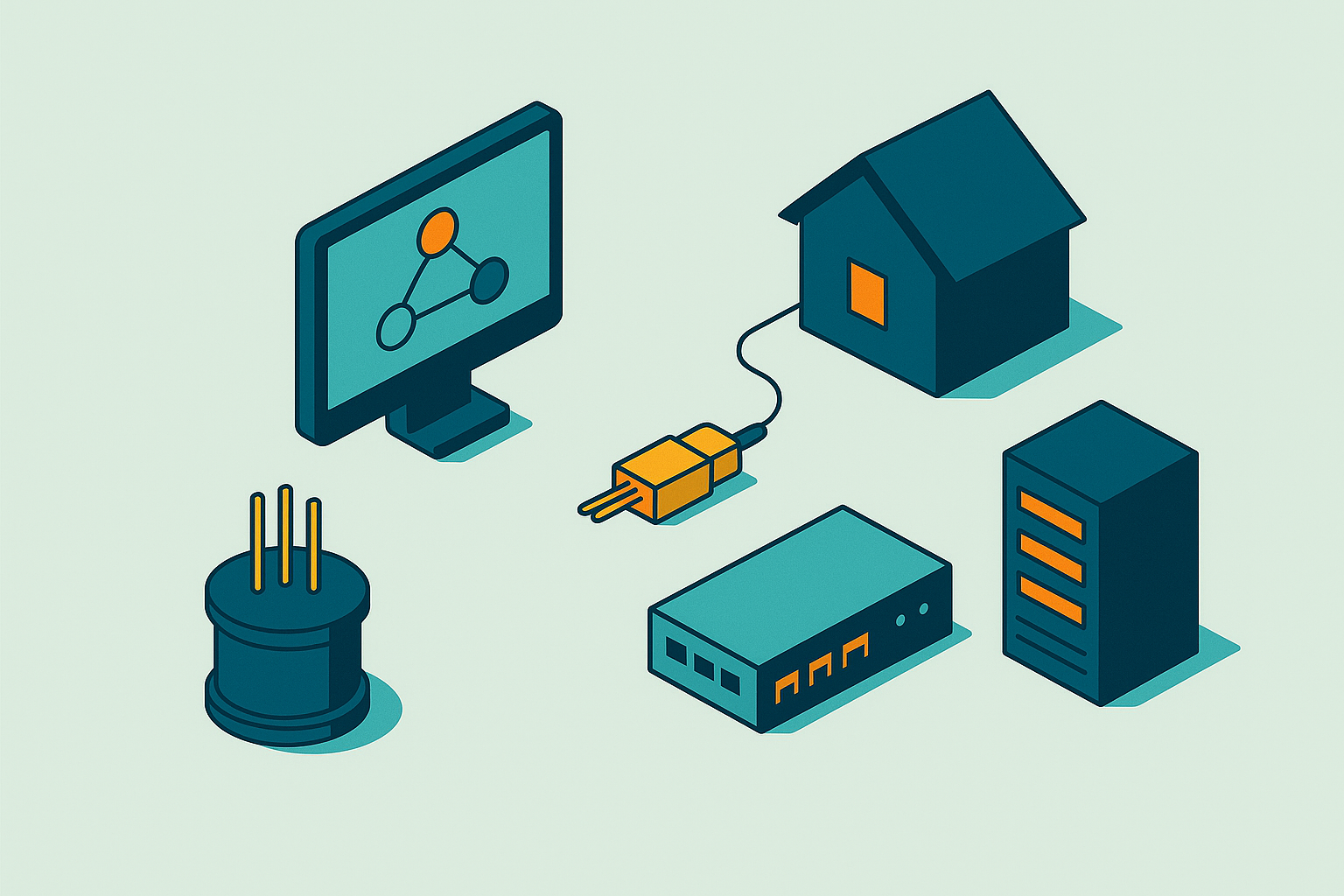
At the center of virtually every FTTH deployment is a passive optical network. The OLT, housed at the service provider's central office or headend, generates optical signals and manages downstream traffic. A passive optical distribution network, constructed from fiber and unpowered optical splitters, carries those signals to the premises. The ONT at the customer location terminates the optical connection and presents Ethernet or telephone interfaces to the subscriber's equipment. No powered active equipment sits between the OLT and the ONT. That design decision has enormous downstream consequences.
The passive architecture's dominance isn't an accident of market preference. Fewer powered nodes mean fewer failure points, lower maintenance burden, and no dependency on field power infrastructure between the central office and the premises. Active optical networks offer dedicated bandwidth per subscriber, but require powered equipment at intermediate points, introducing maintenance complexity and failure modes that scale poorly across a large access plant. Anyone who has managed a medium-sized HFC network through a bad winter knows precisely what powered field equipment costs to maintain when ambient conditions stop cooperating. For most operators, the passive architecture isn't a compromise; it's the correct engineering conclusion, reached through direct experience with what active intermediate infrastructure actually costs over a ten-year horizon.
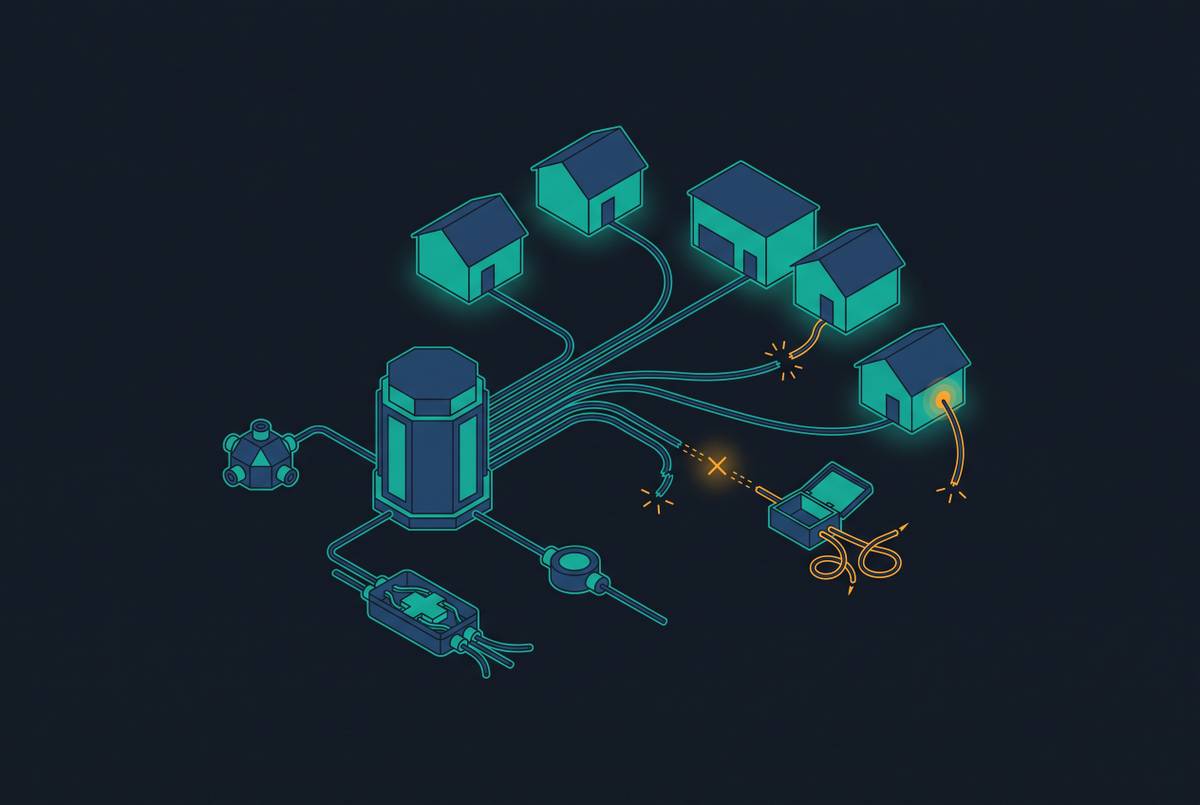
Within PON deployments, four distinct physical architectures define the design space. The home run configuration dedicates a fiber strand per subscriber from the OLT to the ONT, delivering maximum bandwidth isolation at maximum cost. Centralized split consolidates the optical splitting function close to the OLT, simplifying the outside plant but concentrating capacity planning decisions. Distributed split pushes the splitting function deeper into the network, closer to subscribers, reducing feeder fiber requirements while distributing inventory management complexity across more nodes. The optical tap architecture, sometimes called fiber-lean, minimizes upfront outside plant investment but constrains future capacity expansion, sometimes severely. Each choice locks in a different operational profile. An operator selecting between them isn't only choosing a network topology; it's choosing the shape of its inventory data, the nature of its capacity planning problems, and the degree to which future upgrades require physical intervention in the field.
The standards trajectory adds a temporal dimension to these choices. GPON, offering 2.5 gigabits per second downstream, currently dominates installed deployments. XGS-PON, providing 10 gigabits symmetrically, represents the near-term upgrade path most operators are actively designing toward. 50G-PON is entering the component market now, establishing the horizon beyond that. Whether a future capacity upgrade requires a forklift replacement of outside plant or a software and transceiver change at the OLT depends almost entirely on the architectural decisions made at the time of initial deployment. This is a planning decision with a decade-long tail, and it's also, fundamentally, an OSS decision. Different split ratios, node configurations, and equipment generations generate different inventory structures and topology representations that the operator must track and reconcile throughout the network's life. The operators who treat that data burden as a secondary consideration during network design are the ones who encounter it later as a primary operational problem.
The Scale of FTTH Investment Underway and What It Means for Operators Building Now
The investment committed to FTTH globally isn't speculative; it's obligated. Approximately 40 percent of the global population is projected to have fixed FTTH connections by 2026. Western Europe has committed an estimated $270 billion in fiber infrastructure investment through 2025. The United States is projected to deploy roughly $150 billion in fiber infrastructure between 2024 and 2029.
The U.S. context deserves specific attention. The BEAD program allocates $42.45 billion of the Infrastructure Act's $65.8 billion broadband commitment, making it the largest federal broadband investment in the country's history. States are expected to obligate the majority of those funds by late 2025, with peak physical construction concentrated in 2026 and 2027. These aren't soft milestones. They are policy-driven deadlines tied to grant disbursement schedules. Operators who miss them don't get extensions; they lose funding.
2026 is the inflection point. Programs that have been announced, designed, and funded convert into physical construction at scale in that window. The build itself can be accelerated with capital and labor. The ability to qualify, design, provision, and activate at commensurate speed requires operational infrastructure that takes real time to build correctly, and that time is already running short. There's no version of this problem where the OSS gets built after the construction crews finish.
Cable operators face a distinct variant of this decision. The choice between upgrading to DOCSIS 4.0, migrating fully to FTTH over PON, or running a hybrid platform isn't purely technical. Each path carries its own operational overhead, its own inventory model, its own provisioning architecture. The operational systems built around one architecture don't translate cleanly to another, and the compounding cost of that mismatch becomes more expensive with every year it persists.
The Service Delivery Chain FTTH Requires — Qualification, Design, Provisioning, and Activation
Serving a subscriber on FTTH is a sequence of dependent stages, each of which relies on accurate output from the one before it. The chain begins with qualification, determining whether a given address can be served, at what tier, and through which physical path. It continues with design, where the circuit is defined, resources are assigned, and the engineering record is established. Provisioning configures the network elements, the OLT, the ONT, and any intermediate devices, to deliver the service as designed. Activation completes the sequence, bringing the service live for the subscriber.
The dependency structure is unforgiving. A qualification error, an incorrect serviceable address record, a stale outside plant record, propagates forward into a flawed design. The flawed design propagates into a provisioning attempt that fails or produces a misconfigured service. There is a particular operational pattern, familiar to anyone who has managed a high-volume activation queue, where a single stale record in the address database causes the same provisioning attempt to fail repeatedly across multiple work orders before anyone identifies the root cause. By then, a field crew has already rolled, a subscriber has already called, and a supervisor is already explaining to someone why the activation window was missed. That sequence, repeated at scale, isn't a workflow problem. It's a data architecture problem.
Zero-touch provisioning is the operational goal most operators articulate, and it's achievable. Activating, suspending, resuming, modifying bandwidth, and deleting services without manual touchpoints or truck rolls is a concrete operational capability. Vendors offering ONTs with zero-touch provisioning identify truck roll elimination for service changes as a measurable operational gain. That gain is real, but it depends entirely on the provisioning system having accurate, current network data to act on.
Flow-through activation across GPON, XGS-PON, and TR-069 device types is now a baseline expectation in the operator market. A production network is never homogeneous. Hardware generations coexist; vendors differ; device capabilities vary. The provisioning layer must abstract across that heterogeneity without requiring manual intervention for each equipment variant. Pluggable OLT abstraction illustrates the architectural pattern: heterogeneous PON and switching hardware is presented to the OSS layer as a single logical OLT, decoupling the provisioning interface from the physical equipment underneath it and avoiding vendor lock-in at the point where configuration commands are issued.
The provisioning system that can't see the design record, or the qualification record that no longer reflects the current outside plant, breaks the chain at the exact moment a subscriber is waiting for service.
Why Fragmented Tooling Turns FTTH's Operational Chain Into a Liability
Fiber operators commonly run separate systems for billing, provisioning, network management, field service, and customer support. Each boundary between those systems is a place where data goes stale, gets lost, or requires manual intervention to reconcile. At the scale of an FTTH build, this isn't a minor inefficiency; it's a structural liability that compounds with every subscriber added.
The OSS/BSS divide is the foundational version of the problem. The operations support system owns network inventory, fault management, and performance data. The business support system owns customer orders, billing records, and service assurance workflows. A fault detected in the OSS may not surface in the BSS until a customer calls. A provisioning change initiated in the BSS may require a manual OSS update to keep the network record accurate. Neither failure is exotic; both are routine in environments where the two domains are loosely coupled, and both erode the operator's ability to deliver service reliably at pace.
The cost accumulates in time and labor. From customer order to network activation, every manual handoff adds elapsed time, introduces error risk, and consumes workforce capacity that could otherwise support additional activations. At the scale that BEAD-era construction demands, the throughput constraint imposed by manual reconciliation steps isn't a manageable inefficiency; it's a ceiling on how many subscribers an operator can activate per day. Construction crews don't slow down because the OSS is backed up.
Wholesale and open-access operators face a compounded version of this. Running multiple ISPs across shared infrastructure requires automated wholesale billing, revenue assurance, and service management across providers. Each additional layer of organizational separation amplifies the cost of data inconsistency.
The fragmentation has historical roots. Legacy OSS platforms were built hardware-tethered and batch-driven, designed for a service environment that changed more slowly and carried far less operational surface area than a modern FTTH deployment demands. The architecture reflected its era. The problem is that many operators are still running it, against a build schedule that was designed for neither the era nor the architecture. That gap doesn't close by itself.
What a Unified Data Model Across the FTTH Lifecycle Actually Changes
A unified data model means that qualification, design, provisioning, and activation all read from and write to the same representation of the network. There's no translation layer generating errors between stages. There's no reconciliation job running overnight to align two systems that drifted apart. There's no stale copy of an inventory record informing a provisioning decision that will fail in the field.
The practical effect on exception handling is concrete. When a provisioning step fails, the cause is visible in the same system that holds the design intent and the qualification record. An operator doesn't have to correlate across three platforms to determine whether the failure originated in a bad address record, a resource assignment conflict, or a device configuration error. The fault is attributed, the record is corrected, the workflow resumes. That sequence, which can require hours of manual investigation in a fragmented environment, becomes minutes in a unified one. This isn't a theoretical improvement; it's a reduction in mean time to resolution that is measurable in any production activation queue.
Federation of inventories and a unified topological view are central to modern OSS frameworks precisely because they eliminate the replication problem at its source. As the physical plant changes, the network representation updates once, and every system that depends on it reads current data. TM Forum's Open Digital Architecture and Shared Information/Data model provide the standards framework for this approach, enabling standardized orchestration and zero-touch provisioning for both residential and business products.
For operators scaling quickly under BEAD timelines, the difference between a unified model and a fragmented one isn't a matter of degree. It's the difference between activating hundreds of subscribers per day and being bottlenecked at the provisioning queue while physical construction continues ahead of the operational system's capacity to absorb it.
Where AI Fits Into FTTH Operations, and What Governed AI Actually Requires
According to NVIDIA's Annual Telecom AI Study, 97 percent of telecom organizations were assessing or adopting AI in 2025, up from 90 percent in 2024. Adoption is nearly universal. What "adopting AI" means in practice varies enormously, and the variance matters far more than the adoption rate.
In network operations, AI's useful functions are specific — reading alarm streams and filtering noise from signal, identifying traffic anomalies before they become outages, predicting failure modes from performance trend data, surfacing likely fault causes before a technician begins manual investigation. These are OSS functions, not general IT automation. They operate on operational data, and their value is bounded by the quality of that data. An AI model predicting network failures from incomplete or inconsistent inventory data will produce predictions that reflect the incompleteness and inconsistency, not the underlying network reality. The model doesn't know what it doesn't know; it works with what it's given.
The distinction between AI-augmented and AI-native operations is consequential. Attaching an AI tool to a fragmented legacy OSS doesn't resolve the underlying data problems; it inherits them. The data architecture is a prerequisite, not a parallel track, and no amount of model sophistication compensates for a fundamentally compromised data foundation.
Governed AI means AI agents operate within the same API surface, audit logs, and permission structures as human operators. It's not a separate automation layer running outside the governance framework; it's automation that is attributable, reversible, and observable by the same mechanisms that govern human action on the network. That definition isn't aspirational. It's the minimum viable posture for AI operating in a provisioning workflow.
The regulatory dimension is concrete and imminent. The EU AI Act (Regulation 2024/1689) categorizes AI managing critical telecommunications infrastructure as likely high-risk under Annex III, requiring risk management systems, human oversight mechanisms, decision logging, and technical robustness. Operators deploying AI in provisioning and activation workflows need to design for compliance now, not as a retrofit after deployment. Retrofitting governance onto an ungoverned automation layer is expensive; in some cases it requires rebuilding the system rather than modifying it.
The security dimension is equally concrete. O-RAN Working Group 11 has identified the "Output Integrity Attack" as a high-impact threat category, where adversarial manipulation of AI and machine learning model outputs forces incorrect network decisions. The same working group notes that current governance specifications leave open what to monitor, how to evaluate output safety, and how to log decisions for audit. These are open problems, not solved ones. Every AI action in a provisioning or activation workflow that isn't logged and attributable is a gap in the audit trail an operator may be required to produce.
What FTTH Operations Look Like When the Architecture Is Built Right
The goal is a service delivery chain where each stage, from qualification through activation, runs on accurate, shared data; where exceptions surface immediately in a system that also holds their context; and where AI assists within a framework that is auditable, governed, and aligned with the regulatory environment operators now face.
Zero-touch activation, bandwidth modification without truck rolls, and flow-through provisioning across heterogeneous hardware are achievable. They follow from getting the data model and integration architecture right, not from any single tool or vendor. The technology to accomplish them exists today. The question is whether operators have built the operational foundation on which those capabilities can actually function at production scale.
Operators who treat OSS as back-office plumbing rather than the operational platform that FTTH service delivery runs on will find that their physical network buildout outpaces their ability to activate and manage what they've built. That gap can't be closed by adding staff. It requires architectural correction, which takes time, and the 2026 build wave will not pause to accommodate it.
FTTH's defining characteristic, fiber all the way to the premises with no copper fallback, is also a precise description of the operational commitment it requires. The operators doing large-scale activations in 2026 and 2027 will be running on whatever architecture they have today or are building now. There's no simplified version of the service delivery chain. There's a well-built one, and there's a fragmented one, and the scale of investment underway globally presupposes the former.