Intent-Based Automation in Network Provisioning
Automation that executes commands fails silently; systems that verify outcomes stay compliant.
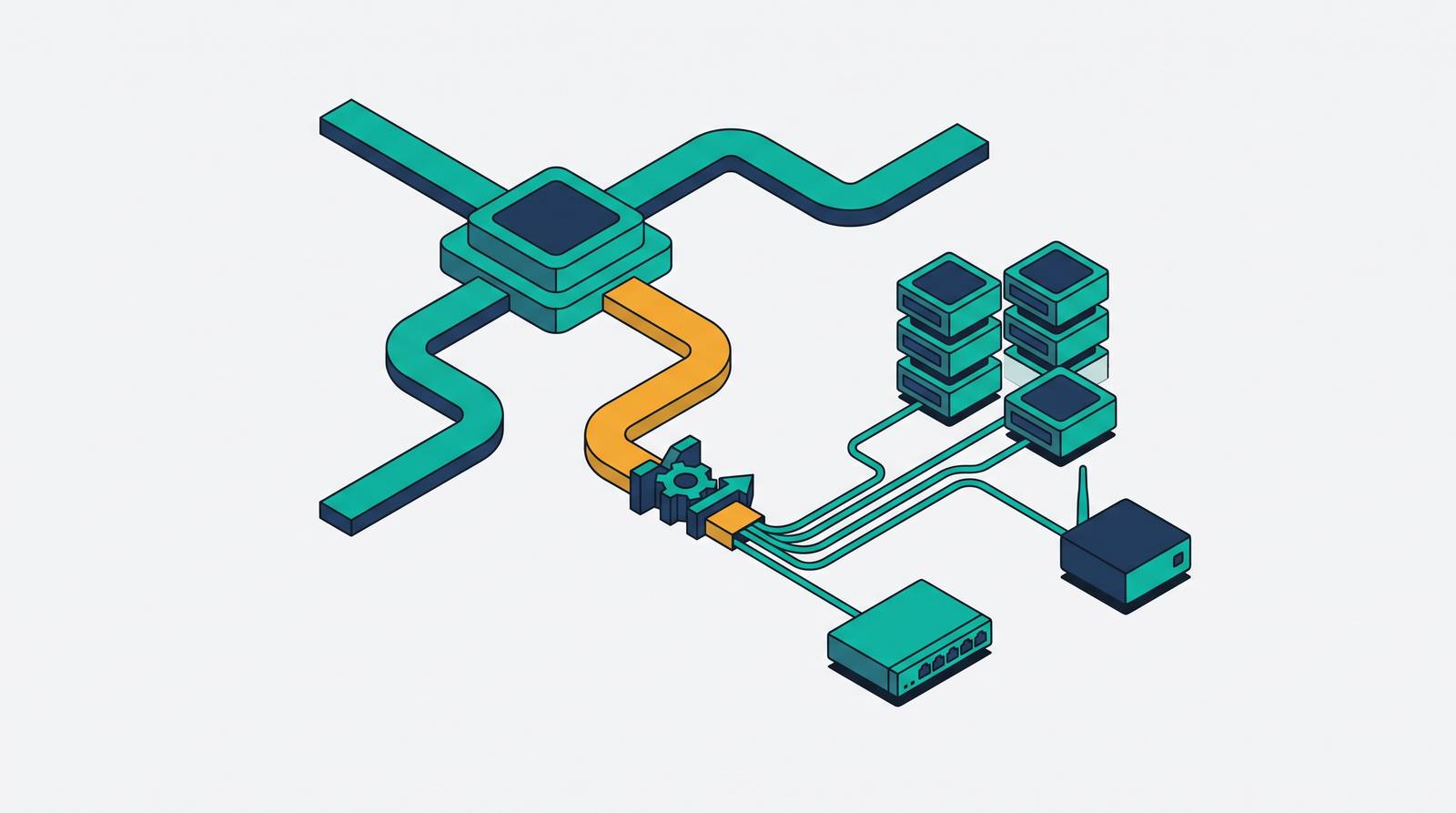
The distinction that matters isn't between manual and automated. It's between automation that executes instructions and automation that pursues outcomes.
Legacy provisioning automation works by pushing scripted commands at devices, tightly coupled to specific vendor configurations, specific firmware versions, specific topology states. When any of those conditions change (a vendor updates firmware, a topology shifts, an edge case surfaces that the script's author never anticipated) the automation fails. More precisely, it fails without knowing it has failed, because it never held a model of what success looked like. It only knew what it was told to do.
Intent-based networking inverts this. Operators declare desired outcomes: guarantee 50 Mbps throughput and sub-10ms latency for all Gold-tier subscribers in a given building, or activate a business Ethernet service meeting a defined bandwidth profile and performance objective. The system determines how to achieve those outcomes across whatever network conditions actually exist, then keeps watching to confirm they're being met. The declaration is the authoritative reference; every subsequent action is evaluated against it.
The architectural model that formalizes this has three layers. The Business Layer is where stakeholders express intent in operational terms tied to service agreements and commercial commitments. The Intent Layer translates those expressions into policy and orchestration logic. The Network Layer executes against that logic and continuously validates the result against the original declared outcome. That last activity, intent assurance, is as important as intent fulfillment. Provisioning once isn't enough. The system must confirm, across the full service lifecycle, that the network remains in compliance with what was declared.
This architecture sits at the natural end of a progression the industry has been building toward for over a decade. Software-defined networking centralized control, separating it from the physical hardware executing it. Zero-touch provisioning extended automation to the device layer. Intent-based automation applies AI and policy reasoning to the layer above both, adjusting behavior when conditions drift without waiting for a human to identify the gap and write a new script.
In a carrier OSS context, this model requires three components working in concert: an orchestrator handling service activation, workflow sequencing, and testing; an assurance system connected to live network inventory providing closed-loop feedback on whether declared intent is being met; and a policy manager defining the rules that govern orchestrator behavior when conditions vary. These three components must operate against the same data model. When they don't, the intent declared at order entry doesn't survive contact with execution.
How FTTH, Dedicated Internet, and Carrier Ethernet Each Expose Intent-Based Provisioning's Requirements
Each major service type makes a different demand on an intent-based provisioning architecture, and each one exposes a different failure mode in systems that lack one.
FTTH
Fiber-to-the-home activation spans multiple ONT vendors across both GPON and XGS-PON technologies, each with distinct integration requirements. Flow-through activation across voice, video, and data services is the stated goal in virtually every FTTH deployment, but each vendor integration is typically custom-built and fragile. The Intraway and BISDN zero-touch provisioning work for XGS-PON shows what standards-based multi-vendor automation can accomplish when integration is built against a common model rather than a vendor-specific one: commissioning complexity decreases when the provisioning logic doesn't have to be rebuilt for each ONT variant.
The core FTTH provisioning actions are discrete and well-defined: activate, suspend, resume, modify bandwidth, delete. That definiteness is an advantage for intent translation, because each action maps cleanly to a declared state. The structural problem is that without a shared data model, each action executes against a different system of record. Activation queries one database, bandwidth modification queries another, and the assurance layer (if it exists at all) has no authoritative reference to check against. Where does the original intent live? Nowhere, really. Certainly not as a persistent object that any downstream system can interrogate.
Carrier Ethernet
MEF 3.0 Carrier Ethernet defines service attributes, bandwidth profiles, QoS parameters, and performance objectives with considerable precision. That standardization is exactly what makes CE services amenable to intent-based management. The intent can be expressed in certified, interoperable terms because the industry has already done the hard work of defining what a CE service is supposed to mean.
The gap is between that standardized definition layer and the OSS that executes against it. A CE service definition in MEF terms is an intent. The question is whether the OSS can ingest that definition as the authoritative object and provision against it directly, or whether a human has to translate it into a series of configuration commands that carry none of the original semantic content. In practice, that translation step is where the semantic content dies. It doesn't erode gradually; it's gone the moment someone converts a structured service definition into a ticket.
Dedicated Internet and NaaS
The Mplify Alliance, the industry body formerly known as MEF before its renaming in June 2025, published its 2025 NaaS Blueprint and MEF 140 Broadband standard to enable automated buying, selling, and management of wholesale broadband access. More than 165 service providers are engaged in adoption. This is intent-based ordering becoming industry-level infrastructure: a standardized framework in which a service request carries its performance requirements, pricing parameters, and fulfillment obligations as structured data that systems can act on without human translation. That's not a future state; it's an active build, and the organizations that can't receive that structured data coherently are already behind.
Across all three service types, the binding constraint is the same. Without a unified data model connecting qualification, design, provisioning, and activation, the intent expressed at the business layer can't reliably reach the network layer intact. The problem isn't the declared intent. The problem is everything that happens to it between declaration and execution.
Why the OSS Data Architecture Determines Whether Intent Translates or Breaks
A 2023 TM Forum survey found that a significant share of telecom operators are still running OSS platforms more than a decade old. Those platforms were built for command-and-control automation. They weren't designed to hold intent as a first-class object, track its translation through engineering and provisioning, or validate outcomes against the original declaration. They accept instructions and execute them. That's a meaningful architectural limitation, and the operational consequences compound over time in ways that aren't always visible until a major service rollout goes sideways.
Change velocity is where the limitation shows up first. Legacy OSS platforms commonly require lengthy update cycles even for incremental changes, because the integration layer is tightly coupled to specific system states. New service definitions, new vendor integrations, and new intent expressions all require formal projects. The architecture can't adapt at the pace the service layer demands.
TM Forum's Shared Information/Data Model, SID, illustrates what resolution looks like in practical terms. When aggregating telemetry from a heterogeneous set of network vendors, normalization to SID is what makes the data consistent across systems. Without it, every integration requires manual reconciliation when something breaks, because the data objects from one vendor don't map cleanly to the objects from another. With it, the provisioning logic can reason about network state without needing to know which vendor produced the data. That's a meaningful operational simplification, not a marginal one.
A unified data model spanning qualification, design, provisioning, and activation means the intent declared at order entry is the same object that travels through engineering, reaches the provisioning system, and is validated by the assurance layer. No handoff introduces a new representation. No re-interpretation strips semantic content. The intent persists as a coherent artifact, rather than degrading into a sequence of system-specific commands that no longer remember what they were originally trying to accomplish.
Without that continuity, "intent-based automation" becomes a new label on old fragmentation. The business layer declares an intent, the integration layer converts it to a script, the provisioning system executes the script, and nothing in the system ever checks whether the original outcome was achieved. The word "intent" is present in the marketing materials. The architecture of intent is not.
TM Forum's Open Digital Architecture, ODA, is the industry's formal attempt to define what a unified surface looks like at scale. The AI-Native Blueprint launched at DTW Ignite 2025 extends that framework to address how AI agents operate within it, specifying the component model and data contracts that allow intelligent automation to operate on consistent, governed objects rather than vendor-specific data shapes.
What Governed AI Agents Add to Intent-Based Provisioning, and What They Require to Be Safe
The term gaining traction in OSS circles is "Agentic OSS": systems capable of reasoning about intent, adapting when network conditions change, and orchestrating end-to-end service activation without requiring human instruction at each step. Ericsson has published research indicating that a high degree of practical autonomous operation is achievable by combining existing AI techniques within a cognitive management layer. Full human-level reasoning isn't the threshold. Functional autonomous provisioning already works in constrained, well-defined domains.
The governance problem arrives immediately after the capability claim, and it's not a minor qualification. Generative and agentic AI models are probabilistic. Their outputs can't be guaranteed accurate or repeatable in every instance. Telecom networks, by contrast, require deterministic, auditable actions. A misconfigured provisioning change doesn't affect one subscriber; it can cascade across thousands simultaneously, across an entire service group or topology segment. Operators who have managed a provisioning incident at scale understand this exposure in a way that's hard to convey abstractly. You remember the first time you watched a single configuration error propagate across a service group in real time. After that, "governance" stops being a compliance word and starts being a design requirement.
The resolution is architectural. AI models operate as creators and accelerators of automation logic. Every network actuation is executed by validated, rules-based pipelines whose behavior is deterministic and whose audit trail is complete. AI drives speed and scale; governance drives safety and trust. These aren't competing objectives; they're complementary layers of the same system, and treating them as trade-offs is a sign that the architecture hasn't been thought through.
The gap between deployment pace and governance maturity is real. According to Deloitte's 2024 State of Generative AI in the Enterprise report, most companies haven't yet established mature frameworks for governing autonomous AI agents, even as agentic AI adoption continues to accelerate. That gap is most consequential in operations-critical functions like provisioning, where ungoverned autonomous action has direct service impact at scale.
The regulatory dimension adds formal obligation to operational prudence. Europe's AI Act, in force since August 2024, classifies AI systems used as safety components in critical infrastructure as high-risk. That classification carries specific obligations: documented risk management processes, automatic event logging, and defined human oversight mechanisms. Telecom provisioning systems fall within scope. Operators building agentic provisioning capabilities in European markets aren't making optional architecture decisions when they choose how to govern AI agents; they're making compliance decisions. The obligation exists regardless of whether the architecture team has named it as such.
What this means operationally is that AI agents must work on the same APIs, audit trails, and permission structures as human operators, not on a parallel automation surface that is faster but ungoverned. Every action an agent takes must be traceable, reversible, and defensible, whether the audience is a regulator auditing AI Act compliance, an enterprise customer disputing an SLA breach, or an operations team diagnosing a service outage at two in the morning.
What a Governed, Intent-Native Provisioning Architecture Looks Like in Practice
The governing layer in a properly designed intent-native architecture isn't a workflow manager layered on top of existing systems. It's a shared data surface on which the intent, the orchestration logic, the provisioning action, and the assurance feedback all exist as the same persistent object, not as messages passed between disconnected systems that each maintain their own representation.
The Dish Wireless and EchoStar greenfield deployment is worth studying carefully. Building a 5G network from the ground up, the team chose an event-driven architecture with Apache Kafka as the central coordination layer, merging OSS and BSS into a cloud-native stack that moves from orchestration to provisioning to assurance in real time. The unified data model was the design starting point. Every capability built on top of it (including autonomous provisioning logic) operates against consistent, well-defined objects. Most operators don't have greenfield conditions, but the Dish Wireless and EchoStar work is instructive precisely because it shows what the problem looks like when it has actually been resolved, rather than papered over.
For operators rebuilding on top of existing infrastructure, the practical path runs through normalization. The integration layer normalizes data from existing systems to a reference model (with SID and ODA being the industry standards for this purpose) and the AI agent surface is built against that normalized model. Agents reason about consistent objects regardless of which vendor or legacy system produced the underlying data. The existing systems don't have to change immediately. The translation happens at the integration boundary, which is often the only boundary an operator can actually control in the near term.
Closed-loop control is what makes intent assurance operational rather than theoretical. The system monitors provisioned services against the declared intent continuously, detects drift when network conditions change, and either corrects autonomously within defined tolerance bounds or escalates to a human operator with complete context: what the drift is, what the original intent was, what corrective options exist, and what the impact of each would be. That feedback loop isn't optional instrumentation. It's the mechanism that separates intent-based provisioning from one-shot automation that declares victory at activation and stops watching.
Human operators remain inside the loop, but their role changes. They're not the default execution path for routine provisioning. They're the named, permissioned actors the system routes to when autonomous action would exceed defined bounds, when an exception falls outside the policy envelope, or when an approval is required before proceeding. AI-native doesn't mean AI-only; it means the system knows precisely when and why a human should be in the decision, and surfaces that decision with the context needed to make it quickly.
The audit trail closes the architecture. Every step in the intent-to-action chain must be legible: who declared the intent, what policy it triggered, which agent executed it, what the network state was before and after, and whether the assurance loop confirmed the declared outcome was achieved. This isn't a compliance afterthought bolted on at the end of implementation. It's what makes the architecture trustworthy to every stakeholder who needs to rely on it, from regulators to operations engineers to enterprise customers whose SLAs depend on it.
Why the Market Moment Makes OSS Architecture a Strategic Decision, Not a Technical One
Global OSS/BSS modernization spend is projected at $211 billion between 2025 and 2028, per a 2025 IDC report. That capital is already committed. The question isn't whether operators will invest; it's whether that investment lands on architectures capable of supporting intent-based automation or on incremental upgrades to systems that fundamentally can't support it. Those two destinations produce different competitive positions, and the gap between them compounds with each subsequent investment cycle.
Telecom mergers and acquisitions have continued at an elevated pace through 2025 and into 2026, according to industry tracking data. Consolidation means operators inheriting multiple incompatible OSS stacks. Each acquisition sharpens the case for a unified data model, because the alternative is multiplying integration complexity with every new service type and every new AI capability added on top. Operators managing three or four OSS environments after a series of acquisitions face a choice that usually doesn't feel urgent until a major service rollout stalls or a post-merger integration project runs two years over schedule. By then, the architectural debt has compounded considerably.
TM Forum and World Economic Forum research frames 2025 and 2026 as the period in which AI pilots give way to autonomous networks becoming operational priorities. The window for treating intent-based provisioning as experimental is closing. The organizations now defining their reference architectures and data governance models are building the platforms on which they'll compete for the next decade, and the organizations treating this as a future decision are already making one by default.
Service providers that continue to treat OSS as back-office infrastructure—as a cost to manage rather than a capability to build—will encounter a specific disadvantage. Competitors operating on unified, AI-governed platforms can activate services faster, maintain SLA compliance more reliably, and absorb new service types without rebuilding integration layers each time. That performance difference surfaces in order fallout rates, in provisioning cycle times, and in audit readiness when a regulator or an enterprise customer asks for evidence that a committed outcome was actually delivered.
The real choice is between bolt-on AI that inherits the fragmentation underneath it and AI-native architecture that resolves it. Bolt-on AI adds intelligence at the surface while leaving underlying data incoherence intact; the probabilistic layer now sits on top of a deterministically broken foundation. AI-native architecture treats the data model as the foundation and builds every capability (including intelligent agents) against consistent, governed objects. Operators building their modernization programs right now are making this choice, whether or not they've named it as such. The architecture decision and the competitive decision are the same decision.