AI-Native vs AI-Augmented OSS Platforms
AI-native platforms eliminate data silos that inherently limit AI-augmented systems.
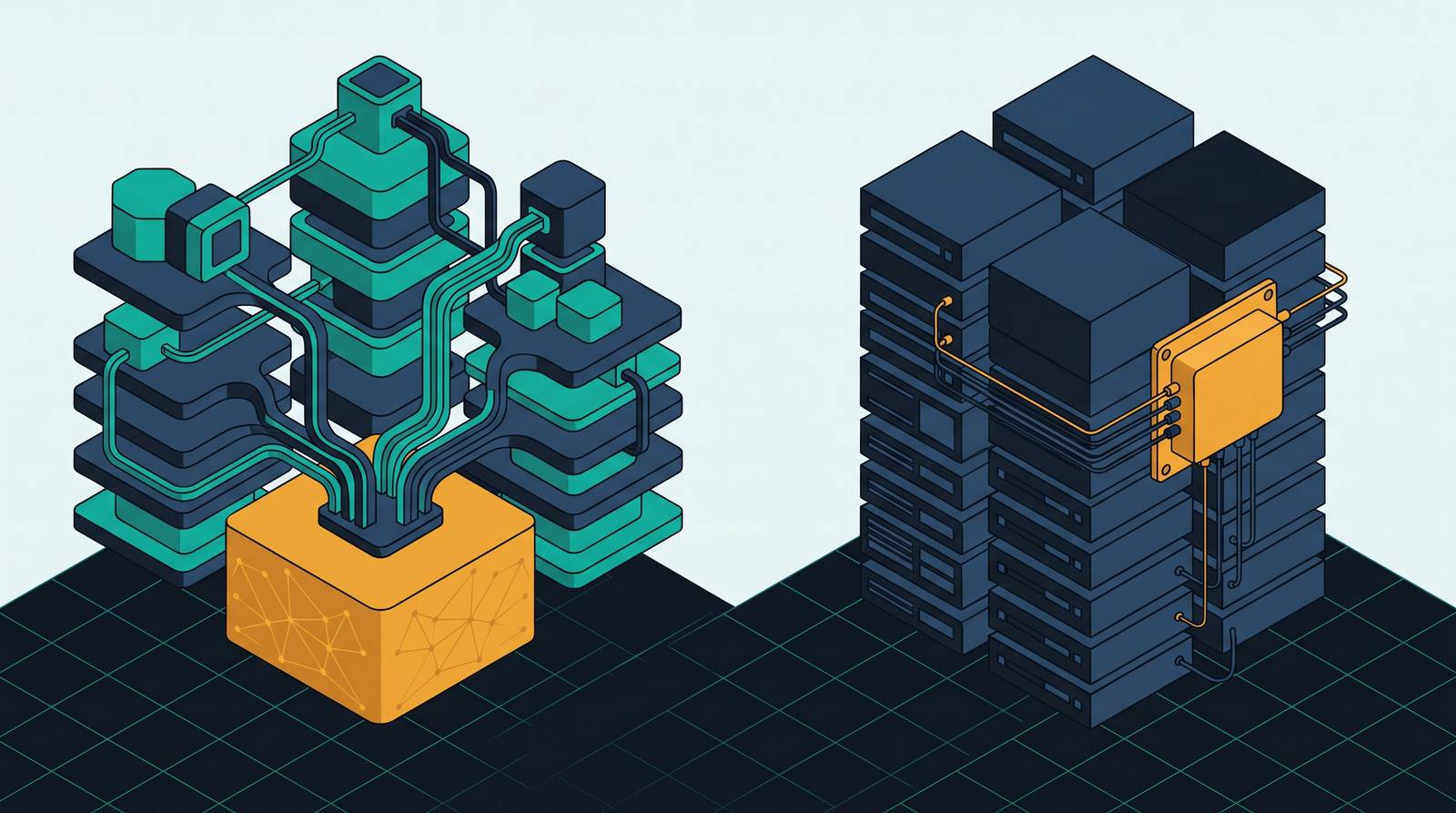
Traditional OSS platforms were built for human beings following deterministic scripts. Static product catalogs, predefined workflows, rule-based routing — the entire architecture presupposes that a person sits at the meaningful decision points, validates the exceptions, and carries operational context in their head from one function to the next.
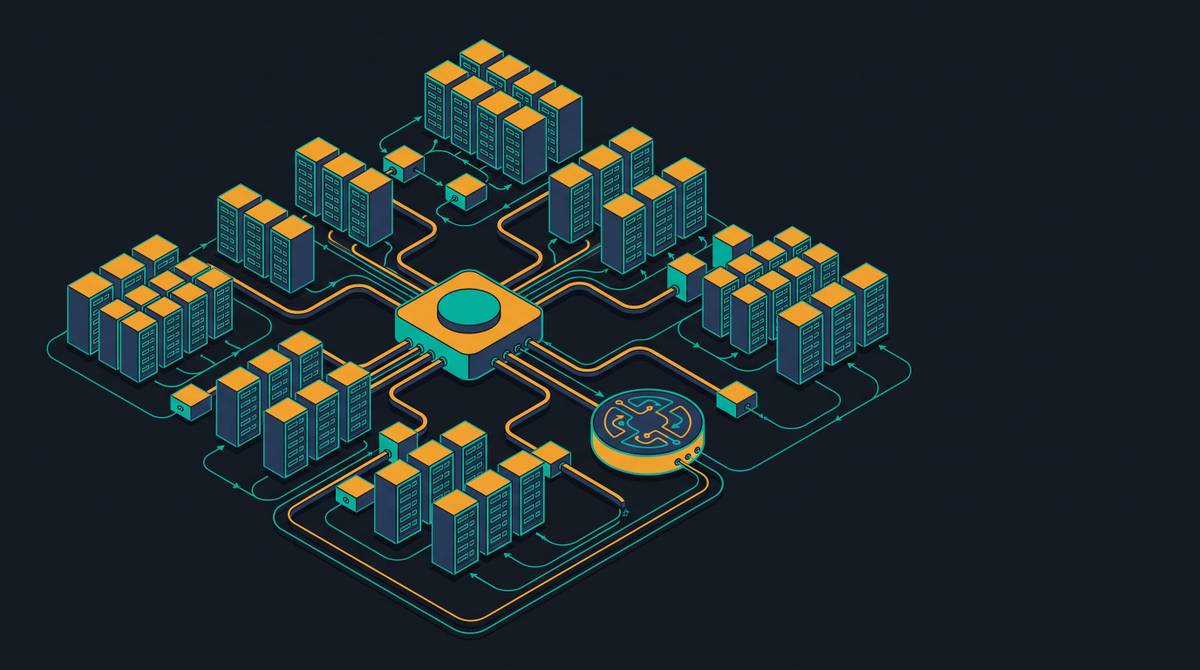
That assumption is baked into the data model itself. Qualification, provisioning, activation, and assurance typically live in separate systems with separate data stores, maintained by separate teams operating under separate conventions. Integration gets handled through point-to-point connectors and middleware layers that are fragile by nature and expensive to sustain. In a live FTTH deployment, OLT management platforms, billing systems, provisioning tools, and monitoring applications each arrive with different APIs, different schemas, and documentation of varying completeness. Custom integration work between a single system pair routinely takes months, and by the time it ships, one of the platforms has usually been patched in ways that invalidate portions of the integration work.
None of this was a mistake. These were rational design choices for the operating environment these systems were built for, an environment where human judgment was plentiful, automation was limited, and the cost of architectural fragmentation was manageable. The problem is that the operating environment has changed in ways these architectures can't absorb from within.
How AI Augmentation Works and What It Runs Into
AI augmentation means applying machine learning models or AI tooling to discrete functions within an existing OSS — ticket triage, order fallout detection, anomaly alerting. These use cases are real. They deliver measurable value within narrow scope, and it would be dishonest to dismiss them.
AvidThink analyst Roy Chua has described the near-term realistic path for most operators as gradual decomposition, where AI agents and lightweight microservices grow around the legacy core rather than replace it. Agents wrap the monolith; they automate what they can reach. That is, frankly, an accurate description of where most of the industry actually sits right now.
The wrapping strategy has a hard ceiling, though, and it's not a subtle one. An AI layer operating on top of fragmented data models can only reason on the data it can see. Incomplete context produces incomplete decisions, and the errors that result aren't randomly distributed across operations. They're systematic, shaped by the same data boundaries that shaped the legacy system underneath. There's something almost ironic in that — the AI inherits the original system's blind spots as if by genetic transfer.
Chua has also observed something the vendor community consistently understates: AI agents can actually reduce switching costs for incumbent OSS and BSS, meaning augmentation can entrench the systems it was ostensibly meant to supplement. Capital invested in layering AI tooling onto a legacy platform accumulates, over time, into an organizational argument for keeping that platform. Procurement teams should understand that dynamic before a contract is signed, not during the renewal conversation three years later.
What It Actually Means for a Platform to Be AI-Native
Ericsson's formal definition is the sharpest available on this question. "AI native is the concept of having intrinsic trustworthy AI capabilities, where AI is a natural part of the functionality, in terms of design, deployment, operation, and maintenance." Not added later. Designed in from the beginning. That distinction carries specific structural implications that no amount of clever post-hoc integration can resolve.
An AI-native platform commits to a unified data model, where qualification, design, provisioning, and activation all operate on the same underlying data. AI carries complete service state not because data has been synchronized across systems but because there's no seam between functions at the data layer in the first place. APIs are standardized so AI agents call the same interfaces human operators use, not a separate pathway bolted alongside the production system. The architecture is cloud-native, built from containerized, independently deployable microservices, so AI can act on specific operational domains without requiring changes to the entire monolith. Data flows in real time, not in batch, because decisions need to reflect current operational reality rather than yesterday's reconciled picture.
Whale Cloud's ODA-compliant architecture illustrates what this looks like in practice. BSS and OSS components share a common base layer and continuously learn from transactional data, so every business interaction feeds back into the system's evolving operational picture. Tekonyx President Sid Nag describes the logical endpoint of this model — in a fully realized AI-native architecture, core systems become "a sort of executive back end while the real control plane moves to an AI agentic-driven orchestration engine." That inversion of control, where the AI orchestration layer leads and the transactional system follows, is not something that can be retrofitted onto a system that wasn't designed to support it. The plumbing simply isn't there.
Where the Architectural Difference Shows Up in Service Delivery
Service qualification, order management, provisioning, and activation are where the architectural gap stops being theoretical and becomes visible in daily operations. Each workflow involves handoffs between functions. In an AI-augmented stack, each handoff is a seam where data must be translated, mapped, or reconciled. Errors accumulate at those boundaries because context gets lost in the crossing — the AI operating upstream of a seam has no reliable knowledge of what happened downstream, and it proceeds anyway.
In an AI-native stack with a unified data model, qualification output flows directly into design, design into provisioning, provisioning into activation. The AI carries full context at every step. There are no translation layers between functions because there are no separate functions, only stages of a single operational record.
The MEF's Lifecycle Service Orchestration API framework, in its ninth release as of February 2025, covers the full lifecycle of Network as a Service, including automated service delivery across enterprises, service providers, and cloud providers. Realizing that automation requires an OSS that can consume and act on those APIs without manual intermediary steps inserted between them. An AI-augmented system reintroduces those intermediary steps at every handoff, which defeats the purpose of the framework.
TMForum's agentic AI scenarios define what is actually achievable — an AI agent identifying a service condition, evaluating network availability, generating a recommendation, initiating fulfillment, and managing the resulting support interaction, all with minimal human intervention. But only if the agent has coherent read and write access across the full operational picture. Not across five systems with five schemas, each requiring reconciliation before the agent can act.
The telecom order management market is valued at USD $6.14 billion in 2026 and growing at a CAGR of 13.61% through 2035. That figure represents the operational cost embedded in these workflows. The architectural choice made at the platform level determines whether the automation value embedded in that market figure is accessible or structurally foreclosed before the project starts.
Why Governance Is an Architectural Requirement, Not a Compliance Checkbox
The EU AI Act, Regulation 2024/1689, classifies AI managing critical infrastructure as likely high-risk, requiring risk management systems, human oversight mechanisms, transparency, logging, and technical robustness. In a regulated operating environment, these requirements aren't optional. But compliance framing actually undersells the argument, because the operational case for governance stands completely independent of what any regulator demands.
Ungoverned AI agents acting on production systems without audit trails create operational risk whether or not a regulator is watching. The central question for OSS is concrete — do AI agents operate through the same APIs, permission structures, and audit logs as human operators, or through a separate pathway with different access controls and no attribution? That question has a right answer, and it matters acutely every time something goes wrong in the network and someone needs to reconstruct what happened. In my experience, the reconstruction is always harder than anyone anticipated, and the absence of attribution always surfaces at the worst possible moment.
Microsoft's Network Operations Agent framework addresses this directly. A Foundry Control Plane sits above the multi-agent system as what the framework describes as "the governance + observability + safety enforcement layer," explicitly identified as the mechanism that makes the solution "scalable, governed, and enterprise-ready." Governance isn't wrapped around the system after the fact; it's the layer through which the system operates. That ordering matters enormously.
Blue Planet reflects the same principle. Every agentic process is designed to be transparent and auditable, with the stated commitment that "increased autonomy does not come at the expense of oversight." A secure LLM gateway embeds access control and explainability into the AI pathway itself, not into a monitoring dashboard sitting adjacent to it.
Whale Cloud's Digital Asset Governance Layer functions, in their framing, as an "HR system for digital employees," managing agent registration, versioning, permissions, and monitoring. The metaphor is apt. Agents are treated as accountable entities with defined roles and traceable actions, not as anonymous background processes running outside the operational record.
In AI-native architecture, governance is a design constraint built in from the start. In an AI-augmented platform, AI tooling typically gets added outside the existing permission and logging framework, creating shadow automation that neither human operators nor auditors can fully observe. Omdia has reported that establishing strong governance control is among the central challenges of deploying AI agents alongside legacy OSS systems, not because governance is conceptually difficult, but because legacy architectures were never built to accommodate it. That's not a solvable integration problem. It's a structural one.
What Service Providers Should Actually Be Evaluating When Modernizing Their OSS Stack
The global OSS and BSS market was valued at USD $65.81 billion in 2024 and is projected to reach USD $148.26 billion by 2033, growing at a CAGR of 9.4%. The telecom network automation segment is growing faster still, projected at a CAGR of 22.5%, reaching $32.7 billion by 2026. At that scale and velocity, the architectural decision made during modernization compounds across years of operational cost and competitive position. Providers not structurally positioned to participate in the automation curve will feel the gap operationally before they can measure it analytically, and by then, the earlier architectural choices are considerably harder to unwind.
The evaluation questions that actually surface architectural reality are specific and require no interpretive work. Does AI operate on the same API layer as human operators, or through a separate integration? Is there a single data model across qualification, design, provisioning, and activation, or are those functions joined by middleware? Are AI agent actions captured in the same audit log as human operator actions? Can the platform support FTTH, dedicated internet, and Carrier Ethernet service types without separate tooling instances? What does the permission model for AI agents look like, and are they registered entities with defined access boundaries?
A platform that can't answer these questions clearly hasn't resolved the underlying architectural questions. It has deferred them to the integration teams that arrive after the contract is signed, who will solve them in ways that aren't necessarily coherent, at costs that were not in the original budget.
The wrapping strategy, placing AI augmentation on top of a legacy monolith, is the pragmatic near-term path for operators who can't execute a full migration. That is a legitimate operational reality, particularly for providers mid-cycle on an Amdocs or Nokia NetCracker deployment with three years left on a support contract. But pragmatism in the near term is not a modernization strategy, and Chua's observation on switching costs is exactly the part of that picture vendors don't advertise — the longer the wrapping continues, the more entrenched the underlying system becomes, and the harder the eventual transition gets.
Service providers who treat OSS as a strategic platform rather than a back-office function will be positioned to deploy AI where it changes operational economics, not merely where it makes existing processes incrementally faster. The decision is not about which platform lists more AI features in a capability matrix. It's about whether the architecture being committed to was actually designed for the operational model the provider intends to run.