Intent-Based Provisioning Workflows in Fiber Networks
How manual provisioning workflows break under fiber scale and why intent-based approaches fix it.
The numbers are uncomfortable. U.S. fiber has passed 99.7 million homes, with roughly 35 million actually connected. New Street Research projects 139 million locations passed by 2030. That gap between passed and connected isn't a sales problem. It's operational, and it widens every quarter that provisioning throughput fails to keep pace with construction.
Every location that converts from passed to connected requires a provisioning event. Those events don't get easier because the industry is building faster. Manual and semi-manual workflows execute the same sequence of steps regardless of volume; they don't compress with scale. The human-in-every-step model has no mechanism for parallelism at the throughput the current build pace demands. It breaks not because the people running it are inadequate, but because it was never designed for this moment.
The competitive dimension sharpens things further. The CLEC market was valued at USD 25 billion in 2025 and is projected to reach USD 40 billion by 2034, per Verified Market Research. In a market expanding at that rate, operators that activate faster and with fewer errors accumulate a structural advantage that compounds. Speed and accuracy in provisioning aren't operational nice-to-haves; they show up directly in subscriber experience and revenue realization.
The broader investment signal is consistent. Per NVIDIA's 2025 Annual Telecom AI Study, 97% of telecom organizations were assessing or adopting AI that year. Intent-based provisioning is where that investment meets the specific problem of activating fiber services at scale, where abstract AI capability collides with the concrete pressure of a construction curve that won't wait.
Scale alone, however, does not justify intent-based approaches. The argument only holds if legacy provisioning workflows are structurally unable to keep pace, and that structural failure warrants a closer look.
How Legacy OSS Provisioning Workflows Break Under Fiber-Scale Automation Demands
Legacy OSS was designed as a reactive back-office function: monitor faults, track inventory, follow predefined rules. Nobody built it to orchestrate thousands of concurrent provisioning events across a rapidly expanding physical plant. The gap between that original design assumption and the current operational reality isn't a configuration problem. It's architectural, and no configuration manager has ever fixed an architecture.
Over decades, operators accumulated best-of-breed point systems: billing here, CRM there, ordering and network management in their own silos, each solving a department-specific problem with integration deferred to a future initiative that rarely arrived. A single provisioning action must now traverse multiple disconnected systems, each with its own data model and its own API surface. The latency isn't in the network. It's in the handoffs between systems that were never built to coordinate.
The deeper failure mode is more specific than siloing. When provisioning logic lives in hand-coded scripts tied to specific device command sequences, any topology change, new vendor introduction, or service variant requires re-scripting. Configuration drift accumulates. Misconfigurations compound across a growing device population. What was manageable at hundreds of concurrent activations becomes brittle at thousands, and the brittleness isn't gradual. It surfaces suddenly, usually at the worst possible moment, because that is the nature of accumulated technical debt.
Operators who try to patch their way forward find a particular trap. AI doesn't solve this problem in a fragmented architecture; it worsens it. AI-driven tools depend on coherent, accessible, contextualized data. Adding AI tooling onto siloed OSS produces disconnected domain intelligence, where each system becomes marginally smarter about its own corner while remaining blind to adjacent context. The orchestration gap widens rather than closes.
OSS modernization programs fail for exactly this reason with notable regularity. Replacing individual systems without addressing the orchestration layer between them repeats the cycle of accumulated complexity at a higher cost basis. The structural problem isn't the age of the systems. It's the design assumption that humans would initiate every significant workflow step. Intent-based, AI-native provisioning requires machine interfaces where humans observe, tune, and override. That inversion is simply incompatible with architectures built around human-initiated transactions.
The Translation Layer: How an Intent Becomes a Provisioned Fiber Service
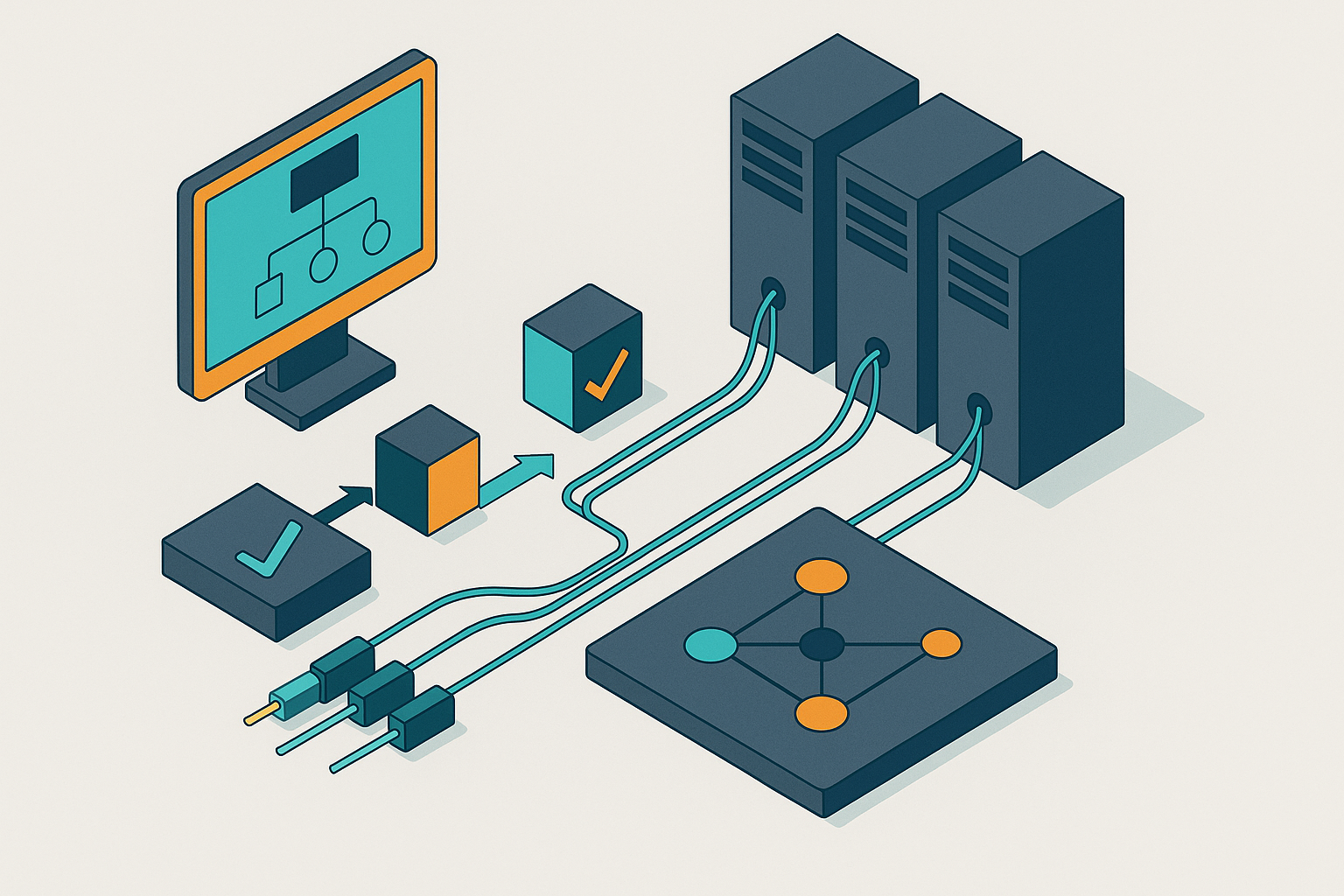
Between the operator's declared intent and the configured device, three functional components must exist inside the OSS: an orchestrator that processes intents and sequences configuration actions; an assurance system backed by live network inventory that maintains closed-loop feedback; and a policy manager that constrains what the orchestrator can do per predefined operator objectives. All three must operate on the same data. The translation layer is only as coherent as the data model beneath it.
The first translation step is a feasibility check. Before any configuration is attempted, the system validates whether the declared intent is actually achievable: fiber line availability, path viability, resource availability. Catching blockers at this stage eliminates an entire class of provisioning failures that would otherwise surface mid-execution, after configuration changes have already been partially applied to live network elements. Partial configuration on a live network element isn't a neutral state. It requires human intervention to resolve, which is precisely the bottleneck the architecture was designed to eliminate.
The product catalog is what makes intent machine-readable. Service specifications define toggleable feature sets. SLA tiers map to concrete, measurable performance parameters: minimum transfer rate, latency ceiling, uptime floor. Without a well-governed catalog, the operator's declaration is a wish, not an intent. Vocabulary gaps in the catalog produce misconfigurations rather than error messages, and misconfigurations are invisible until they surface in subscriber complaints.
State transition logic matters as much as initial provisioning. When a customer upgrades service, the platform calculates the delta between current state and desired state and applies only what changes. Re-provisioning from scratch on every modification is computationally wasteful and introduces unnecessary disruption. The orchestrator must reason about current state, not only about the target.
Device-layer execution sits below the orchestration layer. Tools like Ansible, NetConf, and TR-069 handle actual device communication. Intent orchestration sits above them, deciding what to send and when. The Intraway and BISDN ZTP solution illustrates what this looks like at the access layer: their platform abstracts OLT hardware from multiple vendors behind a single device interface, making vendor-specific command sequences invisible to the orchestration layer. The orchestrator declares what the OLT should do; the translation layer handles how each vendor's hardware achieves it.
Where Intent Abstraction Changes Fiber Workflows from Qualification Through Activation
The fiber provisioning workflow has four sequential stages, and intent abstraction changes the operational character of each one in ways that are less obvious than they first appear.
At qualification, the operator or system states a desired service for a location, and the platform runs feasibility checks against live network inventory automatically, rather than requiring an engineer to manually query topology databases. The engineer isn't removed from the picture. The mechanical querying is.
At design, the orchestration layer derives the service design from the intent and the policy constraints, rather than requiring engineers to select and sequence device configurations command by command. The engineer reviews and approves a proposed design. The cognitive work shifts from authoring to judgment, which changes the skills the role requires and the throughput a single engineer can sustain. Operators who haven't thought through those staffing implications tend to discover them at an inconvenient time.
At provisioning, the derived design executes automatically. Essential lifecycle functions, including activate, suspend, resume, bandwidth modification, and delete, become intent-driven state changes rather than manual script executions. This is where the volume problem is actually solved. The same execution logic applies to the hundredth activation as to the first, without degradation in speed or accuracy.
At activation, the zero-touch model means service goes live without per-event human action, ready within minutes of the provisioning trigger rather than after a manual validation queue clears.
The convergence of B2B and B2C services onto a single OSS stack is operationally significant here. A unified model means business and residential services run through the same intent translation logic, the same inventory, and the same activation path. Nexera in Poland achieved this with an API-first approach built on MEF and TM Forum APIs integrated with Nokia NMS, demonstrating that the convergence is operational reality, not architectural aspiration.
The lifecycle compression this produces is quantifiable. BICS, working with Tietoevry, reduced quote-to-bill time from more than three days and seven employees to three minutes, with operational expenses cut by more than 70%. Remove the human handoffs and the latency they carry disappears with them.
What Intent Assurance Means and Why the Closed Loop Is Not Optional
Provisioning an intent isn't the end of the workflow. The network's actual state must continuously match the declared intent, and the system must act when it drifts. This is intent assurance. Treating it as optional means accepting a network that degrades silently between human-initiated audits, and nobody finds out until a subscriber calls.
The assurance loop works as follows. Real-time analytics feed back into the orchestrator. If observed performance falls below the declared SLA tier, the system either reconfigures automatically or escalates to an operator. The feedback is continuous. The gap between intent and state is measured in seconds, not audit cycles.
Configuration drift is the specific failure mode intent assurance addresses. In legacy environments, drift accumulates between the last human review and the current device state, and the gap can be substantial by the time anyone looks. In an intent-based architecture, the declared intent becomes the reference state against which actual performance is continuously measured. Vendor studies have reported reductions in misconfiguration rates of up to 85% and deployment time improvements of up to 70% in early adopter environments. Both numbers trace back to the same mechanism: removing the latency between drift detection and remediation.
The assurance system requires network inventory to be live and accurate. Stale or fragmented inventory breaks the feedback loop at its foundation. If the system's model of what is provisioned doesn't match what is actually provisioned, the assurance loop operates on false premises, producing confident wrong answers. A unified data model is therefore an architectural prerequisite for intent assurance, not something to schedule for a future release cycle when the team has more bandwidth.
The policy manager constrains what the assurance loop can do autonomously. Not every remediation action is permissible without human review. The policy layer encodes which deviations trigger automatic reconfiguration, which trigger escalation, and which require explicit operator approval. This is where governance enters the operational picture, and the governance problem is more serious than most operators currently treat it.
Governance Requirements When Provisioning Workflows Run Without Per-Step Human Approval
Deloitte's State of AI in the Enterprise, 2026 found that only one in five companies had a mature model for governing autonomous AI agents. Provisioning automation is already outpacing the governance frameworks intended to constrain it.
Ungoverned automation carries specific risks in the provisioning context. A misconfigured intent that executes without auditability can affect hundreds of subscribers before a human notices. The blast radius of an untraced automated action is structurally larger than the blast radius of a single engineer's mistake, because the automated action executes at machine speed across a large device population before any feedback surfaces. The scale that makes intent-based provisioning valuable is precisely what makes ungoverned execution dangerous.
Governed intent execution requires more than logging. Every provisioning action must be traceable to the intent that triggered it, the agent or policy version that resolved it, and the input context at execution time. Traceability must be built into the execution architecture, not reconstructed after an incident. Post-hoc logging describes what happened. Execution-time attribution makes each action accountable to the decision logic that produced it. That distinction matters most at two in the morning when a misconfiguration is affecting a business customer's SLA and someone needs to understand exactly what the system decided and why, without sifting through logs that were never designed to answer that question.
AI agents involved in provisioning decisions must operate on the same APIs, audit trails, and permission structures as human operators. Shadow automation that bypasses the OSS governance layer isn't a shortcut. It's a liability that can't be audited, constrained, or remediated through the mechanisms the operator has established.
Human-in-the-loop governance isn't a binary choice between full automation and manual approval. The design question is which decisions require human approval before execution, which allow human override after execution, and which run fully autonomously within defined policy bounds. Governing by decision type rather than by workflow step is more precise and more scalable than requiring human approval at fixed positions regardless of risk level.
Omdia's 2026 research identified legacy OSS integration as a governance blocker specifically. Fragmented, siloed data makes it impossible to enforce consistent policy across provisioning domains. Governance requires the same unified data model that intent translation requires. An operator cannot govern what it cannot observe consistently.
What Operators Need to Evaluate Before Adopting Intent-Based Provisioning Architectures
Four questions determine whether an intent-based provisioning architecture will deliver what it promises or reproduce legacy complexity at a higher abstraction level.
The first is data model completeness. Intent translation only works if the platform can resolve an intent against accurate, unified inventory. Qualification, design, provisioning, and activation must operate on the same data, not synchronized copies across separate systems with inevitable latency and divergence between them. No amount of orchestration sophistication compensates for an inventory that lies.
The second is policy expressiveness. The platform's policy manager must encode the operator's actual business rules as machine-enforceable constraints. If policies live only in documentation or tribal knowledge, intent automation will violate them, not because the system is wrong, but because the rules were never expressed in a form the system could read. The policy layer isn't configuration. It is the machine representation of operator intent at the governance level, and it deserves the same rigor operators apply to their service catalog.
The third is auditability architecture. Can every provisioning action be traced back to the intent, the policy version, and the system state at execution time? Operators need to understand what the audit trail looks like before an incident occurs, not while they're trying to contain one. The auditability design determines whether a misconfiguration can be understood and corrected, or merely observed after the fact.
The fourth is lifecycle completeness. A system that automates activation but excludes suspend, resume, or bandwidth modification leaves operators managing a hybrid of automated and manual state changes, and the seams between those two modes are precisely where errors accumulate. Partial automation creates its own consistency problems. The system's model of subscriber state diverges from actual state whenever a manual operation occurs outside the platform's awareness.
The OSS consolidation question underlies all four. Platforms that retrofit intent capabilities onto fragmented legacy architectures inherit the integration debt those architectures carry. The OSS/BSS market is projected to reach USD 148.26 billion by 2033, per IMARC Group, a figure that reflects the significance of the transformation underway. Capital deployed on the wrong architectural foundation compounds rather than resolves the underlying problem. Intent-based provisioning requires unified data, governed automation, and full lifecycle coverage. Operators who treat it as a feature to enable rather than an architecture to commit to will find that the abstraction layer they've adopted to simplify their workflows has introduced a new class of complexity, and one they are not equipped to govern.