Audit Trail Requirements for AI Agents in Network Operations
Regulators and telecom operators demand audit trails that standard network logs cannot provide.
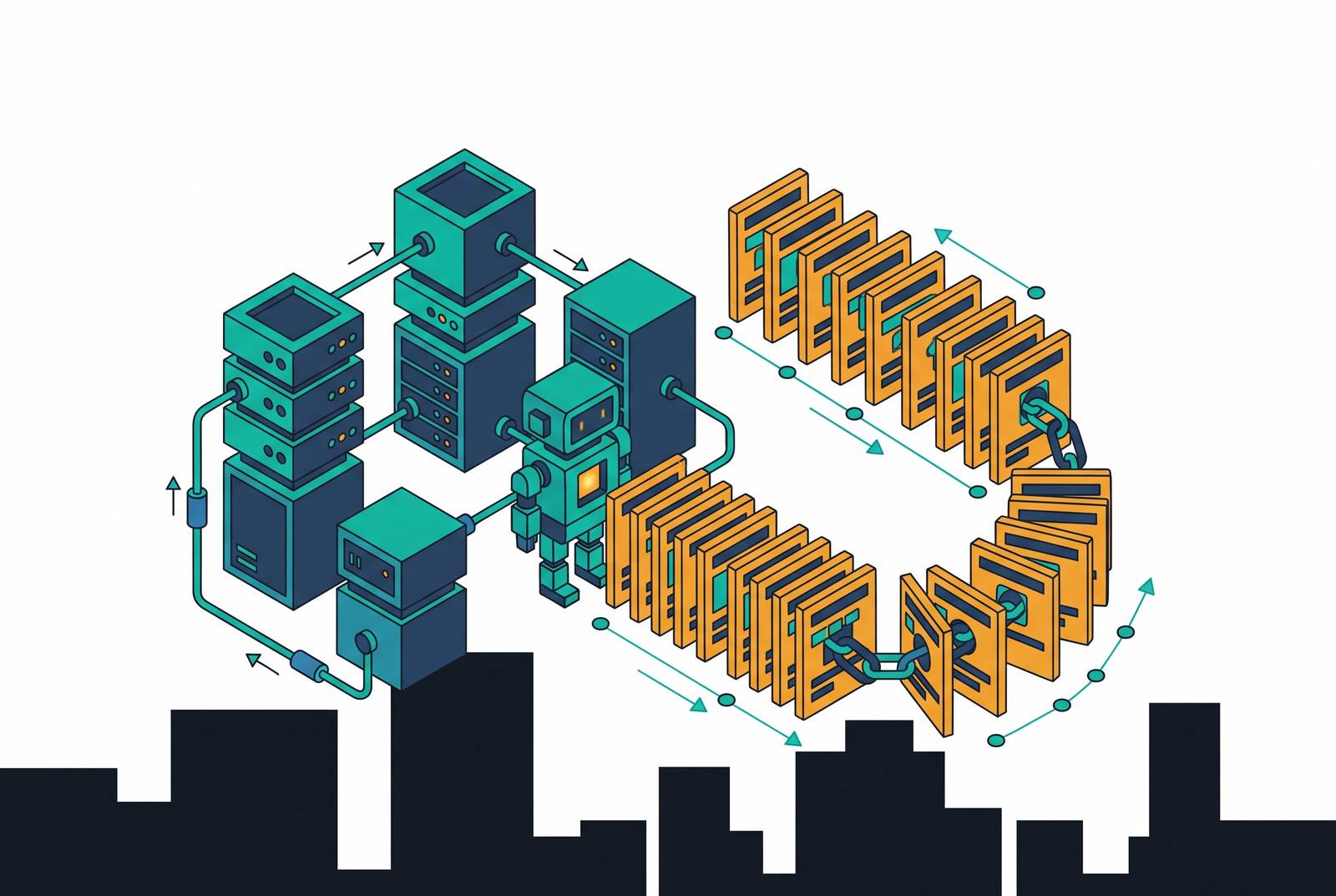
The agentic AI market for telecom and network management hit $8.7 billion in 2025 and, according to Fact.MR, is on track to reach $61.8 billion by 2036, growing at a 19.5% compound annual rate. Network Operations Agents alone are expected to claim 38% of that market by 2026. That is not a lab experiment scaling up slowly. That is a workforce of software agents already routing traffic, allocating spectrum, and enforcing security policy on live networks, at speeds no human review process can match. The question this raises is not whether these agents work. It's whether anyone can explain what they did after the fact, and whether that explanation would hold up to a regulator, an auditor, or an angry customer.
Research cited by Aurascape found that only one in five companies has a mature model for governing autonomous AI agents, even as deployment climbs sharply. The danger isn't that an agent will misroute a packet or misallocate spectrum. Mistakes happen in every system, human or otherwise. The danger is that when it happens, the operator has no way to reconstruct what the agent saw, what it decided, and why, which means no way to assign accountability or stop it from happening again. A TCS white paper on AI regulatory compliance makes the underlying problem plain: conventional monitoring tools were never built to produce the kind of evidence regulators now expect, meaning decision logs, reasoning traces, and records of model behavior. Autonomous action without a record of that action isn't efficiency. It's ungoverned risk running on production infrastructure.
What an AI agent audit trail actually captures, and why standard logs fall short
A server log tells you an API call happened. It does not tell you why the model picked that action instead of three other plausible ones. That gap sounds small until an agent shuts down a network segment, denies a customer's service request, or reroutes traffic away from a legitimate node, and nobody can say why.
An AI agent audit trail is a tamper-resistant, chronological record of everything that happened inside an agent's decision process: every input, every internal reasoning step, every call to a language model, every tool it invoked, and the final output it produced. Guardrails are a different animal entirely. They're reactive filters, sitting in the present moment, catching bad outputs before they ship. Audit trails work backward across the entire lifecycle of an interaction. A guardrail tells you what got blocked. An audit trail tells you why the agent tried it in the first place.
A complete decision trace has several distinct parts, and skipping any one of them leaves a hole. There's the input as it arrived, along with whatever identity metadata came with it. There's the chain of thought, the planning steps and task breakdown the agent worked through before acting. There's the record of tool and API calls, both the parameters sent out and the exact response that came back. There's the context fed into the model at decision time, including governance rules and retrieved data. And there's the output, the final action taken, which means almost nothing without the stages before it.
Guardrails alone can't close this gap. They show what was stopped, never why the agent reached for that action to begin with, and that missing piece is exactly what root-cause analysis needs. AI agents aren't like traditional software, which follows a fixed path from input to output. They stitch together application logic, outside tools, retrieval systems, and a probabilistic model that doesn't always do the same thing twice given the same input. That combination is structurally harder to log than anything standard monitoring tools were designed for.
Network operations add dimensions that generic AI audit frameworks do not cover
Telecom brings its own baggage to this problem, and generic enterprise AI audit tools weren't built with it in mind. Three things need to show up in the trace that a typical software audit log skips entirely.
Network metadata comes first: latency figures, call routing paths, packet loss numbers, and other signals of network health. The reason this matters so much in telecom specifically is straightforward. Without it, there's no way to tell whether a bad outcome came from the agent reasoning poorly or from the agent responding correctly to a network that was already falling apart. Then there's service state, meaning what the provisioning, activation, or assurance record actually showed at the exact moment the agent acted. And there's inventory and topology context: which circuits, which network elements, which resources the agent touched, read, or changed.
Leave network metadata out of the trace, and post-incident review turns into guesswork. Nobody can separate a flawed decision from a correct response to a genuine fault, and that particular blind spot doesn't show up in most AI governance conversations because most AI governance conversations aren't written with telecom in mind.
Palo Alto Networks identifies bounded autonomy architectures as an emerging response to governance pressure, meaning explicit escalation paths, full audit trails, and approval gates that sit in front of any containment action touching production systems. Cognizant adds a related wrinkle around billing: persistent checkpoints across the whole service delivery lifecycle are what make full-trail auditability possible for billing accuracy and regulatory compliance, not just for security incidents.
None of this reduces to a single log file. A network operations audit trail is layered, and its real job is connecting an agent's reasoning to the actual state of the network it was reasoning about at the time.
The architectural reason legacy OSS cannot generate trustworthy audit trails for AI agents
Older OSS platforms weren't built for this. According to Blue Planet, citing Omdia research, legacy architectures leave data fragmented and siloed by design, and that's a structural condition, not something a configuration change fixes.
Here's what happens in practice, according to networkoss.com: AI tooling gets bolted onto these platforms from outside the existing permission and logging framework. The result is shadow automation, agent activity that neither the human operators nor the auditors reviewing the system can actually see. When an agent acts through a separate pathway sitting alongside the production system rather than inside it, the audit trail has a hole built into its architecture. The agent's actions never land in the same system of record as the actions taken by human operators standing next to it.
Handoffs make this worse. Every boundary in a fragmented OSS stack, qualification to design, design to provisioning, provisioning to activation, is a seam where context gets translated, and sometimes lost, between systems that don't share a data model. An audit trail that needs to span those seams has to reconstruct what each system understood at that moment, and often that information simply isn't recoverable after the fact.
The underlying point is plain: legacy platforms will fail here not because they lack AI features on the label, but because their underlying architecture was never built to support AI that actually drives outcomes rather than just assisting a human at a terminal. Shadow automation is the sharpest version of this liability: AI acting outside governed APIs and outside the logging infrastructure produces outcomes with no traceable chain of authority behind them. An audit trail is only as good as the data model underneath it, which is the problem Optinet was built to address as a unified OSS for FTTH and Carrier Ethernet delivery. A siloed data model produces a siloed trace, and a siloed trace isn't a trace at all once an agent workflow spans more than one system.
What a governed AI architecture looks like when audit trails are a design requirement, not a retrofit
The fix starts with a simple rule, laid out by networkoss.com: AI agents call the same APIs and work within the same permission structures as human operators. Not a parallel system. Not a separate integration layer. The same one. That's what puts an agent's actions into the same audit record as a human operator's actions, rather than off to the side in a different log nobody cross-references.
That requires a single, unified data model spanning qualification, design, provisioning, and activation. When every stage of the workflow reads and writes to the same underlying record, an agent's full context at the moment of a decision is already there. Nobody has to reconstruct it later from fragments.
Blue Planet describes this as building governance into the agentic core layer itself, meaning access control, observability, and explainability aren't features added on top, they're part of how the layer is built. Every agentic process needs to be visible and auditable by default. In practice, that means a handful of concrete things: standardized APIs so agents and humans move through the same interfaces; immutable action logs, which a governance framework published on arxiv.org treats as a baseline requirement alongside a human escalation path for every hosted agent; approval gates configured for any action that touches production; a secure LLM gateway that lets an operator pick models based on compliance needs, per Blue Planet; and closed-loop control points, described by PwC as giving agents the ability to act within policy bounds, with decision and action patterns captured as they happen.
None of this works without governed data underneath it. PwC's framing is direct: customer, product, order, usage, and financial data need clear ownership, with quality standards, lineage tracking, and access controls attached. An agent operating on that data inherits whatever governance the data already has, good or bad. When governed data practices are in place, teams spend less time hunting for the source of a problem and more time figuring out what it actually affected.
Platforms built AI-native from the ground up have an advantage here that's architectural, not incidental. Platforms built this way run AI agents on the same APIs, audit controls, and permissions as human operators, which means the audit trail requirement gets built into the core data model instead of retrofitted onto a stack that was never designed to hold it. The distinction between an agent's reasoning and its output becomes something you can actually observe, because the system was built to show it, not patched after the fact to hide the gap. AI-native doesn't mean AI-only. It means AI and human operators working inside the same governed, visible system, and the audit trail is the proof that this is actually happening rather than just claimed in a product deck.
The regulatory framework that is now forcing these requirements into production
The EU AI Act entered into force in August 2024. Its prohibited practices took effect on February 2, 2025, and enforcement penalties began August 2, 2025. High-risk AI system requirements, the ones that matter most here, were originally set to apply from August 2, 2026, but the Digital Omnibus on AI, Regulation (EU) 2026/1744, entered into force on July 27, 2026 and pushed that deadline to December 2, 2027 for standalone Annex III systems.
Telecom networks fall squarely into this. The Act classifies AI systems acting as safety components in the management of critical digital infrastructure as high-risk under Annex III, and The EU AI Act's own framing confirms telecom qualifies. That classification comes with specific, demonstrable obligations: documented risk management, auditable governance over training data, automatic event logging, and defined mechanisms for human oversight, all of it producible to a national regulator on request, not just claimed in a policy document.
The obligation splits across the supply chain. The OEM providing the AI system has to build logging capability into the system itself under Articles 12, 16, and 19. The operator deploying that system carries a separate, independent obligation under Article 26(6) to retain those logs and produce them when asked. Building the capability and being accountable for using it are two different jobs, assigned to two different parties.
NIS2 adds another layer, and the coverage is narrower than it first appears. Providers of public electronic communications networks sit in Annex I, the digital infrastructure sector, but only qualify as essential entities if they meet the medium-sized enterprise threshold under Article 3(1)(c). Small or micro providers are still in scope regardless of size, under Article 2(2)(b), so size doesn't offer an exemption at the bottom end. Telecom security obligations now draw from NIS2, from ENISA's Technical Implementation Guidance published in June 2025, and from Implementing Regulation (EU) 2024/2690, which covers digital infrastructure and ICT service providers but not public electronic communications network or service providers directly. The practical guidance emerging from compliance discussions is that the fastest path to an audit-ready posture is anchoring on the EU AI Act's requirements and mapping NIS2's obligations onto the same set of controls, rather than building two separate compliance programs.
Standards bodies are moving in parallel. ETSI's Securing Artificial Intelligence committee adopted a European Standard for defending AI systems against cyber threats in December 2025, with public release announced in January 2026, per Aurascape. And 3GPP has been building AI and machine learning directly into the network starting with Release 18, the first release under 5G-Advanced, meaning AI governance in telecom is now a standards-body concern as much as a regulatory one. Gartner, in 2025, predicted that guardian agents, AI systems built specifically to govern other AI agents, will capture 10 to 15% of the agentic AI market by 2030. A whole product category emerging to police other AI is a strong signal that regulators and the market have landed on the same conclusion from different directions.
How audit trails enable operational trust, not just legal defensibility
The governance gap costs more than a compliance headache. Deloitte's finding, that only one in five companies has a mature model for governing autonomous agents, is also the reason AI stays confined to low-stakes pilot workflows instead of running live network operations at scale. Trust is the actual gate here, not technical capability. No operator hands an agent control over production infrastructure without a way to review what it did, challenge a decision, and get a straight answer for why it acted. The audit trail is that mechanism, full stop.
Audit trails also function as a discovery tool, not just a record-keeping exercise. PwC's observation is that when agents keep stalling out or escalating to a human, those patterns almost always trace back to something specific: a broken handoff between systems, conflicting business rules, missing data, or an integration that was never solid to begin with. Capturing and reviewing those signals shows an operator exactly where the underlying platform needs work, which is a use of the audit trail that has nothing to do with regulators at all.
Post-incident, the value is direct. When the trail captures the full sequence, including the network state the agent was responding to at the time, an operator can actually determine whether an outcome was a reasoning failure or a correct response to a genuine condition on the network. Without that record, every incident stays ambiguous, and ambiguous incidents don't build trust, they erode it.
PwC also frames this as a division of labor that only works if it's enforceable: people set the intent, define the guardrails, and step in on edge cases; agents operate inside those boundaries and escalate the moment confidence drops. The audit trail is the proof that boundary actually held. Governed AI with a complete trail lets an operator expand what an agent is allowed to do gradually, with each expansion earned by the record that came before it. Ungoverned AI with no trace can't expand at all, not safely, because there's no way to measure the risk it's already carrying.
An agent that can be audited can be trusted. An agent that can be trusted can be handed more responsibility. Audit trails were never a ceiling on what AI can do in network operations. They're the mechanism by which an agent earns the right to do more.