ITIL Problem Management Applied to Recurring Network Faults
Structured investigation and ownership practices reduce repeat network faults more than tools alone.
Recurring network faults expose the gap between restoring service and removing the cause of disruption. ITIL problem management closes that gap with a process that governs investigation, known errors, and permanent fixes through to completion. In network operations, its success depends on dedicated ownership and continuous, trustworthy data.
Why recurring network faults are an operations discipline problem, not a tools problem
The team restarts the server, calms the alarm storm, and faces the same alert next Monday. The immediate response worked, but the underlying fault survived. When teams are structured and rewarded mainly to close tickets quickly, that distinction disappears from the measures used to judge their work.
The operational signal is low MTTR together with low MTBF. Speed-to-close is easy to measure and reward, whereas reduction in recurrence requires a separate practice to track. Without it, getting service back each time can look like good work even as the same faults take up engineers’ time.
Monitoring and AIOps do not remove this organizational gap. Surfacing an anomaly or a likely cause does not assign responsibility for investigating it, approving a fix, and verifying the result. Without a governed process, even useful findings receive ad hoc attention or none at all.
What ITIL problem management is and what it is not
ITIL 4 defines an incident as an unplanned interruption to a service or reduction in the quality of a service. A problem is the cause, or potential cause, of one or more incidents. ITIL 4 states that problem management aims to “reduce the likelihood and impact of incidents by identifying causes of incidents as well as managing workarounds and known errors”.
Incident management produces restored service. Problem management produces a known error record and a permanent fix or Request for Change. Its objectives are to reduce incident frequency and impact, maintain useful known errors and workarounds, and identify patterns that support continuous improvement. A known error bridges the practices by recording a problem analyzed sufficiently to establish its cause, or at least its symptoms and a workaround. The Known Error Database makes that knowledge available during subsequent incidents.
Problem management can be reactive or proactive. Reactive work starts after incidents, while proactive work uses trends to find weaknesses before they disrupt service. Recurring incidents, a single major incident, and evidence of an underlying weakness can all trigger the practice. The best-performing operations aim to make most of their work proactive, but both modes are part of problem management.
How network operations translates incident and problem into concrete fault patterns
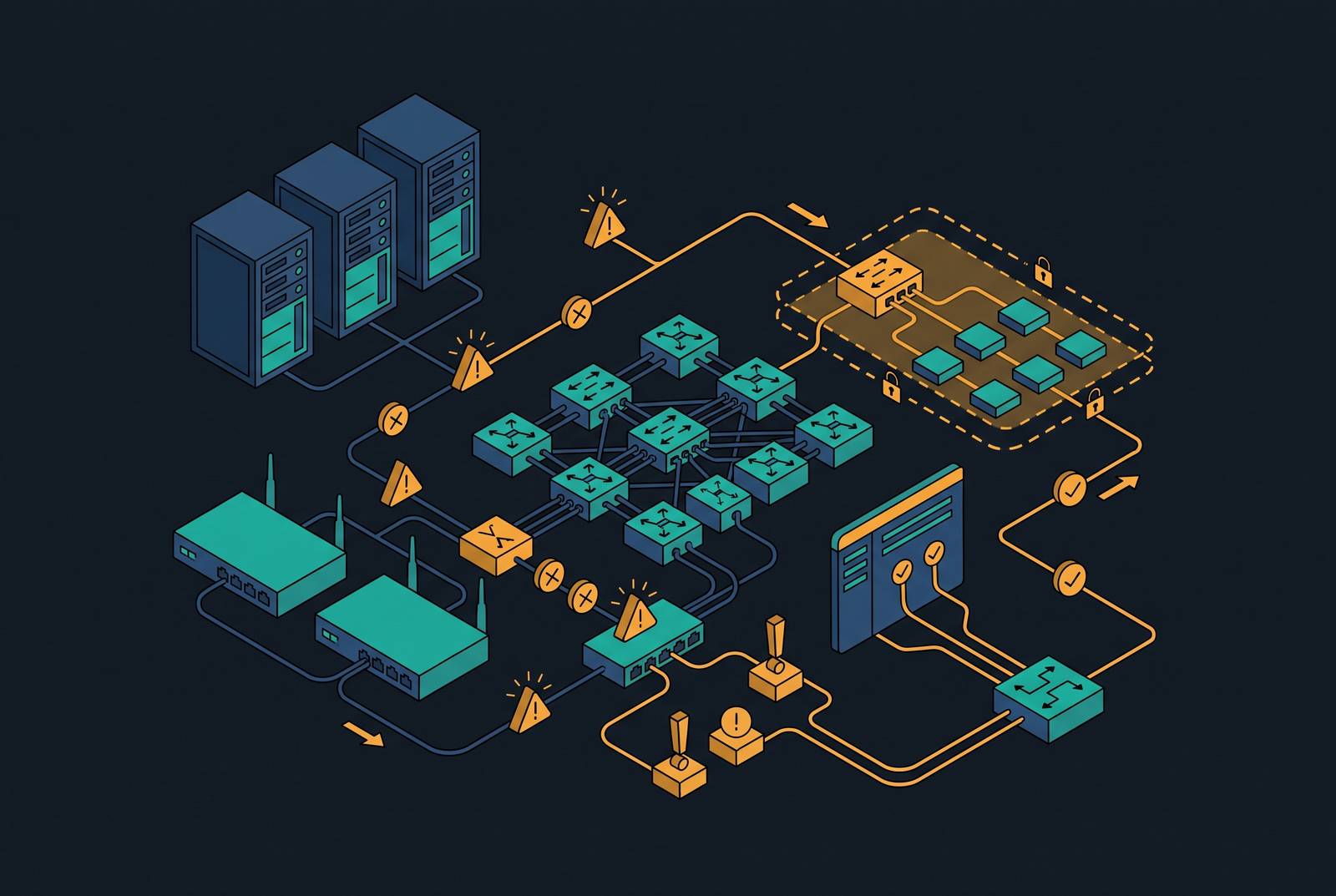
The network formulation makes the distinction measurable through unavailable seconds. Unavailable seconds are incidents, while many unavailable seconds on the same network path are a problem. Each interruption requires service restoration, but the repeated concentration on one path requires investigation across events. The object of that investigation is the shared cause.
Telecom root-cause analysis uses a range of methods, from fixed and topology-based rules to heuristic and AI/ML-based detection. These methods need data continuity because they cannot reason over gaps. Proactive investigation similarly depends on incident logs, performance metrics, and capacity trends that reveal recurring patterns, anomalies, and emerging bottlenecks. Alarm correlation can identify a candidate problem, but it cannot substitute for the process that logs, owns, investigates, and resolves it.
This matters particularly in a NOC where highly trained staff watch alarm screens and respond to individual events. Without a tiered structure and a framework that routes work by root cause, alarm volume determines where effort goes. During a large event, engineers can spend more time sorting related tickets than resolving the fault.
The ten-stage problem management process applied to a network fault
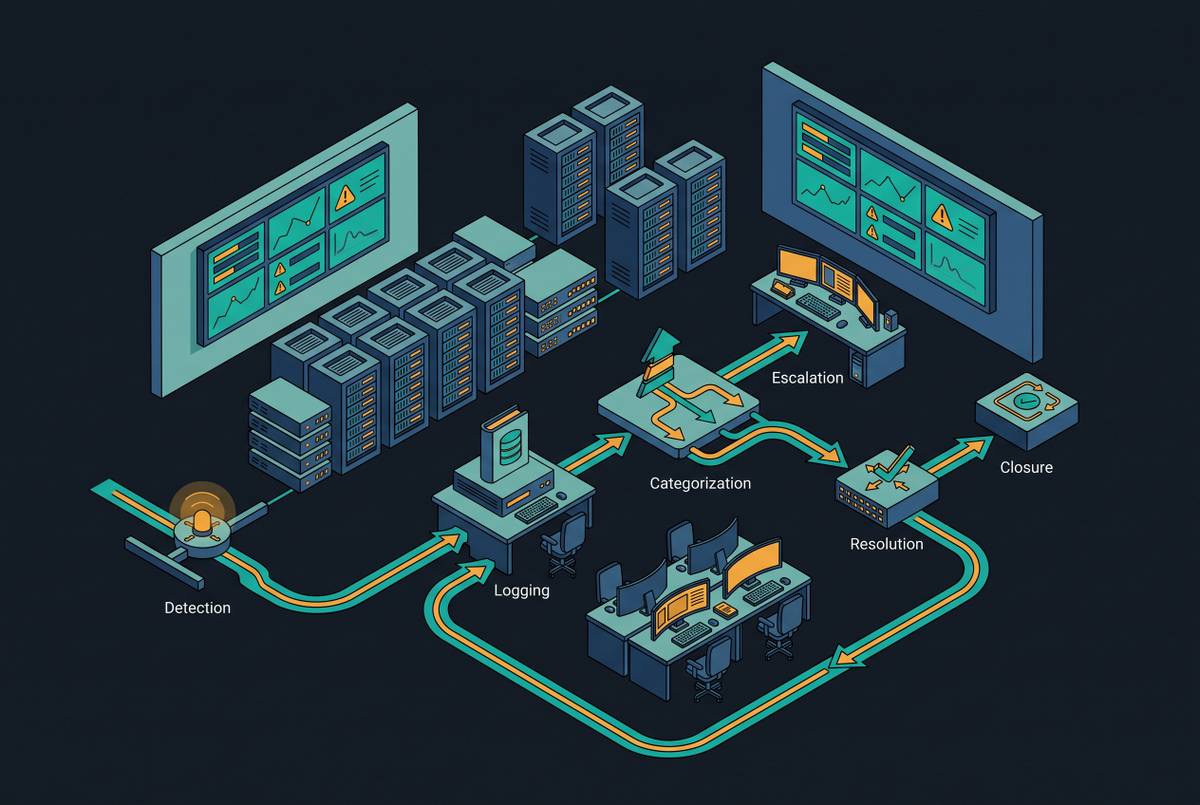
Stage 1, Problem Detection, begins when staff recognize repeated tickets, monitoring flags recurring anomalies, or technical teams identify a weakness during maintenance. Trend analysis can also expose a path-level problem before an incident occurs. Stage 2, Problem Logging, turns that finding into a formal record containing symptoms, affected services, associated incidents, initial categorization, and priority. For a recurring path fault, the record preserves the evidence connecting interruptions that might otherwise be handled separately.
Stage 3, Categorization, classifies the problem by service, system, component, and type. In network operations, those categories should reflect topology, distinguishing a path fault or interface-type issue from platform-wide degradation. Stage 4, Prioritization, assigns urgency according to the impact of associated incidents and the business exposure. A high-impact recurring fault receives dedicated resources, while a lower-priority problem may be scheduled for a standard maintenance window.
Stage 5, Investigation and Diagnosis, gathers component data, logs, configuration records, and dependency relationships from the CMDB. For an interface fault, this establishes the context needed to investigate beyond the failed component. Stage 6, Root Cause Analysis, applies structured techniques including the 5 Whys, Fishbone diagrams, and Fault Tree Analysis. The analysis must move beyond the observation that an interface went down and trace whether configuration drift, a capacity ceiling, a hardware characteristic, or a dependency failure caused it.
Stage 7, Known Error Creation, records the confirmed cause and any available workarounds in the Known Error Database. Stage 8, Workaround Identification, establishes a temporary measure that reduces or removes impact without eliminating the cause. Failing over to a secondary path, for example, can reduce disruption while the primary path’s misconfiguration remains under investigation.
Stage 9, RFC Creation, documents the proposed permanent change, expected impact, testing plan, and rollback procedure. Change Enablement reviews and approves the request before implementation. Stage 10, Problem Closure, follows implementation and verification. The closed record captures the root cause, resolution actions, and lessons learned, returning the investigation’s findings to the service improvement cycle.
Why the process stalls in practice and what breaks it at each failure point
The most common failure is cultural. When speed dominates rewards, teams close tickets before they fully understand them. The organization counts the work as done even though the cause is still there. Correcting this failure requires ownership, investigation, known error records, and change governance, with a post-incident review serving as an input to problem detection.
When incident records have gaps, categories differ, and data stays in silos, problem managers cannot see patterns across events. Without tiered support, highly trained engineers spend their time on alarm triage and have no time to keep investigating. If every alarm generates a ticket regardless of actionability, the resulting workload further displaces that investigation.
The process can also break after a cause has been found. A diagnosis that never becomes an RFC leaves the remedy unimplemented, while an approved change without post-implementation verification leaves its effectiveness unresolved. Correlation findings outside a connected problem workflow have the same weakness because nobody formally owns their completion. These are broken handoffs between practices that are distinct but operationally coupled.
These failures often leave teams predominantly reactive by default. Trend analysis needs continuous, structured data and the capacity to analyze it. When legacy environments cannot sustain either, the next incident takes precedence over the pattern behind it. A process document can describe proactive work without supplying the conditions that make it possible.
What problem management actually requires from the underlying data and OSS infrastructure
Those conditions begin with continuous, queryable, timestamped data across the service lifecycle. Teams must be able to review incident logs for patterns, see anomalies in performance metrics, and spot bottlenecks in capacity trends. The integration bottleneck is getting clean data from legacy OSS/BSS systems that were not built to stream telemetry at the required granularity. Adding analysis above those systems does not repair missing or stale evidence.
When architectures are rigid and batch-driven, teams have to base decisions on yesterday’s network state. Provisioning logic buried in outdated workflows can also separate the service record from the actual network state, giving investigators an unreliable baseline. With proprietary integrations, cross-system correlation costs more and carries more risk. Meanwhile, maintaining monolithic platforms consumes engineering capacity that sustained problem investigation also needs.
Topology-aware diagnosis places a specific demand on the CMDB. Its dependency relationships must be accurate enough to support investigation through the network, and batch updates cannot support real-time topology-aware diagnosis. A unified data model therefore serves an operational purpose. If the same circuit or address is represented differently in four systems, investigators lack a single record against which to connect evidence.
AI-generated findings need to sit within the audit trail referenced by the problem record so they can be owned and traced. A connected, governed OSS makes categorization, pattern detection, dependency analysis, and known error linkage executable within one coherent record of work. It enables the discipline, but does not replace responsibility for carrying the investigation through change and verification.
Metrics that tell whether problem management is working in a network environment
The clearest outcome measure is a reduction in recurring incident volume over time. MTBF trends by path, circuit type, or service class make that result specific to the network. Read together with MTTR, they distinguish faster recovery from improved stability.
Process measures explain why those outcomes do or do not improve. Problem record age and cycle time from detection to RFC approval expose work stalled in investigation or governance. RFC conversion rate shows whether diagnosed problems reach the change process. Post-change recurrence rate then shows whether changes put in place removed the underlying cause after the administrative steps were complete.
Known Error Database utilization shows how much teams use the practice’s work while they wait for permanent fixes. Low use of documented workarounds suggests that the database is not accessible or trusted by incident teams. These measures are only credible when incident records use consistent categories and remain connected across systems. The unified data model required for reliable root-cause analysis is also the basis for trustworthy performance reporting.
Building a problem management practice that sustains itself in a network operations team
A durable practice starts with a tiered support structure and dedicated ownership separate from incident response. The same engineers cannot keep doing both jobs at once when fault volumes are high. A formal problem manager owns records from detection through RFC, maintains the Known Error Database, and drives proactive trend analysis.
The architectural foundation requires streaming telemetry, continuous incident logging, and a live CMDB with accurate topology. A unified data model across qualification, design, provisioning, and activation connects the service lifecycle to the network evidence used in investigation. The platform must also support the governance chain from root-cause analysis through RFC, deployment, and closure verification. When teams use email to manage those handoffs across separate tools, they have no continuous record of the process.
AI can detect more in environments with high alarm volumes when its agents use the same APIs, permission structures, and audit logs as human operators. Their findings must enter the same governed workflow as human-initiated problem records, rather than forming a parallel set of unowned anomalies. The Known Error Database also needs to stay up to date and be easy for incident teams to reach and trust during their work.
Finally, recurrence reduction must be measured and made visible together with MTTR so sustained investigation has organizational value. That changes the incentive from closing the immediate ticket to improving the architecture that keeps generating it. The team systematically reduces the faults that recur, even as some faults remain in the network. For service providers whose service commitments depend on stability, that discipline is a competitive differentiator beyond speed of response alone.