Service Activation Testing in Fiber and Carrier Networks
Testing before activation catches configuration gaps that provisioning alone misses.
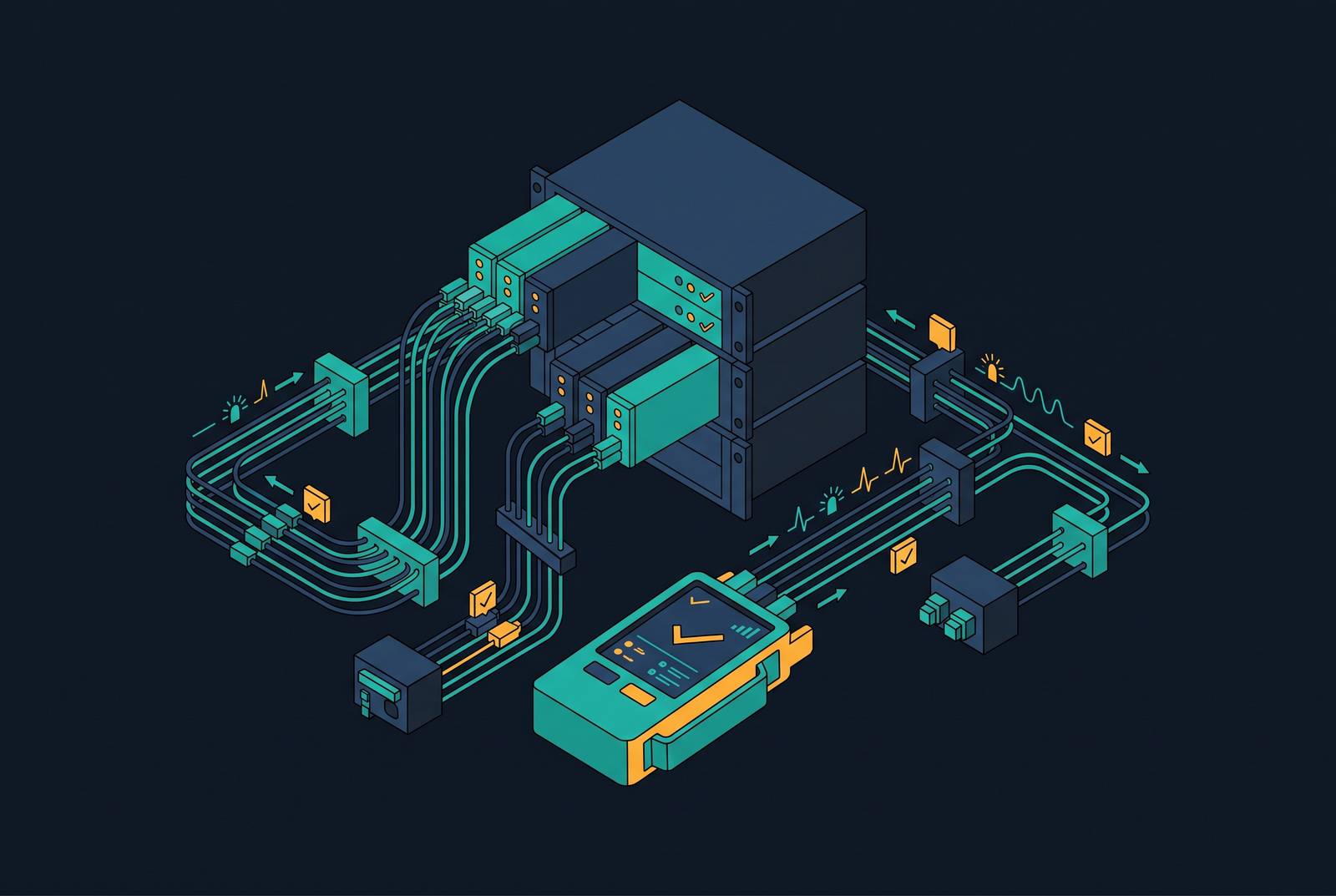
Service activation testing is the checkpoint between "the network says it's configured" and "the customer can actually use it." It catches the gap between a provisioning record and real-world performance, and it deserves the same attention operators give to fiber qualification or OSS design. Too many networks still treat it as an afterthought: a box checked after the technician leaves the site, rather than the gate that decides whether the site visit was worth making at all.
SAT does a narrower job than troubleshooting, monitoring, or physical-layer qualification, which handle signal levels, connector cleanliness, and link integrity before SAT ever runs. SAT confirms that a provisioned configuration, bandwidth, QoS profile, traffic policing against committed and excess rates, actually performs once the service carries real load. Provisioning says the service is set up, but SAT finds out whether that setup holds.
How the two dominant standards define what "passing" means
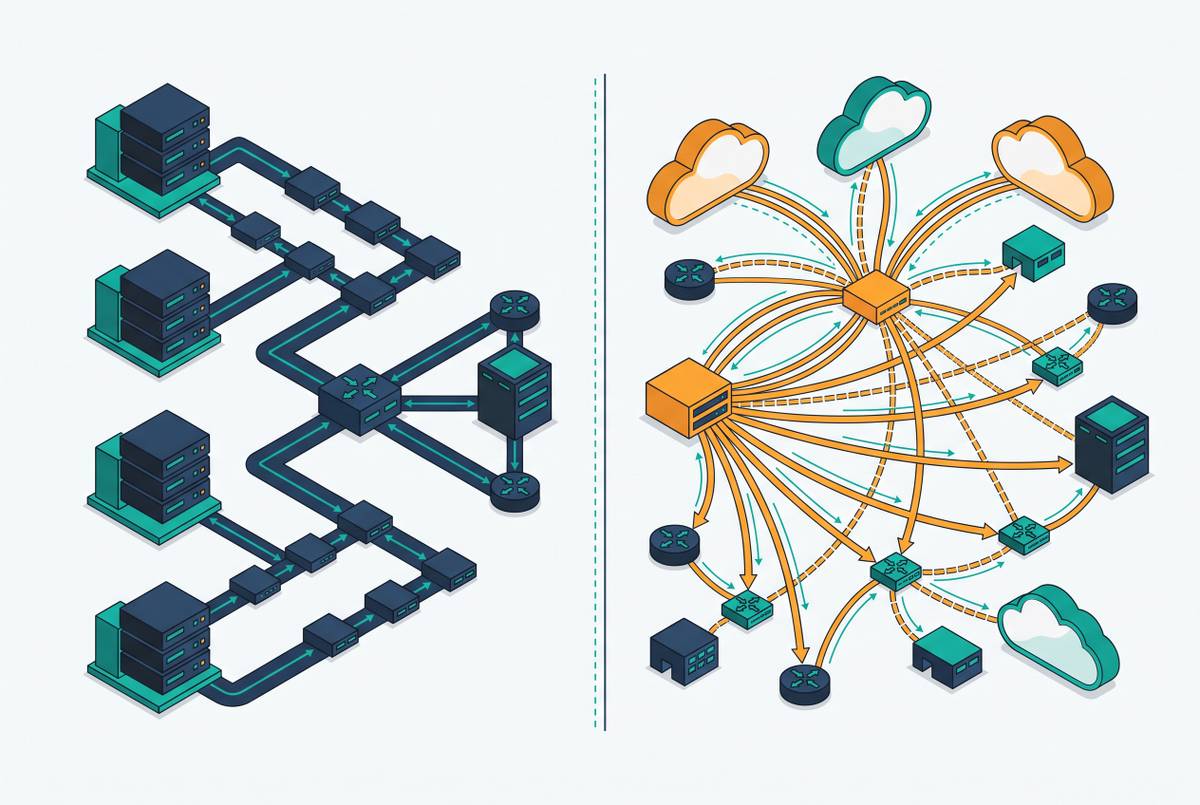
RFC 2544 was the early default, and it made sense for what it was built to do: benchmark individual network devices, one at a time, in sequence. That worked fine back when providers mostly sold Ethernet pipes, but it stopped working once providers started selling Ethernet services, each with its own SLA, running at the same time over shared infrastructure. Test one flow at a time and you never find out what happens when five flows fight over the same resources.
ITU-T Y.1564 is what most operators actually mean today when they say "service activation testing." It replaced RFC 2544 for architectural reasons, not incremental ones, because it tests every data flow and service attribute at the same time. That single design choice catches flow interactions serial testing can't see: contention, jitter under combined load, policing behavior when several services hit their limits together. Passing under Y.1564 means verifying frame loss ratio, frame delay, frame delay variation, and Ethernet availability, along with QoS correctness and CIR/EIR policing. It runs faster too, and it looks a lot more like what the network will actually see in production than a single-stream benchmark ever could.
ITU-T Y.156sam pushes that logic into medium- and long-term SLA validation. It has three jobs: validate the SLA itself, verify maximum committed rate across every service at once, and run a soaking period that stresses network elements over time instead of at a single instant. For operators whose SLA promise isn't just "does it work at turn-up" but "does it keep working," this is the standard that matters.
MEF 23.1 adds another layer, defining class-of-service performance objectives for more than 20 application types under Carrier Ethernet 2.0: Mobile Backhaul, VoIP, video conferencing, financial services, cloud services, and others. A single pass/fail threshold can't serve all of them fairly, since a financial transaction and a video conferencing stream tolerate delay and loss on completely different scales. Which standard an operator picks isn't paperwork; it decides, contractually, what "ready" means.
Where SAT sits in the fiber and carrier service delivery sequence
The activation workflow runs in order: qualification, design, provisioning, SAT, activation, billing trigger. SAT sits between the moment provisioning finishes and the moment the customer hears the service is live, and it works as a gate rather than a parallel track running alongside provisioning. Skip that gate, or rush it to save time, and the risk it exists to catch doesn't disappear. It just moves downstream, into the customer's first weeks of service.
In FTTH deployments, here's how the sequence actually runs. OSS/BSS generates a provisioning profile, VLAN assignments, speed parameters, voice settings, subscriber-specific customizations, tied to a device serial number. The ONT or router pulls that configuration from the provisioning server and comes online, and a technician then checks the physical layer on site: signal levels, connector integrity, link quality. Only then does SAT verify the provisioned profile actually delivers what it promises. Subscriber status flips to "active," and billing starts from that verified date, not from whenever the ONT happened to power on.
Carrier Ethernet runs a parallel logic. Y.1564 testing hits every configured flow before the service goes to the enterprise customer, and readiness comes down to pass or fail against defined SLA parameters, measured rather than judged by a technician's impression that things look fine.
Physical-layer qualification and SAT are separate jobs, and it's worth being clear about where one ends and the other starts. Fiber inspection, connector cleaning, and link qualification handle the medium the service travels over. I've seen disciplined pre-activation fiber work push build traceability toward a low single-digit failure rate at activation; EXFO has pointed to figures under 5% as achievable with the right process, which tracks with what shows up in practice. Clean fiber says nothing about whether the configuration riding on top of it is correct, and no amount of connector polishing substitutes for that verification.
The moment SAT lives in a tool separate from provisioning, the handoff between them turns into a system boundary. Boundaries are where delays pile up, where sync fails quietly, where a step that was supposed to run automatically slides back onto somebody's checklist.
Why multi-service, multi-OEM environments make SAT structurally harder
The original SAT model assumed one service type running over one vendor's gear. Almost no operator of any size still lives there. A network running Calix in one region, Adtran in another, and a recent Nokia deployment somewhere else needs a provisioning engine that speaks to all three, which means it needs a SAT process that works the same way across all three too.
When a technician has to figure out which OEM sits at a given site and then follow a different test procedure depending on the answer, complexity doesn't just eat into activation time. It changes what "verified" even means from one site to the next.
Multi-service complexity stacks on top, and the problem compounds. Modern networks run FTTH, GPON, XGS-PON, VoIP, video, and dedicated internet access at once, over shared infrastructure, and each service has to hold up under full load while everything else runs alongside it. This is exactly what Y.1564's simultaneous multi-flow testing was built for, and exactly why RFC 2544's one-flow-at-a-time approach can't do the job here. MEF 23.1's 20-plus application-type objectives exist for the same reason: Mobile Backhaul traffic, financial transactions, and video conferencing streams tolerate delay and loss so differently that one metric can't judge them all fairly.
The compound risk shows up at the seam between systems. A provisioning platform that handles multi-OEM environments well but feeds into a siloed SAT tool has just moved the coordination problem downstream, to the test boundary. Errors slip through not because either system failed on its own, but because nobody kept them talking to each other.
What siloed SAT tooling costs operators in practice
When provisioning sits in the OSS/BSS and testing sits somewhere else entirely, the trigger between them has to cross a system boundary. That's where things go wrong: delays, sync failures, manual steps designed to run automatically that, in practice, don't. None of this shows up cleanly in a log, but it shows up instead as a customer complaint about a delayed activation, or a service that quietly degrades in its first few days.
Manual entry, MAC addresses, service parameters, network assignments, adds error risk at every handoff along the way. An error SAT catches before activation is cheap to fix, while an error that skips past SAT because testing was informal, or skipped, or disconnected from provisioning, turns into a field escalation instead, a far more expensive way to find the same problem.
There's a billing angle too. If the billing cycle starts on a date that doesn't reflect a verified activation, the operator is charging for a service nobody actually confirmed ready. That's a contractual risk, and a fast way to burn customer trust. When SAT failures only surface after the technician has already left the site, the operator eats a return visit, probably the single most expensive fix anywhere in the activation workflow.
Siloed tooling also creates a blind spot for diagnosis. It gets genuinely hard to tell a provisioning error apart from a physical-layer problem or a plain configuration mismatch, because all three look identical to the customer and the field technician alike: the service just doesn't work. Zero-touch provisioning has done real work cutting manual configuration errors and shrinking installation time, but on its own, without SAT built into the same workflow, it only automates the setup half of the job. Verification stays manual, or worse, disconnected entirely.
How a unified data model changes what SAT can verify
When qualification, design, provisioning, and activation share one data model, SAT finally has something authoritative to test against. The configuration under test is the same record that carried the original service design and the customer's contracted parameters, with no translation layer sitting in between, and no version drift creeping in between what was ordered and what actually gets tested.
That unification also triggers tests automatically the moment provisioning finishes, running against the exact parameters living in that same system, rather than handed off to a separate tool with its own data format and its own guess at what the service was supposed to be.
There's a real audit benefit here too. When SAT results live in the same system as the provisioning record, the operator ends up with a continuous, queryable history: what was configured, what was tested, what the result was, when the subscriber went active, all in one place. The alternative, several systems stitched together after the fact, leaves the test result and the configuration record sitting in different stores entirely. Reconciling them takes manual correlation that, in practice, rarely happens consistently.
For Carrier Ethernet specifically, Y.1564 results tied directly to the service record give an operator a timestamped answer the moment a customer disputes whether the service met SLA at activation. Inside a purpose-built OSS for fiber and carrier delivery, one where AI agents and human operators work inside the same governed data layer, SAT results can do more than gate pass or fail. They become structured data that shapes provisioning quality over time: which configuration patterns keep generating failures, which OEM integrations produce consistent results, where in the network activation failures cluster.
The role of AI in making SAT a proactive rather than reactive step
Traditional SAT is binary and backward-looking. The service passes or fails at the moment of the test, and that result informs exactly one activation and nothing past it. Once SAT results start piling up inside a governed data model, AI agents can surface patterns no single test could ever reveal alone: provisioning configurations that consistently need a second pass before clearing, OEM or node combinations that produce elevated frame delay variation under load, network segments where activation failures cluster in ways that hint at a physical-layer issue before it spreads.
None of this works without governance. AI agents need to run on the same APIs, the same audit logs, and the same permission structures as human operators. Otherwise automated test triggers, result recording, and escalation routing stop being accountable actions inside the operational record and turn into shadow automation nobody can see.
This fits a shift already underway across the industry. A broad majority of telecom companies were already using AI in some form as of 2024, with adoption moving faster than many expected even a couple of years ago. The direction is away from narrow task automation and toward agentic AI that coordinates across network, IT, and business systems at once. SAT is a natural place for that coordination to land, since it already sits at the intersection of a configuration record, a test result, and a customer commitment.
The technician on site still matters, and that's worth saying plainly. What changes is the technician now gets real-time results, anomaly flags against expected parameters as they happen, and a loop closed back to the provisioning record automatically instead of left for a separate update later. First-time-right activation rates climb for operators who build SAT this way, feeding results back into how the next hundred sites get configured rather than treating each test as a closed event. Operators still running SAT as a checklist item find the same problems anyway; they just find them later, further downstream, with the customer already on the line.