Operational Complexity as a Competitive Disadvantage in Telecom
Fragmented systems force telecom operators to choose between patching complexity or rebuilding it.
Operational complexity in telecom compounds the way debt compounds, with interest that accrues faster as the network grows. The instinct across the industry has long been to patch around the problem: add a workaround here, hire a coordinator there, build a bridge between two systems that were never meant to talk to each other. That instinct treats complexity as friction, when the more accurate framing treats it as principal.
Fragmented OSS environments did not happen by accident. They are the residue of decades of point-solution purchasing, merger integrations that never fully merged, and platforms bolted onto platforms because a full replacement was always going to cost more, this quarter, than living with the seams. Each system carries its own data model, its own release calendar, its own way of failing. The seams between them, the manual reconciliation, the format translation, the handoff from one team's queue to another's, are where time and revenue quietly disappear. A single enterprise order can pass through five to seven internal departments before service goes live, and at every one of those handoffs, something gets lost, mistyped, or interpreted differently than the last person intended. In many mid-market telecom environments, that shows up as activation delays running 5 to 15 business days beyond the point where the network itself was ready to turn service up. The network moves at one speed. The workflow moves at another.
This distinction matters because it points to two very different responses. Operators who see this as a workflow problem will keep optimizing the seams, adding another coordinator, another dashboard, another exception-handling script. Operators who see it as an architectural problem will stop managing the seams and start removing them.
How fragmented workflows turn into measurable revenue loss
Order fallout is the number that makes the cost impossible to wave away. Legacy OSS and BSS platforms regularly post fallout rates above 30%, meaning nearly a third of orders trigger some kind of manual rework, a re-touch by a technician, or a repeat cycle through provisioning that consumes labor and capacity without producing a dollar of revenue. Across a carrier's total order volume, even modest fallout rates translate into substantial labor and capacity costs, which turns a double-digit fallout rate from an operational headache into a significant financial problem sitting quietly on the income statement.
The mechanics behind that number are not exotic. Data format mismatches between systems force someone to manually reconcile records that should have matched automatically. Workflows that should run in parallel instead run in sequence, because System B cannot start until System A finishes and hands off a file. Billing configuration lags behind provisioning readiness, so a circuit that is technically live sits there generating zero revenue while it consumes real network capacity, waiting on someone to key in a rate plan.
Enterprise Carrier Ethernet and dedicated internet orders take this exposure to another level. Custom pricing, multi-tier discount schedules, and contract-specific billing terms all have to get configured correctly in the BSS and OSS stack before activation can move forward, and every one of those configuration steps is another place where the process can stall. The pattern across all of it is the same: complexity does not just slow the business down. It creates moments where revenue that should have landed simply does not.
The scale of investment chasing the problem confirms its severity
A 2025 IDC-Ericsson report projects global OSS/BSS modernization spend will hit $211 billion between 2025 and 2028, naming legacy OSS and BSS platforms as one of the biggest barriers standing in the way of telecom growth. The broader OSS/BSS market, valued at $65.81 billion in 2024, is forecast to reach $148.26 billion by 2033, growing at a 9.4% compound annual rate. That scale of spending reflects an industry rebuilding its plumbing, not fine-tuning a modernization budget.
Money at that scale does not move because operators want new features on the same old system. It moves because the architecture underneath can no longer carry what the business needs it to carry: the ability to scale AI, the ability to launch a new service in weeks instead of quarters, the ability to monetize revenue models that did not exist when the platform was designed. Separately, the global telecom network automation market is projected to grow at a 22.5% compound annual rate, reaching $32.7 billion by 2026, a pace well ahead of the broader OSS spend curve. That gap tells you where operators think the real leverage sits.
None of this guarantees the outcome operators are paying for. Committing $211 billion to modernization is not the same as closing the gap; the architectural choices made with that capital will decide whether the money actually buys unification, or just buys a newer version of the same fragmentation.
Why legacy OSS platforms fail on architecture, not just age
Calling these systems "outdated" undersells the real issue. Age is not the defect. The defect is that legacy OSS platforms were never built around a single, shared data model in the first place. They were built as functional blocks, each one doing its job and passing a record to the next block in line, the way an assembly line passes a part from station to station.
That design shows up as rigidity everywhere you look. Update cycles of four to six months, even for small changes, mean an operator cannot respond to a competitor's move or a new regulatory requirement at the speed the market actually demands. Data spread across multiple systems, each with its own schema, cannot support the kind of real-time correlation that proactive assurance or zero-touch provisioning requires; you cannot correlate what you cannot see in one place. Integration layers stacked on top of these platforms, meant to paper over the gaps, add their own latency and their own new points of failure at every seam they touch.
These platforms became rigid and expensive right as 5G, cloud-native network cores, and new service models started demanding the opposite: agility, speed, and the ability to reconfigure on short notice. The deeper problem is that these systems were built for an operational model that assumed a human being would sit in the middle, correlating information by hand and deciding what happens next. Layering workflow automation on top of that model does not fix it. It moves fragmented data between silos a little faster than a person could, without addressing the underlying design.
What the AI readiness gap looks like when you measure it
Intent is nearly universal. The NVIDIA Annual Telecom AI Study 2025 found 97% of telecom organizations were assessing or actively adopting AI that year, up from 90% in 2024. Delivery has not kept pace: only 19% of communications service providers have successfully embedded AI into more than three OSS or network functions. Everyone is trying. Almost no one is finished.
That gap traces back to architecture rather than to talent or tooling shortages. AI agents bolted onto legacy OSS through APIs and integration layers inherit every bit of the data fragmentation sitting underneath them; you cannot ask an AI agent to correlate insight across three siloed systems if the agent only has an API key into one. Task-based automation can speed up a predetermined step, sure, but it cannot look across the full picture and decide what to do next without a person stepping in. According to the same study, 57% of telecom executives see cloud and AI as critical to building autonomous networks, but autonomous operations need unified, event-driven data flowing through the system in real time, not a set of patched-together feeds pulled from five different legacy stacks.
The useful distinction here is AI-augmented versus AI-native. AI-augmented means the AI sits on top of the existing architecture, working with whatever data it happens to be able to reach. AI-native means the AI operates inside the operational model itself, on the same data, the same APIs, and the same workflows as the human operators sitting next to it, with the full picture available in real time rather than a slice of it. Appledore Research forecasts agentic AI in telecom growing from $92 million in 2025 to $6.2 billion by 2030, a trajectory that says the industry is moving toward AI that takes action, on top of AI that produces a report. Operators whose architecture can actually support that shift will move faster than the ones whose architecture cannot; there is no patch that closes that distance after the fact.
Why governed AI in operations is an architectural requirement, not a compliance checkbox
The governance gap runs right alongside the adoption gap. Industry research has found only one in five companies has a mature model for governing autonomous AI agents, even as agentic AI is already moving into provisioning, customer care, and live network operations. Governance is arriving after the automation, running exactly backwards from where it needs to sit.
Telecom carries risks here that most industries do not. Networks qualify as critical digital infrastructure under Europe's AI Act, in force since August 2024, which brings obligations for documented risk management, auditable training-data governance, automatic event logging, and clearly defined points of human oversight. CPNI rules, CALEA requirements, GDPR, and the NIS2 directive all mean that any AI system touching a regulated function has to guarantee data integrity, traceability, and auditability, on demand, to a regulator who does not accept "the system is a black box" as an answer. And AI systems making decisions at millisecond speed generate a volume of operational events that no conventional monitoring tool was ever built to capture; you cannot bolt a logging system designed for human-paced operations onto a decision loop running a thousand times faster.
Governance cannot be retrofitted onto AI that shipped without it. Audit trails, permission structures, and decision logs have to be part of the system's design from day one, not added after an incident forces the question. Gartner's 2025 research predicts guardian agents, meaning AI systems whose job is governing other AI, will capture 10 to 15% of the agentic AI market by 2030, a clear signal that the industry is already formalizing AI-on-AI oversight as its own category rather than treating it as an afterthought. AI agents operating on the same APIs, the same audit logs, and the same permission structures as human operators are simpler to audit and represent the architecture where governance at operational scale is actually achievable, because there is one record of what happened, not five records that have to be reconciled after the fact. Shadow automation, AI tooling running outside that governed stack, becomes a bigger liability every time the automation footprint grows. Holding AI to the same accountability as every other action an operator takes is the fix that matters here, more than adding or removing AI itself.
What FTTH and Carrier Ethernet deployments reveal about the cost of workflow fragmentation
North American fiber broadband deployments reached nearly 12 million homes passed in 2025, the highest growth on record for the category. The build-out itself is not the bottleneck. The workflow behind the build is what slows a subscriber from getting service, quite apart from the fiber in the ground.
FTTH activation at scale puts every seam in a fragmented stack on full display. In most legacy environments, subscriber registration, network construction records, and service activation each live in a separate system, with separate owners and separate update schedules. Zero-touch activation, the point where a subscriber buys service and it turns on without a human touching it, requires all three of those systems to share one operational view. A siloed stack simply cannot deliver that, no matter how much workflow automation gets layered on top.
Carrier Ethernet and dedicated internet orders add a second layer on top of that. Custom pricing, multi-tier discounts, and contract-specific billing terms all need to be configured correctly across BSS and OSS before activation can proceed, and when billing configuration lags behind provisioning readiness, a completed circuit sits idle, generating no revenue while it consumes real network capacity. This is a direct consequence of two systems that do not share a data model, more than a training issue or a staffing issue: provisioning finishes its job in one system while billing sits waiting for someone to manually trigger the next step in another. The scale of investment flowing into order management reflects just how real this problem has become; operators are pouring money into order management specifically because broken order flows are a known, quantifiable drain on revenue. FTTH and Carrier Ethernet have become the main delivery surface for modern service providers rather than edge cases for OSS, and they need tooling built for how they actually work, not generic network management software stretched to fit.
What a unified data model actually changes about service delivery operations
A unified data model amounts to a re-architecture of how qualification, design, provisioning, and activation relate to one another, well beyond a database migration with a new coat of paint, so that they stop behaving like four separate businesses that happen to share a logo.
Once the data model is unified, qualification data carries straight through into design without anyone re-entering it, and without a translation step where formats have to be converted from one system's dialect to another's. Provisioning state becomes visible to billing in real time, so a completed circuit starts generating revenue the moment it is ready, instead of waiting on a manual trigger somewhere down the hall. AI agents working against that unified model can correlate across the entire service lifecycle rather than optimizing one silo in isolation. Audit trails cover the full sequence of events, human and AI both, because every action writes back to the same record instead of five different ones.
The operational payoff follows directly. Order fallout drops because the handoffs that cause fallout get eliminated, not just watched more closely. Activation timelines compress because systems that share state can run steps in parallel instead of waiting in line for each other. Zero-touch provisioning becomes something the architecture supports natively, well beyond a bolt-on automation trick, because every step in the workflow already has the information it needs sitting right there. Instead of isolated functional blocks passing records back and forth, an AI-native system lets its components collaborate, learn from live data, and improve on their own, moving the operator from reactive firefighting toward operations that are proactive and, eventually, largely autonomous. The competitive upshot is straightforward: an operator running a unified stack can launch a new service or change an activation workflow in a fraction of the time it takes a competitor to coordinate the same change across five systems that were never designed to agree with each other.
How operators who consolidate now will separate from those still patching legacy systems together
This divergence is already happening rather than sitting out as a future risk. Operators running unified, AI-native stacks are shrinking the gap between network readiness and revenue, while operators still running fragmented legacy systems are spending that same interval on manual reconciliation, watching completed work sit idle because a form has not been filled out in the right system yet.
As agentic AI capability expands, from $92 million in 2025 toward a projected $6.2 billion market by 2030, operators whose architecture can absorb that capability will compound their advantage with each new deployment; operators whose stacks cannot will fall further behind every single cycle, because the gap is not additive, it is multiplicative. The $211 billion in modernization spend projected through 2028 functions as a forcing function more than an optional spending line. Operators who delay consolidation are not avoiding that cost. They are deferring it while they continue paying the ongoing tax of complexity, in fallout, in activation delays, in circuits sitting idle and earning nothing.
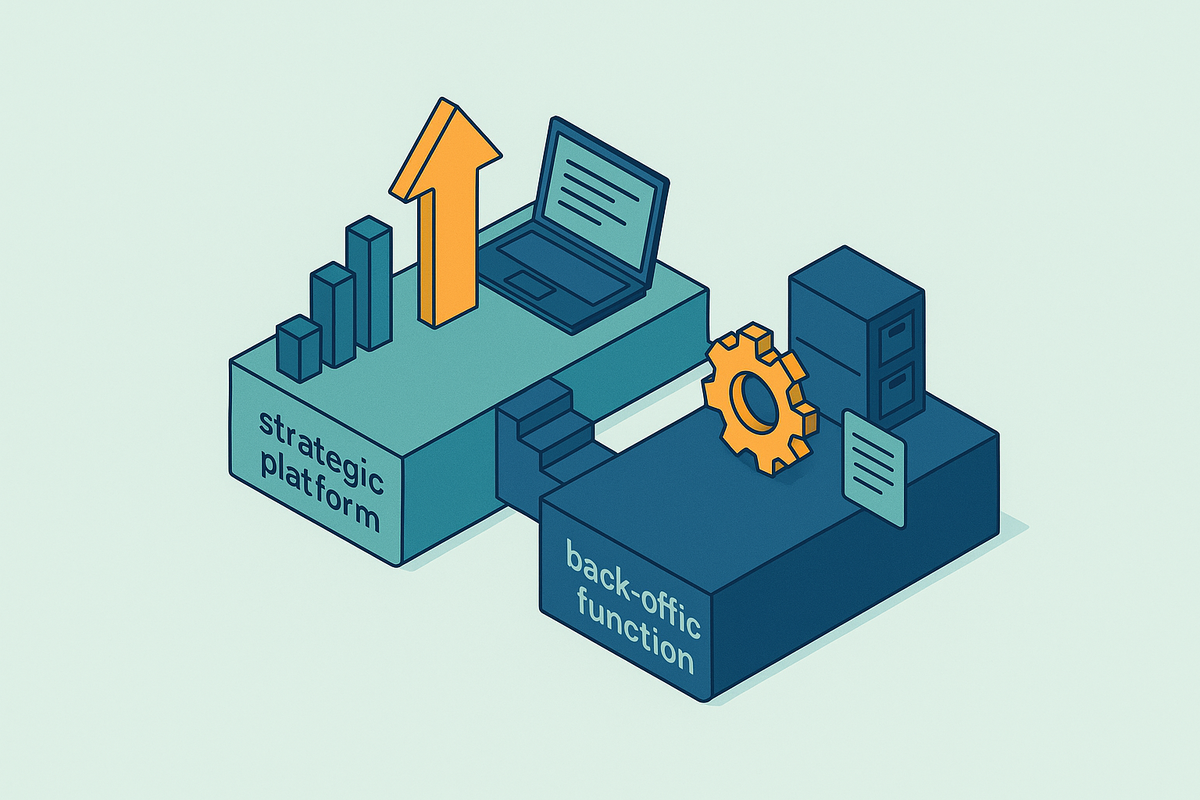
In practice, the operators pulling ahead treat OSS as a strategic, AI-ready platform that determines how fast a service can launch and how reliably an SLA gets met, well past its old role as a back-office utility. They hold AI and human operators to the same standard of visibility and accountability, working off the same data, the same audit trail, the same source of truth. That is the difference that compounds. Everyone else is still hiring another coordinator to bridge two systems that were never meant to talk, and calling it progress.