Qualification Workflow Differences for Dedicated Internet vs Carrier Ethernet
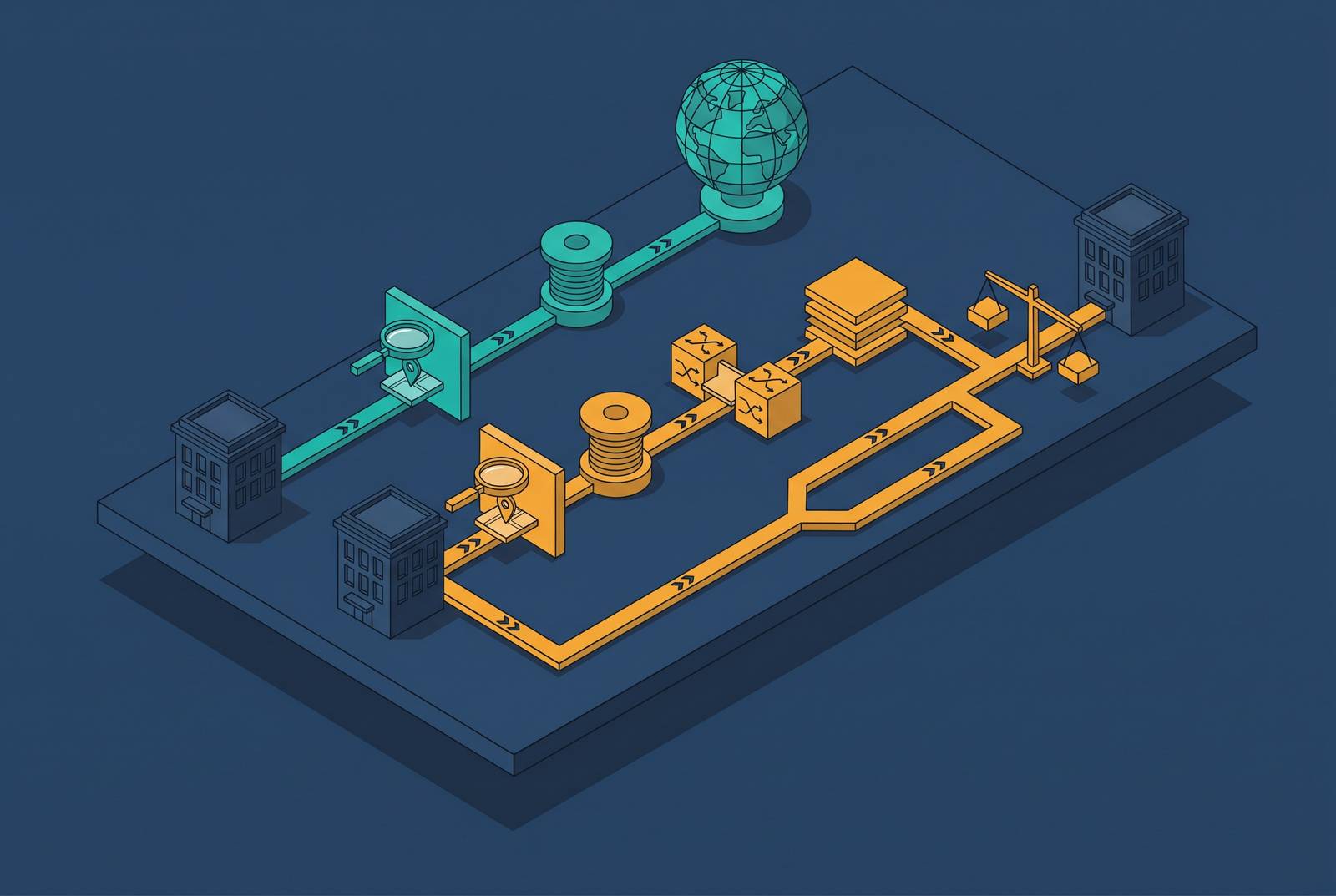
DIA resolves whether one site can receive a defined internet service. Carrier Ethernet validates a topology across endpoints and, sometimes, operators. Service providers need a shared OSS data model that preserves this distinction, so qualification produces the records that design, provisioning, and activation actually require.
How DIA and Carrier Ethernet differ as services before qualification begins
DIA is a private, uncontended connection from one premises to the public internet, while Carrier Ethernet provides private Layer 2 connectivity between sites, data centers, or cloud endpoints. Internet breakout is not part of Carrier Ethernet unless explicitly designed in. Neos Networks distinguishes DIA’s site-to-internet connection from Business Ethernet’s connections between sites or to data centers without crossing the public internet. The service boundary determines what qualification must resolve. DIA has one customer, one port, and one connection to the provider’s internet gateway.
Carrier Ethernet instead requires a choice of endpoint relationships. Its service types include E-Line, E-LAN, E-Tree, and E-Access, with different connectivity and traffic-separation requirements. E-Line supports point-to-point connections, while an EVPL design with multiple EVCs per UNI can connect to multiple endpoints. E-LAN has any-to-any connectivity, E-Tree has rooted multipoint connectivity that keeps leaves separate, and E-Access carries the service through another operator’s network. Bandwidth also has a different service structure. Carrier Ethernet’s committed and excess capacity must be tied to the connections it serves, even when it is also recorded as a site’s internet port commitment.
What DIA qualification actually resolves: single-site feasibility logic
DIA qualification starts by checking whether the address is on-net, with provider-owned fiber end-to-end, or off-net, where it needs a Type 2 leased loop. This distinction governs both delivery dependencies and SLA treatment. Lightpath’s buyer’s guide says that service outside a provider’s footprint is delivered over Type 2 and that the carrier is managed directly. That dependency belongs in qualification before order acceptance. A feasible site is not necessarily a site the provider can deliver entirely through its own infrastructure.
The access medium then constrains the available bandwidth. Fiber delivers the same speeds regardless of distance, while copper-based access, including EoC and legacy T1/DS1, has limits on how far it can reach and how much capacity it has. Availability records must also reflect service withdrawals. AT&T’s Michigan Guidebook states that, effective November 1, 2025, the services described in Part 15, Section 3 are no longer available for purchase by new or existing customers, except in the listed wire centers.
Once reach and medium are established, the remaining decisions follow a bounded sequence. Qualification resolves the bandwidth tier, BGP peering configuration, IP address allocation, and SLA class, including unprotected service or protection over diverse paths. The customer’s WAN edge is the handoff, and the provider is responsible for the internet gateway. The customer qualification record does not need to describe a multi-site private topology beyond that handoff. The 95th-percentile overage model likewise resolves a committed rate and port measurement arrangement.
What Carrier Ethernet qualification actually resolves: multi-endpoint topology validation
Carrier Ethernet qualification begins with the service type because that choice defines the relationships to validate. An E-Line order requires point-to-point EVC validation, including the relevant EPL or EVPL arrangement. An E-LAN order needs any-to-any connectivity across two or more sites, while E-Tree needs the planned root-and-leaf relationships and traffic separation. E-Access introduces reach through another carrier’s infrastructure. The endpoint set alone is therefore insufficient. Qualification must establish how those endpoints are allowed to communicate.
Neos Networks describes E-Access as extending service to off-net subscriber sites through an external NNI, so qualification must include the other operator’s reachability. At every inter-domain boundary, ENNI feasibility includes bandwidth profiles, OAM continuity, and performance monitoring endpoints. Unlike DIA’s initial reach classification, the Carrier Ethernet record must retain the parameters that make the inter-provider connection workable.
Bandwidth validation follows the EVC. CIR and EIR profiles must be captured per connection, even where multiple EVCs share a UNI. OAM and performance monitoring endpoint configuration must also be resolved during qualification because they define activation verification and fault isolation across operator boundaries. Deferring those decisions leaves the service incompletely qualified. Carrier Ethernet qualification therefore terminates only when its endpoints, UNI parameters, inter-carrier handoffs, and per-EVC profiles form a reconciled topology record.
Where qualification errors become provisioning failures — and why the gap is wider for Carrier Ethernet
A DIA qualification error commonly becomes a delivery problem through reach, medium, or dependency data. A wrong on-net status can lead to a truck roll to check whether a loop is available. A misrecorded access medium can leave provisioning with a bandwidth commitment the access cannot support, while an underestimated Type 2 lead time pushes out the billing date. The commercial consequence follows the technical omission.
Carrier Ethernet exposes more relationships to the same risk. A wrong UNI parameter at one endpoint, an unconfirmed ENNI, or a per-port profile used where a per-EVC profile was required can halt provisioning. Corrections may span several systems and organizations. In a five-site E-LAN, all five UNIs must be validated, together with the applicable EVC profiles and any ENNIs. The error space grows beyond the endpoint count because the relationships and boundaries between endpoints must also be correct.
Both services are at risk when the address and network records in one system disagree with those in another. Those disagreements force staff to check records by hand before quoting, while errors found later can lead to truck rolls and delays in billing. Multiple providers make resolution harder still. An on-net engineering team can work from one provider’s end-to-end record, whereas Type 2 and multi-provider services introduce separate organizations with their own responsibilities. The qualification record must be authoritative enough to settle activation disputes without reconstructing the service design. For Carrier Ethernet, that authority depends on preserving the interconnections as well as the individual endpoints.
Why a shared OSS data model must represent both qualification paths without collapsing them into one
The architectural requirement is to represent both records in their native form. A DIA record contains the site address, on-net or Type 2 flag, access medium, bandwidth tier, BGP configuration reference, IP address block, and SLA class. Its completeness can be assessed against that bounded set of fields. Carrier Ethernet needs a different completeness test. Its record includes EVC type, per-endpoint UNI specifications, ENNI references, per-EVC CIR/EIR profiles, OAM endpoint identifiers, and MEF 3.0 service attribute conformance flags, with all endpoints reconciled as a topology.
Flattening Carrier Ethernet into a site record removes relationships that provisioning and activation need. Adding every topology requirement to DIA instead burdens a bounded workflow with irrelevant structure. Unification means qualification, design, provisioning, and activation can use the service’s complete record without rebuilding its meaning at each handoff.
This is also the distinction between integration and unification. APIs or middleware can connect separate OSS and BSS systems, but their translation layers remain vulnerable when either system changes. In a unified model, qualification data flows directly into work order creation, with the serving infrastructure, available services, and required equipment already associated with the qualified address. Changes must follow the same principle. If a UNI parameter changes during Carrier Ethernet design, the qualification record and affected provisioning or activation state must update immediately, rather than wait for batch reconciliation against stale data. Structured Type 2 flags and ENNI references must likewise support work order management and partner coordination without re-entry.
How AI-native OSS qualification differs from rule-based and AI-augmented approaches
The data model determines what AI can reliably do in qualification. Address anomaly detection, prediction of Type 2 lead-time risk, and automated ENNI feasibility checks against partner data all depend on current, consistent, structurally complete records. Missing topology relationships are missing inputs to an AI layer’s decisions. Automating an incorrect verdict can propagate the error faster than manual handling, making ungoverned AI on fragmented data worse than leaving that decision unautomated.
Rule-based qualification handles the cases encoded in its rules. A new EVC type, partner ENNI, or topology combination outside that rule set can fail silently or require manual handling. AI-augmented systems add models for tasks such as anomaly detection or predictive maintenance, but may leave the fragmented legacy records beneath them as they are. That distinction is consequential in live qualification. A model can reason over data that was accurate yesterday while design and provisioning are already working with changed endpoint parameters.
An AI-native architecture instead embeds AI in the qualification decision flow, using the same APIs, audit trails, and permissions as human operators. An agent flagging a UNI mismatch across two E-LAN endpoints acts on the same record as the provisioning engineer. Every automated on-net check, bandwidth profile validation, and ENNI feasibility query is logged in the same audit trail as a human action. With a unified model, this approach can validate endpoints in parallel, identify ENNI gaps against live partner data, and expose CIR/EIR inconsistencies before provisioning, without requiring a human to assemble the topology from scratch for every order.
What service providers should verify in their qualification workflows for each service type
Providers should first check whether DIA qualification keeps the on-net or off-net flag for each address in step with network changes without someone having to update it by hand. They should then examine whether the recorded access medium constrains the bandwidth tiers offered, including current DS1/T1 availability. Qualification must record the SLA class, including whether protection uses diverse paths, and pass it into design and provisioning. Providers should also check whether the Type 2 dependency is in a structured field that triggers partner coordination or only in a free-text note that waits for someone to act on it.
For Carrier Ethernet, the assessment should begin with whether qualification distinguishes E-Line, including EPL and EVPL, from E-LAN, E-Tree, and E-Access. Providers should check whether the service record holds per-endpoint UNI specifications and per-EVC CIR/EIR profiles in a structure that shows how they relate, or as flat order line items that hide those links. They should also examine whether ENNI references and partner feasibility checks belong to the workflow or remain in email and spreadsheets. An endpoint change during design also shows whether the qualification and active provisioning records update at once or wait for a later reconciliation cycle.
These checks should reveal different downstream steps and partner coordination paths for the two services. They should not reward a single template merely because both products can be entered into it. Providers should establish whether qualification, design, provisioning, and activation operate on a unified service record or exchange translated versions through middleware at every handoff. Field gaps, manual coordination, and stale updates are symptoms of that deeper distinction. A shared data model addresses them only when it preserves DIA’s single-site feasibility record and Carrier Ethernet’s multi-endpoint topology without reducing either to the other.