Policy Enforcement Points for AI in Multi-Domain Network Environments
Unified control layers must govern AI actions across network domains as a single path.
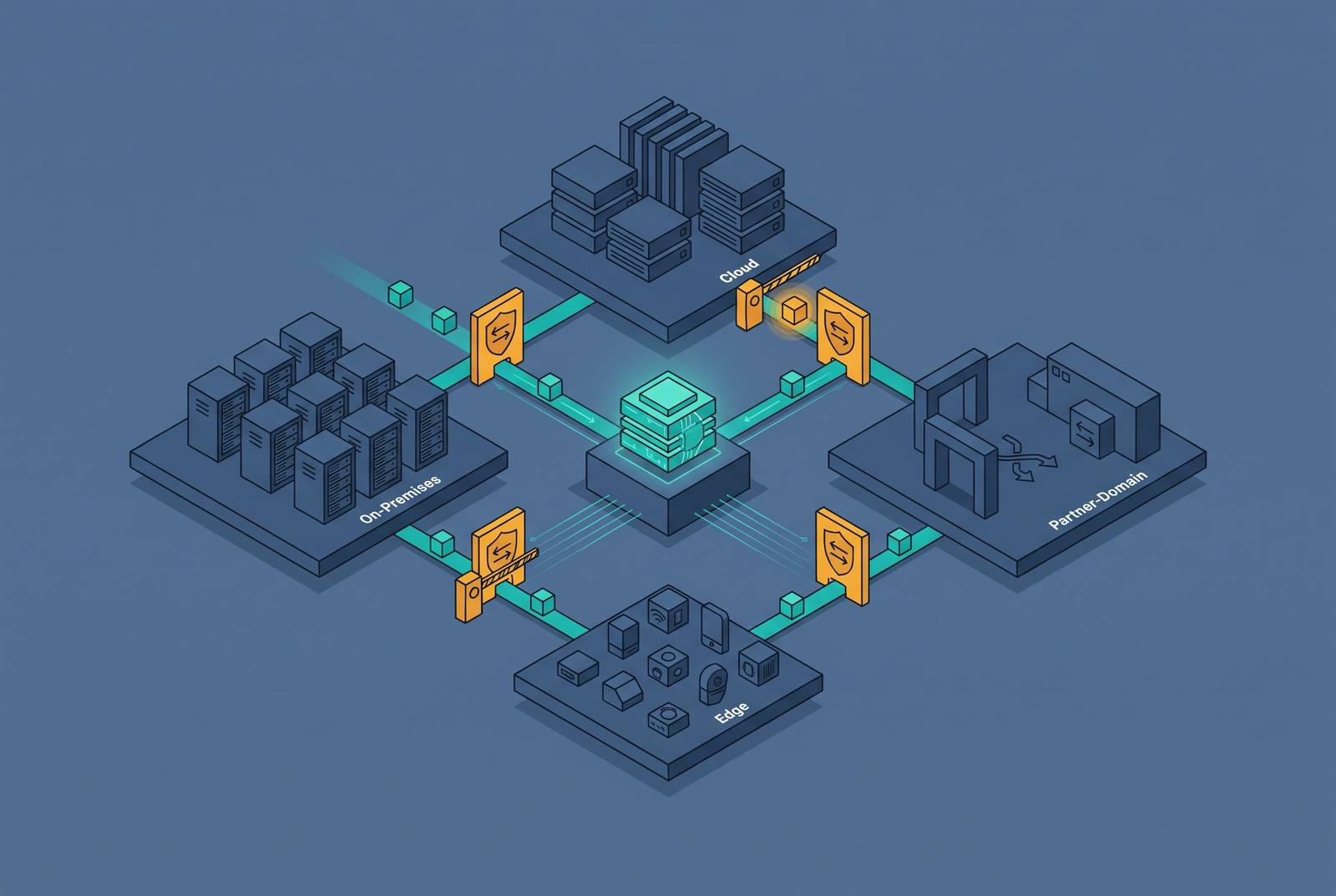
Policy enforcement points for AI in multi-domain networks belong in a unified control layer. Every AI action must pass through the same identity, permission, and audit structures as a human action, regardless of which domain it touches. This needs shared policy, authoritative data, and governed execution along the whole action path.
Why domain-specific AI controls fail in multi-domain networks
An AI agent adjusting RAN parameters may then reach into transport, core, and OSS provisioning to coordinate a service change. Each step crosses a different enforcement perimeter. The RAN controller can authorize the radio adjustment, but its decision grants no authority over the agent’s later provisioning action. At the same time, separate controllers can accept actions that clash across domains and cause configuration drift that no controller can detect or roll back on its own.
The AI-Native Network Controller framework paper identifies fragmentation across domains, protocols, and vendor-specific management systems as a foundational obstacle to coordinated automation. This fragmentation also divides the evidence needed to govern an agent’s work. A controller may know that a local command is permitted without knowing whether it conflicts with a change elsewhere. Local permission is not end-to-end authorization.
Enterprise multi-provider AI exposes the same weakness when a request bypasses a gateway or an agent uses a direct API key. A policy can look uniform while execution remains fragmented. In networks, the gap lies between individually controlled domains and the cross-domain intent the agent is trying to fulfill.
What a policy enforcement point actually does, and why its location determines everything
A policy enforcement point, or PEP, intercepts an AI action before execution, evaluates it against identity, entitlement, and data classification rules, and logs the outcome. It is not merely a destination filter. A permitted endpoint can still receive an impermissible prompt, retrieved context, response, or tool call, so enforcement must inspect the actual exchange.
The evaluation establishes whether the requester is a human, service identity, or AI agent and what data the request sends. It also determines which provider, model, or tool is permitted, whether budget, rate, geography, or retention constraints apply, and how the event will be recorded. These checks need a common execution boundary. Otherwise, the same request can receive different treatment depending on its route.
For multi-provider AI, that boundary sits at a gateway or proxy before requests reach models, agents, or tools. For telecom, the equivalent is a governed control layer spanning RAN, transport, core, and BSS/OSS. Its placement determines the scope of its authority and evidence. A PEP embedded in a domain controller can see only that domain.
How the AI-NNC's layered safety model demonstrates what cross-domain enforcement requires
Trinity College Dublin’s AI-Native Network Controller (AI-NNC) illustrates how a cross-domain boundary can be built into the architecture. Physical devices connect through lightweight Python adapters, and domain-specific control applications give agents access to validated tools. The adapters abstract protocol differences without giving agents unrestricted device access. Agents operate exclusively through the validated applications.
The framework adds explicit command validation based on the principles of safe reinforcement learning. This helps provide safety guarantees and detect conflicts between applications by checking their commands together. Validation therefore governs both the agent’s initial access and the command path. Direct agent-to-device commands are excluded because they bypass that protection.
Uniform measurement and control interfaces also support both operational control and dataset collection. The resulting audit trail follows from the validated path. As an illustrative design model, the framework establishes concrete criteria for other approaches, including protocol-agnostic integration, validated applications, and command validation. Its treatment of unified radio access, optical transport, and core control as a fundamental requirement for future 6G systems makes those criteria architectural requirements.
Why the AI path crosses multiple planes and no single sensor covers it
A unified policy layer still needs to see what happens across distinct activity planes. The network plane sees traffic leaving managed devices but misses local activity that never leaves in an inspectable form. Endpoint software sees desktop applications, terminal sessions, and local agents, but not API-layer activity. Neither vantage point covers the whole exchange.
The API plane governs calls that programs make to services and providers, while the browser plane sees AI use within a page. API controls do not cover sensitive data pasted into a chat interface, and browser controls cannot follow activity outside the browser. Streaming adds another visibility problem. WebSockets and QUIC, Protobuf and JSON payloads, and multi-turn state demand more than classic request-response HTTP parsing, because accumulated context can change a policy decision between turns.
In telecom, a RAN RIC control point sees radio actions, while an OSS API gateway sees provisioning. Neither can follow the whole path through RAN, transport, core, and OSS. Retrieved documents and tool results can also contain prompt injection that attempts to override the agent’s task. Enforcement must therefore distinguish instructions from data and coordinate observations under one policy model.
What composable, model-agnostic control planes teach telecom about portable policy enforcement
Composable AI architecture keeps policy enforcement separate from the work of running a model. Its control plane provides a common policy execution environment regardless of which provider receives a request. This separation makes governance independent of model choice. The telecom parallel is a control layer whose rules remain valid when a domain controller or vendor changes.
Azure AI Content Safety serves its ecosystem, while AWS Bedrock Guardrails can apply policies to models outside Bedrock through the ApplyGuardrail API. The latter’s configuration and management remain within AWS infrastructure. Covering more models therefore does not, on its own, make policy portable.
A model-agnostic control plane standardizes inputs and outputs so applications do not absorb provider-specific differences. A provider swap can then become a tested configuration change with rollback. The corresponding telecom test is whether adding or replacing a domain preserves guardrails, approval gates, and decision logs. Those artifacts must be exportable. Otherwise, the operator has centralized access without gaining independent control of governance or its audit trail.
How ODA's governed execution layer operationalizes cross-domain PEPs at industry scale
TM Forum’s AI-native Open Digital Architecture (ODA) gives the industry a way to put this control-plane pattern to work. TM Forum members introduced AI-native extensions at DTW Ignite 2026 in Copenhagen, adding a governed execution layer for agents within the component architecture and Open APIs already in place. AI actions go through the same structures that govern human operators. The design preserves human control and accountability.
ODA Canvas Operators provide centralized control over secure agent interactions, guardrails, and access to data products and LLMs. Standardized AIOps patterns also address observable and explainable decisions and proactive management of token consumption and costs. A reference implementation supports demonstrations of Level 4+ autonomy. That level requires independently orchestrated components, strong API coverage across provisioning, assurance, inventory, and billing, and governance of agent actions and escalation.
As of DTW Ignite 2026, a large cohort of global CSPs representing billions of subscribers had achieved “Running on ODA” accreditation, establishing production scale for the modular architecture. The governed execution layer keeps deterministic systems of record in place, with AI working beside them. ODA and the AI-NNC thus apply the same principle at different layers, through governed components and validated control applications respectively.
Why unified data models are not just an efficiency play but the enforcement substrate AI agents operate against
Governed execution depends on the records used to authorize it. A correctly placed PEP can still approve an incorrect action if identity, entitlement, or resource data is stale or contradictory. Fragmented legacy OSS models therefore add to the cost of integration and leave flaws in governance. The policy check can pass against the wrong network state.
FTTH, dedicated internet, and Carrier Ethernet workflows make that dependency concrete. Fiber fulfillment can require checks of whether service is feasible at an address and conditional reservations for installation appointments, with each step governed by current inventory and workflow data. Operators often use systems that were not designed to work together to manage billing, provisioning, device management, and field service. Each silo adds a place where enforcement may miss an action.
A unified model gives the enforcement layer one authoritative record of which resources are available, replacing versions that disagree. This removes the conflicting-record basis for configuration drift and supports reliable autonomous provisioning. Unification does not excuse poor underlying data. In mergers and acquisitions, inventory and GIS records may not match actual conditions, so buyers have to re-digitize before governance can work reliably across the combined estate. The enforcement substrate must be both shared and accurate.
Governance tiering — why binary allow/block rules cannot govern AI agents operating across domains
Accurate data supports a decision, but the decision must reflect the action’s consequences. Waiving a fee and restructuring a contract demand different authority. In network operations, the corresponding distinction is between a routine parameter adjustment and cross-domain reprovisioning that affects live equipment. Binary allow/block rules either block useful automation or let actions go ahead on their own when they need human approval.
Tiered governance differentiates actions by type, blast radius, and reversibility before deployment. Draft-first execution follows draft, validate, approve, and commit stages, with human approval for sensitive actions and explicit gates separating deterministic constraints from probabilistic reasoning. Registering an intent still leaves limits on what an agent has authority to do next. Policy also constrains the domains an agent may touch, the tools it may invoke, and the escalation path when it reaches a limit.
Scoped credentials make those constraints enforceable for the agent itself. Authorization to adjust RAN parameters does not authorize changes to core routing policy. Each action class also needs a rollback mechanism and a measurable KPI, so cooperating agents can reverse changes when performance regresses. Decision logs must preserve enough context, including model selection and tool invocation, to reconstruct the request path for incident response or regulatory review.
Blue Planet's agentic framework as a live example of unified enforcement across OSS domains
Blue Planet puts inventory, orchestration, and assurance on a platform shared across domains and vendors. That shared view of operations gives isolated controllers the context they lack, so automation can run end to end. Teams work from common data and processes. The enforcement boundary can therefore align with the service workflow.
Its three-layer agentic AI framework exposes OSS data through the Model Context Protocol (MCP) and embeds a secure LLM gateway. CSPs can select models based on capability and compliance requirements while retaining transparent, auditable agentic processes. This makes oversight part of the framework’s execution architecture. It is not presented as a separate inspection step after autonomous work has finished.
With the protocol-level interface, agents get OSS context through a governed path instead of using direct database access or informal API calls. That path maintains the boundary between instructions and data while preserving cross-domain visibility. The framework illustrates how shared operational data, model selection, and auditability can coexist within one OSS architecture. Those are the properties a provider needs to assess, beyond the presence of an agent interface alone.
What service providers must require of an OSS platform to make cross-domain AI enforcement viable
For service providers evaluating OSS modernization, these architectural principles become procurement requirements. A platform must provide a unified data model across qualification, design, provisioning, and activation. Agents must use the same APIs, permissions, and audit structures as human operators. That commitment must be verifiable in the control plane.
The control plane must also be model-agnostic and domain-agnostic, with configuration changes and rollback supporting model replacement or domain addition. Governance tiering must be built into how actions run, with draft-first workflows, human approval for high-blast-radius actions, and domain-aware credentials. Portability is the test against renewed lock-in. Operators should require exportable guardrails, approval gates, and decision logs rather than accept explainability confined to one vendor’s infrastructure.
For CLECs and fiber operators, consolidation across qualification, design, provisioning, and activation supports both margin protection and consistent governance. Gateway tooling cannot make up for data that conflicts or for agents that act outside shared authority structures. An AI-native OSS must provide those structures from the ground up, because adding AI features to a legacy stack does not supply the enforcement architecture it lacks.