Software Configuration Management in Service Provider Networks
Configuration consistency is now the foundation of automated network service delivery.
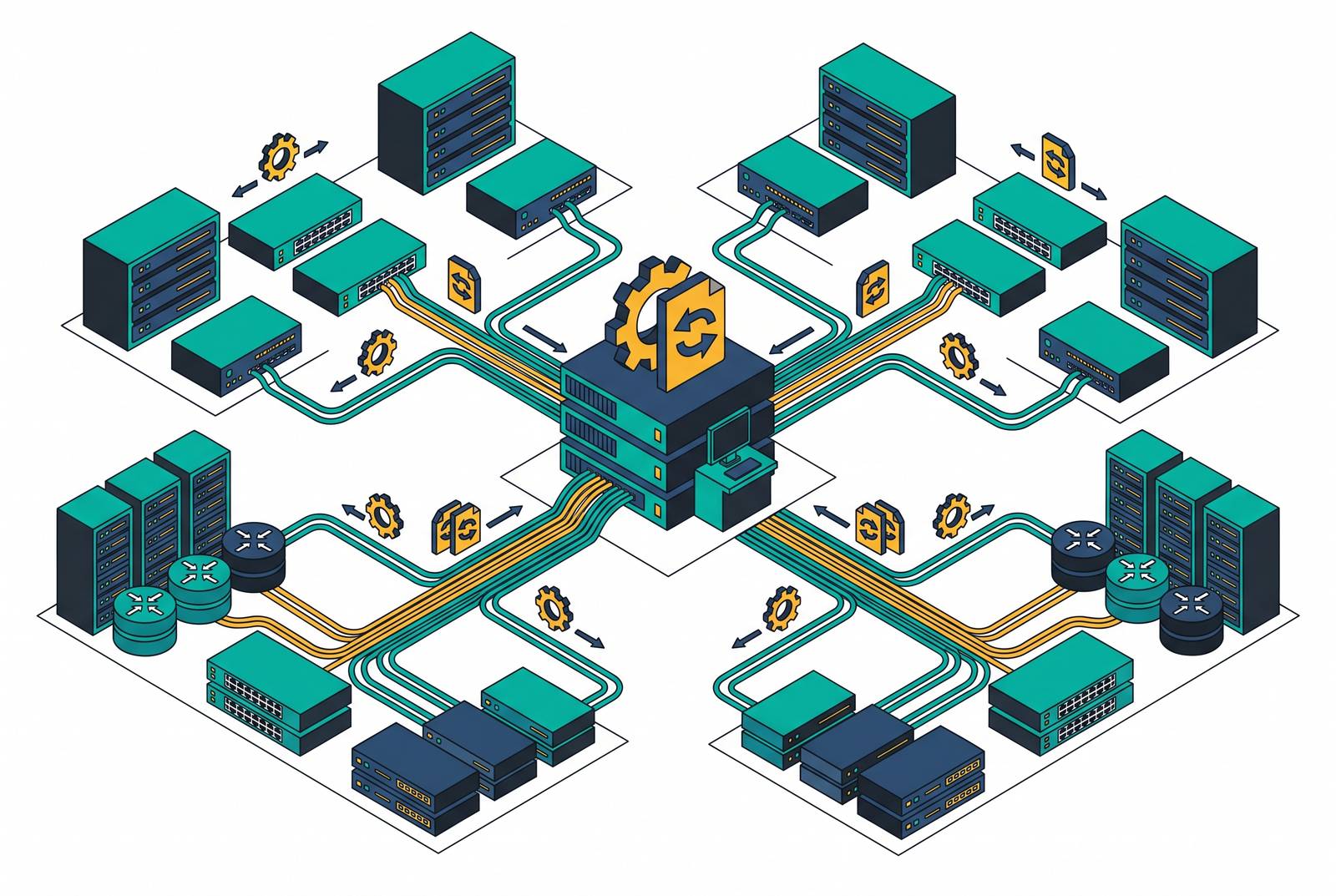
Software configuration management in a service provider network no longer means version control for device firmware or a changelog for software releases. It is the discipline that keeps the network's recorded state matching what is actually running at any given moment, and every automated workflow an operator runs depends on that match.
Configuration management as the load-bearing layer of modern service delivery
SCM began as a narrow discipline: track changes to software, firmware, and configuration files across network elements so that drift could be caught and rollbacks were possible when something broke. That scope has widened considerably. Today it covers address qualification records, network design artifacts, product configuration templates, provisioning profiles, and activation state, all of which the service delivery chain depends on staying consistent with each other. The gap between what an OSS records and what the network is actually doing has a name: configuration drift, and drift is the root cause behind failed provisioning, missed SLAs, and the manual rework that eats operational budgets. Service types that make this acute: FTTH, where geographically dispersed ONTs get provisioned through zero-touch workflows with no technician checking the result in real time; Dedicated Internet Access, where SLA-backed symmetrical service demands exact parameter fidelity with no room for approximation; and Carrier Ethernet, where MEF-standardized interconnects require configuration state to stay aligned across the boundary between one provider's network and another's. In each case, the OSS record is the thing the network is built from, not a reference document sitting beside it, and when it stops matching reality, the failure appears downstream as a missed install window, a blown SLA, or a trouble ticket nobody can explain without digging through three separate systems.
Legacy OSS architectures that turned configuration management into a fragility, not a safeguard
These systems were built around assumptions that no longer hold, not from any particular operator's negligence. Legacy OSS platforms were designed around deterministic, human-initiated workflows: a person opens a ticket, a person checks a record, a person pushes a change. That architectural assumption makes them structurally incompatible with the kind of continuous configuration consistency that modern service delivery now requires. Over years of operation, legacy stacks accumulate separate tools for qualification, design, provisioning, and activation, each maintaining its own version of what the network looks like. Every handoff between those tools is a place where one system's record can quietly diverge from another's, and from the network itself. European operators, for instance, carry more than half their infrastructure as technical debt on average, with some systems having sat in place for decades, and the configuration records inside those environments reflect years of patches and workarounds rather than a clean, current picture of the network. As a result, a provisioning order can arrive at a device carrying a configuration built from a design record that was already stale by the time the order was issued. NTT DATA's Next Gen OSS analysis names this directly: integrating cloud-native systems with existing OSS frameworks remains a significant obstacle for operators trying to modernize. None of this is a story about bad vendors or careless engineering. It is what happens when systems built for a world of manual, sequential changes get asked to support a world of continuous, automated ones.
What AI-driven automation demands from configuration data
AI agents working across service delivery workflows need event-driven access to configuration data that is unified and consistent, and legacy architectures were never built to deliver that. That makes the quality of an operator's SCM the hard limit on how far its automation can actually go. The mechanism is straightforward: an AI agent running a provisioning workflow has to read qualification state, design parameters, and device configuration from one consistent source. Amdocs' announcement of aOS, its Agentic Operating System for Telecom, in February 2026 makes visible at scale a coordination requirement: orchestrating customer provisioning across IT systems, network domains, and business operations without a human stepping in at each handoff requires every one of those domains to expose configuration state that is readable and current in real time. HCLTech's 2026 telecom trends analysis points to the same dependency from a different angle, identifying AI-native systems as the enabler of intent-driven orchestration, predictive maintenance, real-time traffic management, and zero-touch service delivery, none of which can function without configuration state the AI agent can actually trust. That word, trust, is doing real work here. AI-nativeness, as an industry concept, means building intrinsic, trustworthy AI capability into how a network is designed, deployed, operated, and maintained, rather than bolting a model onto an existing pipeline, and that requires configuration data to be a first-class input to AI reasoning rather than something an agent looks up as an afterthought. This is an ongoing data quality discipline rather than a one-time integration problem that gets solved and stays solved, because configuration state keeps changing as the network keeps changing, and an AI agent that reasoned correctly last week on last week's data can reason badly this week if nothing refreshed it.
Governing AI actions within the same configuration framework as human operators
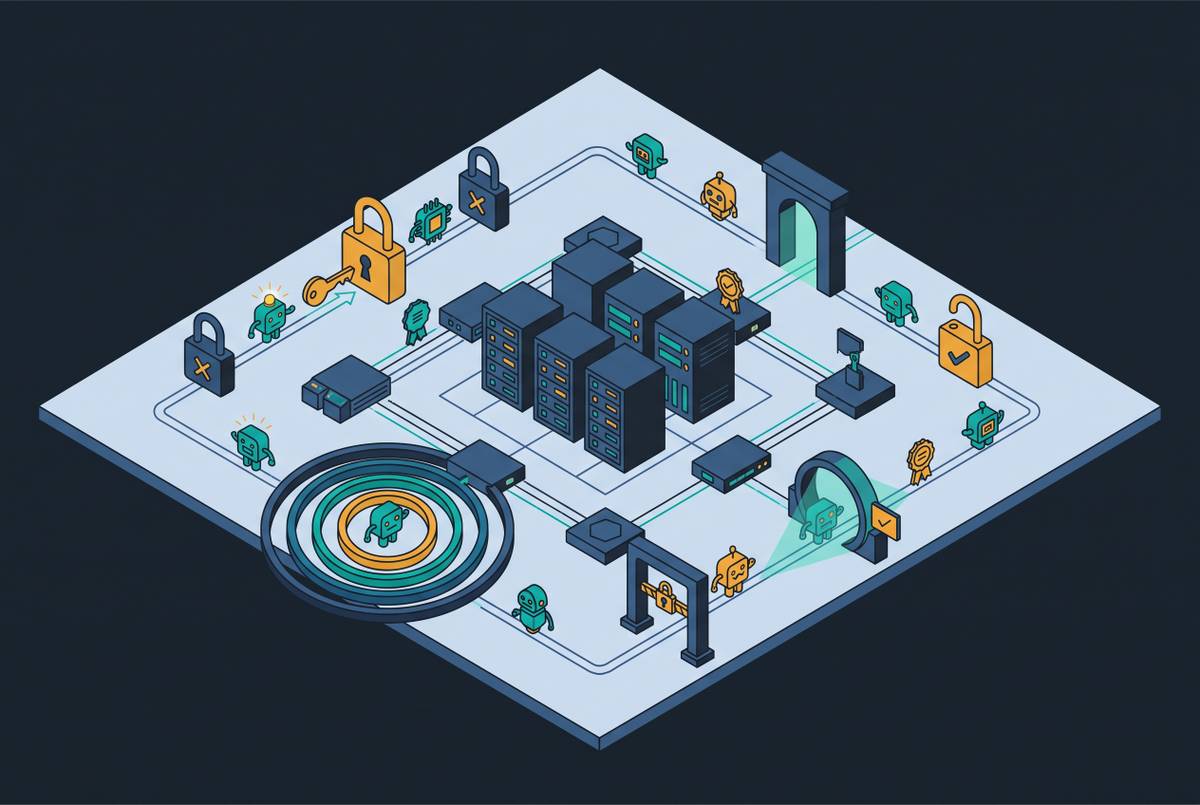
The danger in letting AI touch configuration state is that it will act outside the audit trail, making changes to network state that the SCM record has no way of accounting for. That distinction shapes how operators are actually deploying these systems today. Even with industry-wide momentum behind agentic AI, operators are running it in a controlled and heavily supervised way: agents can detect faults, reroute traffic, or trigger basic remediation on their own, but anything with real consequence, changing radio parameters, modifying a live configuration, kicking off site-level maintenance, still needs a human to sign off. Only a small fraction of GenAI deployments in telecom have actually reached network operations; most of the activity sits in customer service, billing, and administrative workflows, and governance confidence is a primary reason operators are holding the line there. An intent-based orchestration layer gives AI agents a deterministic, model-driven framework to operate inside, instead of adding more approval steps onto existing processes, which keeps automation predictable, auditable, and aligned with what the operator actually intended. Compliance automation built on AI can continuously check workflows and configurations against regulatory requirements, flag deviations before they turn into violations, and generate audit-ready documentation without a person compiling it by hand, but that only works if the AI's own actions get written into the same audit trail as a human operator's actions. AI agents need to operate through the same APIs, the same audit logs, and the same permission structures that human operators use. The moment an agent can write configuration state through a path that skips the SCM record, that record stops functioning as operational truth. A set of standards is starting to formalize what this governance should look like: the NIST AI RMF, organized around Govern, Map, Measure, and Manage, supplies a methodology; ISO/IEC 42001, published in December 2023, is the first AI management system standard an external auditor can actually certify against; and the GSMA Responsible AI Maturity Roadmap, launched on 17 September 2024 as the telecom industry's first industry-wide framework, started with 19 mobile network operators already committed. Even so, HCLTech's 2026 analysis, citing findings from McKinsey and Deloitte, found that only a small minority of companies currently has a mature model for governing autonomous AI agents, even as agentic AI use is set to climb sharply. Governance, in this context, is the thing that keeps the SCM record trustworthy enough to serve as the input AI automation depends on, because a record anyone or anything can alter outside the audit trail stops being a record at all.
Solving SCM structurally with a unified data model
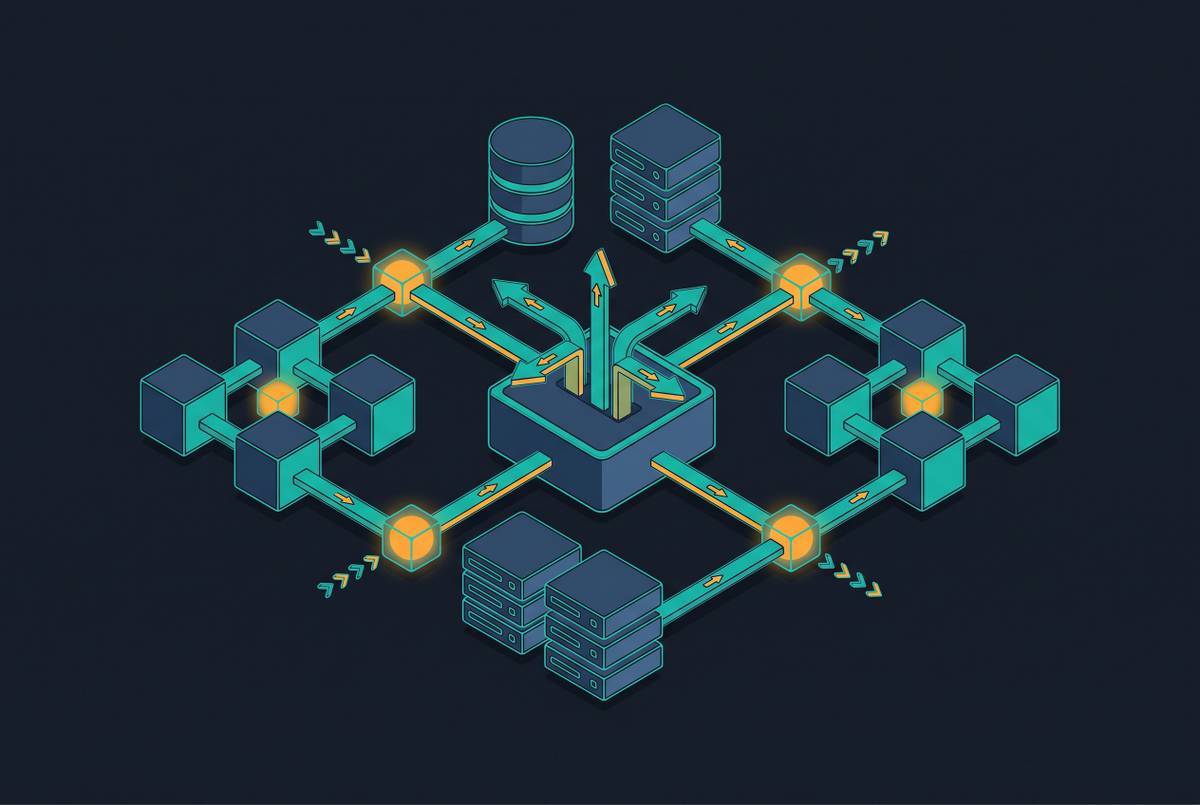
A unified data model spanning the full service delivery lifecycle, qualification, design, provisioning, and activation, is the architectural condition that lets SCM function as a live operational record instead of a document that perpetually needs reconciling against reality. The mechanism is direct: a unified architecture lets service readiness data flow straight into work order creation, closing the gap between the network record and what the network is actually doing that makes fragmented stacks such a liability. Zero-touch provisioning for FTTH shows what is at stake concretely. When an ONT comes online, the provisioning server has to hand it the correct VLAN assignments, speed parameters, voice settings, and subscriber-specific customizations based on the current OSS record, and if that record is out of step with what was actually designed and qualified, the provisioning either fails outright or delivers the wrong service. Because it is SLA-backed and symmetrical, with contractual metrics for latency, jitter, and loss, any drift between the OSS record and the device's actual state becomes a measurable SLA exposure, appearing as a penalty or a credit the moment it is caught. Carrier Ethernet illustrates the same need at the interconnect level. MEF's LSO Sonata APIs automate the business-to-business transactions that make multi-provider Ethernet work: address validation, site queries, product offering qualification, inventory, quoting, ordering, trouble ticketing, contracts, and billing, aligned with TM Forum's APIs so that a broader set of providers can interconnect in a federated model and deliver service on demand. That automation is being extended further, with work underway to bring LSO Sonata's approach to IP broadband, IP MPLS, Dedicated Internet Access, and the 5G connectivity underpinning SD-WAN and SASE services at the network edge. MEF and TM Forum have announced a joint initiative to align their respective API and product and service models, integrating MEF's Lifecycle Service Orchestration (LSO) APIs with TM Forum's Gen5 Open API standards using Domain Context Specialization, with TM Forum contributing its Open Digital Architecture, Gen5 DCS APIs, and NaaS TMF909 API suite to provide an abstraction layer mapping NaaS services to network resources irrespective of vendor implementation. A TM Forum Catalyst project built around what it calls the "Coupler" orchestration layer put a number on what that alignment buys: automatically handling the mapping between TM Forum Open APIs and MEF standards cut API development effort in half. None of this is incidental standards work. It is the industry's own signal that unification, not point-to-point integration, is the direction service delivery infrastructure is heading. The same logic is starting to appear around AI governance itself, with an emerging orchestration layer, sometimes called an "AI substrate," designed to manage trust, telemetry, and lifecycle governance across AI models, something that only works once configuration state is unified enough across the stack to be trusted in the first place.
Modernization in practice for operators carrying legacy SCM debt
Operators making real headway on SCM are finding the specific configuration failures causing the most operational pain and fixing those first, using architecture built to extend rather than architecture built to impress, rather than running sweeping transformation programs. Instead of launching broad AI initiatives, these operators are picking their spots: fixing long-standing customer experience problems in BSS, cutting operational overhead through more autonomous OSS workflows, and using network data and APIs to support new revenue models where results can be shown quickly. Big, all-at-once AI programs tend to collapse under their own weight inside legacy environments. The operators that actually progress start with their most painful problems, apply AI with a clear method, and only expand once results hold up. One of the clearer observations to come out of Fiber Connect 2026 was that many providers have hit a point where adding more vendors or more headcount no longer moves the needle. Orchestration is the bottleneck, not capacity. NTT DATA's Next Gen OSS analysis describes the architectural direction this points toward: cloud-native microservices built for scalability and adaptability, with open architecture, open data, and open-source technologies doing the work of interoperability. New technology layered onto old provisioning workflows without changing the workflows themselves does nothing to close the configuration drift gap; process has to change alongside the architecture, or the new system just inherits the old inefficiencies. Greenfield operators have an advantage here because they can build AI-native configuration foundations from day one, with nothing legacy to work around. The real decision in front of most operators is which configuration failure to fix first, because that choice determines what AI automation becomes possible next. Providers that keep treating OSS and its configuration management layer as back-office plumbing will lose ground to those that treat it as a strategic, AI-ready platform, since the configuration record is what AI agents act on, and a degraded record puts a hard ceiling on what automation can ever do.
The foundation SCM must provide for AI-ready service delivery
Modern SCM in a service provider network is a set of capabilities working together to keep configuration state accurate, consistent, governed, and accessible to human operators and AI agents alike, through the same interfaces. A single source of truth has to span the whole service delivery lifecycle, with qualification records, design artifacts, product configuration templates, and device provisioning state resolving to one data model rather than getting reconciled after the fact across separate systems. State has to update in response to network events rather than on a batch schedule, because drift builds up in the gap between syncs, and an AI agent reasoning on stale data produces unreliable results. Every change to configuration state, whether made by a person or an AI agent, needs to pass through the same permission structure and land in the same audit trail, so the record keeps its authority as operational truth. Being AI-native does not mean being AI-only: AI and human operators both need to work inside the same governed, transparent system, because the configuration record is the shared medium they both depend on, and its integrity rests on both using the same interfaces rather than separate shortcuts. Interoperability with the standards already doing this work at the industry level, MEF LSO Sonata APIs and TM Forum Open APIs, is the practical route to federated configuration management across provider boundaries for Carrier Ethernet and NaaS services. Taken together, these are not aspirational features for some future OSS release. They describe the baseline a configuration management system now has to meet before an operator can trust an AI agent to act on what that system reports.