MPLS vs SD-WAN for Carrier-Grade Service Providers
Carriers must operate both architectures simultaneously as MPLS revenue collapses.
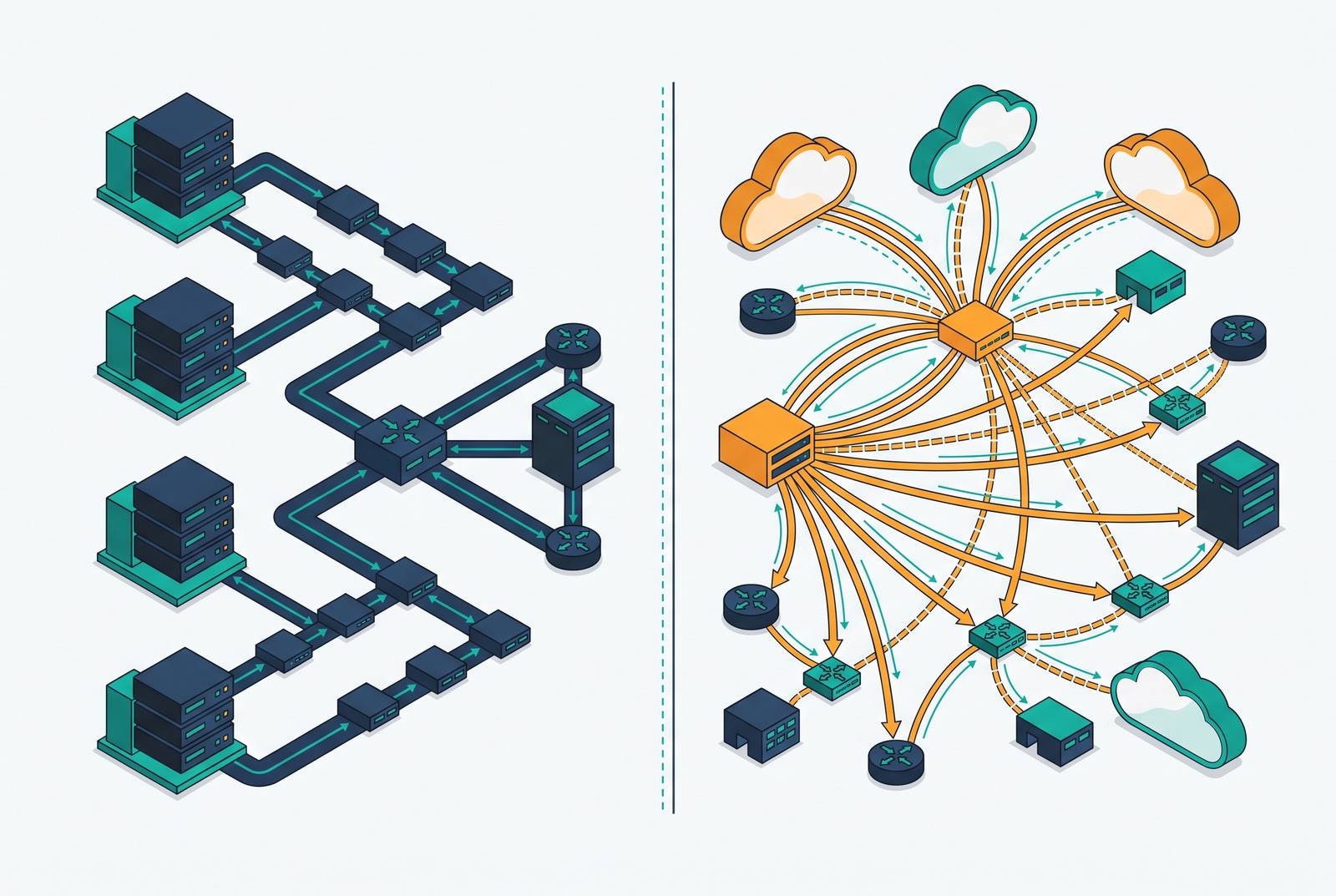
MPLS and SD-WAN aren't competing technologies a carrier picks between once and moves on from. For carrier-grade providers, each one is a standing commitment: a set of provisioning timelines, SLA obligations, and lifecycle workflows that get baked into how the business runs. Most published comparisons treat this as an enterprise buyer's decision, weighing features for a single company's WAN. That framing misses the harder problem sitting on the other side of the relationship, where carriers are the ones provisioning, operating, and guaranteeing these services at scale, for thousands of customers, across contracts that don't get renegotiated easily.
Both architectures remain live obligations for most carriers today, and will stay that way for years. TeleGeography's forecast puts global MPLS revenue at $130 billion in 2025, falling to $57 billion by 2030. That's not a market trend to note in passing. It's a planning problem: a carrier has to figure out how to run two operational models at once while one of them shrinks under its feet. What follows is an account of what each architecture actually demands at the infrastructure and operations layer, not a feature checklist.
What MPLS actually commits a carrier to at the infrastructure and operations layer
MPLS works by routing traffic through label-switched paths over private carrier circuits. Delivery is deterministic. QoS classes get defined at provisioning time and stay fixed until someone changes them, which means the carrier, not the customer, is the one making the change.
That last point matters more than it sounds. Every policy adjustment or circuit modification runs through carrier-side intervention. An enterprise customer cannot log into a portal and shift its own QoS priorities or add a site without opening a ticket. Provisioning a new circuit, or altering an existing one, can take weeks, sometimes months, depending on last-mile availability and how much physical build is involved.
The operational shape this creates is a high-touch service model, and it's high-touch by design, not by accident. The carrier owns the reliability guarantee end to end: capacity management, latency monitoring, path health, all of it sits on the provider's side of the line. That ownership is also what locks a customer into a single carrier's footprint. Once a company's branch offices are wired into one provider's MPLS backbone, switching carriers means re-provisioning every site, which is expensive enough that most customers just don't.
Static QoS suits certain traffic profiles extremely well. Voice, video conferencing, real-time collaboration, anything where predictability matters more than adaptability, runs cleanly over MPLS because the path behavior doesn't change under load in ways nobody planned for. What MPLS doesn't include natively is encryption. Security has to be layered on separately, which adds complexity for healthcare, financial services, or anywhere else compliance requirements demand documented, auditable protection alongside deterministic delivery.
Financial trading floors, medical imaging transport, real-time collaboration tools used across regulated industries: these are the places MPLS still earns its price. Not because the technology is newer or cheaper, but because the operational commitment behind it, guaranteed performance over a controlled private path, is exactly what those use cases need before cost even enters the conversation.
How SD-WAN changes the service delivery model, and what that demands of the carrier offering it
SD-WAN takes a different approach entirely. It's a software overlay that runs on top of whatever transport is available, broadband, LTE, dedicated internet access (DIA), or even MPLS itself, and it separates the control plane from the data plane. The path a packet takes is no longer fixed at provisioning time; it's decided in real time based on measured conditions.
That single design choice changes almost everything downstream. Dynamic path selection means the system measures latency, jitter, and packet loss continuously and shifts traffic accordingly, so performance becomes a function of policy rather than a fixed circuit assignment. New sites join by connecting an edge device or a virtual CPE to a controller, a process that takes days, not months. Zero-touch provisioning lets that device ship straight to a site and configure itself on first connection, cutting down on the truck rolls and field engineering that MPLS installs typically require.
Control also moves. Policy changes push out instantly across every site from a central console, whether that console sits with the enterprise or with a managed service layer the carrier operates. For a carrier selling SD-WAN as a managed offering, this means the job description changes: instead of managing circuit SLAs, the carrier now manages software policy, multiple transport providers, and security integration across an environment it doesn't fully control end to end. SD-WAN is built to be provider-agnostic, so customers can mix underlay circuits from different carriers. The lock-in that made MPLS footprints sticky simply isn't there anymore.
The shift in the customer base backs this up. SD-WAN installation rates climbed from 18% in 2018 to 47% in 2022, while MPLS usage over the same stretch dropped from 82% to 51%. And the traffic itself has moved: the average enterprise now sends 48% of its WAN traffic to external cloud and SaaS destinations, which puts real pressure on the old hub-and-spoke MPLS backhaul model, since that architecture was built for traffic patterns that no longer match where the data is actually going.
The real cost gap between MPLS and SD-WAN, and where it narrows or disappears
For a typical 1 Gbps circuit in North America, MPLS runs about $1,439 a month. SD-WAN over DIA with a managed service layer comes in around $1,066, roughly 25% cheaper, according to Lightyear's dataset of enterprise deployments. That's the headline number vendors lead with, and it's real, but it needs unpacking before anyone treats it as universal.
The SD-WAN figure breaks down into underlying DIA transport, priced around $966 a month for 1 Gbps, plus the managed service layer sitting on top. DIA carries SLA-backed performance guarantees comparable to MPLS, which is why it's the transport of choice for SD-WAN deployments that need to match MPLS-grade reliability; broadband is cheaper still, but it's best-effort, with no guarantee behind it. Buying circuits through an SD-WAN provider rather than direct from a carrier also usually adds an aggregator markup, typically around 20% on the underlying circuit.
That gap narrows, and in some cases disappears, depending on geography and workload. In certain international markets, MPLS and DIA pricing converge closely enough that SD-WAN ends up more expensive, not cheaper. Mission-critical workloads that need DIA-grade transport across every single path close the savings gap significantly, since the whole point of the cheaper SD-WAN number depends on mixing in lower-cost broadband somewhere in the topology. And there are costs that don't show up in the vendor pitch at all: firewalls at each new SD-WAN location, security stack consolidation, and the ongoing labor of policy management, all of which can eat into the savings quietly over time.
Hybrid configurations tend to land in the middle, and this is where the economics actually get interesting. Organizations that keep MPLS for critical traffic while moving bulk data onto broadband-backed SD-WAN paths are cutting WAN expenses by 30 to 50%, per Mordor Intelligence. For carriers, the implication is straightforward: the cost story doesn't favor SD-WAN uniformly. Pricing and architecture have to be matched to the specific customer profile, not applied as a blanket replacement strategy.
What provisioning timelines and SLA structures actually look like for each architecture in carrier operations
MPLS provisioning runs on carrier time. Adding or changing a circuit takes weeks to months, since it depends on hardware availability and carrier coordination that the customer has no control over. SLAs get defined at the circuit level, with packet loss, jitter, and latency thresholds committed at the circuit level, and the carrier manages capacity and fault response proactively because the customer has no visibility into the underlying path health.
SD-WAN runs on a different clock entirely. New sites can go live in days, and policy changes push out across the whole network from a central management layer. The tradeoff shows up in SLA design, which gets genuinely harder to write. Performance now depends on the quality of whatever transport sits underneath plus how well the traffic-steering logic performs, and that combination is harder to reduce to a simple contractual number than a fixed circuit's latency spec.
Neither model is operationally simpler than the other, just different. MPLS demands ongoing, proactive path management and carrier-driven coordination for any changes. SD-WAN demands continuous software policy management, multi-path monitoring, and often security posture management layered on top. A carrier that can't provision new SD-WAN sites quickly, or push policy changes at scale, isn't actually delivering the thing customers are paying SD-WAN for, even if the underlying transport is flawless. Speed and agility are the product. Without them, it's just an overlay running slow.
How the MPLS revenue decline is reshaping what carriers need to offer and at what margin
The $130 billion to $57 billion drop in global MPLS revenue between 2025 and 2030, per TeleGeography, isn't a gradual fade. It's a contraction of the revenue base carriers built decades of private WAN business on top of. Broadband and wireless connectivity are growing in volume over that same period, but commodity connectivity services carry structurally different economics than the managed private WAN business they are displacing.
The replacement opportunity carriers are chasing sits in managed SD-WAN services, a market Market Research Future projects growing from $1.132 billion in 2024 to $22.68 billion by 2035, a 31.32% compound annual growth rate. That's a steep curve, and it's steep because the margin isn't in the connectivity itself. Industry analysis points to value-added services — security, analytics, and network intelligence bundled with managed connectivity — as where the actual margin lives. Professional services layered on top can support faster SLA attainment and strengthen the value case for managed offerings. By 2026, 60% of new SD-WAN purchases are projected to arrive bundled into single-vendor SASE offerings, which means carriers that can deliver security and networking as one coherent managed service are better positioned to win those deals.
The risk sits with carriers that treat SD-WAN as just another circuit to resell. Without building real operational capability around security, analytics, and service assurance, they end up competing on price the same way they already do with broadband, and inherit the same margin problem they were trying to escape.
Why the hybrid model is the operational reality most carriers will manage, not a transitional state
MPLS usage fell from 82% to 51% between 2018 and 2022. It did not fall to zero, and the remaining base is concentrated exactly where private paths still earn their cost, regulated industries, latency-sensitive applications, mission-critical operations. That's not a market in transition toward SD-WAN. That's a market that has sorted itself into two segments with different requirements, and both segments are staying put.
Hybrid isn't indecision. It's the rational response to a customer base whose needs simply aren't uniform. MPLS gets retained for regulated or latency-sensitive traffic, SD-WAN gets applied to SaaS, branch, and cloud-bound traffic where flexibility and cost matter more than a deterministic private path. Organizations that segment their traffic this way are the same ones cutting WAN expenses by 30 to 50%, per Mordor Intelligence, because the savings only materialize when the segmentation is done with some judgment behind it.
For the carrier, running hybrid means two provisioning workflows operating in parallel, SLA commitments spanning different performance models and transport types, and an inventory and service design layer that has to stay coherent across both. Siloed tooling for each technology creates operational drag, and that drag compounds every time the customer base grows or a new service gets layered in. The challenge was never the coexistence of the two technologies themselves. It's the data and workflow fragmentation that shows up when a carrier manages each one through a separate system. Worth remembering too: SD-WAN can run over MPLS as its own transport layer, since the overlay and the underlay aren't mutually exclusive, even within a single service.
What the OSS and service delivery stack must do to support both architectures without compounding operational cost
Legacy OSS platforms were built for a world where MPLS circuit provisioning was the main event, batch-driven, circuit-centric, with no real allowance for real-time telemetry or dynamic policy pushes. Bolting SD-WAN managed services onto that kind of platform means forcing a fast-moving workflow through an architecture that was never built to move fast.
The symptoms show up quickly: separate qualification, design, provisioning, and activation workflows for MPLS versus SD-WAN, no shared data model across service types, inventory and topology and SLA information scattered across different systems that don't talk to each other. SD-WAN's days-long change velocity simply cannot survive being routed through the same rigid provisioning queue that MPLS's weeks-long timeline was built around.
A unified data model changes the equation. When qualification, design, provisioning, and activation for both MPLS and SD-WAN run on the same underlying data structure, there's no re-entry of data and no translation layer between siloed systems eating up time and introducing errors. AI agents operating on the same APIs and audit trails as human operators can take on routine provisioning and change management at the speed SD-WAN requires, while keeping MPLS SLA obligations visible in that same operational view rather than off in a separate system nobody's watching closely. Governed AI, held to the same permission structures as any human operator, means that automation scales without opening the door to ungoverned changes that create SLA exposure down the line.
The scale of investment tracks the complexity. The OSS and BSS market is valued at $65.81 billion in 2024 and projected to reach $148.26 billion by 2033, growth that reflects exactly how much harder it's gotten to run hybrid service portfolios well. Carriers that can't manage MPLS and SD-WAN lifecycle operations on one coherent platform end up absorbing the operational cost of both technologies without capturing the efficiency either one is supposed to deliver. A single data model across service types isn't an IT department's preference. When provisioning speed and SLA consistency are what customers are actually paying for, it's the baseline a carrier needs just to compete.