IT Change Management Process for Network Service Delivery
Unified data models and auditability across systems prevent revenue leaks and control AI risk.
Fragmented OSS stacks and uncontrolled change at every handoff
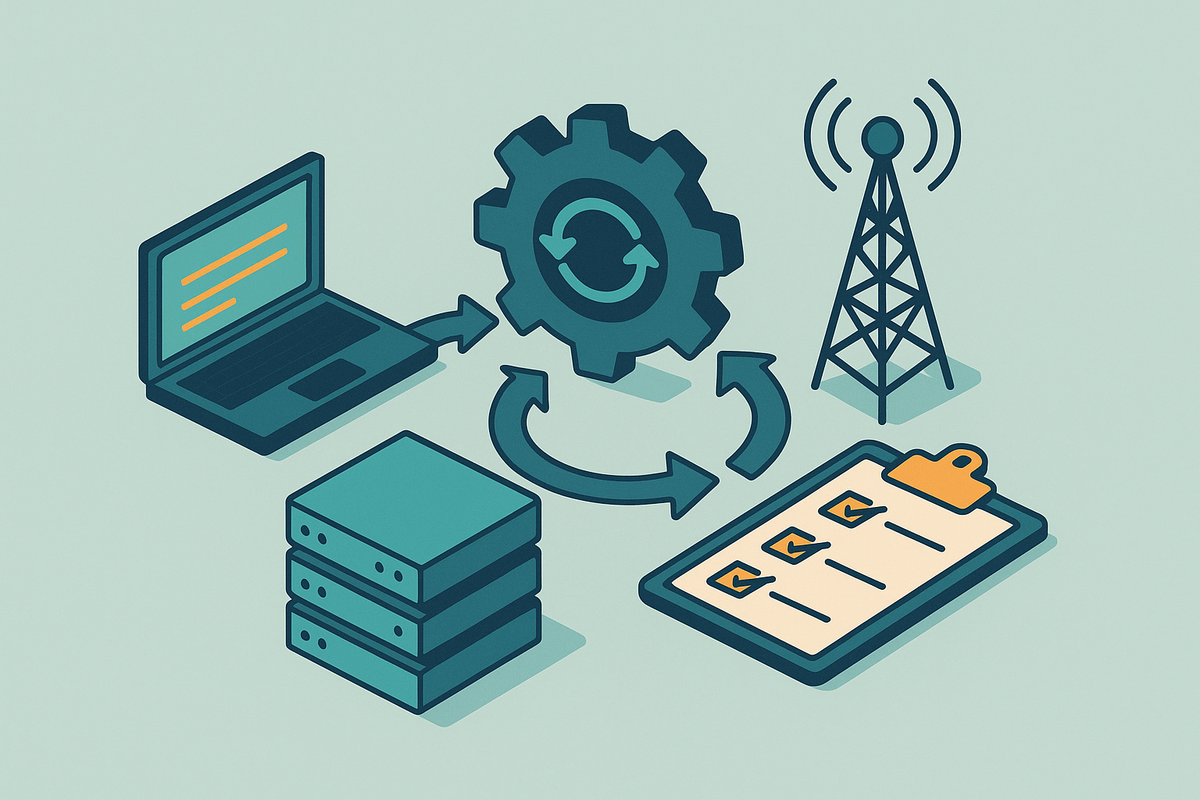
Most operators run separate platforms for network inventory, order management, provisioning, field service, and billing, and each one keeps its own data model and its own version of what's true. That fragmentation is the root of governance failure, not some adjacent inconvenience sitting next to it. Every handoff between those systems is itself a change event: data gets re-keyed, transformed, reconciled, and at each step the record in one system quietly drifts from the record in another.
NetworkOSS notes that confirming a service has actually activated requires updating several systems independently, and status disagrees across tools until somebody sits down and reconciles it by hand. That reconciliation is itself an ungoverned change to what's supposed to be the authoritative record, and nobody logs it as a change because nobody thinks of it that way. Billing start depends on activation confirmation making it all the way through the BSS, so every delay in that reconciliation causes direct revenue leakage. Not a rounding error buried in an operations report. Real money, delayed or lost, month after month, invoice after invoice.
Field service is where the handoff breaks most visibly. When field service runs in a system separate from network provisioning, technicians show up to a job without full context on what the provisioning record actually says, and any correction they make on-site can vanish, never making it back into that record. Blue Planet and Omdia find that fragmented systems and processes create real barriers to unified network automation, and that fragmentation caps what AI can safely be trusted to do on top of it. Fragmented data sets a ceiling on the whole operation, and no amount of automation stacked on top of it raises that ceiling by an inch.
A staffing cost runs through all of this too. Reconciliation, re-keying, and exception handling eat up skilled technical headcount on work that adds nothing to the network and nothing to the customer relationship. Most operators get backwards that in a fragmented stack, change management can't be whole, because there's no single system of record left to govern. You can govern the ticket. A deeper cause produces this outcome: an operator cannot govern the data underneath the ticket, and pretending otherwise is how an operator ends up compliant on paper and exposed in practice.
Governed change across the full service lifecycle
Governed change is a property the entire lifecycle either has or doesn't. Every stage needs to carry the same accountability standard for the property to hold, and a gap at any single stage undoes the whole chain.
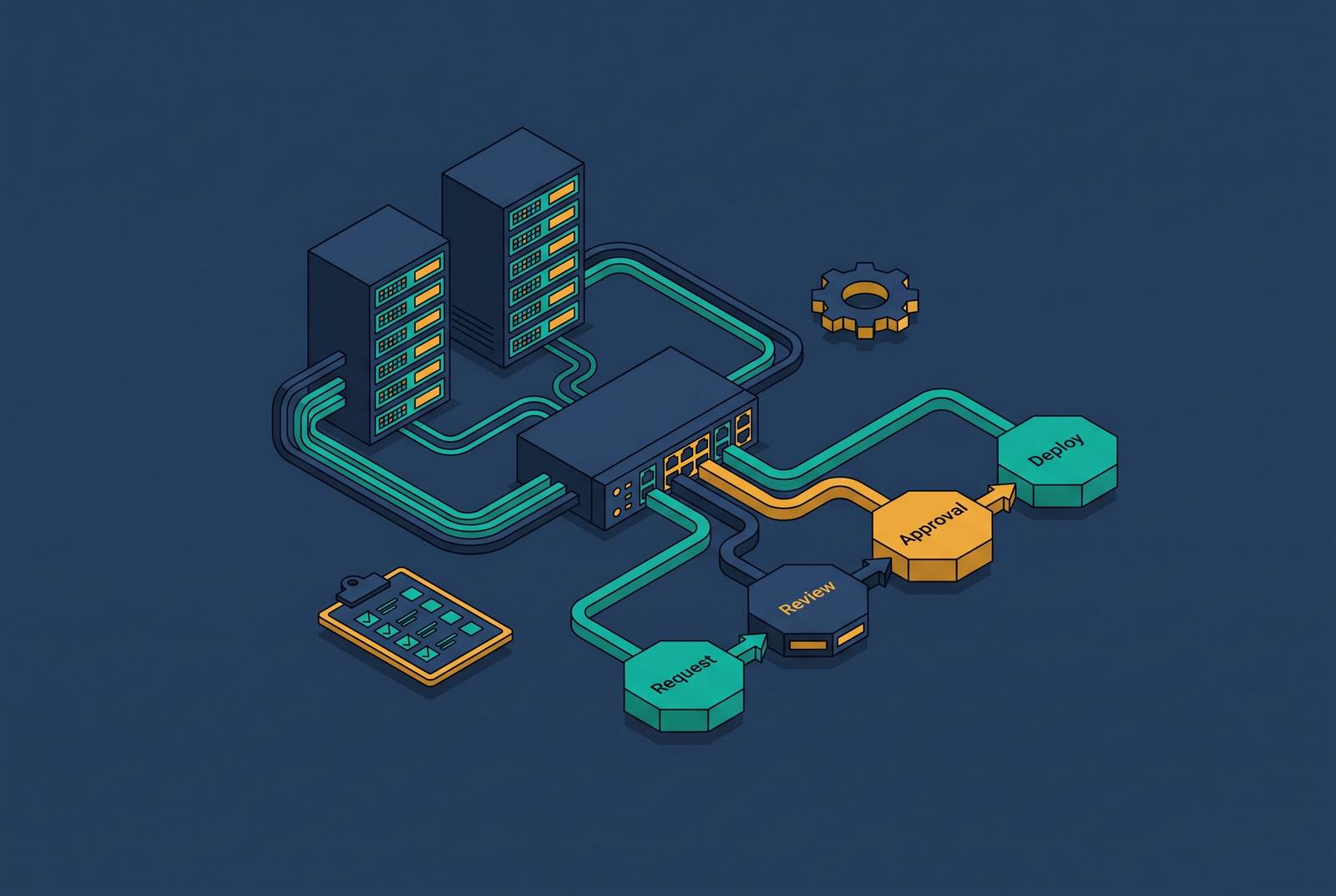
At qualification, a change to address data, serviceable territory, or available capacity needs a timestamp, an attribution (which system or which operator made the update), and a propagation path. At design, changes often surface for the first time as a trigger for downstream recalculation, and a governed design stage keeps that recalculation traceable while preserving the prior design state so someone can actually compare the two versions side by side. Provisioning is the highest-risk window in the whole sequence: device configuration, IP assignment, VLAN setup. A governed provisioning change needs a rollback path, a confirmation state, and an automatic trigger that updates every dependent system without someone having to remember to do it manually.
Activation is where all of this pays off or falls apart. AEX Inc describes a connected platform linking provisioning, activation, and billing so a successful activation automatically updates the customer record, triggers billing, and fires customer notifications. That's the actual definition of zero-touch provisioning: not device configuration alone, but the full operational workflow wrapped around it.
A unified data model underneath produces the outcome that makes any of it work. AI agents can do genuinely useful work, anomaly detection, predictive provisioning, capacity planning, when what they're reasoning over is current and consistent. The same logic governs change management directly: a change can't be traced through a lifecycle if each stage reads a different version of the record. The same logic applies to inventory specifically: a network inventory kept continuously synchronized with the physical and logical layers means every decision gets made against the network's actual state, not against outdated assumptions somebody forgot to update.
Carrier Ethernet delivery shows this at the partner boundary. An API-first architecture built on MEF and TM Forum standards enables zero-touch process automation, letting operators quote, provision, and invoice wholesale services fast, and the API contract doubles as the governance contract, making changes observable across the line between one operator's systems and another's. The target state is simple to state even if it's hard to build: a change at any lifecycle stage is a single event in a single data model, visible to every downstream function at the same moment, with attribution intact.
The shared governance standard for human-initiated and AI-initiated changes
Agentic AI is no longer sitting on the sidelines offering suggestions inside OSS platforms. The Active Minds Hub analysis of negotiated systems architecture finds that these systems are becoming participants in decisions. Once hundreds of intelligent systems act at the same time, the hard problem is coordination and accountability, not raw capability. How do these systems coordinate with each other, and who answers for it when a change goes wrong?
The scale at stake here isn't abstract. A human operator making a provisioning change has to log in, hold a defined permission level, and leave a trail behind. An AI agent making that same change should have to meet the identical conditions, full stop. Treating AI-initiated changes as inherently lower-risk gets the logic backwards: AI acts faster and at greater volume than any human operator ever could, which makes the case for equal scrutiny stronger, not weaker. The identity of the initiating actor never lowers the bar.
Shadow automation, AI tooling operating outside the governance framework, calling different APIs, bypassing the audit log, running with permissions broader than any human role would ever be granted, gets sold as efficiency. It is a liability wearing efficiency's clothes.
Ericsson's June 2026 position holds that observability into AI agent performance and behavior reinforces security and governance precisely by preventing unsafe or unauthorized actions before they happen, not by documenting them afterward. Observability, in other words, functions as a governance mechanism, not a reporting feature bolted on for the compliance team. Early deployments bear this out: identity layers, auditability, and policy-restricted autonomy are emerging as standard features of serious rollouts rather than aspirational extras. The guardrail principle is clear: AI is only as safe as the orchestration layer controlling it, and an intent-based, model-driven framework provides deterministic guardrails that keep automation predictable, auditable, and aligned with operational intent even as the system gains more flexibility.
Building it is complicated. Governed AI in service delivery means AI agents work on the same APIs, write to the same audit trails, and operate under the same permission structures as the human operators standing beside them.
The regulatory floor that now mandates governance architecture
The regulatory picture solidified fast through 2026. Governance architecture stopped being a design preference somewhere along the way and became a compliance requirement with real enforcement behind it, and operators still treating it as optional are the ones who'll get caught flat-footed.
Under the EU AI Act's enforcement phase, telecommunications operators are formally designated as providers of critical infrastructure, which pulls many of their AI systems, particularly anything touching network management, cybersecurity, or routing, into the high-risk category (per AI Conference London). High-risk classification comes with obligations that map almost line for line onto what governed change management already requires: risk management, data governance, transparency, human oversight. Article 50 of the Act, effective August 2, 2026, adds a transparency requirement specifically for AI-powered customer interaction systems, per gdprlocal.com: virtual assistants and automated service agents have to disclose that they're AI before or at the start of each interaction.
The UK is moving on a parallel track, with regulatory attention to AI in core network functions building alongside European requirements. Every AI-initiated change in a core network function needs to be traceable and attributable well before an auditor comes asking. Layer on top of that the obligations already in force, lawful intercept, data retention, NIS2 in Europe, and the requirement becomes cumulative: any AI system touching a regulated function has to guarantee data integrity, traceability, and auditability as baseline conditions, not stretch goals.
An operator that hasn't built governance architecture into its OSS (unified audit trails, permissioned AI access, explainable change records) isn't looking at an operational inefficiency anymore. That operator is looking at regulatory exposure, plain and simple. And the architecture built for operational reasons turns out to be identical to the architecture required for compliance. The audit trail that lets an engineer roll back a bad provisioning change at two in the morning is the same audit trail a regulator will eventually ask to inspect.
The FTTH, dedicated internet, and Carrier Ethernet delivery context for these requirements
Scale turns this from a theoretical governance argument into an operational one. By the end of 2025, US operators had pushed fiber past 99.7 million homes passed, with more than 84.6 million unique homes able to order a fiber product and roughly 35 million actually connected. At that volume, uncontrolled change propagation is a systematic risk running through every order in the pipeline, because the scale removes any chance of treating it as an edge case.
FTTH delivery involves address-level qualification, a technology decision between Active Ethernet and PON, design, truck roll scheduling, provisioning, and activation, and each of those stages is a potential change event. Different technology types often carry different data representations inside a legacy OSS, and multi-technology support, Active Ethernet, PON, fixed wireless, sometimes all three in the same footprint, creates a specific failure mode: a change perfectly valid under one technology's provisioning model gets applied incorrectly to another. Governed change management has to be technology-aware at the permission level and at the reporting level.
Dedicated internet and Carrier Ethernet raise the stakes further by pushing changes across partner boundaries. Wholesale provisioning, cross-carrier handoffs, and SLA-governed delivery mean a change made in one operator's system has contractual and operational consequences inside a partner's system that operator doesn't directly control. The MEF and TM Forum API-first architecture exists to address this: it lets operators quote, provision, and invoice wholesale services fast across their footprint, with partners getting immediate, frictionless access governed by the API contract itself.
A concrete migration example helps ground this. Announced in March 2026 by Business Wire, gaiia now powers billing, customer management, field services operations, online checkout, and network monitoring for The Junction Internet. Putting billing, field service, and network monitoring inside one operational environment eliminates an entire category of ungoverned change, the kind that only exists because those functions used to live in separate systems that never talked to each other cleanly. The Junction Internet's advantage is a greenfield one: building AI-native foundations from day one is simply faster than retrofitting them onto an established stack. Operators carrying years of legacy infrastructure face tougher tradeoffs getting there, but they're all heading the same direction.
The efficiency case is measurable. AEX Inc customers report time-to-invoice improvements of 60% or faster once completion data automatically triggers billing without manual steps in between. That gain doesn't come from stacking automation on top of a broken handoff. It comes from removing the ungoverned handoff entirely, which is a different thing than automating around it.
The OSS architecture requirements underneath governed change management
Governed change management can't get bolted onto a fragmented OSS after the fact. The underlying architecture has to satisfy several conditions at once; skipping this means nothing else in this piece holds, and dropping any one of the conditions breaks the whole chain.
Start with a single data model. Qualification, design, provisioning, and activation all need to read from and write to the same authoritative record, so a change is a change to one thing, not a cascade of separate updates fired off across disconnected systems and hoped into alignment. Permissioned access comes next, covering human operators and AI agents under one identity layer, with the same rules applying to both, since an AI agent should never hold broader permissions than the human role it's acting on behalf of. An audit trail has to be native to the data model itself, not something reconstructed afterward from logs that three different systems kept in three different formats. And rollback matters as much as any of it: a governed change has to be reversible, so the prior state gets kept rather than overwritten, and a provisioning system that replaces records instead of versioning them simply can't support this.
Observability ties all of it together. Ericsson's June 2026 position reframes what observability is for: it prevents unsafe or unauthorized actions rather than just documenting them after the fact, so it has to run in real time and be actionable, not sit in a dashboard someone checks after an incident already happened.
Legacy OSS platforms weren't built with any of this in mind. Blue Planet and Omdia's assessment is direct: these platforms produce data that's fragmented, siloed, and inaccessible, and retrofitting governance onto that foundation is an integration project, not an architectural fix. Analysys Mason's numbers make the cost of that gap concrete: 97% of operators view AI-powered automation as essential to survival and growth, yet only 6% achieve ROI above 25% from their AI initiatives, and 60% manage to push just 20% of their proofs of concept into production. That gap between intent and outcome is an architecture problem at its root, and ungoverned change is one of its clearest symptoms.
The coordination challenge only grows from here. Active Minds Hub's analysis argues that the future of OSS and BSS will turn not on how many AI agents an operator deploys, but on how well those agents coordinate with each other, and coordination at that level requires a shared governance layer, the same layer that governs change everywhere else in the stack. Purpose-built OSS for FTTH, dedicated internet, and Carrier Ethernet, with AI and human operators working inside one governed, transparent system rather than parallel ones, has stopped being a nice-to-have. At the scale these services now run, it's the operational prerequisite, and operators still treating it as optional are running on borrowed time.
Getting this right raises returns in places beyond compliance. PwC's data point on one operator's deployment is instructive: using AI-supported taxonomy, automated data classification, and end-to-end lineage tracked through an observability layer, that operator cut data-operations costs by roughly 50%. The audit trail built to govern change turns out to be the same lineage that drives the efficiency gain. Governance and performance were never competing goals here. They were the same architecture, seen from two angles.
Sources
- The Future of Telecom OSS/BSS Is Not More AI Agents — It Is Negotiated Systems Architecture | by Nitin Gupta | Active Minds Hub | Medium
- Autonomous customer experience required for AI-Native 6G and distributed intelligence at the network edge – IEEE ComSoc Technology Blog
- Ericsson accelerates OSS/BSS automation with Agent Fabric
- AI and modernization for telecom transformation: PwC
- AI in Telecom: From 5G to AI-Native Networks — August 2026 Update
- aexinc.com
- networkoss.com