Operations Orchestration in AI-Native Service Provider Environments
Unified data models are the foundation for AI agents to act reliably.
Legacy OSS was never designed as a unified system. It was assembled, domain by domain, over decades, with inventory here, provisioning there, activation somewhere else, each block maintaining its own data, its own process state, its own integration contracts. The handoffs between them are mediated by proprietary integrations built once, negotiated continuously, and broken whenever either side changes.
Because each domain claims authority over its own slice of truth, coordinating across them requires reconciliation through batch jobs, manual checkpoints, and engineers who know which system to trust when two of them disagree. That coordination overhead has been institutionalized and called a workflow. It isn't orchestration. It's managed fragmentation.
The deeper problem is temporal, and it's the one that proves most resistant to incremental fixes. Legacy OSS works in queues, not in response to live network state. When a provisioning job enters the queue, the network state captured at qualification is already stale. A network element that was up at 9 a.m. is offline by the time design begins at noon, and the architecture has no mechanism to detect that across stages. The system was built without the capacity to recognize what it doesn't know, which is a harder kind of ignorance to remedy than simply lacking data.
When operators attempt to augment this architecture with AI, the AI inherits every structural deficiency. A model reading from fragmented state can't produce coherent decisions. An agent writing through its own side channel creates shadow state, actions that happened, consequences that propagated, a record the governance system can't see. The architecture constrains the AI first, and eventually breaks it.
OSS 4.0, characterized by cloud-native design, microservices decomposition, and real-time event pipelines, is a direction some operators are moving toward. Most carriers remain far from that destination. The gap is structural, not incremental, and it can't be bridged by laying an AI layer over a system designed for a different era.
The Unified Data Model as the Precondition for Real Orchestration
Real orchestration begins with a single canonical representation of network state that every lifecycle stage reads from and writes to. Qualification, design, provisioning, and activation operate on the same model, through the same API surface, against the same versioned record. No translation layers, no reconciliation jobs, no team of engineers deciding which system to trust after the fact.
Without this, what gets called orchestration is actually choreography between disconnected systems. Each system remains authoritative for its own slice, and the orchestration layer spends its cycles doing impedance matching rather than coordination. Much of the latency and error accumulation that operators attribute to operational complexity is, on closer inspection, an artifact of architecture. That distinction matters, because architectural problems are solvable in ways that diffuse complexity problems often aren't.
What the model must contain is well-defined. Service topology, resource inventory, eligibility rules, order state, and activation status must live in the same structure, coherent at every moment across every stage. TM Forum's Open Digital Architecture provides the industry's reference for how this is built. Components expose shared APIs and collaborate rather than operating as isolated blocks, and ODA exists as an architectural standard against which platform investments can be honestly measured.
The compounding value of a unified model becomes most tangible in failure scenarios, which is where most architectural arguments are actually won or lost. When qualification confirms a serviceable address and a network element simultaneously goes offline, the design stage has immediate access to that updated state. No manual trigger, no re-query, no engineer working the phone between systems. The model stays coherent because the underlying data is coherent, and that coherence at the data layer is what makes orchestration possible rather than aspirational.
Auditability is the second-order benefit, and it's systematically underappreciated until the first regulatory review or disputed SLA arrives. A single model produces a single audit trail. Reconstructing the sequence of events for a provisioning failure no longer requires assembling logs from five systems, joining them on timestamps, and hoping nothing was dropped in the process. For operators dealing with enterprise SLA enforcement or regulatory scrutiny, completeness of the audit record isn't a nice-to-have; it's what the entire conversation hinges on.
How AI Agents Change the Orchestration Model When They Operate on Shared Infrastructure
The shift that defines AI-native architecture isn't the volume of automation. It's the authority of the agents. In a mature implementation, AI agents aren't recommending actions for humans to execute; they're dispatching work, updating state, and coordinating across lifecycle stages. They act. That's a categorical difference from a decision-support tool, and it changes what the underlying architecture must support in ways that are easy to underestimate until the first production incident.
What AI-native means architecturally is specific. Agents operate on the same APIs, the same permission structures, and the same audit trail as human operators. They're not a separate automation layer running alongside the OSS. They are participants in the same system, subject to the same rules, visible through the same record. The alternative, a bolt-on agent layer that reads from the OSS but writes through its own channel, creates shadow state by design.
Shadow state is ungovernable by definition. Actions happened. Consequences propagated. The governance system has no record. This is also, in practice, where the failures that become incidents originate. Anyone who has spent time reconstructing an outage sequence knows the particular frustration of discovering that the authoritative record doesn't exist, not because the data was lost, but because it was scattered across systems that had no obligation to agree with each other.
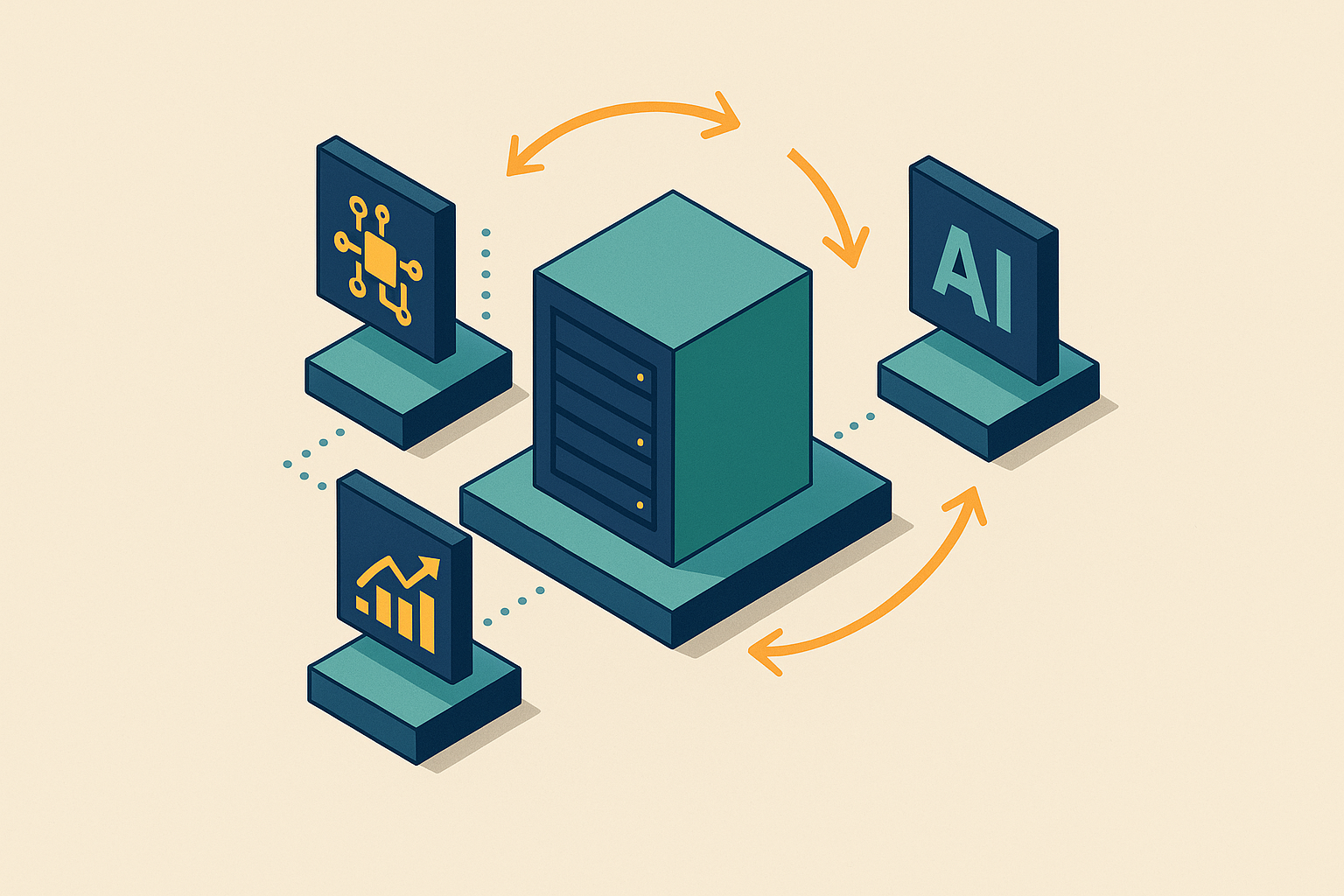
The architectural challenge of agentic AI isn't deploying more agents; it's coordinating them. When multiple intelligent systems act simultaneously on the same network state, the architecture must define how they negotiate, prioritize, and hand off. A June 2026 analysis from Active Minds Hub framed the competitive question directly: the winners in OSS/BSS won't simply automate more; they'll coordinate intelligence better. Amdocs' introduction of aOS, an agentic operating system for telecom, signals that at least some of the industry's largest vendors have accepted agent coordination as a first-class architectural concern rather than something to be sorted out in a later release.
Why Governing AI Agents Requires the Same Structures That Govern Human Operators
Deloitte's State of AI in the Enterprise in 2026 found that only one in five companies has a mature model for governing autonomous AI agents, even as agentic AI is actively being deployed into provisioning and network operations. That gap isn't abstract risk. It is the operational difference between a system that can be audited and one that cannot, and in regulated, high-uptime environments, those aren't equally acceptable positions.
Ungoverned agents produce a predictable set of failures, including actions without an accountable principal, state changes without an audit trail, and escalations with no defined approval path. These are precisely the failure modes that serious operations can't tolerate. That the failure was generated by software rather than a human operator provides no operational cover, and certainly no regulatory one.
The governing principle is straightforward, even if implementation is not. An AI agent that can trigger a provisioning action or reallocate bandwidth must do so through the same permission model a human operator would use. Role-based permissions apply to agent identities. Every agent action writes to the same audit log as human actions. Escalation triggers surface decisions that exceed the agent's permission scope to a human with appropriate authority. These aren't aspirational controls; they are the minimum viable architecture for agentic operations in a production environment.
The regulatory apparatus is reinforcing this direction, and the pace of that reinforcement is accelerating. Kiteworks reported in 2026 that 54% of IT leaders now cite AI governance as a top enterprise risk priority, up from 29% two years earlier. Gartner projects that guardian agents, AI systems governing other AI systems, will represent 10 to 15% of the agentic AI market by 2030. ETSI's SAI committee published a European Standard for securing AI systems in December 2025; 3GPP embedded AI/ML governance into 5G-Advanced beginning with Release 18. Operators making platform decisions today should treat that convergence as a signal about where the requirements floor is moving, not where it currently sits.
What Governed Orchestration Looks Like Across FTTH, Dedicated Internet, and Carrier Ethernet Workflows
FTTH
The coordination problem in fiber-to-the-home isn't provisioning in isolation. It's the chain. Subscriber qualification, network design, drop construction scheduling, ONT provisioning, and activation have historically lived in separate systems, and errors at any handoff delay activation in ways that compound downstream. A bad address record at qualification resurfaces as a truck roll. A missed capacity flag at design becomes an activation failure three days later, after a crew has already been dispatched and time has already been lost.
Operators deploying FTTH with integrated workflow platforms report service activation times decreasing by 75% and planning cycles shortening by 50 to 60%, per vetrofibermap.com. Modern platforms automate up to 90% of provisioning tasks, cutting activation time from days to hours, per vetrofibermap.com. What makes those numbers achievable is eliminating reconciliation cost between stages. The time was always lost at the boundary, not within any individual stage.
When qualification confirms a serviceable address, a unified model gives the design stage immediate access to current network state. No re-query, no reconciliation job, no human carrying data between systems. AI agents in this context can flag capacity constraints during design rather than discovering them at provisioning, when the cost of correction is substantially higher and operationally more disruptive.
Dedicated Internet Access
DIA turns up against a committed SLA, and that obligation begins the moment an order is accepted, not the moment service is activated. The orchestration system must track not just activation state but performance obligations across the entire lifecycle, and the record of those obligations must be unambiguous at every stage.
MEF's LSO API framework, with more than 165 leading service providers engaged in its adoption lifecycle, provides the inter-provider coordination standard that DIA at scale requires. MEF's June 2025 addition of Layer 2 over Broadband to the LSO API portfolio extended automated buying, selling, and management of wholesale internet broadband to a production-ready standard, a direct enabler for DIA orchestration across provider boundaries.
Governed agents are essential here, and the reason is straightforward. An agent managing bandwidth allocation must operate within the same SLA-enforcement rules a human provisioner would follow. An agent that can override committed parameters because it's running as a separate optimizer creates audit and liability exposure that becomes visible at the first SLA dispute. At that point, the audit trail either exists or it doesn't, and there's no middle ground.
Carrier Ethernet
Carrier Ethernet services operate under MEF 3.0 standards in a market valued at approximately $60 billion, per Dell'Oro Group's Carrier Ethernet Market Forecast (2024). The precision of that standard isn't bureaucratic convention; it exists because orchestration errors in CE services carry direct customer-facing consequences, measured in jitter, latency, and availability. This is a domain where approximation is unacceptable, and the operational record of the industry bears that out.
Y.1731 performance monitoring, IEEE 1588v2 timing, and NETCONF/YANG-based configuration aren't optional for modern CE demarcation. They're table stakes. An orchestration platform that manages these parameters in a proprietary NMS silo is siloing at a different layer rather than orchestrating, and when a new service type or partner is introduced, it demands a new integration project. A unified model surfaces these parameters through the same API surface as every other service type, making cross-service orchestration tractable rather than a bespoke engineering effort each time.
Operators selecting orchestration platforms for CE at scale are increasingly choosing multi-service orchestrators that operate across service types rather than point tools per domain. Platforms built on a unified data model covering qualification through activation for FTTH, dedicated internet, and Carrier Ethernet on a single API surface represent one architectural direction the market is moving toward. The question for operators is whether that architectural model meets their operational requirements, and the criteria for making that assessment are concrete.
The Operational Outcomes That a Unified, Governed Architecture Produces That Legacy OSS Cannot
Speed without error accumulation is the first thing operators notice. When qualification, design, and provisioning share the same model, an error caught at qualification stops the cascade before it reaches activation. Errors don't compound across stages because shared state means there are no gaps between stages for errors to hide in. Catching problems early becomes structurally enforced rather than contingent on a diligent engineer at the handoff.
The cost argument is where this becomes financially legible. Operators deploying integrated FTTH workflow platforms report operational costs dropping 30 to 40% compared to legacy infrastructure, per vetrofibermap.com. One operator using AI-supported data classification and end-to-end observability reduced data operations costs by approximately 50%, per PwC. These are structural cost differences that compound over the life of a network, and they surface, eventually, in margin.
Auditability that actually works changes the risk profile of the entire operation. A single audit trail covering both human and AI agent actions means compliance reporting, root-cause analysis, and SLA dispute resolution all draw from one source. Legacy architecture structurally can't provide this, because the events it needs to record happened across multiple systems with independent logs. Reassembling them is itself an error-prone process, and it fails precisely when the stakes are highest.
Service velocity as a competitive variable changes the strategic picture in ways that are difficult to dismiss at the board level. When activation compresses from days to hours and inter-provider coordination runs through standardized LSO APIs rather than manual order exchanges, time-to-revenue decreases. Speed that is structurally reliable, because it's built on shared state and coherent handoffs, scales. Speed achieved by cutting human checkpoints and hoping integrations hold eventually fails publicly.
What legacy OSS can't replicate is shared state. An architecture that coordinates through integrations and batch jobs can automate individual tasks within stages; it can't achieve coherent, real-time orchestration across lifecycle stages, because that requires all stages to share the same view of the network at the same moment. That requirement is either met at the architectural level or it is not met at all.
What Service Providers Need to Evaluate When Assessing Their Orchestration Architecture
The first question isn't whether the organization has deployed AI. It's whether AI agents operate on the same data model and permission structure as human operators, or whether they operate through a separate channel. That distinction determines whether the AI investment is producing governed orchestration or a new category of ungoverned liability.
The diagnostic for structural fragmentation is practical and requires no outside help. If qualification, design, provisioning, and activation maintain separate records of network state that are periodically reconciled, the architecture can't support real-time orchestration regardless of what AI layer sits on top. The reconciliation jobs are the evidence. They exist because the model is fragmented, and tooling layered over that fragmentation doesn't resolve it.
Governance readiness has a concrete test. Can the organization produce a complete audit trail, including every agent action, for any provisioning event in the last 90 days? If the answer requires pulling logs from multiple systems and joining them manually, the governance architecture is unfit for agentic operations. It will fail the first regulatory review or SLA dispute that demands a coherent record, and that's a matter of when, not whether.
Standards alignment is a reliable signal for platform maturity, one that cuts through vendor positioning. Support for MEF LSO APIs, TM Forum ODA component contracts, and NETCONF/YANG interfaces indicates a platform designed for interoperable orchestration. Absence of these signals indicates proprietary integration, which means renegotiating every boundary when a new service type or partner is introduced. Proprietary integration isn't a foundation; it's a recurring cost that grows as the network grows.
The strategic choice for operators is between incremental modernization of a legacy stack and adopting purpose-built tooling that starts from the correct architectural model. Platforms built on a unified data model, covering the full service lifecycle across FTTH, dedicated internet, and Carrier Ethernet on a single API surface, exist and are being selected today.
The CLEC market stood at $15 billion in 2025 and is projected to reach nearly $30 billion by 2033, per Grand View Research. Operators in this segment who treat OSS as a back-office cost center rather than an orchestration platform are embedding a structural disadvantage into a market projected to double. That compounding runs in both directions, and the architecture decision made today will be difficult to reverse once the market has moved.