Network Inventory Accuracy and Its Impact on Provisioning
Inaccurate inventory kills orders before provisioning even begins.
Network inventory accuracy determines whether a provisioning pipeline succeeds or fails, from the moment a sales rep quotes serviceability to the moment activation pushes configuration to a live port. I've watched operators treat inventory as a back-office record, something you update when someone gets around to it, and the bill always comes due downstream: failed orders, wasted truck rolls, assets sitting on the books racking up maintenance expense while generating nothing. Every stage of provisioning rests on this foundation. Miss that, and you spend years solving the wrong problem.
How inventory drift accumulates and why it compounds
Inventory doesn't start out wrong. It drifts there, one small omission at a time. A splitter gets reassigned during an emergency repair and nobody logs it that week, or that month. A fiber reroute happens during a maintenance window, and the technician's notes sit in an inbox instead of the inventory system. A migration to a new OSS platform carries forward whatever the legacy system had on record, errors included, because nobody had time to audit before cutover.
None of this is dramatic on its own. The trouble is that it stacks. A phantom circuit blocks a port that provisioning logic then marks unavailable, so a design engineer routes around it, adding complexity to solve a problem that doesn't exist. A ghost asset keeps generating a maintenance contract and a depreciation schedule for equipment decommissioned two budget cycles ago. Industry-wide, a sizable share of network assets sit in exactly this state: on the books but not in service, or in service but recorded wrong.
Most operators don't know how far their inventory has drifted until a provisioning failure exposes it. By then the customer has already felt it, whether that's a missed install date or a service that activates in the OSS but never actually lights up.
The qualification stage is where bad inventory does its first damage
Qualification exists to stop undeliverable orders before they enter the pipeline. It can only do that job as well as the inventory it queries. That's where the first failures usually start.
Overstate available capacity, and sales accepts orders for locations the network can't serve. The commitment gets made, a delivery date gets promised, and nobody notices until engineering or provisioning tries to act on an order that was never deliverable to begin with. Understate capacity, and the opposite failure happens quietly: serviceable addresses get flagged as out of range, and revenue that should have closed never gets pursued.
Both failures trace back to the same root cause. Serviceability validation depends on GIS spatial data, network inventory records, and OSS availability status agreeing with each other; when those systems sit in silos, they frequently don't. A GIS platform tells you precisely where an asset sits. Network inventory tells you what that asset is and whether it's actually available. Held separately, in different databases, updated on different schedules, the two drift apart, and qualification approves orders it should reject or rejects orders it should approve. When spatial and operational data reconcile continuously within one coherent record, qualification has a fighting chance of getting it right the first time.
An order that slips past a broken qualification check doesn't vanish. It becomes engineering's problem. Then it becomes provisioning's problem. Eventually, it becomes a truck roll.
What accurate inventory must carry to support design and provisioning
Accurate inventory means more than correct street addresses and port counts. Design and provisioning need layered, relational accuracy: the physical layer, the logical layer, and the service layer all have to agree with each other and with the network as it actually exists on the ground.
The physical layer covers fiber routes, splice points, conduit paths, and the status of equipment at each location. The logical layer covers VLANs, logical paths, circuit assignments, and how ports map to services. The service layer sits on top of both, tracking which active services ride which physical and logical elements, along with their current state and dependencies. Provisioning logic that checks one of these layers against inventory while the others sit stale will produce conflicts the moment it tries to activate: overbooked splitters, VLANs reused for two different services, logical paths that trace back to physical infrastructure no longer configured that way.
Design work depends entirely on inventory to select available resources. Draw that selection from a stale record, and the conflict gets baked in long before anyone pushes a configuration. Running a conflict simulation (checking a proposed design against live inventory before activation) catches a lot of these failures early, but only if the underlying inventory is both layered and current. For operators running FTTH alongside dedicated internet and Carrier Ethernet, the record also has to carry service-type context, because the provisioning logic for an xPON port assignment differs substantially from the logic for a MEF-compliant Ethernet hand-off. Blur that distinction in the data model, and you get design decisions that look correct on paper and fail on the network.
How siloed tools turn inventory gaps into provisioning seams
Most operators run separate tools for inventory management, network planning, order management, and activation, and each one maintains its own version of what the network looks like. Every handoff between those tools is a seam. Data gets translated, mapped, or manually reconciled at each one.
Qualification queries one system. Design reads from a second. Provisioning writes to a third. At every boundary crossed, context can get lost, fields can get mapped wrong, and an update made in one system may never reach the others. The individual systems can each hold reasonably accurate data, and the composite view (the one provisioning actually depends on) can still be wrong, because nothing forces the pieces to reconcile in real time.
Middleware and manual reconciliation cycles help, to a point. They stitch the seams together well enough to function day to day, but they introduce lag by design: the composite view is accurate as of the last reconciliation run, not as of right now. For fiber operators, where field changes happen continuously, a reconciliation cycle running nightly or weekly means provisioning is permanently working against a record hours or days behind whatever is actually in the ground. That gap isn't a rounding error. It's where failed orders come from.
A unified data model addresses this at the source, removing the translation seams where drift concentrates in the first place.
What a unified data model changes about the qualification-to-activation pipeline
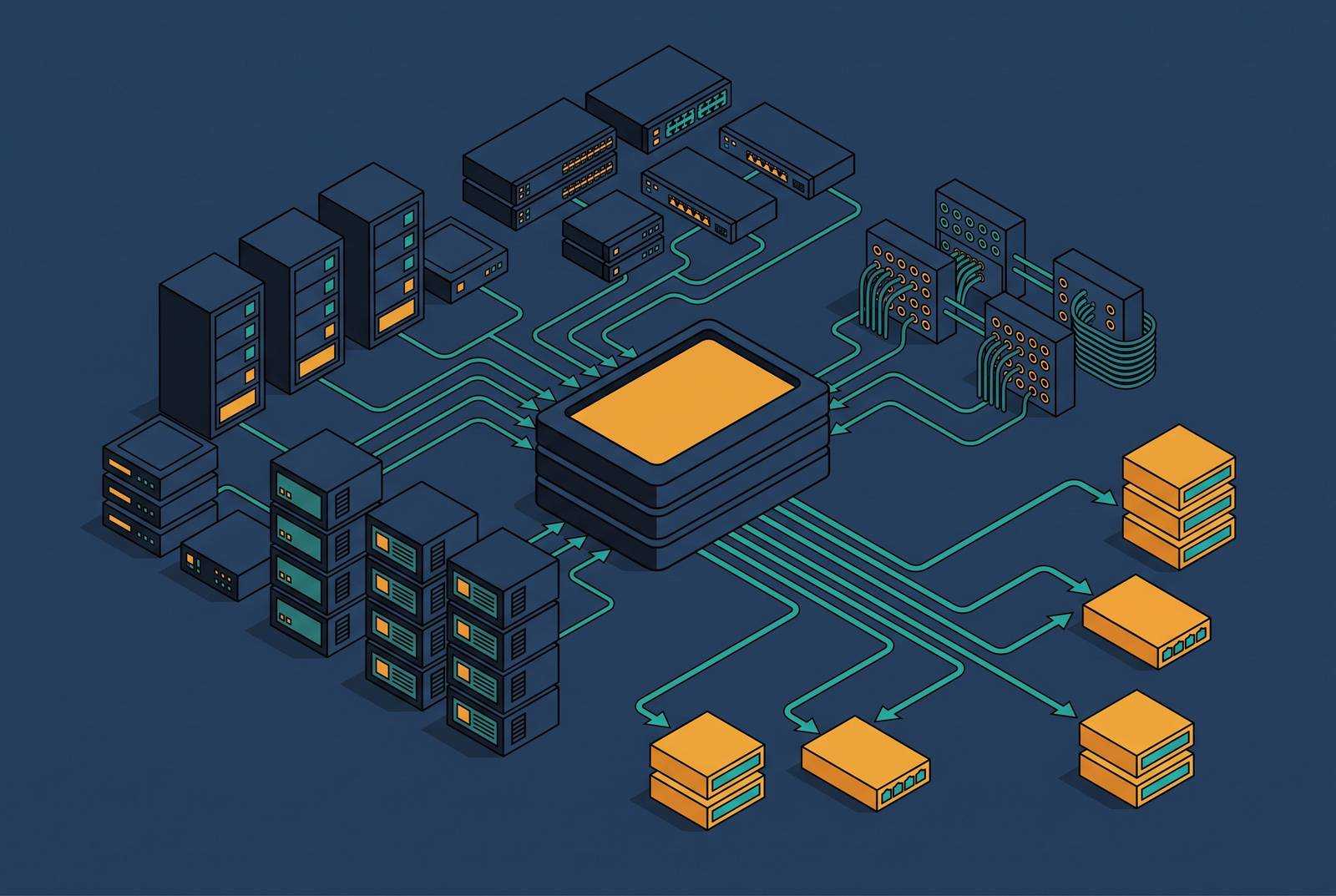
In a unified model, qualification output doesn't get exported from one tool and re-imported into another. It becomes the starting point for design, inside the same record. The resources validated at qualification are the resources reserved for design. The choices design makes are the choices provisioning executes against. Activation confirms against the same record design wrote to, not a separate copy someone has to keep in sync by hand.
Field changes update the record once, and every stage downstream reads that updated state immediately. There's no reconciliation lag sitting between what happened in the field and what provisioning sees when it runs. That alone changes what conflict detection can do: instead of discovering a conflict at activation, after the order has already failed, the system checks a proposed configuration against current resource state before committing anything to the network.
Catalog-driven provisioning benefits the same way. Service definitions in the catalog link directly to the resource model, so an order for a specific Carrier Ethernet service type triggers design logic that already knows what physical and logical inventory that service requires, no human translation required between systems. Orders advance automatically as dependencies clear, and completion data flows straight into billing and customer records without a separate manual entry step. The gain here goes past speed. It's the removal of an entire category of failure, the kind of provisioning error that traces back to the inventory the workflow was reading rather than the workflow itself.
Why AI in the provisioning pipeline makes inventory accuracy non-negotiable
Automated provisioning and AI-assisted workflows are force multipliers, and that cuts both ways. They execute faster and at greater scale than any human team, which also means they propagate a bad inventory record faster and at greater scale.
An AI agent handling serviceability qualification draws from the same inventory a human rep would consult. Feed it a wrong record, and it reaches the wrong conclusion at machine speed, approving orders for locations that can't be served or rejecting ones that can. AI-assisted design that selects resources from a stale or incomplete inventory produces designs that are technically coherent and still wrong, because the logic doing the selecting is sound while the data feeding it isn't. GSMA has pointed out that AI systems in network operations depend on fragmented and incomplete datasets in ways that reduce model accuracy, and that finding is really an inventory quality problem wearing an AI label.
Operators chasing automation before they fix inventory accuracy end up speeding up the rate at which bad data turns into operational failure. For AI to be a reliable participant in provisioning rather than a liability, it has to work against the same governed, current, authoritative record human operators use, not a separate copy drifting on its own timeline. An AI agent and a human operator reading from and writing to the same data model, under the same access controls and the same audit trail, is what an AI-native design actually looks like. Bolt an AI layer onto an existing system instead, and you get a shadow dataset quietly diverging from the operational one, with nobody the wiser until something breaks.
Keeping inventory current: reconciliation and the field update problem
A unified data model fixes the structural drift problem, the seams between disconnected tools. The field update problem is separate, and it starts from a plain fact: networks change every day, continuously, whether or not anyone writes it down.
Fiber reroutes, port reassignments, splitter changes: these happen during maintenance windows, during emergency repairs, during routine capacity upgrades. If updating the inventory record depends on a technician filling out paperwork after the fact, the record lags. If it depends on a back-office team processing field reports in batches, it lags longer still. That lag window, however long it runs, is exactly when provisioning is most likely to read stale data and produce a conflict nobody saw coming.
Field-validated inventory needs to be the standard, not the exception. Changes should land in the record at the time they happen, not days later through an email chain or a batch upload. Automated reconciliation against network management systems and element management systems adds a second line of defense, comparing live network state to the inventory record on a regular cadence and surfacing discrepancies into a managed workflow instead of letting them sit undetected until they cause a failure. Run that discipline consistently, and the volume of discrepancies actually drops over time, because teams start fixing root causes instead of patching symptoms. The record starts correcting itself, and periodic cleanup projects stop being necessary. AI has a role here too, prioritizing which discrepancies actually threaten an active provisioning workflow instead of treating every gap in the data as equally urgent.
The truck roll as the most visible cost of inventory inaccuracy (and what it hides)
The truck roll is where inventory inaccuracy stops being an abstraction. A technician shows up to connect a service, and the port doesn't exist as described, or the path is already carrying another circuit, or the equipment at the premise isn't what the record said it would be. That failure is visible, immediate, and easy to pin on the field team, even though the field team did exactly what the record told them to do.
The failed dispatch is only the most visible line item. There's the cost of the dispatch itself: technician time, vehicle cost, a scheduling slot now gone. There's the re-provisioning cycle after it, where the order gets revised, the design redone, a new dispatch scheduled, each step piling delay on delay. There's the customer on the other end of a missed commitment, calling support about a delay that should never have happened. And there's the upstream cost nobody tracks well: the sales and engineering hours already sunk into an order that was never going to work as designed.
Stranded assets run alongside this as a quieter, parallel cost. Equipment that's provisioned, carrying maintenance and licensing expense, generating no revenue, and tracked incorrectly, drags on operating budgets across the industry in ways that rarely get their own line item. Ghost circuits and phantom assets keep accruing maintenance contracts and support costs against equipment that may not exist in the form the record describes, and that distortion compounds quietly until an audit or a reconciliation cycle finally surfaces it. The consequences reach financial reporting, capex planning, and asset management alike, because the network described on the books and the network sitting in the field are, in a real sense, two different assets with two different values. Operators who treat inventory as a passive record absorb these costs continuously, usually without ever tracing them back to where they started.
What modernizing operators are doing differently about inventory as a strategic input
The operators getting this right have made a framing shift. Inventory functions as an active operational input, one that shapes decisions continuously rather than getting consulted occasionally and updated whenever convenient. That shift changes what they build toward.
It means inventory systems that field teams can write to in real time, not read-only archives refreshed in batches. It means qualification, design, provisioning, and activation drawing from one authoritative record, so the data a sales rep sees when quoting serviceability is the same data an activation script reads a week later. It means AI agents and human operators working against that same data model, under the same permissions and the same audit trail, so an automated decision is exactly as traceable as a manual one. And it means reconciliation running continuously against live network state, catching drift while it's still small enough to fix quietly, instead of waiting for a truck roll or an audit to expose it.
None of this is glamorous. It doesn't show up in a product demo, and it doesn't generate the kind of headline automation or AI tends to produce on its own. But it's the precondition for both of those things working the way they're supposed to. Operators who skip it aren't avoiding the work; they're just automating the same failures at a faster clip.