Serviceability Confidence Scoring in OSS Qualification Engines
Probability signals replace yes-or-no serviceability checks to prevent costly order failures.

Serviceability confidence scoring in OSS qualification engines replaces a brittle yes/no lookup with a probability signal built from coverage, inventory, construction status, and fulfillment outcomes. Its value depends on more than the scoring algorithm. Qualification needs a shared data model, structured outputs, and rules that govern decisions to lead to service commitments the network can meet and avoid adding to order fallout.
Why binary serviceability lookup breaks down across FTTH, DIA, and Carrier Ethernet
A technician arrives at a premise where the strand is not yet complete, although sales has already accepted the order. The truck roll generates no revenue. Sales relied on a coverage map, while network operations held a different answer in physical inventory. The architectural failure is a binary gate that treats those answers as interchangeable and hides the conditions behind them.
FTTH qualification is parcel-by-parcel and depends on build stage. A premise can sit inside a coverage polygon but outside a completed strand, so the answer can be wrong in either direction depending on when the lookup occurs. Dedicated internet access and Carrier Ethernet introduce different constraints, including SLA, bandwidth profile, and topology requirements. An address alone cannot settle those questions. An E-Line EPL and an EVPL to the same address are not equivalent qualification outcomes.
MEF defines services for subscribers, including E-Line, E-LAN, and E-Tree, and services for operators or wholesale use, including Access E-Line and Transit E-Line. Their performance objectives and service attributes differ. Qualification that suppresses those distinctions can produce commitments the network cannot honor, while an overly restrictive gate can reject valid orders. Confidence scoring addresses this failure by representing the evidence behind serviceability rather than flattening it into a single unconditional answer.
What a confidence score is made of: the four input layers a qualification engine must weight
The GIS coverage layer defines the geographic boundary of claimed serviceability. It establishes where service may be available. Errors are particularly consequential at the polygon edge, where an address can fall inside the coverage shape but outside the built network.
The physical inventory layer supplies evidence of what is installed, including fiber strand, splice, and ONT port availability. Without it, the engine cannot distinguish “covered” from “connected.” For FTTH, precise address-level inventory linkage is mandatory because construction advances street by street and parcel by parcel. Inventory must also reflect actual field conditions. Stale records pass their inaccuracies into the score and then into provisioning.
Build-stage status places the relevant plant segment within its construction lifecycle, whether permitted, under construction, spliced but not activated, or fully live. This layer adds time to the qualification decision. It turns a coverage claim into a delivery timeline and establishes confidence about whether and when service can be delivered.
Order-fallout history weights the signal based on fulfillment failures seen at the address or segment. Agreement between GIS and inventory is not enough. A high-fallout segment should depress confidence even when those layers agree, because completed order outcomes provide evidence that the other inputs do not. This feedback requires the OSS to log outcomes at order resolution and return them to qualification, a capability legacy batch-driven architectures lack.
Why the underlying data model determines whether the score is trustworthy
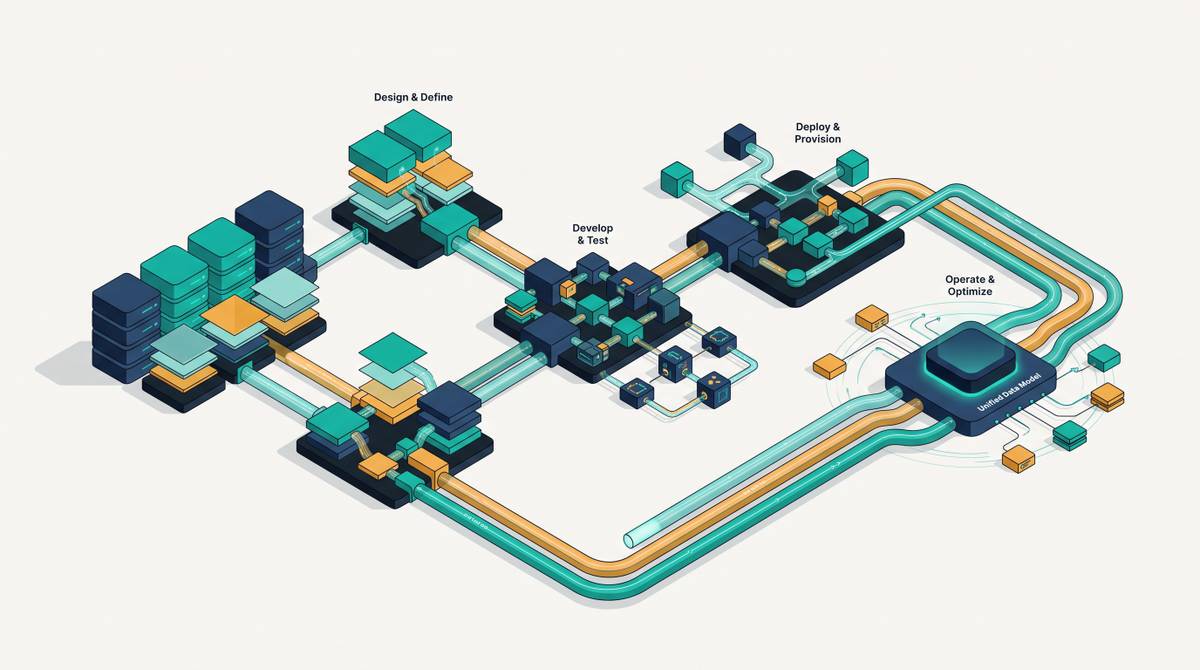
Those four layers can support a reliable score only if they share a single data contract. Separate address representations make the score depend on a join that can fail precisely where qualification needs address-level accuracy. Each input may look sound on its own. Their combination is not credible if coverage, inventory, construction status, and fulfillment history refer to different representations of the premise.
Qualification sits at the seam between the BSS, which defines the commercial offer, and the OSS, which executes fulfillment in the network. That separation of responsibilities is sound. Separate address databases are not, because they allow the commercial and operational sides of the transaction to disagree silently. The qualification anchor must therefore be one address record, updated from build data and readable by every sales and service channel. When workflows fail because addressing data and serviceability rules conflict, the corrective action is to unify the decision logic.
An FTTH as-performed dataset illustrates what an authoritative inventory record provides. It captures how well a link was built, records its quality at birth, and is timestamped and linked to the physical network. It functions as a digital birth certificate for the connection. That linkage gives inventory confidence a physical basis rather than merely recording an assertion of availability. Legacy platforms designed for static services and batch processing cannot represent an active build reliably through periodic record updates alone, so the constraint lies beneath the algorithm.
How the score output should be structured so downstream systems can act on it differentially
A composite probability alone leaves downstream systems to reconstruct the decision rules that qualification should own. Sales, provisioning, and dispatch need different resolutions of the same evidence. The output must therefore expose both an actionable tier and the component signals behind it.
For sales quoting, high confidence means quote and commit, medium confidence means quote with a qualification caveat or escalate to survey, and low confidence means do not quote and flag for build-stage review. Provisioning needs component scores to work out what to do next. When GIS confidence is high but inventory confidence is low, the next step should be inventory verification, with the order kept open.
Workforce dispatch needs to know the build-stage signal. An address with otherwise strong serviceability evidence but an incomplete strand should produce a projected ready-date, with dispatch deferred. Component scores also make fulfillment feedback more precise, because a failed provisioning step can be attributed to the input layer that was wrong. That layer’s reliability can then be weighted down for future scoring on the segment.
When automated workflows use qualification through the same API as human operators, the same permission and audit structures apply to them. A separate scoring API available only to automation creates an ungoverned route for bad scores to propagate.
The governance layer that makes a scored qualification system auditable and trustworthy
A qualification score can trigger a quote, dispatch, or construction decision, so its provenance must remain available after the action. Logging the output alone is insufficient for accountability. The assurance system must record the inputs, weights, exact decision parameters, and policy limitations that produced it. Without those records, an operator cannot explain why it made a commitment that is now in dispute.
Governance also determines how much autonomy each confidence tier permits. The “in the loop,” “on the loop,” and “out of the loop” levels distinguish human review, supervised automation, and fully autonomous action. These boundaries belong in policy configuration. Otherwise, the same qualification evidence can lead to different levels of oversight depending on which system requested it.
Explainability serves the operational decision as well as the audit. When a sales representative believes an address is fully serviceable but receives medium confidence, the output must reveal which input layer is depressing the score. Without that explanation, the result is likely to be contested, leaving the qualification gap unresolved.
TM Forum’s 2026 research, conducted with IBM, describes operators as materially unprepared for formal AI compliance despite self-reported confidence. AI regulation also puts pressure on operators to account for automated decisions. For qualification scoring, the concrete requirement is that every score query becomes an audited event, with inputs, weights, policy rules, and output tier recorded against the order record. That record makes the decision defensible when order fallout is disputed, rather than leaving the operator with an unexplained number.
How CLECs and fiber operators absorb order fallout when scoring is absent or ungoverned
False-positive serviceability produces the most visible cost for CLECs and FTTH operators. A technician dispatched to a non-serviceable premise consumes a truck roll without generating revenue and damages the customer relationship before service begins. False negatives create a less visible loss. Valid orders turned down at qualification never bring in the expected revenue, and a customer told that service is unavailable often does not call back.
These losses compound as an operator takes more orders. CLECs have too little margin to absorb avoidable internal waste, yet disconnected GIS, inventory, and fallout history do not necessarily appear as a distinct expense in operations review. Scoring without governance also leaves the operator at risk because it still cannot show why a commitment based on wrong information was approved.
Consolidation makes this more than a daily operational problem. North American fiber deployments reached tens of millions of homes passed in recent years, and operators moving into competitive markets face rivals that have put money into delivery infrastructure. An OSS that cannot distinguish a saleable premise from a fulfillable service places the operator at a structural disadvantage.
Acquired footprints can deepen that disadvantage when address data and serviceability rules differ across states. Provisioning friction cannot be resolved without harmonizing qualification first. The recommendation to unify OSS/BSS and address data early in consolidation addresses this specific dependency. A confidence layer built over conflicting records cannot substitute for that work, because the conflicting records are what the layer would score.
What separates a qualification engine that can be extended from one that has to be replaced
A durable scoring layer uses the same unified data model and governed API surface as the rest of the OSS. A separate module that copies address, inventory, and coverage data to avoid the work of integration creates a third source of truth. That copy will diverge from operational reality. The design recreates the disagreement that confidence scoring was intended to resolve, even if its initial outputs appear more sophisticated than a binary lookup.
When a Carrier Ethernet variant, build-stage classification, or fallout category is added, the scoring engine should get it through the canonical model without re-integration work. New consumers need the same continuity at the interface. A field mobility app, partner portal, or AI agent that handles order intake should use the structured qualification output without needing a separate engine.
An agent must query the same API, use the same permission model, and leave the same audit trail as a human representative who makes the same request. A separate route creates shadow qualification with unaccountable commitments. TM Forum’s AI-native extensions to its Open Digital Architecture, launched in 2026 as part of the Race to 2030, introduce a governed execution layer within the existing architecture, with ODA Canvas control points and Model Context Protocol support. Alignment with that framework allows qualification to inherit governance, removing the need to construct it independently.
A fiber strand that has just gone live puts this design to the test. Once build-stage status changes in the operational system, the number of additional steps needed for qualification to return a higher confidence score reveals the architecture. In a unified model, there are zero additional steps, because the next query reflects the updated record. In a siloed or cached architecture, the change waits for a batch cycle, a manual refresh, or a data-ops ticket. That dependency is the design criterion separating qualification that grows with the network from another system awaiting replacement.