Unified Data Models Across the Service Delivery Lifecycle
Unifying data across service stages eliminates costly handoff errors.
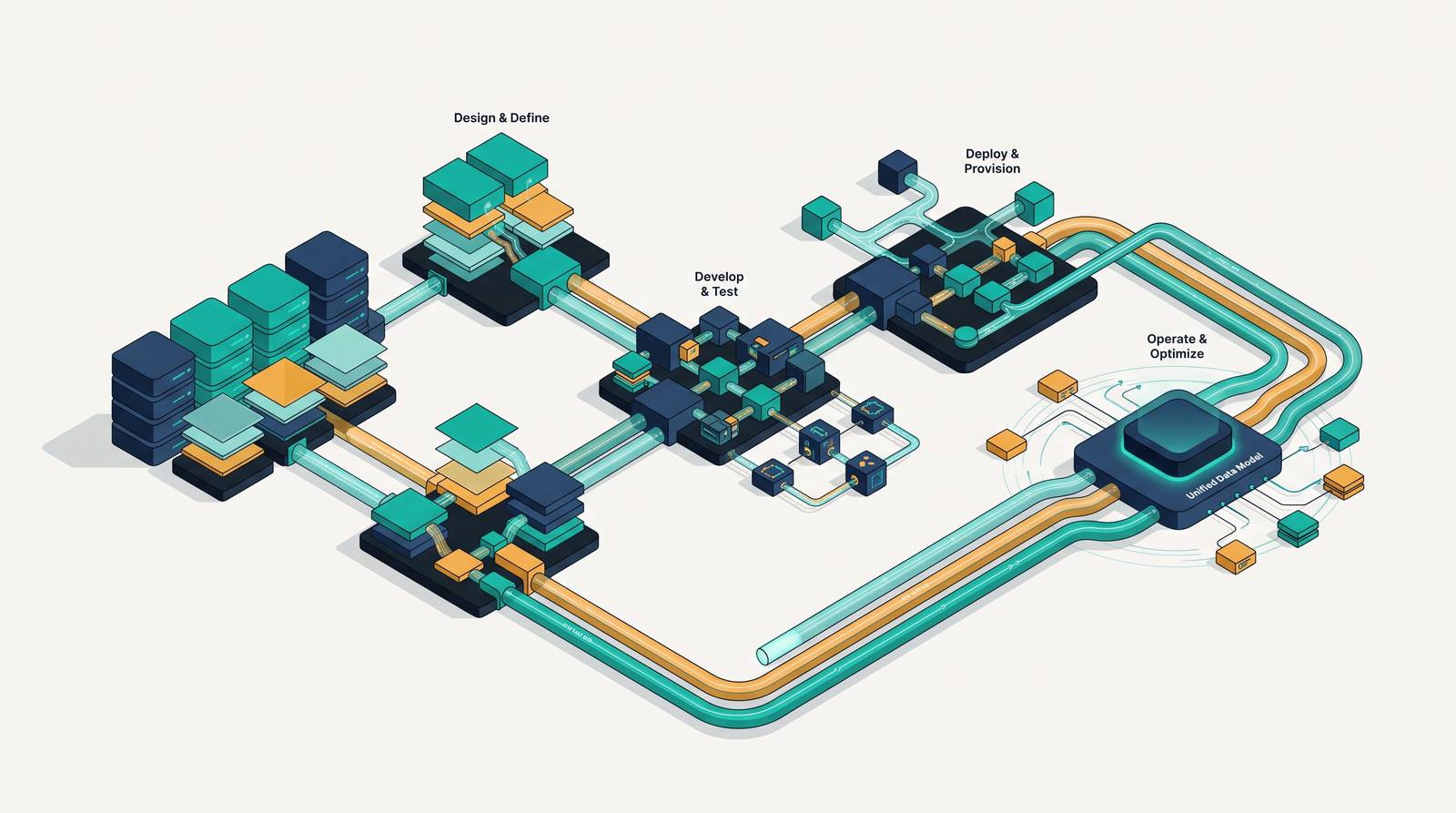
Qualification determines what can be delivered to a given location. The data it produces, network reach, available capacity, and service eligibility, feeds directly into design. Design translates that qualification output into a specific service configuration, which feeds provisioning, which executes against live network elements. Activation then verifies that what was executed matches what was designed and what was originally qualified as deliverable.
This chain has one dominant failure mode: an error introduced at qualification is invisible until activation. By then, reversing it requires unwinding work across every intervening stage. The error doesn't announce itself at the handoff. It travels silently, accumulating in each downstream record until activation either fails outright or, worse, passes with a latent defect embedded in the live service.
The canonical example is inventory mismatch. When the network inventory that design consults is out of sync with the physical plant, design produces a configuration that can't be executed as specified. Provisioning then either fails against the network element or gets manually corrected in the field, and that correction is rarely written back to the design record with any precision. Activation inherits a record that doesn't match reality. The billing system reconciles against the activation record later, working from data that was already incomplete.
TM Forum has grounded its digital operations maturity work in end-to-end service lifecycle management for years, specifically in the alignment of OSS and BSS around shared lifecycle stages rather than separately optimized domains. That argument predates the current wave of cloud-native enthusiasm by at least a decade. The stages themselves aren't the problem. What happens to data at the boundaries between them is.
What a Unified Data Model Actually Means in an OSS Context
A unified data model isn't a single database, and it's not a data lake. It is a shared representation of network and service state that every lifecycle stage reads from and writes to, in real time, with no intermediate reconciliation step. That last requirement is the one that separates the concept from its imitators.
Integration-layer approaches, connecting siloed systems through APIs or middleware, do produce interoperability of a kind. But each system still maintains its own internal model of network state. When system A updates a record, system B doesn't know until the sync runs. Reconciliation is deferred, not eliminated. Anyone who has spent time chasing a provisioning failure back through four separate system logs knows what that gap actually costs: hours of investigation, re-dispatched technicians, and customer calls that shouldn't have happened.
In a unified model, a provisioning event updates the same record that activation will verify against. A qualification result is the record that design works from, not a translated copy of it. Change history is shared across stages, so when something goes wrong, the audit is a single sequential account of what happened and when, not a forensic reconstruction assembled from disparate logs.
TM Forum's Open Digital Architecture, ODA, is the industry reference architecture for this pattern. ODA describes a modular, component-based architecture where standardized data and AI-driven decisions are orchestrated through a common canvas. Its Production functional block, responsible for service and resource lifecycle management, inventory, and work order management, is the largest of ODA's five functional blocks. That is not an editorial choice. It reflects the actual operational weight of lifecycle management in a modern service provider environment. ODA launched conformance certification for commercial products in January 2025, giving vendors and operators a concrete benchmark: a certified product must demonstrate interoperability against shared lifecycle data standards, not merely claim it. That shift from aspiration to verifiable compliance changes what operators can reasonably demand from vendors.
Why Legacy OSS Architectures Cannot Be Retrofitted
Legacy OSS was designed around hardware-bound, reactive workflows. Early systems handled provisioning and fault management as discrete functions with no shared data layer, because the network they managed was itself discrete and relatively static. Each subsequent generation of capability, NFV and SDN integration, cross-domain views, and real-time telemetry, was layered onto that original architecture rather than replacing it. Nobody revisited the foundation, because revisiting the foundation meant stopping everything else.
The result is a compounding structural problem, not a configuration problem. Every system holds its own canonical truth, and keeping those truths aligned is the ongoing operational cost of the architecture, one that grows with every new service type added to the portfolio. That cost doesn't plateau. It compounds.
Retrofitting a unified model onto a legacy stack requires every system in that stack to agree on a single canonical representation of network state, which is precisely what their original designs were built to avoid. Legacy platforms were engineered for rigid, siloed workflows, and their data schemas reflect that posture at a structural level. A unified model's canonical representation doesn't exist in those schemas. It would have to be imposed from outside, through exactly the kind of reconciliation layer that unified models are meant to eliminate.
Every system update reopens the seams. Every new service type requires new mapping between models. Every topology change creates fresh divergence the reconciliation layer has to absorb. Growth makes this worse rather than better, because disconnected platforms and manual handoffs scale with the network, not against it.
TM Forum's ODA framework and the investment trajectory of cloud-native OSS/BSS vendors now reflect an industry consensus: AI-native operations require a cloud-first, modular architecture built for continuous learning. That is a fundamental departure from the design posture of legacy systems. Layering new capabilities onto opposite assumptions doesn't change the assumptions.
How a Unified Model Eliminates Handoff Errors and Rework in Practice
When lifecycle stages operate on a shared model, orders advance with verified context. Design receives what qualification actually found, not a translated summary of it. Provisioning executes what design actually specified, against an inventory record reflecting actual deployed infrastructure. Activation verifies against the same record that provisioning wrote to. The chain is traceable because it is, literally, one record.
Handoff errors become detectable at the point of transition rather than at activation. When design consults the qualification record and finds a mismatch, that mismatch surfaces before any provisioning work has begun. The cost of correction is the cost of fixing a record, not the cost of reversing field work.
Rework drops for a structural reason. The record of what was done is the same record used to plan what comes next. No re-entry of data across systems, no re-verification of state, no reconstruction of what actually happened from four separate logs. The provisioning technician, the design engineer, and the activation system are looking at the same object. When field execution depends on inventory that reflects the actual deployed plant, provisioning configurations are executable on first attempt. The technician arrives with instructions that match what the network actually is. That sounds obvious. It is, in fact, rare.
Billing coherence follows directly. When the activation record and the provisioning record are the same record, revenue recognition doesn't wait for reconciliation between separate systems. The service is live; the record says so; billing acts on it.
Dish Wireless, operating as EchoStar's 5G network, built its greenfield infrastructure with an event-driven architecture that merged OSS and BSS into a cloud-native stack, orchestrating from provisioning to assurance in real time. The decision to eliminate the reconciliation layer between domains from the outset is instructive precisely because greenfield builds carry no legacy constraints. The architectural choice was made on its merits alone. The result is a lifecycle where scale becomes manageable because stages share context rather than negotiate it across system boundaries.
Why AI in the Service Delivery Lifecycle Requires the Unified Model First
An AI agent operating on provisioning data that doesn't reflect the current design record will make decisions based on stale state. The error is invisible until it propagates into the network. This isn't a limitation of the AI. It is a limitation of the data the AI is acting on, and no degree of model sophistication closes that gap.
Microsoft's 2025 analysis of agentic AI in enterprise contexts makes this explicit: harnessing agentic AI requires a unified source of data truth. Without cohesive access to high-quality data across network, operational, and business domains, AI-powered insights become fragmented or misleading. Fragmented data doesn't merely constrain AI performance; it introduces active error risk into automated decisions. That is a categorically different problem than reduced accuracy, and it's worth sitting with that distinction for a moment.
The difference between AI-augmented and AI-native systems matters here. AI-augmented systems provide recommendations within a process that humans still execute. AI-native systems make AI a participant in decisions from the ground up, which requires the data those decisions rest on to be shared, current, and authoritative. You can't build an AI-native provisioning system on a data model where provisioning, design, and qualification live in separate systems with asynchronous sync. The architecture precludes it.
Governance adds a constraint that is already binding in some markets. Europe's AI Act, in force since August 2024, classifies AI used as a safety component in critical digital infrastructure management as high-risk, carrying obligations for auditable training data governance, automatic event logging, and demonstrable human oversight. A fragmented data environment can't systematically satisfy these requirements. When an AI acted on data drawn from three systems that sync nightly, the audit trail is itself fragmented, and no after-the-fact reconstruction changes that.
Deloitte's State of AI in the Enterprise research for 2026 found that only one in five companies has a mature model for governing autonomous AI agents. In telecom, where AI is already moving into provisioning and network operations, the unified data model is the prerequisite for governance maturity. Treating data unification and AI governance as separate problems with separate timelines produces neither reliable automation nor defensible compliance.
What the Market Pressure Looks Like for Operators Who Delay
The numbers are not ambiguous. The OSS/BSS market was valued at USD 65.81 billion in 2024 and is projected by IMARC Group to reach USD 148.26 billion by 2033, at a 9.4% compound annual growth rate. Telecom network automation is projected to grow at a 22.5% CAGR, reaching USD 32.7 billion by 2026. The NGN OSS/BSS segment is expected to reach USD 109 billion by 2030, with cloud-based deployments accounting for 64.5% of that market at a 13% CAGR.
What those figures describe, collectively, is an industry making a coordinated architectural bet. Unified data models are a prerequisite for cloud-native operations. Operators running fragmented stacks aren't standing still while the market moves; they're accumulating a structural deficit against peers who are building the data foundation that automation requires. The deficit is not abstract. It shows up in provisioning cycle times, in the cost per order of manual reconciliation, and in the growing gap between what AI-native competitors can offer and what legacy-constrained operators can field.
World Economic Forum and TM Forum research identifies 2025 and 2026 as the period when autonomous networks shift from pilot programs to operational priorities. Operators who enter that transition carrying fragmented data stacks enter it without the foundation AI-native operations require. The window for foundational architectural work is narrowing, and foundational work done under time pressure produces exactly the kind of expedient layering that compounds the original problem. I've watched operators make that trade, convinced they would return to fix the foundation later. They rarely do. The integration layer that was supposed to be temporary is still running seven years later, and the team that understands it has largely turned over.
The competitive logic is direct. Service providers who treat OSS as a back-office cost center will lose ground to those who treat it as a strategic platform. Unification is the structural decision that separates those two postures, and the market trajectory makes the cost of delay legible in ways it wasn't five years ago.
The Architectural Requirements a Unified Data Model Must Satisfy Across the Lifecycle
Single Canonical Representation of Network and Service State
Qualification, design, provisioning, and activation must all read from and write to the same record, with no reconciliation layer between them. When the record changes, it changes once, and every stage sees the change immediately. This is the definitional requirement; everything else is downstream of it.
Real-Time State Visibility Across Stages
A change in one stage must be immediately visible to the next. No batch sync, no polling interval, no stale snapshot. Deferred visibility is the structural cause of the handoff errors a unified model exists to eliminate. Reducing the sync interval is not a solution; it's a slower version of the same problem.
Shared Permission and Audit Structure for Human Operators and AI Agents
Every action against the model, whether taken by a person or an automated process, must be logged against the same audit trail and subject to the same governance rules. When AI and human operators share a lifecycle record, the audit must be coherent across both. Separate logging for automated and manual actions produces the same forensic reconstruction problem as separate data models, just one abstraction layer up.
Modular but Coherent
Individual lifecycle functions must be able to evolve independently without forking the underlying data model. A change to qualification logic shouldn't require a change to the provisioning schema. TM Forum's ODA component model is the reference architecture for this pattern: modular components, standardized interfaces, and shared data semantics. The modularity is what allows operators to adopt new capabilities without reopening the seams between stages.
Purpose-Built for the Service Types Being Delivered
FTTH, dedicated internet access, and Carrier Ethernet each have specific qualification, design, and provisioning semantics. A fiber service qualification depends on plant records, splitter configurations, and available port capacity in ways that generic network management software wasn't designed to represent natively. When operators are forced to model their services inside a schema that wasn't built for them, translation errors accumulate at precisely the points where precision matters most.
Compliance-Ready by Design
Audit trails, decision logs, and data provenance must be structural outputs of the model, not capabilities retrofitted after deployment. Retrofitting compliance onto a fragmented data environment produces compliance artifacts that are themselves incomplete, because they're reconstructed from systems that never shared a common record. A model that is compliance-ready by design produces these artifacts as a natural consequence of normal operations, not as a separate reporting exercise.
These requirements collectively describe an architecture that is coherent by construction rather than by ongoing effort. The fragmentation problem in service delivery is not a process problem or a people problem. It is an architectural one, and it has an architectural solution.