Autonomous Network Operations in Carrier Environments
Agentic AI in telecom demands governance baked into system architecture, not bolted on afterward.
Earlier automation was legible. Scripts ran on known inputs, followed decision trees that operators had designed, and when something went wrong, the blast radius was bounded and predictable. The script failed; a human investigated; the world continued. I spent years watching NOC teams operate with exactly that mental model, and it served them reasonably well.
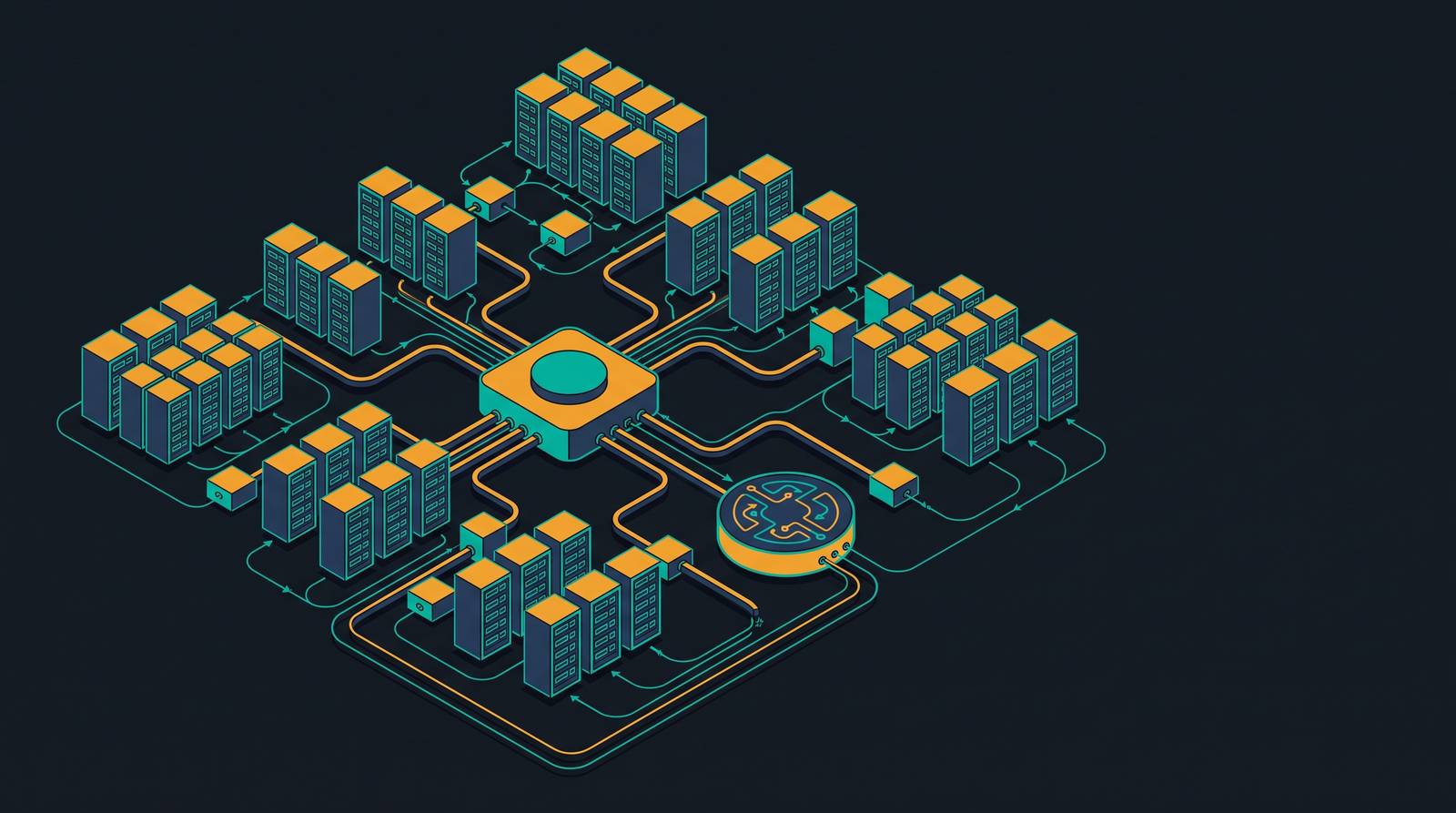
Agentic AI operates in a qualitatively different register. An agent pulls context from multiple disconnected systems simultaneously, correlating logs, diagnostics, telemetry, and configuration records, then reasons across that context to determine what action to take without a human directing each step. It initiates multi-step workflows, incident triage, change orders, provisioning sequences, each consequential on its own and compounding in combination. The combinatorial surface for unintended consequences is orders of magnitude larger than anything scripted automation created, and that surface expands with every new data source you feed the agent.
Carrier environments amplify the stakes in ways that are genuinely hard to internalize until you've seen the blast radius of a misconfigured automated system at scale. Spectrum allocation, traffic routing, and security enforcement happen at millisecond speed across subscriber bases measured in millions. This is exactly what makes agentic AI compelling here, and exactly what makes governance non-negotiable.
Consider a provisioning agent that can initiate work orders across a live network. A misconfiguration isn't a failed script. It's a potential policy violation, a service impact across a subscriber base, and a regulatory exposure, all simultaneously, all generated faster than any human can intervene. The failure mode isn't just technical. It's institutional, and institutions move much slower than agents.
Only one in five companies has a mature model for governing autonomous AI agents, according to Deloitte's State of AI in the Enterprise research published in 2026, even as agentic deployments accelerate. The efficiency argument for agentic AI is real and well-understood. What's less understood is that ungoverned agentic AI doesn't merely risk operational errors. It risks errors that can't be explained, attributed, or corrected after the fact. That's a categorically different order of problem.
The Regulatory Environment Carriers Already Operate In, and What It Demands of AI Systems
Telecom is among the most heavily regulated industries in existence. Lawful intercept obligations, data retention requirements, network neutrality rules, consumer protection frameworks, cybersecurity directives such as NIS2 in Europe, E911 and E112 emergency services mandates: these aren't bureaucratic inconveniences. They are the legal architecture within which carriers operate, with meaningful enforcement consequences attached.
What's new isn't the regulatory environment itself. What's new is that AI systems are now affecting regulated functions autonomously, which means the evidence obligations that previously applied to human decisions now apply to machine decisions, and the systems generating those decisions must be built to produce that evidence by design, not reconstructed after the fact.
Europe's AI Act, which entered into force in August 2024, is the clearest expression of where this trajectory leads. It classifies AI systems used as safety components in the management and operation of critical digital infrastructure as high-risk, and telecom networks qualify. The concrete obligations are substantive: documented risk management systems, auditable training data governance, automatic event logging with sufficient granularity to assess model behavior, and defined human oversight mechanisms. All of it must be demonstrable to national regulators on demand.
That last point is the one operators most consistently underestimate. The evidence regulators require isn't generated by conventional monitoring systems. It must be architected in from the start. You can't produce an audit trail you never instrumented. You can't demonstrate human oversight mechanisms you never defined. ETSI's Securing AI committee published a European Standard for securing AI systems against cyber threats in December 2025, giving operators a concrete reference architecture for what securing the AI layer means in practice.
The design-time obligation is real and unambiguous. A seatbelt installed after a crash satisfies nothing. The obligation attaches when the car is built, not when it fails. Gartner projected in 2025 that governance agents, AI systems explicitly designed to oversee other AI agents, will capture 10 to 15 percent of the agentic AI market by 2030. Regulators and the market are arriving at the same conclusion from different starting points. That convergence is worth taking seriously.
What Governed AI in Carrier Operations Actually Requires Architecturally
Governance isn't a layer added on top of an autonomous system. It is a property of the system's core architecture. This distinction is the one that every operator I've watched approach this with genuine intentions gets wrong, and getting it wrong has costs that don't appear on any balance sheet until something fails.
Four architectural properties are the minimum threshold for governed AI autonomy in carrier environments. Shared APIs: AI agents must call the same endpoints as human operators, not shadow interfaces, not direct database writes, every agent action passing through the same access controls and validation logic as a human action would. Unified audit trails: every agent action producing the same log record as a human action, capturing who or what initiated it, what changed, and what the system state was before and after. Consistent permission structures: agents operating under defined roles with scoped authority, unable to act outside the bounds a human operator with an equivalent role could act within. Explainability at the action level: for any given automated decision, the system surfaces why, not as a post-hoc reconstruction, but as a record generated at the time of action.
Explainable AI isn't optional decoration in this context. It is the mechanism by which operators validate automated actions, ensure governance compliance, and meet accountability requirements when a regulator or a customer asks what happened. Human-in-the-loop isn't a binary condition either. Governed autonomy defines which classes of action require human confirmation and which can proceed autonomously, based on scope, reversibility, and risk level, making that classification systematic rather than situational.
ServiceNow's Project Arc is an instructive real-world implementation reference. Autonomous NOC agents govern every action through ServiceNow's AI Control Tower, making every step auditable and within policy, while NVIDIA OpenShell provides sandboxed access to underlying telecom systems. The architectural principle isn't AI-only. It is AI and human operators sharing the same governed, transparent operational layer. That is what AI-native means in practice, as opposed to what it means in a vendor pitch.
Why Legacy OSS Architectures Cannot Provide This Foundation, Regardless of What Is Bolted On
Legacy OSS was designed around a fundamentally different operational model: reactive, hardware-coupled, rule-driven, with humans directing every consequential action. The generational progression here is important to understand clearly, because the gap between generations isn't merely technical.
OSS 1.0 and 2.0 were built to respond after problems occurred, tightly coupled to specific hardware generations, with workflows designed around human review cycles. OSS 3.0, the SDN and NFV era, decoupled from hardware but remained monolithic in its data model and workflow architecture. OSS 4.0, the AI-native generation, is built on microservices, real-time data pipelines, and APIs designed for machine-to-machine interaction; governance here is a property of the platform, not an afterthought someone welds on during a sprint.
The AI-augmentation trap is what happens when operators try to shortcut this generational transition. Bolting predictive analytics or an AI agent onto a monolithic OSS doesn't create shared audit trails. It creates a parallel action channel that bypasses existing controls entirely. The agent acts on behalf of the operator, but the system of record doesn't know an agent acted. There's no log, no attribution, no rollback path. This is shadow automation, and it's not a theoretical risk. It is the natural consequence of agentic capability deployed against an architecture that was never designed to accommodate it. I have seen this dynamic play out in environments where the original architects were long gone and nobody fully understood what the system was doing on their behalf.
The integration fragmentation problem compounds this substantially. FTTH networks alone span dozens of systems, OLT management platforms, OSS, billing, provisioning tools, monitoring infrastructure, each with different APIs, different data formats, and documentation of varying quality. Traditional integration requires months of custom development per system. By the time that integration is complete, systems have been upgraded or replaced. An AI agent operating across that fragmented stack can't produce coherent audit trails because there is no coherent data layer for it to write to.
The spend data makes the structural under-investment visible. Next-generation OSS and BSS represents an estimated USD 18.25 billion against USD 1.68 trillion in total global telecom spend in 2025, roughly one percent. That isn't a modernization budget. It is a maintenance budget wearing modernization language. The architectural conclusion follows: you can't govern what you can't see, and you can't see AI actions that run outside the system of record.
How Governance Enables Autonomy Rather Than Constraining It, Across the Service Delivery Lifecycle
This is the part that operators consistently get backwards. Governance isn't the brake on autonomy. Without governance, every expansion of AI scope demands a compensating manual review process somewhere downstream. Governance replaces that review with systematic assurance, and systematic assurance is what allows autonomy to scale without a proportional increase in human oversight headcount.
Walk through what governed autonomy actually unlocks across the service delivery lifecycle.
At qualification, an AI agent assesses service feasibility against network inventory in real time, without a human pulling records, because it operates on the same inventory API a human would use and produces the same audit record. At design, the agent generates service options and checks them against capacity and policy constraints; the governance layer ensures those decisions are traceable when a dispute or a fault surfaces weeks later. At provisioning, zero-touch activation, activating a subscriber automatically from a field technician action with no manual back-office step, requires the agent to touch OLT configuration, OSS records, and billing state simultaneously. Governed autonomy means each of those touches is logged, permissioned, and reversible, which is the only condition under which most carriers will authorize zero-touch activation in the first place. In ongoing operations, closed-loop fault response, detect, correlate, remediate, can run autonomously within defined scope; human escalation is triggered by policy when scope exceeds what the agent is authorized to handle unilaterally.
Carrier Ethernet and dedicated internet services add wholesale complexity that governance must accommodate. A single service order may touch multiple operator systems across organizational boundaries. Governed APIs are what allow an agent to act across that boundary without creating an ungoverned action in a partner's system. When qualification, design, provisioning, and activation share a single data model, the audit trail is continuous rather than stitched together from logs across four disconnected systems at two in the morning after something has already gone wrong.
The market trajectory confirms the direction of travel. The autonomous networks market is projected to grow from USD 8.56 billion in 2025 to more than USD 45 billion by 2034, according to Fortune Business Insights. That growth assumes carriers find a way to trust autonomous systems enough to expand their scope progressively. Governance is how that trust is built, maintained, and demonstrated to the people who need convincing.
What Separates Carriers That Will Expand AI Scope Responsibly from Those That Will Accumulate Hidden Liability
The deployment wave is already underway. Nearly 90% of telecom companies are already using AI, with roughly half in pilot phases and a substantial portion in active deployment. Governance infrastructure or not, agentic AI is being deployed into carrier operations right now. That fact is settled.
The divergence that matters won't show up immediately. It will show up when something goes wrong, or when a regulator asks a question, or when a carrier attempts to expand agent scope and discovers it can't demonstrate that the prior scope was safe. Carriers with governed autonomy can expand incrementally, with evidence that each expansion is defensible. When something goes wrong, they have the audit record to understand what happened and correct it. Carriers with ungoverned automation labeled as autonomy accumulate hidden liability: actions the system of record didn't capture, permissions no governance framework enforced, decisions no one can explain to a regulator or to themselves.
The questions that expose this gap aren't hypothetical. Do AI agents in your environment call the same APIs as your human operators, or do they have parallel access paths? Is every automated action logged in the same system of record as human actions, with the same attribution fields? Can you produce, on demand, an audit trail of what any agent did, why, and what state the network was in before and after? Are agent permissions defined and scoped by role, or does the agent have ambient access to whatever systems it needs to reach? These questions have binary answers, and the answers are either in your logs or they're not.
More than 70 of the world's leading telcos have signed TM Forum's Autonomous Networks Manifesto, committing publicly to Level 4 autonomy. The commitment is on record. Architectural readiness is the variable that determines whether the commitment becomes capability or liability, and those aren't the same outcome. Intent does not bridge that gap.
The OSS modernization decision is therefore simultaneously a governance decision. Operators choosing their next-generation OSS platform are choosing the governance infrastructure their AI agents will operate inside, or the absence of it. The carriers who treat OSS as a strategic, AI-ready platform rather than a back-office cost center are building the foundation on which governed autonomy can actually run. The ones who don't are building technical debt that compounds faster than any previous generation of infrastructure debt, because the agents running on top of it don't wait for anyone to catch up.