Carrier Ethernet Service Types and Provisioning Complexity
Provisioning complexity compounds with each service type layer and endpoint added.
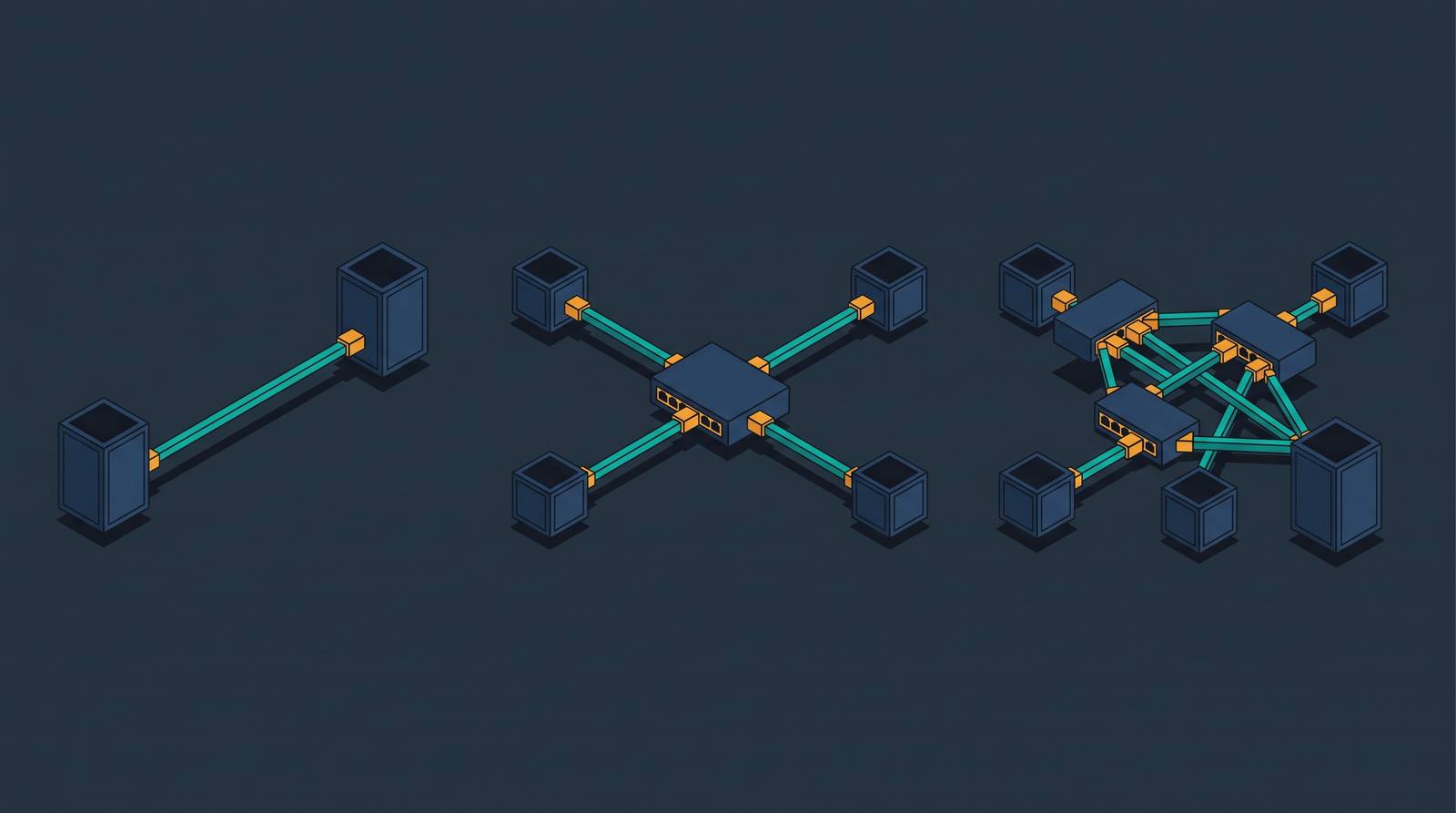
E-Line is the closest Carrier Ethernet gets to a circuit. Ethernet Private Line, EPL, is a dedicated point-to-point Ethernet Virtual Connection with no multiplexing — one EVC, two endpoints, full bandwidth dedication. Ethernet Virtual Private Line, EVPL, introduces C-VID mapping, preserving or translating customer VLAN IDs to S-VIDs for internal transport and enabling service multiplexing over a shared UNI. The VLAN space supports up to 4,094 unique C-VID values per EVC endpoint. That's manageable in isolation. Across a large port base, it becomes a bookkeeping coordination problem, not a technical limitation.
The provisioning sequence spans network qualification, circuit design with CIR/EIR and burst parameters, cross-connect ordering, CPE configuration, and activation testing. Each step can live in a different system. The workflow is linear; the tooling often isn't. I've watched activation coordinators maintain spreadsheets bridging three systems that technically should have talked to each other. That gap is where fallout occurs even on the service type that demands the least coordination.
Zero-touch provisioning for E-Line is achievable where the data model is clean and the service template is well-defined. An operator selects two endpoints, applies a template with defined QoS parameters, and the system creates the service and configures all intermediate elements. CIR or EIR modifications propagate automatically. E-LAN and E-Tree show how far below that ceiling operators are often forced to work.
E-LAN provisioning: the multipoint mesh and the variables that multiply
EVPLAN is a full-mesh logical topology over shared transmission infrastructure. Any endpoint can communicate with any other. That architectural fact, which reads simply enough on paper, is responsible for a provisioning complexity that compounds with every endpoint added. Each new participant in the mesh requires validation against every existing participant, not just against two fixed points.
Customer separation is achieved through VLAN encapsulation or MPLS, and that mechanism choice propagates downstream into what the operator must manage and monitor. The cost efficiency argument for E-LAN, shared bandwidth over a converged infrastructure, trades against protection complexity, congestion management difficulty, and buffering requirements that are categorically harder to satisfy than in point-to-point services.
At scale, Provider Backbone Bridging, IEEE 802.1ah, addresses VLAN exhaustion by introducing the I-TAG, a 24-bit service instance identifier that enables roughly 16 million unique service mappings. Global E-LAN deployments across provider boundaries no longer hit the ceiling. But the I-TAG introduces a layer of identifier management that OSS tooling must track explicitly. Solving the scalability ceiling shifts where the coordination must happen, which is a distinction OSS architects sometimes miss until they're rebuilding the tracking system under production pressure.
Multi-operator E-LAN adds another dimension. Each provider segment must coordinate service parameters across Network-to-Network Interfaces, with inventory state, VLAN and I-TAG assignment, and QoS profiles consistent end-to-end. Fault management compounds this: alarms arrive from the MPLS layer, from underlying SONET/SDH or IP infrastructure, and from the Ethernet service layer simultaneously. Correlating those into a single coherent service-impacting event is not a single-system problem, and it rarely has a single-team owner. That ownership gap is, reliably, where service restoration times extend well past what the SLA specifies.
The provisioning wizard model that works for E-Line doesn't extend cleanly to E-LAN. Each new endpoint added potentially touches multiple intermediate elements and requires re-validation of the full mesh. Partial updates carry risk that point-to-point provisioning simply doesn't face, because a partial state in a mesh can quietly violate isolation guarantees for endpoints that weren't touched at all.
E-Tree provisioning: hub-and-spoke topology and its asymmetric design constraints
E-Tree is rooted multipoint. The root communicates with all leaf sites; leaves cannot communicate with each other. That asymmetry is not a policy setting or a configuration option. It is an architectural constraint baked into the EVC definition, and it must be reflected in the forwarding state of every node in the topology. Operators who treat leaf isolation as a configuration flag rather than a topology property have, in practice, learned otherwise under the worst possible circumstances — a live customer incident where isolation has silently broken.
The primary use cases are broadcast and multicast distribution, hub-and-spoke enterprise WAN, and wholesale access for CLECs and fiber operators delivering services over shared access networks. In each case, the root carries different operational significance than the leaves. For wholesale deployments, the root is typically the operator's aggregation point and the leaves are customer or downstream-provider endpoints. The service definition must map cleanly to both the operator's internal network design and the customer-facing contractual parameters simultaneously.
Adding or removing a leaf site requires validating that isolation is preserved across the full topology, not just at the modified endpoint. A provisioning system that updates only the local node's state without re-verifying the full topology is accepting risk that will surface as a data-plane violation. That validation step is straightforward when it's automated and structurally required. It gets skipped when it's manual and the activation window is closing.
Bandwidth and QoS profiles often differ between root-to-leaf and leaf-to-root directions. Asymmetric provisioning requires the OSS to hold and apply directional parameters as first-class attributes rather than deriving them from a single symmetric value. Systems designed around symmetric circuit provisioning must be extended to accommodate this, and that extension is rarely clean, because the original data model didn't anticipate directionality as a service property. That gap shows up as a special-case handler that accumulates technical debt with each new E-Tree customer.
How transport technology choice — Ethernet-native vs. MPLS core — changes what the provisioning system must handle
An Ethernet-centric implementation carries lower operational overhead and is the more tractable case for automated provisioning. MPLS core deployments, which operators use to carry Carrier Ethernet over longer distances or between geographically dispersed sites, introduce a second operational domain that the activation system must model explicitly. The infrastructure choice and the OSS architecture decision are, in practice, the same decision, even though different teams often make them at different times without coordinating.
When MPLS is in play, provisioning requires simultaneous configuration across two planes — Ethernet service parameters at the UNI and MPLS transport parameters in the core. A change to one plane without corresponding propagation to the other is a service integrity risk. The activation system must understand both layers as a unified model where changes trigger appropriate updates across planes, not as separate tools that a human operator reconciles manually after the fact.
Fault management under a mixed transport architecture is where you see whether an operator's tooling is actually integrated or merely adjacent. Alarms arrive from SONET/SDH, ATM, MPLS/IP, and Ethernet service layers. Correlating them into a service-impacting event requires contextual awareness of all layers simultaneously. Performance management carries the same requirement; statistics from each underlying technology must be gathered, normalized, and surfaced coherently to both the NOC and the customer's SLA reporting interface.
Transport technology selection is, therefore, not only an infrastructure decision. Operators who choose the transport without modeling its implications for the activation system will manage each layer separately. Managing layers separately is not the same as managing the service.
Where provisioning workflows actually fragment across service types and systems today
Operators running E-Line, E-LAN, and E-Tree alongside Dedicated Internet Access and FTTH services are, in most cases, managing islands. Vendor-specific and technology-specific management systems accumulated over years of departmental purchasing decisions don't interoperate cleanly. Each system solved a specific problem when it was deployed. The integration that was deferred is the operational liability that shows up now on fallout reports, mean-time-to-restore metrics, and activation interval commitments that go unmet.
Order journeys break at handoffs. Network data, design data, and activation state live in separate systems. Each handoff is a potential fallout point. Fallout on a multipoint service is structurally harder to recover than fallout on a circuit, because the affected state is distributed across multiple nodes and must be restored consistently rather than at a single point.
VLAN and I-TAG state management across disconnected systems is where identifier collision risk concentrates. If the inventory system and the activation system don't share a single authoritative view of identifier assignment, the probability of collision grows directly with scale. E-LAN deployments using PBB are particularly exposed here, because 16 million identifiers sounds like an enormous space until multiple teams are writing to it from separate systems with no shared locking mechanism. I've seen this exact scenario produce duplicate I-TAG assignments that took days to diagnose.
DIA is, per Vertical Systems Group, the largest and fastest-growing U.S. Carrier Ethernet service by both revenue and ports, with ports projected to grow at a double-digit compound annual rate between 2024 and 2029. Operators provisioning DIA at scale face the same qualification-to-activation workflow gaps that affect all Carrier Ethernet services, with the additional pressure of volume. FTTH adds yet another provisioning domain — OLT and PON hardware abstraction, zero-touch ONT activation, and bandwidth modify, suspend, and resume lifecycle events all require integration with Carrier Ethernet workflows when both services run over the same access plant.
The structural problem is semantic. Legacy systems were built by separate teams with separate data models. "Customer" in one system is not the same object as "customer" in another. When automation is applied on top of this architecture, it encounters these mismatches before it can drive any outcome. The integration debt is a data architecture problem that tooling must eventually solve, not a tooling problem that better tooling can paper over.
Why the U.S. Carrier Ethernet market's current growth trajectory makes workflow fragmentation more costly
The U.S. retail Ethernet port base grew 2.2% in 2024, per Vertical Systems Group. That headline number obscures a sharper compositional shift: DIA and Cloud Access ports are growing at double-digit rates while legacy segment growth is flat or declining. The fastest-growing segment is also among the most provisioning-intensive. Workflow inefficiency is, therefore, compounding at the exact point of maximum demand.
The demand side is not softening. AI and generative AI workloads, cloud connectivity requirements, and managed SD-WAN and SASE deployments are driving enterprise customers toward higher-bandwidth, lower-latency Ethernet services. These customers arrive with tighter SLA tolerance than enterprise customers carried a decade ago. Provisioning errors and activation delays that were acceptable friction in a less competitive market are now displacement risks.
Competitive pressure from adjacent technologies is real. Wavelength services, managed SD-WAN, SASE, and dark fiber are drawing traffic that previously moved over Carrier Ethernet. Operators who can't provision Ethernet services quickly and accurately are more exposed to that substitution. The service quality gap is a retention problem, and the revenue consequences accumulate quietly until a customer notifies you they're leaving.
The hardware market reflects where the industry is heading. The Carrier Ethernet Access Devices market was valued at approximately USD 18.3 billion in 2025 and is projected to reach approximately USD 21.6 billion by 2032. More than half of newly launched devices support flexible bandwidth provisioning and remote orchestration; nearly 55% of current platforms prioritize dynamic provisioning and traffic engineering. The access layer is moving toward software-driven activation. Operators whose OSS tooling can't keep pace are widening a gap that the access layer won't wait for them to close.
What a provisioning system needs to handle all three service types without per-service-type workarounds
The requirement is a single data model that represents E-Line, E-LAN, and E-Tree service parameters natively. Not three separate workflows bolted together behind a common interface, but a unified schema that holds point-to-point, full-mesh multipoint, and asymmetric rooted topologies as first-class structures. When the model accommodates all three service types intrinsically, provisioning logic reads the topology from the model and acts accordingly, rather than branching on service type and executing a different code path for each. Every per-service-type code branch is technical debt with an expiration date.
Service template-driven provisioning follows from that foundation. CIR, EIR, burst parameters, and asymmetric QoS profiles defined once and applied consistently, with modifications propagating automatically to all affected endpoints. The template is the contract between the service definition and the network configuration, and enforcing that contract automatically is precisely what separates a mature provisioning system from a collection of configuration tools.
Identifier state management must be centralized — VLAN, S-VID, and I-TAG assignment tracked in a single authoritative source that qualification, design, and activation all read from and write to. Disconnected bookkeeping is a latent collision waiting to surface, typically when the topology is largest and the rollback is hardest.
Cross-layer awareness must be structural. The system must model the Ethernet service layer and the MPLS or underlying transport layer as first-class objects whose states are interdependent. Reconciliation performed manually by operators is reconciliation that will eventually be skipped, not because operators are careless but because manual steps under time pressure get abbreviated. This is not a process problem. It is a systems design problem.
MEF 3.0 LSO compliance provides the northbound API surface — RESTful interfaces that capture high-level service intent and translate it to device-level configuration across PON, Carrier Ethernet, and IP service definitions. Operators who build to this standard are instantiating intent against a model that knows what to do with it.
The architectural backbone should be event-driven rather than synchronous point-to-point integrations between assurance, inventory, and orchestration. A streaming architecture lets every system consume and publish state changes in real time. The operational difference between a static record of what was provisioned and a live view of what is active is the difference between reactive fault management and proactive service assurance, and that difference becomes more consequential as the service mix shifts toward multipoint topologies.
AI agents operating within the same API and permission structure as human operators complete the picture — intent-driven provisioning, anomaly detection on activation fallout, automated remediation, all auditable, all governed, none operating outside the workflow visibility that SLA accountability requires.
How governed AI changes what's operationally possible across E-Line, E-LAN, and E-Tree delivery
Zero-touch provisioning for E-Line is achievable today in environments where the data model is clean and the service template is well-defined. Operators with mature OSS tooling are running it now. The endpoint-selection-to-activation pattern is automatable, and the operators executing it at scale are clear-eyed about what a clean data model actually costs to build, because they paid for it.
E-LAN and E-Tree are where AI assistance earns its operational role. Validating mesh consistency across a growing endpoint set, checking leaf isolation rules after topology changes, correlating multi-layer alarms into a coherent service event, flagging VLAN and I-TAG collisions before activation — these are tasks that are error-prone at scale for human operators working across fragmented systems. Human attention doesn't scale with variables; automated validation logic does.
The governance condition is non-negotiable. A failed E-LAN activation can affect all endpoints in the service simultaneously rather than degrading a single circuit. The blast radius of a multipoint provisioning error is categorically different from the blast radius of a point-to-point error, and any governance architecture that doesn't reflect that asymmetry is providing a false sense of control. AI agents operating on the same APIs, audit logs, and permission structures as human operators produce actions that are traceable and reversible. Traceability is what makes the automation trustworthy rather than merely fast.
Bolt-on AI doesn't solve this. An AI layer applied over siloed systems inherits the semantic mismatches and data gaps those systems carry. It can flag problems visible in one domain; it cannot act coherently across qualification, design, and activation when those processes live in separate data models with incompatible definitions of the same entities. The integration debt that prevents human operators from working fluidly across systems will constrain AI agents identically, because the AI is bounded by the same data architecture.
AI-native provisioning doesn't mean removing human operators from Carrier Ethernet delivery. It means AI handles the variable-intensive, multi-constraint validation work that service complexity generates, and humans retain control over exceptions, customer commitments, and escalation decisions. That division of labor requires both human operators and AI agents to work within the same model, the same permissions, and the same audit trail. Anything short of that is automation theater, and operators who have been in this industry long enough have seen automation theater before. It tends to look very impressive until something breaks at 2 a.m. on a Friday.
Operators who treat E-Line, E-LAN, and E-Tree as distinct complexity profiles can design provisioning workflows that match automation to where it fits and human judgment to where it matters. The data and integration debt accumulated under years of departmental system procurement is resolvable. The operators who resolve it will provision faster, fall out less, and retain customers who have other options.