Dedicated Internet Access Provisioning at Scale
Automating DIA provisioning requires unified data models before adding AI.
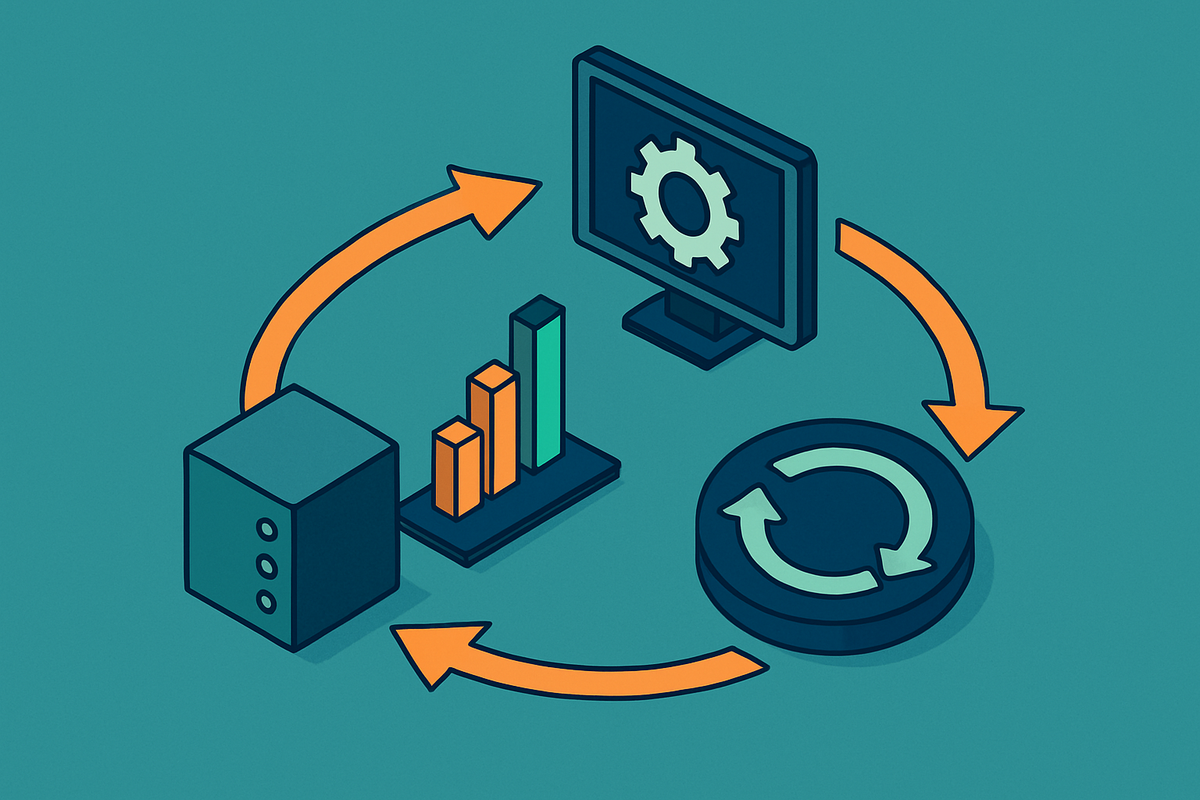
At low volumes, DIA provisioning survives on competence, coordination, and tribal knowledge. A skilled team manually bridges the gaps between qualification, design, provisioning, activation, and billing. They know which system holds the authoritative record, which fields to double-check, which technician to call when something doesn't match. The workflow is fragile, but it holds. For a while, nobody notices the fragility because the volume never tests it.
Then the orders come in.
Each handoff in the DIA delivery chain is a latent failure point. At low volumes, a human catches the discrepancy before it propagates. At high volumes, the discrepancy moves faster than anyone can track. A qualification mistake made at order entry becomes a design error, becomes a provisioning failure, surfaces as a customer-facing delay on a circuit carrying a contractual activation commitment. Errors don't stay isolated. They compound, they travel, and by the time they're visible, they've already cost something measurable.
DIA orders can't be batched like residential broadband. Each enterprise order is distinct — specific bandwidth tier, specific SLA class, specific physical path, often specific CPE. No two are identical. The automation logic that works for consumer services can't be borrowed here; the variability is too high and the consequences of getting it wrong too significant.
Fiber providers expanding into new service areas encounter this directly. Orders, upgrades, and disconnects that still depend on manual steps and disconnected systems stack activation delays, multiply errors, and degrade service quality on accounts that represent meaningful recurring revenue. Enterprise customers on SLA-backed contracts notice. Churn on high-value accounts is expensive in ways that don't appear on a provisioning dashboard but absolutely appear on a P&L.
The structural causes of DIA provisioning failure in legacy OSS environments
Legacy OSS wasn't designed for this service model. It was built around batch-driven, circuit-era architecture and extended over decades through proprietary integrations that created vendor lock-in without creating capability. Migration is risky and expensive, so providers stay on platforms that were never suited for high-volume, SLA-bound enterprise fiber delivery. The architecture that was adequate for what the business used to sell is structurally mismatched to what it now needs to deliver.
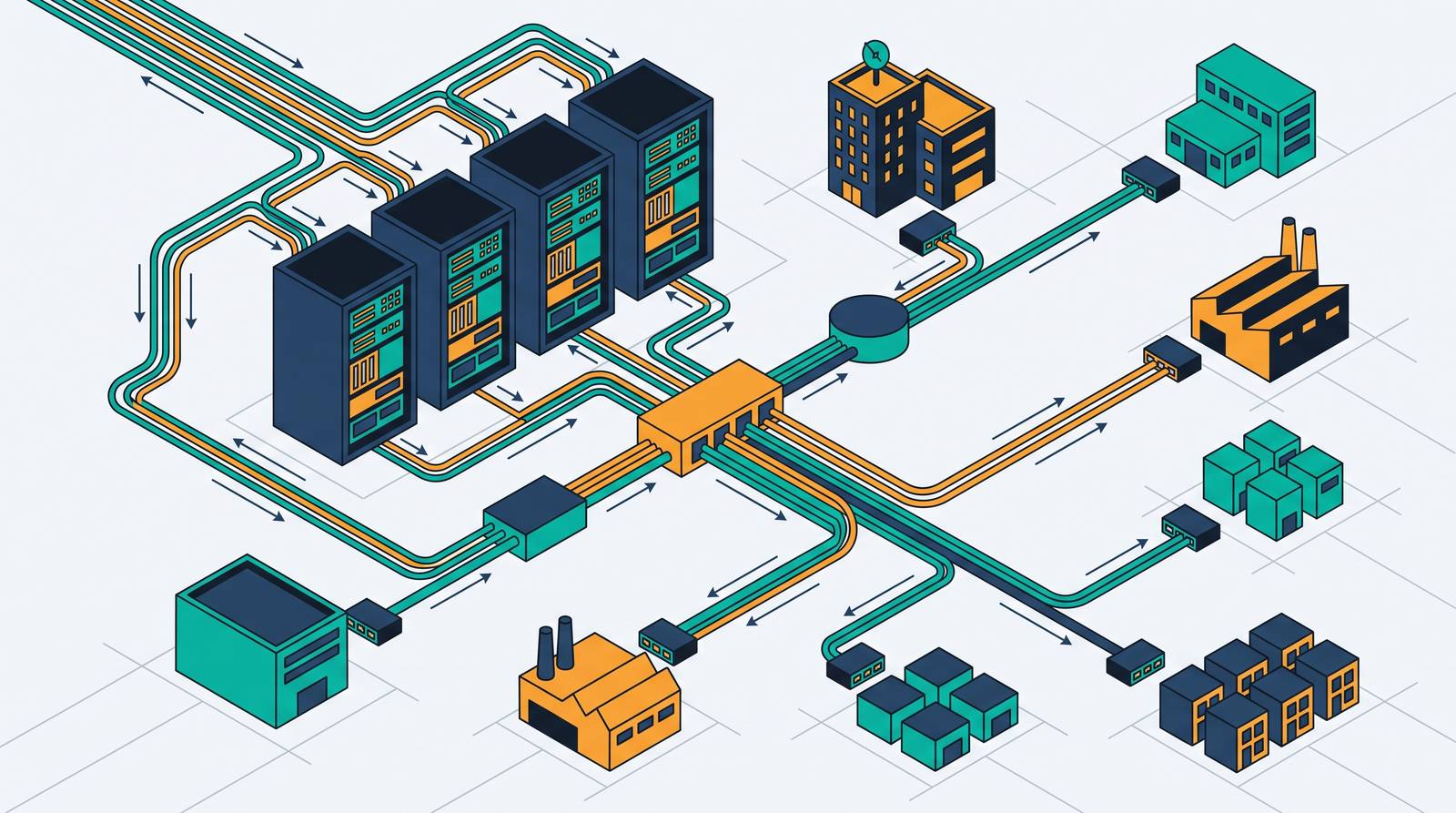
The fragmentation this produces is specific. Qualification lives in one system. Design lives in another. Provisioning, activation, and billing each occupy their own toolset, with no shared data model tying them together. Every handoff between systems requires manual reconciliation because there's no authoritative record both sides trust. Field records and billing records diverge routinely. When field execution data doesn't flow directly into billing, invoices don't reflect what actually happened, manual verification delays revenue recognition, and billing disputes become a standard feature of the customer relationship rather than an exception.
Better training won't fix this. More coordination staff won't fix it either. These are architectural defects — incompatible data models, fragile integration points, and design assumptions about volume and variability that enterprise DIA at scale violates every day. The OSS estate, in this condition, functions as an anchor. Every engineer reconciling records between systems is an engineer not provisioning circuits, and that trade-off is happening constantly, invisibly, at a cost that accumulates across every order.
What flow-through provisioning requires from the underlying data model
The target state for DIA provisioning is flow-through service activation, where an order entered into the system moves directly to device configuration without manual intervention at any point in the chain. That outcome is technically achievable. It requires one precondition that is consistently underestimated, which is data integrity at every stage, sustained across every system that touches the order.
TM Forum's Shared Information and Data model, documented in GB922, is the canonical data model for telecommunications information. Aligning both an order management platform and a provisioning system to this model is what makes data flowing between them trustworthy, rather than requiring someone to verify it manually when something doesn't match. TM Forum's enhanced Telecom Operations Map, documented in GB921, maps every business process a service provider runs, from order management through network assurance and billing, giving multiple teams, vendors, and integration partners a shared vocabulary for what a process means and what data it requires.
For DIA specifically, the logic follows directly. Qualification data must be the same data design uses. Design outputs must be the same inputs provisioning consumes. Activation status must trigger billing without a human in the middle. When these conditions are met, the workflow is coherent. When they're not, "automation" means automating individual steps that still require humans to bridge gaps between systems. The failure points move; they don't disappear.
A single unified data model is the prerequisite for eliminating reconciliation overhead, not an IT preference. Without it, the workflow cannot achieve flow-through, regardless of how capable the individual tools are. At DTW Ignite 2025, TM Forum launched the AI-Native Blueprint specifically to prevent siloed, bolt-on AI deployments from replicating this same fragmentation at a new layer. That launch signals that the industry recognizes the structural risk of automating on top of an incoherent data foundation.
Where AI fits into the DIA provisioning lifecycle (and where it cannot be trusted without governance)
AI compresses the DIA delivery lifecycle at several specific points — qualification inference from network inventory, design validation against SLA parameters, provisioning sequencing, and anomaly detection during activation. These are not speculative future capabilities. They're operational today in mature deployments.
The ceiling that AI-assisted workflows aim for is zero-touch provisioning, where a customer purchasing a service triggers automatic activation without operator or provider intervention at any stage. Reaching that ceiling requires not just AI capability but AI reliability, which is a function of governance, not intelligence. This distinction matters more than most operators realize until something goes wrong.
The NVIDIA Annual Telecom AI Study 2025 found that 97% of telecom organizations were assessing or adopting AI in 2025, up from 90% the prior year. Adoption is near-universal. Maturity is not. Only about one in five companies has a mature model for governing autonomous AI agents, according to Deloitte's State of AI in the Enterprise 2026 report. Agentic AI is moving into provisioning workflows faster than governance frameworks can follow, and the gap between those two curves is where liability accumulates.
In a provisioning context, the consequence of ungoverned AI action is concrete — a misconfigured circuit, a wrong bandwidth tier, an SLA parameter applied to the wrong endpoint. Each carries direct customer impact and potential contractual liability. Gartner projected in 2025 that guardian agents (AI systems designed specifically to govern other AI agents) would capture between 10 and 15 percent of the agentic AI market by 2030. That projection reflects a market acknowledging that governance architecture is a product category, not an afterthought. Speed gains from autonomous action are negated if those actions can't be audited, traced to their inputs, or reversed when they produce the wrong outcome.
What governed AI in provisioning actually looks like at the architecture level
Governance in AI-assisted provisioning is not a policy document or a review committee. It is architecture — governance mechanisms embedded at the gateway layer, covering access control, observability, and explainability, that ensure every agentic provisioning action is transparent and auditable in the same way a human action is.
AI agents must operate on the same APIs, audit trails, and permission structures as human operators, not on shadow integrations, not on out-of-band tooling that bypasses the operational record. The same change-management logic that governs a human provisioning action governs an AI provisioning action — same approval thresholds, same rollback capability, same audit entry. The actor changes; the accountability framework does not.
McKinsey's State of AI 2025 makes this point directly: guardrails must be use-case specific, data-governed, and system-contained. For DIA, the use-case-specific guardrails cover bandwidth parameter validation, SLA class assignment, and CPE configuration. These are the exact fields where provisioning errors create service failures and billing disputes. The governance layer doesn't restrict AI broadly; it constrains AI precisely where the risk is highest.
A practical governance model defines three tiers: where AI agents can act autonomously, where they require human confirmation before proceeding, and where humans must remain the primary actor. This graduated architecture scales with the maturity of the AI system and the risk profile of the action being taken. One operator, using AI-supported data classification with end-to-end lineage tracked through an observability layer, reduced data-operations costs by approximately 50 percent, per PwC. Cleaner inputs produced fewer break-fix cycles, which produced faster service launches. The governance layer wasn't an obstacle to that outcome; it was a precondition for it.
The full DIA delivery lifecycle on a unified operational architecture
Qualification is the entry point. Network inventory and serviceability are checked against a single authoritative data model, without a separate lookup tool, without a manual verification step, and without the risk that the qualification record and the design record will diverge before the order reaches provisioning.
Design derives directly from qualification outputs. SLA class, bandwidth tier, and physical path are resolved in the same system that performed qualification. There is no translation step, no re-entry of data already captured.
Provisioning flows through to device configuration without manual intervention. Whether the underlying technology is GPON, XGS-PON, Active Ethernet, or Carrier Ethernet, the order reaches device configuration through the same workflow. The data model doesn't change based on access technology.
Activation, where possible, is zero-touch. AI agents validate configuration against SLA parameters before the circuit is handed over to the customer. When parameters fall outside defined thresholds, the governance layer escalates rather than proceeding.
Billing updates in real time from field execution data. The manual verification step that delays revenue recognition and generates invoice disputes doesn't exist in this architecture, because the data that generates the invoice is the same data that recorded the activation.
Every stage operates on the same data model. Qualification data doesn't need to be re-entered at design. Design outputs don't need to be translated for provisioning. OSS platforms purpose-built for this lifecycle, consolidating qualification, design, provisioning, and activation on a single unified data model for dedicated internet and Carrier Ethernet services, demonstrate what becomes possible when the architecture is coherent from the start. Service providers who treat OSS as a back-office cost center provision DIA slowly and reactively. Those who treat it as a strategic platform provision it as a repeatable, scalable product.
How to assess whether your current OSS can scale DIA provisioning
The OSS and BSS market was valued at USD 65.81 billion in 2024 and is projected toward USD 148.26 billion by 2033, per IMARC Group. That growth will produce a continuous stream of vendors marketing "AI-ready" and "unified" capabilities. Operators need a method for distinguishing architecture from positioning.
Four questions cut through it.
Does a DIA order entering your system touch more than one data store before it reaches provisioning? Each additional system is a reconciliation risk, not an integration feature.
Can AI-assisted provisioning actions be audited against the same log as human actions? If not, you have ungoverned automation, and that governance gap will surface as a liability before it surfaces as a process improvement.
When a field technician closes a DIA activation, does billing update automatically, or does someone verify and enter it manually? The answer tells you whether your revenue recognition depends on human accuracy at scale.
If you doubled your DIA order volume tomorrow, which step would break first, and why?
That last question is the most revealing. If the answer points to a handoff between qualification and design, or to a manual check before provisioning fires, the constraint is architectural. More staff and better training don't change what the architecture can hold. Modernization doesn't require replacing everything at once. It requires knowing which seams in the current architecture are load-bearing and which are failure points waiting for volume to expose them. The providers who will deliver DIA as a competitive product rather than a high-effort exception are the ones building the operational architecture now, before volume forces the decision.