FTTH Network Architecture for Competitive Operators
Choosing the right PON standard and split ratio determines long-term competitiveness.
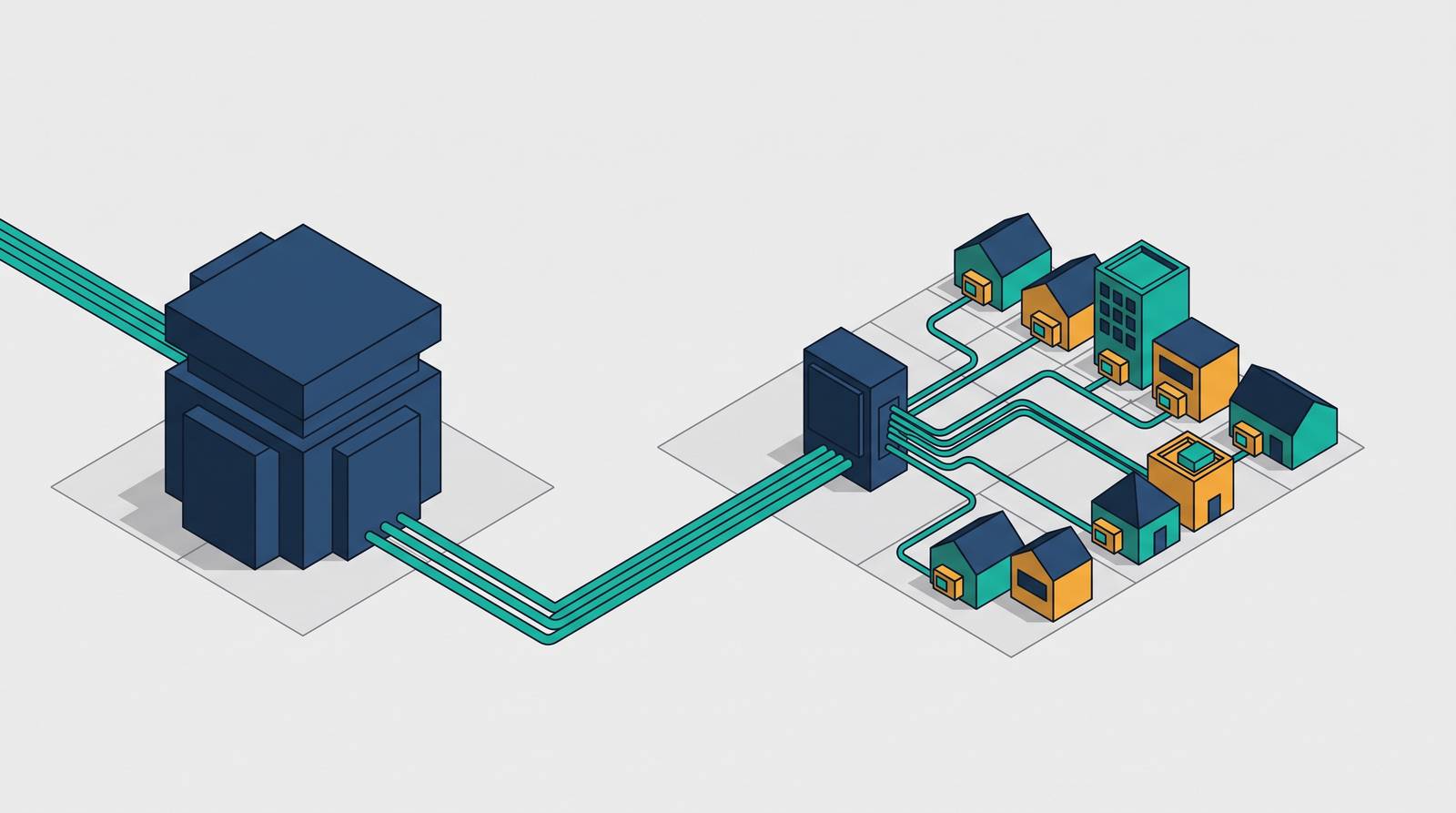
The PON standard an operator selects is the foundational decision of the entire build. It establishes the capacity ceiling, the upgrade trajectory, and the economics of every home served, before a single subscriber is connected.
GPON, operating at 2.5 Gbps downstream and 1.25 Gbps upstream, remains the most widely deployed standard globally. Its ecosystem is mature, equipment costs are lower than newer standards, and for operators whose near-term service mix is residential broadband in the gigabit range, it remains a defensible choice on economics alone. XGS-PON, delivering 10 Gbps symmetrically, is increasingly the baseline for operators building with a ten to fifteen year horizon, particularly where symmetrical gigabit is the entry-level offer and enterprise services are within scope. NG-PON2 and the emerging 25G and 50G PON standards sit further out on the roadmap, but prudent operators evaluate not just what they're deploying today but what their feeder and distribution infrastructure will support without a full rearchitecture.
The split ratio is where PON topology becomes an economic lever, not just a technical parameter. Higher split ratios, 1:64 or 1:128, reduce feeder fiber cost per home passed, which is attractive in dense residential deployments where cost-per-home is the primary construction metric. But higher splits compress per-subscriber bandwidth headroom. That tradeoff is acceptable when the service mix is purely residential. It becomes a real liability the moment an operator wants to layer in business broadband, dedicated internet access, or Carrier Ethernet, services that demand more consistent per-circuit capacity guarantees. Two-stage splitting, distributing the split between a centralized point and a field enclosure, offers reconfiguration flexibility as demand evolves, but it introduces design complexity that must be documented carefully to avoid operational confusion later.
Operators who optimize split ratios for today's service mix without modeling enterprise or multi-gigabit upgrade scenarios frequently face costly rearchitecture when demand moves. That rearchitecture isn't merely a capital problem. It's a delay problem. The time spent revisiting passive infrastructure decisions is time competitors use to provision customers and capture market share.
The upgrade path matters as much as the initial deployment. Gigabit and 10 Gbps symmetrical services are no longer premium offerings in competitive markets; they're the new baseline expectation. I've watched GPON operators in BEAD-funded rural areas hit their near-term cost targets, satisfy grant requirements, and then face an awkward conversation three years later when a better-capitalized entrant builds to XGS-PON from the start and starts marketing symmetrical 10 Gbps to the same addresses. That conversation is expensive, and it was avoidable.
Passive infrastructure design decisions that determine scalability before the first splice
Outside plant design is where topology decisions become real construction costs, and where competitive operators separate from those treating FTTH as a commodity build.
Conduit strategy is the first pressure point. Innerduct placement, spare conduit capacity, and vault spacing determine how easily an operator can pull additional fiber as subscriber density increases or service mix changes. Shortcuts in conduit design aren't one-time savings. They're costs paid repeatedly over the network's operational life, every time a fiber pull is more expensive or more disruptive than it needed to be.
The aerial versus buried decision carries its own distinct economics, and those economics vary meaningfully by terrain, pole availability, and right-of-way conditions. Aerial plant deploys faster and provides easier access for maintenance and upgrades. It also carries higher exposure to storm damage and long-run maintenance variability. Buried plant costs more upfront but delivers lower operational variance over time. Neither is categorically superior; the correct choice depends on geography and the operator's risk tolerance for operational disruption. Hybrid approaches, burying feeder cable while using aerial distribution, are common in mixed-density markets and can optimize economics across both environments, provided the junction points between aerial and buried segments are documented with precision. Operational confusion at those points is a recurring source of provisioning errors and unnecessary truck rolls.
Splice and termination point architecture affects provisioning speed, not just construction cost. This connection gets less attention than it deserves. Where splices are placed, and how fiber paths are documented and named, determines how quickly a technician or an automated system can trace a circuit from OLT port to ONT during provisioning or fault isolation. Operators who build dense, well-documented splice architectures with consistent naming conventions provision faster and isolate faults faster. Those who build organically, without naming discipline or systematic documentation, accumulate technical debt in the outside plant that surfaces as provisioning errors and truck rolls at exactly the wrong moment, during a customer activation.
BEAD's documentation and compliance requirements are, in this respect, a forcing function that competitive operators should embrace rather than tolerate. The discipline required to satisfy real-time reporting obligations is the same discipline that produces the network records quality that supports accurate service qualification and automated provisioning. Operators who treat network documentation as a construction closeout task rather than an operational asset start every downstream workflow with compromised data.
How OLT placement and distribution reach affect provisioning economics at scale
OLT placement is simultaneously a network economics decision and a provisioning workflow decision. The implications of getting it wrong compound with scale.
Centralized OLT architectures minimize the number of managed equipment sites and simplify configuration management. That simplicity is genuinely valuable, particularly for operators with lean field operations teams. The tradeoff is extended fiber reach requirements and potential split ratio constraints in lower-density areas, where the distance from a central hub to subscriber clusters requires longer feeder runs or additional amplification. Distributed hub strategies place OLTs closer to subscriber clusters, reducing fiber reach and enabling more favorable split ratios per service area. The cost is a multiplied number of managed sites and the operational discipline required to maintain consistent configuration across all of them.
The right placement strategy depends on density, geography, and service scope. What's categorically wrong is choosing a placement model without modeling the provisioning workflow implications. OLT port management is where physical architecture meets service delivery speed. Operators who pre-engineer port assignments, maintaining accurate and real-time records of which ports are assigned, provisioned, or available, can automate service qualification and provisioning against actual network state. Operators who manage port assignments manually, or in systems disconnected from their order management and activation platforms, introduce delays and errors at precisely the moment that matters most, customer activation. At scale, the gap between an operator that can qualify a service address against live network data in seconds and one running manual port lookups becomes a measurable difference in sales conversion rates and time-to-revenue.
Hub site diversity and redundancy strategy carries a separate but equally consequential implication, enterprise service eligibility. Carriers offering dedicated internet or Carrier Ethernet services need diverse path capability to support SLA-backed redundancy. Operators who design hub site architecture without path diversity foreclose enterprise revenue opportunities that require contractual uptime guarantees. This is a decision made in the architecture phase. It cannot be easily retrofitted without significant capital expenditure and service disruption. If you want enterprise revenue, you design for it before the first hub site is built. There is no other sequence that works.
Why service qualification accuracy depends on how well the network model reflects physical reality
Service qualification is the first moment the architecture either pays off or creates friction. When a potential customer or an ordering system asks whether a specific address can receive a specific service at a specific speed, the answer comes from the network model, not from the physical plant directly. If that model is incomplete, stale, or disconnected from provisioning systems, the answer is unreliable.
False positives, promising service that can't be delivered, damage customer experience and generate truck rolls. False negatives, missing addresses that are actually serviceable, leave revenue uncaptured. Both failure modes are invisible until they accumulate into a pattern, at which point the underlying data quality problem has often compounded considerably.
The network model is only as accurate as the discipline that maintains it. Operators who treat network records as a construction artifact, accurate at build time and maintained inconsistently thereafter, accumulate what can be called model drift, the growing gap between what the system believes and what is physically true in the field. Model drift manifests as provisioning failures, incorrect address serviceability results, and technician dispatches to resolve discrepancies that should have been caught before activation. It is not a dramatic, singular failure. It is a slow erosion that degrades operational performance across every service delivery workflow, and it is invisible until the degradation is already severe.
Operators who build continuous update processes, feeding outside plant changes, port assignments, and ONT activations back into the network model in real time, maintain the accuracy that makes automated qualification reliable. This is not primarily a technology problem. The technology to capture and propagate field updates exists. The organizational commitment to make it standard operating procedure is where most operators fall short, and that gap is harder to close than any software integration.
The network model is also the foundation for automated provisioning. The same data quality problem that corrupts qualification will corrupt provisioning if not addressed at the source. Qualification and provisioning systems that draw from the same unified data model eliminate the entire class of errors that arise when two systems disagree about network state. Operators running separate qualification databases and provisioning systems, a pattern inherited from legacy tooling, face reconciliation overhead and error rates that scale with the complexity of their service catalog.
How provisioning workflow structure determines time-to-revenue and scalability
Provisioning speed is a competitive metric. The interval between a signed order and an active service is where FTTH operators either convert their infrastructure investment into revenue or bleed it into operational overhead. Incumbents' slow provisioning intervals are a documented weakness in competitive markets, and operators who build provisioning speed into their operational architecture exploit that gap directly.
Legacy provisioning workflows impose structural speed limits that cannot be overcome by working harder or adding staff. When provisioning logic is embedded in siloed systems, with order management disconnected from network inventory and network inventory disconnected from activation, each handoff introduces latency and a new surface for errors. I have seen operators spend the better part of a year integrating a new service type into a fragmented stack, not because the service was technically complex, but because the provisioning logic had to be rebuilt separately in each disconnected layer. That is a direct constraint on how quickly an operator can respond to market demand, and it does not get better with experience. It gets worse as the service catalog grows.
The structural fix is collapsing those workflows onto a unified data model where qualification, design, provisioning, and activation draw from and write to the same source of truth. That architecture enables zero-touch provisioning, which transforms time-to-revenue from a weeks-long interval into an automated sequence measured in hours. Zero-touch provisioning for ONT activation is achievable when three conditions are simultaneously true: the network model accurately reflects OLT port state, the order management system can translate a service order into a provisioning instruction without human translation, and the activation system can confirm completion back to the same record. Each broken link in that chain reintroduces manual steps, and manual steps reintroduce the speed and error profile that automated provisioning exists to eliminate.
Carrier Ethernet and dedicated internet provisioning carry additional complexity that amplifies these gaps at higher cost. Business services require circuit design, path verification, SLA configuration, and often multi-site coordination. The margin for error in network model accuracy and workflow integration is narrower than in residential provisioning, and the revenue at stake per circuit is substantially higher. Operators who can provision business services with the same workflow discipline as residential services unlock a revenue tier that many FTTH-focused competitors leave underserved, often because their provisioning architecture was designed with only residential services in mind.
What a unified data model across the service delivery lifecycle actually changes
The unified data model is the architectural answer to fragmentation. It is not a software feature or a vendor marketing category. It is a structural property of the operational environment, and its presence or absence determines which capabilities are achievable and which are structurally foreclosed.
A unified model means qualification, design, provisioning, and activation all operate against a single representation of network state. When a port is assigned during design, provisioning sees that assignment immediately. When activation completes, the same record reflects it without a synchronization job or a manual update. The alternative, point-to-point integrations between separate systems, creates reconciliation overhead that grows nonlinearly with the number of systems and service types in play. Operators who have built on fragmented tooling often underestimate what fraction of their operational headcount is effectively doing data reconciliation rather than service delivery. That work is real and necessary in a fragmented environment. It is just not delivering value to customers.
The unified model enables capabilities that are structurally impossible in fragmented architectures. Real-time service qualification against live network state, not a snapshot from last week's batch export, becomes straightforward. Automated order fallout detection becomes precise: when a provisioning step fails, the system knows exactly which record is inconsistent and why, rather than requiring human investigation across multiple systems. Accurate capacity planning, seeing port utilization, serviceable address counts, and provisioning pipeline in one view, enables demand-driven infrastructure investment rather than reactive overbuild driven by uncertainty about actual network state.
The AI dimension of this problem is worth confronting directly. AI automation in service delivery is increasingly a realistic operational lever, not a future-state aspiration. But AI agents that surface recommendations or take automated actions must draw from a consistent, governed data model. An agent operating against stale or conflicting records from multiple systems will generate incorrect outcomes at speed. I have seen operators move to build AI into their service delivery workflows before they have unified their underlying data, and the result is not acceleration; it is accelerated error. The sequence matters: unified data model first, then automation, then AI-assisted operations. Operators who shortcut that sequence will find that the automation and AI they deploy produce unreliable outputs that erode, rather than build, operational confidence.
Platforms that operationalize this model, bringing network inventory, service qualification, order management, and provisioning activation into a single governed environment, represent the operational infrastructure that competitive FTTH operators need to match the speed and scale the market now demands. OSS vendors such as Netcracker, Amdocs, and Ribbon have addressed portions of this problem, and purpose-built fiber operations platforms like Boldyn Networks' OSS stack and Calix have approached it from different angles. Operators evaluating the space should prioritize vendors who can demonstrate a genuinely unified data model across the full service delivery lifecycle, not federated systems stitched together at the integration layer.
The competitive FTTH operators who will outmaneuver incumbents over the next decade are those who build the operational architecture to convert fiber into revenue efficiently, qualifying accurately, provisioning rapidly, and scaling without proportional increases in operational complexity. Every architectural decision described in this piece, from PON standard selection through passive infrastructure design to provisioning workflow structure, either contributes to that capability or detracts from it. The decisions made before the first splice is pulled determine whether the network that results is a platform or a liability.