Logical Network Topology in Service Provider Design
Defining services logically, independent of physical gear, shapes every workflow downstream.
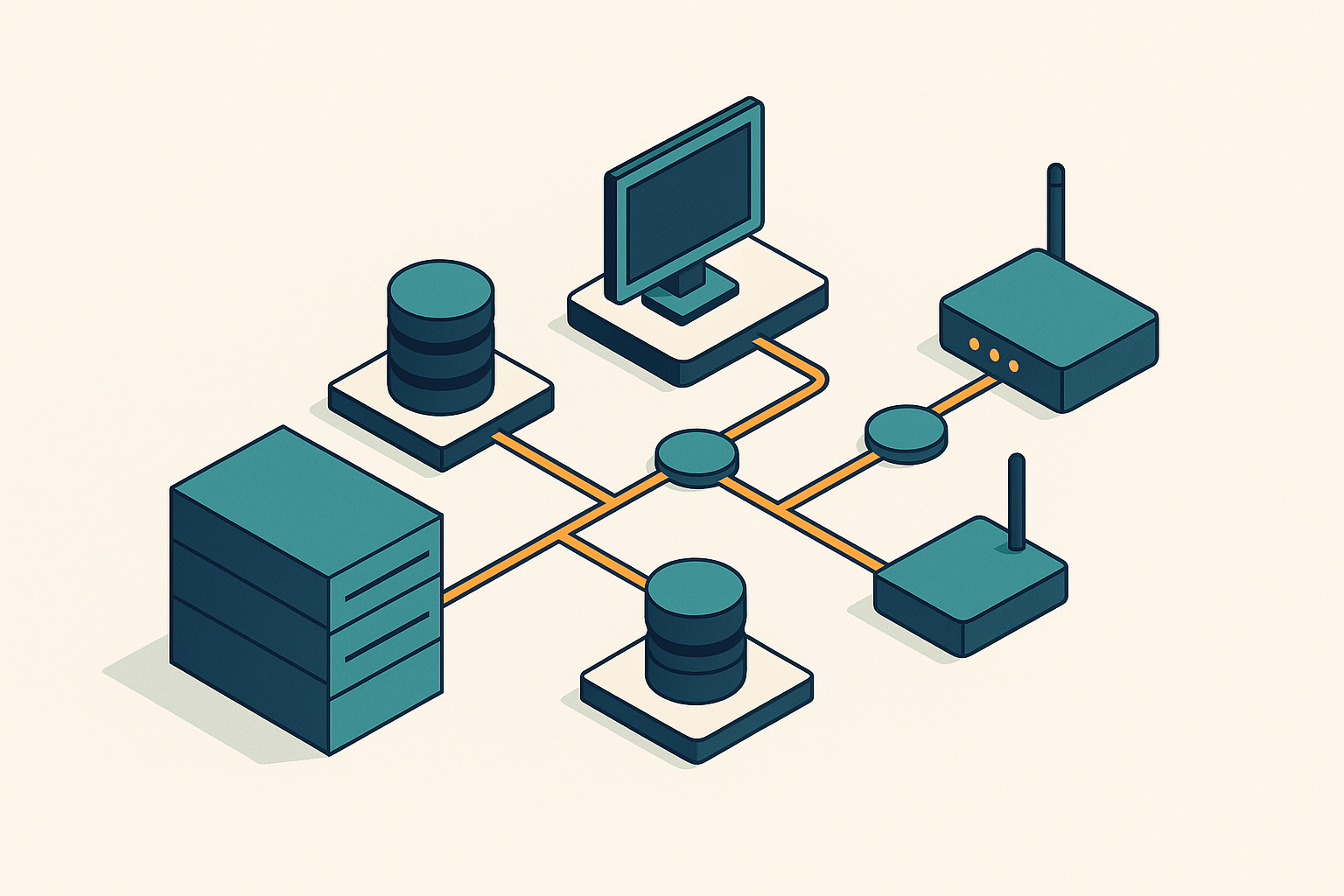
Logical network topology is the abstraction layer that makes service provider design possible at all. It defines how services get modeled, qualified, and delivered independent of the fiber, chassis, and ports that carry them. Get this wrong and every workflow built downstream of it inherits the mistake.
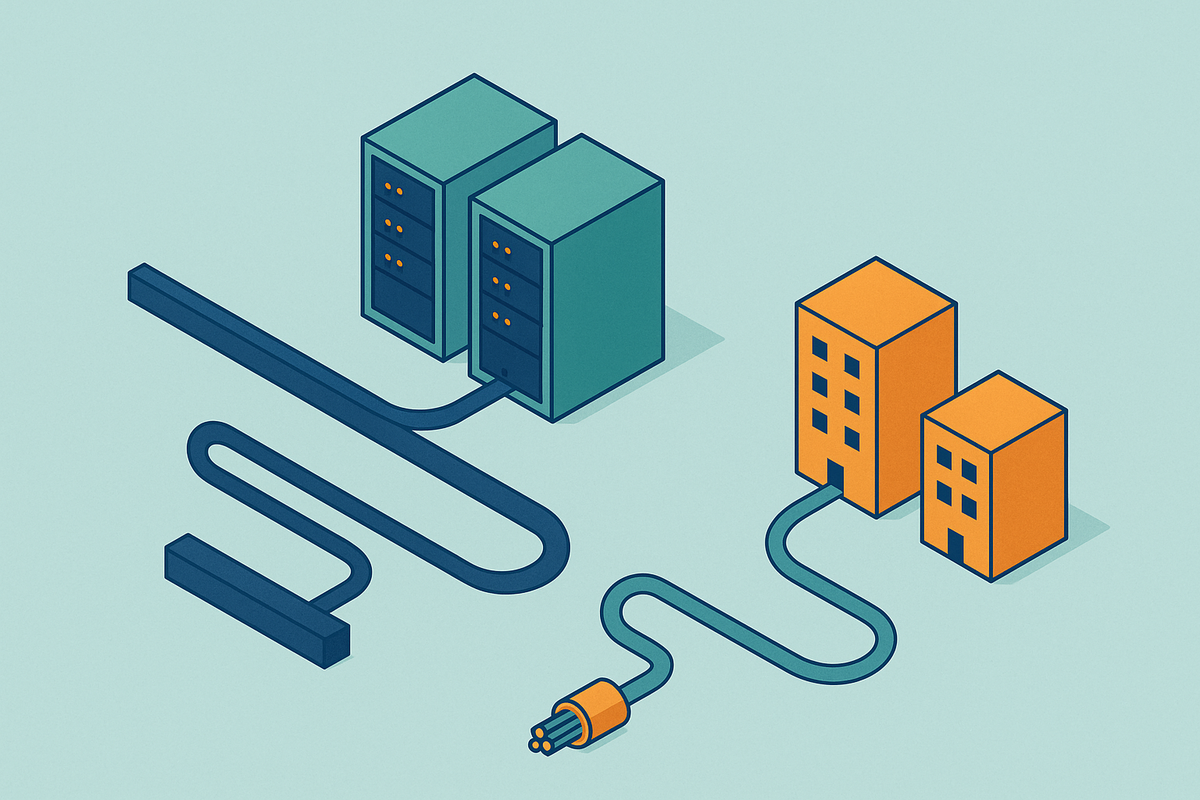
Physical topology answers where the fiber runs and how boxes connect to each other. Logical topology asks something else: what does this service actually look like, from a delivery standpoint, no matter which physical gear happens to carry it today. That distinction sounds like a distinction without a difference until you notice that the same fiber segment can carry a point-to-point Carrier Ethernet service and a multipoint FTTH deployment at the same time. Same glass, same conduit, two completely different logical structures riding on top of it. Logical topology gets authored during service design, then gets consumed downstream by qualification, provisioning, and activation systems. It reflects intended service structure, separate from a snapshot of whatever happened to be plugged in last Tuesday. Providers sell services, and the logical layer is where the product actually lives, distinct from the fiber sheath.
The elements a logical topology model must represent to be useful
A model earns its keep when it defines service endpoints in logical terms. UNIs for Carrier Ethernet, ONT ports for FTTH, hand-off interfaces for dedicated internet, each identified by the role it plays rather than by which physical card happens to serve it this week. Connectivity relationships need the same treatment: point-to-point, point-to-multipoint, hub-and-spoke, ring, expressed as logical constructs instead of a literal trace of cable runs.
Resource allocations belong in there too. VLANs, QoS policies, bandwidth profiles, service identifiers, the specific parameters separating this service instance from the dozen others riding the same underlying capacity. Stack the service hierarchy on top of that: an Ethernet Virtual Connection sits above a transport path, which sits above raw physical capacity, and each layer needs its own attributes represented on its own terms.
Dependency references matter just as much, pointers to the physical or logical resources a service leans on, without baking physical detail directly into the service record. That separation is what keeps the model bendable when the network underneath changes. State needs tracking too, explicitly: designed, reserved, provisioned, active, suspended. The model should always show where a service actually sits in the delivery workflow, not where somebody assumes it sits.
Leave any of this out and the failures write themselves. Conflate logical and physical, and a routine port swap breaks a service record even though the service itself never noticed a thing changed. Skip resource allocation tracking and provisioning has no authoritative source for what to configure; someone starts running manual lookups, and inconsistency creeps in fast. Drop state tracking and qualification stops sharing a picture with activation. Handoffs start running on tribal knowledge instead of system state, which holds up fine right up until the one person who remembers the exception leaves for another job.
How logical topology shapes service qualification before a single resource is committed
Qualification asks whether a specific service can actually reach a specific endpoint under specific parameters: bandwidth, latency, redundancy, service type. A working logical topology model turns that question into a structured query. Given a requested service and an endpoint, what logical path exists, what resources sit along it, can the required parameters actually be met. Without the model, qualification turns into an investigation. Someone traces physical inventory by hand, reasons about feasibility from scratch, and translates that reasoning into a design. It's slow, it's error-prone, and it doesn't scale past a handful of orders a day.
The specifics shift by service type, which is exactly why a one-size answer doesn't work. FTTH qualification asks whether a logical ONT port exists at the address, whether upstream OLT capacity holds up, which splitter and PON port the endpoint falls under. Dedicated Internet qualification asks whether a logical access circuit can carry the requested bandwidth profile, what the upstream aggregation topology looks like, whether hand-off parameters match the customer's gear. Carrier Ethernet qualification asks whether the required EVC type can run between the requested UNIs, whether CoS attributes are available along that path, and whether other services already sharing it eat into what's left.
Industry interoperability frameworks formalize exactly this kind of exchange as structured calls between trading partners, and every one of those calls assumes a logical topology model on the other end that can actually answer correctly. Accuracy is the whole game here. A qualification answer is only as good as how current the model behind it is. Stale topology data produces false positives, promising service that can't be delivered, and false negatives, turning down orders that were perfectly doable. Both mistakes cost money. They just cost it in different places.
Moving from a qualified service to a logical design: what gets authored and why it persists
Once a service qualifies, somebody has to author the logical topology that will actually fulfill it. That's service design: picking which logical resources get allocated, specifying the connectivity model, locking in service parameters. From that point on, the design record is the canonical artifact. Provisioning, activation, and assurance should all read from it directly instead of re-deriving service intent from scratch every time they touch the order.
What gets authored breaks into a few pieces. Endpoint bindings specify which logical termination points are involved and what role each one plays. Path selection designates which logical route connects them, in logical terms, this EVC crosses these logical nodes in this sequence, without specifying wavelengths or which cable sheath carries it. Resource reservations claim VLANs, bandwidth profiles, QoS markings, and service identifiers against the design; not yet configured on any device, but spoken for. Service parameters lock in CIR, EIR, latency class, redundancy model, everything downstream configuration will need to reference later.
Persistence matters because everything after this point leans on it. Provisioning reads it. Activation checks against it. Assurance references it. Change management may pull it back up months later when a customer wants a bandwidth upgrade. Whatever accuracy exists in the record the moment it's created is the accuracy every later stage inherits, for better or worse.
A familiar failure shows up right here: the design lives in a spreadsheet, or a Word doc, or a Visio diagram sitting entirely outside the OSS data model. The logical topology exists as an idea in someone's head and a picture on a slide, with no durable, machine-readable form anywhere. Every downstream team then reads the document its own way, and those readings drift apart from each other over time. The fix is to author the design directly into the same data model used for qualification and provisioning, so the artifact serves as the system record rather than a document describing one from a distance.
Why fragmented tooling breaks logical topology continuity across the delivery lifecycle
The typical operator stack runs qualification in one tool, design in another, provisioning in a third, activation in a fourth, each with its own data store and its own private idea of what a complete service record looks like. Fiber providers especially tend to pile up separate systems for network management, field dispatch, provisioning, and billing, and as the network grows, so does the stack of disconnected platforms sitting between them.
Fragmentation does real damage to logical topology specifically. Each system ends up keeping its own version of the service record. These aren't shared copies of one truth; they're translations of it, produced separately, prone to drifting apart from each other. A VLAN assigned in the design tool might not match what actually got told to the provisioning system. An endpoint state updated during activation might never make it back to the design record at all. None of this drift makes noise. It piles up quietly until a change order, a fault event, or an audit forces someone to notice, and by then reconciliation is manual, slow, and expensive.
Middleware only goes so far here, whatever the integration diagrams promise. Point-to-point connections between systems can sync individual fields well enough, but they struggle to reconstruct a coherent logical topology model out of those fields; they move data more readily than they move meaning. The seam between systems stays put, and errors pile up right at that seam. For a stretch of time, human operators paper over this by carrying context across systems in their heads, catching inconsistencies before they become outages. That works fine until order volume climbs, staff turns over, or the network outgrows the point where any one person can hold the whole picture in memory.
The cost shows up as latency, and it compounds at every handoff. Qualification to design, design to provisioning, provisioning to activation: each transition adds delay, and those delays stack across the order lifecycle. The industry goal of Carrier Ethernet provisioning measured in minutes rather than days gets hard to reach when the logical model has to be manually re-typed at every stage along the way.
What a unified data model means for logical topology in practice
A unified data model, in OSS terms, means one authoritative representation of the service and its logical topology, one that qualification, design, provisioning, and activation all read from and write to, with no translation step wedged in between. This describes one authoritative logical record that multiple services and workflows reach through consistent APIs, rather than a single giant application handling every function.
What actually changes is that the record created at qualification is the exact same record enriched during design, read by provisioning, checked at activation. No re-entry. No translation layer to introduce drift, because there's no seam left for drift to hide in. State changes propagate right away: when activation confirms a service is live, the topology record reflects that in real time, not after some nightly batch job finally runs. Resource reservations made during design become visible to qualification for other, unrelated services immediately, which is the actual mechanism that stops two sales teams from both selling capacity that only exists once.
The physical-logical split holds up cleanly under this setup too. A port swap or a route reconfiguration updates the physical layer without touching the logical service record at all, unless the service itself is genuinely affected, in which case the abstraction is doing exactly the job it exists to do. For operators running FTTH, DIA, and Carrier Ethernet across shared infrastructure, this keeps the logical topology representation consistent across service types instead of getting maintained piecemeal, technology by technology, across three tools that don't talk to each other.
Dish Wireless is a useful example here, at least as a matter of architectural principle. By building its cloud-native OSS/BSS around an event-driven architecture, the company got real-time state propagation across provisioning and assurance functions. That's the same underlying principle that keeps a logical topology model current instead of drifting slowly out of sync with what's actually deployed.
How AI reads and acts on logical topology, and why the model must be authoritative first
AI-driven qualification, design assistance, and provisioning orchestration all work the same basic way: they read the logical topology model and act on whatever it contains. The model is the AI's ground truth. An AI agent running a qualification check executes the same structured query against the same logical model a human operator would use; the difference is speed and scale, not what information it needs. An AI agent orchestrating provisioning reads the logical design record to decide what configuration commands go to which devices. If that record is incomplete, or has drifted from what's actually deployed, the agent's actions will be wrong in ways much harder to catch than an ordinary human mistake.
Scale is where this turns serious. A human operator working off a flawed model makes one bad call at a time, and the damage is usually bounded and visible fairly quickly. An AI agent running at machine speed can make thousands of decisions off that same bad assumption before anyone spots the pattern. That asymmetry is the entire case for governed AI here: agents need to work on the same APIs and the same logical model human operators use, so their actions stay visible, auditable, and constrained by state everyone else can also see.
Reporting on AI deployment inside legacy OSS environments consistently flags governance control as one of the central problems operators face, and the difficulty isn't conceptual. Legacy architectures were never built to share one authoritative state between human and AI actors; they were built assuming a person sits in the loop at every step, catching what the system itself couldn't. Intent-driven orchestration, where an operator states a desired outcome instead of a configuration sequence, only works if the AI can resolve that intent against a logical topology model that's both accurate and complete. Without that, intent has nothing solid to land on.
The order of operations isn't optional here. A clean, authoritative logical topology model is a prerequisite for AI to be trusted with anything, well before it becomes a nice-to-have that AI happens to unlock somewhere down the road.
Where logical topology modeling is visibly immature in current operator environments
Qualification returns a green light for an address that provisioning then can't actually fulfill, because the logical model never reflected current resource state to begin with. A routine change order forces someone to manually re-investigate a service's topology before the change can even be scoped, because no authoritative record of that topology exists anywhere.
Activation failures trace back to configuration mismatches, where provisioning built something different from what the design actually called for, because the design lived in a document instead of a machine-readable record provisioning could read directly. Inventory reconciliation turns into a recurring project instead of a one-time cleanup: periodic efforts to line up what the OSS thinks is provisioned against what's genuinely configured in the network, driven entirely by drift between logical records and physical reality. Service assurance catches a fault but can't say, without a manual lookup, which customer services are actually affected, because the logical service model was never linked to the monitoring layer in the first place.
And when a provider tries to add a new service type, say DIA onto an FTTH-focused operation, or Carrier Ethernet onto a broadband footprint, the existing logical topology representation often can't stretch to fit it without standing up an entirely separate tool. Each symptom looks distinct on its own. Underneath, they trace to the same root cause: logical topology treated as something implicit, living in people's heads and scattered documents, instead of an explicit model the system itself keeps up.
Building toward a logical topology model that can support modern service delivery
Everything above points toward the same handful of requirements, and none of them are aspirational; they follow directly from what qualification, design, provisioning, and AI orchestration each actually need in order to function. The model has to be machine-readable and system-maintained, authored inside the OSS data model itself rather than in a spreadsheet or a slide deck sitting outside it. It has to be shared across functions, so qualification, design, provisioning, and activation read the same record instead of translating between separate ones.
It has to stay current in real time, with state changes propagating immediately instead of through batch syncs that leave every function looking at a slightly stale picture of its own. And it has to be service-type agnostic in its structure, able to represent FTTH, DIA, and Carrier Ethernet topologies within one coherent model instead of forcing operators to bolt on a new representation, and a new tool, every time they add a service line.
This is a structural foundation underneath qualification accuracy, provisioning speed, and increasingly, the reliability of AI acting on an operator's behalf, and it carries weight well beyond that of a technology preference to adopt when convenient. Get the logical topology model wrong, and everything built on top of it, whether a person runs it or an AI does, inherits that error at scale.