Closed-Loop Network Automation and Service Assurance
Unified network data models are the structural requirement for closed loops to actually work.
Closed-loop network automation only works when detection, diagnosis, and remediation run on one shared model of the network and the service. Fragment that model across a dozen OSS tools, and the loop stops being a loop; it becomes a relay race where every handoff is a chance to drop the baton, and somebody always drops it. Traffic keeps climbing while revenue growth struggles to keep pace with rising complexity, a dynamic PwC's Global Telecom Outlook 2025-2029 describes as pushing operators toward AI-native operations, and operators can't grow revenue fast enough to outrun the complexity they keep piling on top of their own networks. Most legacy OSS stacks were never built for that job, and I've spent enough years staring at ticket queues that never should have existed to recognize the difference between automation that works and automation that just looks busy.
What closed-loop automation actually means, technically and operationally
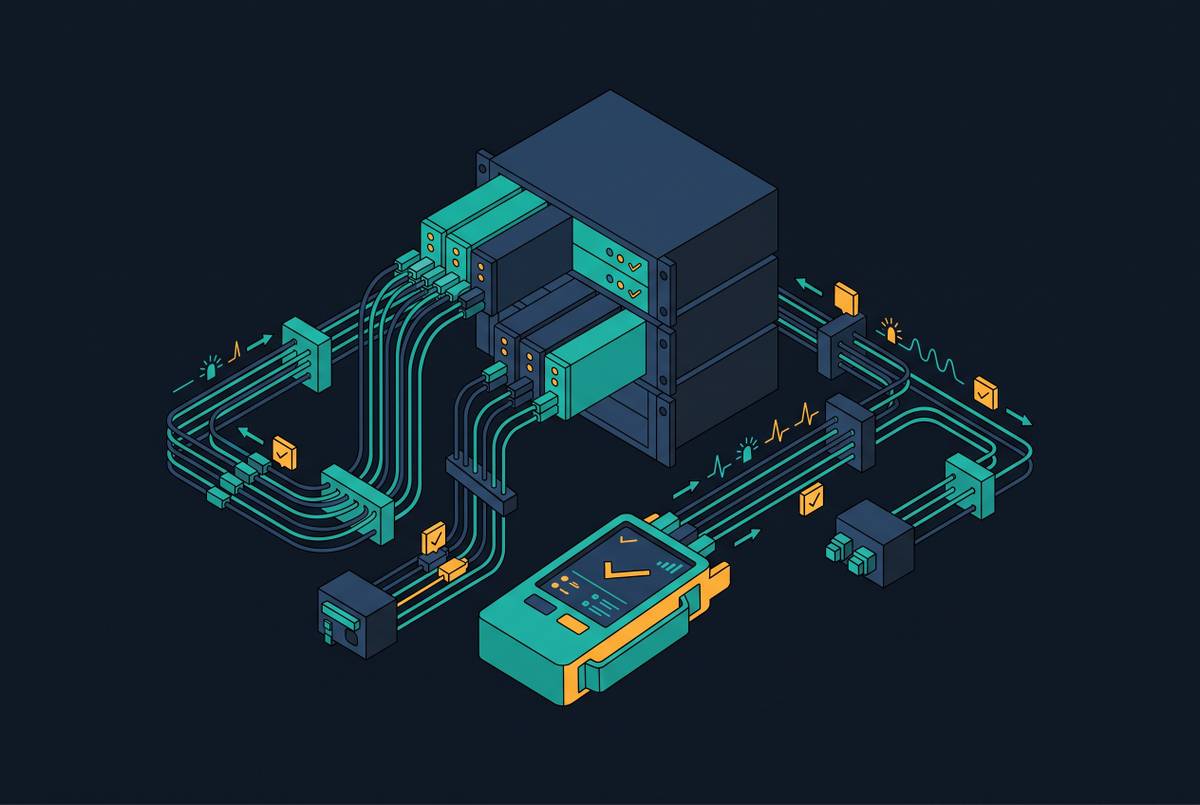
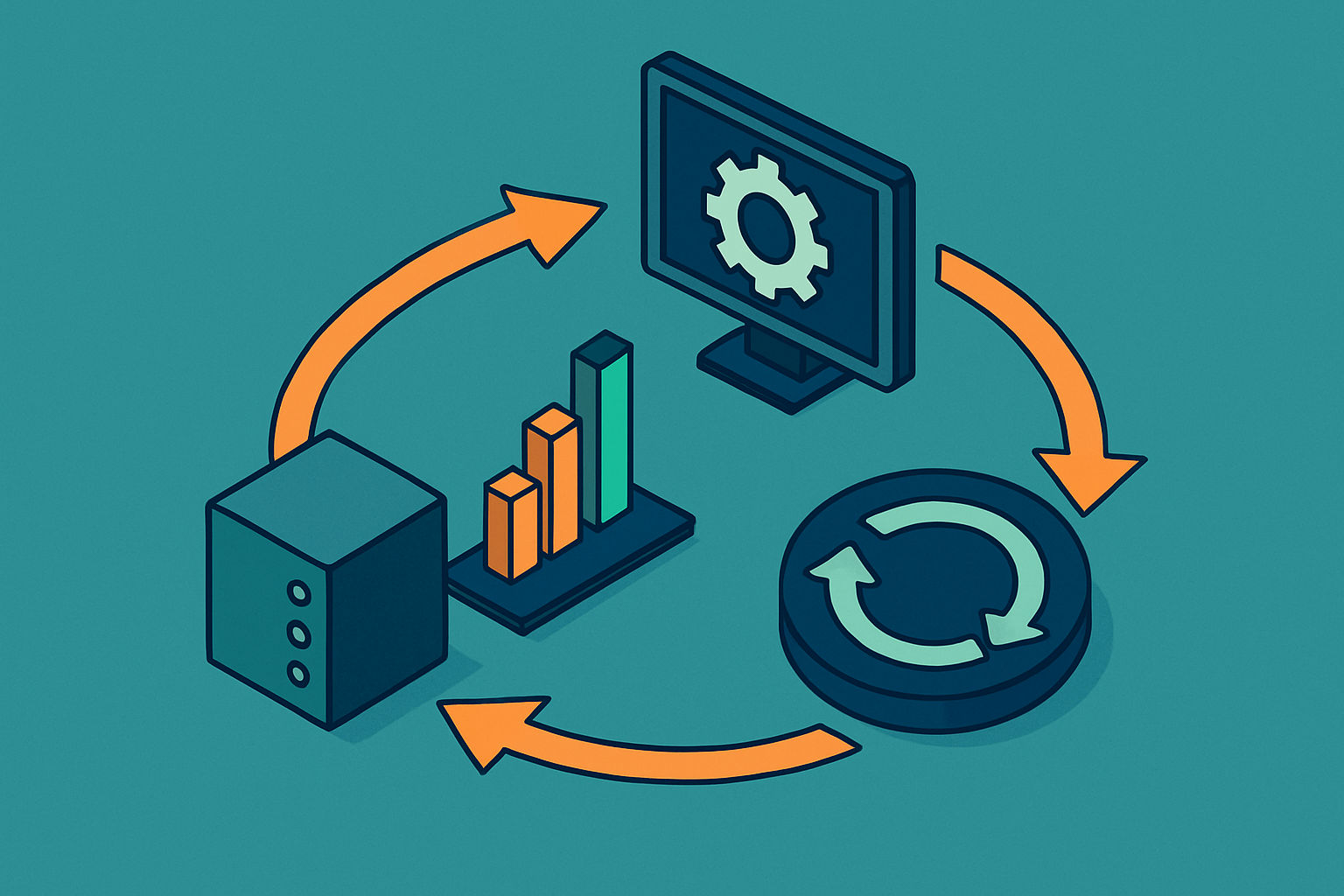
Three phases are wired together, running continuously: detect, diagnose, remediate. Detection is telemetry and health monitoring at the subservice level, while diagnosis traces a symptom back through a dependency graph until it finds what actually broke, not just where the alarm happened to fire. Remediation reconfigures or heals the failing piece without waiting for a person to sign off on each step.
U.S. Patent 11,218,380 is a decent reference point for what this looks like in engineering terms. It describes a system that configures a service as a set of subservices on network devices, decomposes that service into a dependency graph, monitors each subservice's health state, and automatically reconfigures whichever one is failing to restore a passing state. It's a specific pattern of decomposition, monitoring, and action, not a vague notion of "smart" infrastructure, which is a phrase I've come to distrust almost on reflex.
The word "closed" is doing real work in that phrase. A loop closes when remediation feeds back into monitoring, when the system checks that the fix actually held and updates its own model accordingly. Stop short of that, at alerting or at ticket creation, and you get an open loop. That's not useless, but it is incomplete, and the confirmation step it skips matters more than it sounds like it should on paper.
TM Forum's Autonomous Network Levels give the industry a shared yardstick, and the picture is sobering. Most communications service providers are still working toward Level 2, conditional autonomy, where the system handles routine cases and escalates whatever it doesn't recognize. China Telecom has moved further than most, reaching L2 with L3 as a stated target and L4, L5 sitting out on the published roadmap somewhere past the current planning horizon. Across operators, the top stated use case is resource and network optimization, with improving customer experience sitting underneath as the real goal.
ONAP's reference architecture treats this as several coordinated loops rather than one monolithic cycle: long closed loops running offline, layered against real-time and near-real-time loops running at individual compute nodes. That layering matters, since not every correction needs to happen in milliseconds, and not every optimization needs to wait on a nightly batch job either.
An alerting system that pages a NOC engineer at 2 a.m., a ticket that routes into a provisioning queue, a dashboard flagging an anomaly in red: these are open-loop tools, and useful ones at that, but surfacing information is still a different function from closing a loop.
Where the loop breaks in fragmented OSS architectures
Every handoff between siloed systems is a place the loop can snap. Qualification data never reaches provisioning, and network state stays invisible to the assurance layer. Remediation actions happen but never get logged back into the service model, so the next diagnostic cycle starts from a picture that's already stale.
Legacy OSS architecture is rigid and batch-driven by design, and that design choice made sense decades ago; it just can't handle real-time telemetry, intent-based orchestration, or a closed loop today. The whole thing was built for sequential processing, one step handing cleanly to the next, not for feedback flowing back upstream. Proprietary integrations make it worse: vendor lock-in sets in, sharing data between OSS components turns expensive and brittle, and changing one system's schema will probably break the integration to whatever sits next in the chain.
Call the practical failure mode automation theatre. Detection happens in one tool, diagnosis in another, remediation in a third, with a human bridging every gap between them. Each handoff adds latency, adds a chance for error, and blurs who's actually accountable when something breaks. Individual steps get automated, but the system as a whole stays reactive and manual at the seams, which is arguably worse than an honestly manual process, since it looks automated without behaving like it.
Streaming infrastructure like Apache Kafka and Apache Flink solves the speed problem, moving data in real time instead of overnight batches. But fragmentation is a different problem from speed, and faster pipes connecting disconnected systems just produce disconnected outputs faster. You've sped up the rate at which inconsistent data arrives, and that's something, but it isn't the fix.
The Dish Wireless and EchoStar buildout is a useful counter-example, mostly because it started from nothing. They built OSS and BSS on a single event-driven architecture, Kafka running as the central nervous system connecting the two, which let them orchestrate provisioning through to assurance in real time. That's a greenfield advantage most operators don't get; the average incumbent is carrying twenty or thirty years of accumulated systems and doesn't get to just start over, no matter how clean the Dish architecture diagram looks in a conference slide deck.
For those brownfield operators, the fragmentation runs deeper than the technical layer. It's organizational, too: teams own individual tools, not the end-to-end service lifecycle, and that kind of ownership structure is often harder to change than the software underneath it.
Why a unified data model is the structural prerequisite for a working loop
Detect, diagnose, and remediate only function as one cycle if all three phases work from the same representation of the service and the network. Without that shared model, detection sees a symptom but can't map it to a dependency graph. Diagnosis has to reconstruct context by querying multiple systems, and every query adds latency and another chance for reconciliation errors to creep in. Remediation acts on a view of network state that might already be stale by the time the action executes, and a stale view can trigger a cascading failure instead of fixing the one it was aimed at.
A unified model means qualification, design, provisioning, and activation all share the same underlying service representation. When a subservice fails, the system already knows its dependencies, its provisioning history, its current activation state; it doesn't have to go ask three other systems first. This is the only condition under which the dependency graph decomposition from the patent above actually becomes buildable. The graph needs its data living in one place, structured consistently, not scattered across systems that each describe the same service in their own dialect.
This is more or less the premise behind what people are calling OSS 4.0: architecture built on microservices, APIs, and real-time data pipelines that support predictive analytics and line up with TM Forum's Open Digital Architecture. The shift is from OSS as a siloed support function to OSS as a unified strategic platform. The old OSS/BSS backbone, with its rigid workflows and siloed data, didn't just make this inconvenient; it made it structurally impossible, no matter how much integration effort got thrown at the seams over the years.
Intent-based orchestration, zero-touch service delivery, predictive maintenance: all three need a network model that stays current, stays consistent, and stays reachable by whatever system needs to act on it. Take away any one of those properties and the other two start degrading right along with it.
What AI-native architecture adds to the loop that AI-augmented systems cannot
Where does the intelligence actually sit? That's the distinction that matters. In AI-augmented systems, AI surfaces a recommendation and a human decides, while in AI-native architectures, the intelligence sits inside the execution layer itself, participating in the action instead of just suggesting it from the sidelines.
AI-augmented systems break the loop by design. They require a human decision before remediation happens, which turns what should be a closed loop into an open one at exactly the moment speed matters most. An AI agent that can act directly on provisioning APIs reconfigures a failing subservice in seconds, while an AI agent that can only recommend is waiting on a human's availability, and that wait runs minutes to hours, not seconds. The gap between those two numbers is the whole argument, honestly.
In a genuinely AI-native OSS, AI components operate on the same APIs, the same data model, and the same permission and audit structures as human operators. They're participants, contributing actions rather than observations someone else has to act on later.
The investment numbers point the same direction, for what that's worth. The agentic AI market for telecom network operations was valued at roughly $0.9 billion in 2025 and is projected to reach $18.7 billion by 2034, reflecting a compound annual growth rate of 38.4% during 2026–2034, according to marketintelo.com. Appledore Research puts the broader agentic AI market in telecommunications, spanning service management, network security, and operations, growing from $92 million in 2025 to $6.2 billion by 2030. Different firms, different numbers, same conclusion: capital is flowing toward systems that act, not toward systems that merely advise.
None of this argues for pulling humans out entirely. AI-native architecture should support hybrid operations, AI handling high-volume, high-speed remediation while humans handle exceptions, policy calls, and edge cases that don't fit the pattern. Both sides operate inside the same governed system, and that governed system is where the real stakes live.
Why governance is not optional when automation closes the loop without human review
BT has said this plainly for regulated, nationally critical infrastructure: AI deployed on a network like theirs has to be explainable, auditable, and reversible. Skip any one of those three, and autonomous AI has no business running on infrastructure a country depends on for its hospitals, its emergency services, its economy.
The gap between that standard and current practice isn't small. Only 1 in 5 companies has a mature model for governing autonomous AI agents, according to Deloitte's State of AI in the Enterprise, even as agentic AI moves into provisioning, network operations, and customer care faster than governance frameworks can keep pace.
The risk this creates in a closed loop is specific, not abstract. A misdiagnosis, followed by automated remediation acting on that misdiagnosis, can cause the exact outage the system was supposed to prevent, and without an audit trail, nobody can reconstruct afterward what happened or why it happened that way. Autonomous action plus no record of reasoning is precisely what regulators are moving to shut down.
Governance is becoming a regulatory requirement now, not an internal best practice a team gets to opt into on its own schedule. The EU AI Act entered into force in 2024, with enforcement phasing in across 2025 and 2026 for progressively broader categories of AI systems. ETSI's SAI committee published a European Standard for securing AI systems against cyber threats in December 2025. 3GPP has written AI and machine learning into the network specification itself, significantly advanced as of Release 18, 5G-Advanced, which makes AI governance a standards-level concern rather than something left to individual vendors to sort out on their own. NIST's AI Risk Management Framework already gives operators an auditable governance structure they can adopt now, without waiting on some future standard to catch up to where the technology already is.
The emerging category of guardian agents — AI systems built specifically to govern other AI systems — is attracting serious attention as ungoverned autonomous action on live infrastructure proves difficult to scale. A new architectural layer is forming in real time, AI watching AI, because ungoverned autonomous action on live infrastructure doesn't scale. The broader industry message is just as direct: scale responsibly, avoid agent sprawl, build governance in from the start instead of bolting it on after something breaks.
The architectural implication follows pretty directly. AI agents in a closed-loop system need to operate inside the same permission structures, the same API boundaries, and the same audit logs as human operators, not a faster parallel path that quietly skips them.
How service delivery workflows for FTTH, dedicated internet, and Carrier Ethernet stress-test the loop
FTTH, dedicated internet, and Carrier Ethernet share a structural challenge that makes them a genuinely hard test for any closed-loop claim. Each service is a chain of subservices: physical layer, access qualification, logical design, provisioning record, activation state. Every link in that chain has to stay consistent, or the service just doesn't work for the customer sitting on the other end of it.
A closed-loop system built for fiber has to detect a degraded ONT or a failing port from telemetry, trace that condition through the service dependency graph to figure out which customer it affects, decide whether the fix is a config change, a re-provisioning action, or a truck roll, and then either execute the remediation or escalate to a human with full context, all without losing state anywhere along the way.
For dedicated internet and Carrier Ethernet, SLA obligations turn loop latency into a commercial problem, not just an operational annoyance. Every minute between fault detection and service restoration carries a contractual cost, and the speed of the loop is tied directly to money owed or money saved. Finance departments notice that math even when engineering doesn't.
Zero-touch provisioning for FTTH, demonstrated in the joint solution from Intraway and BISDN, shows the provisioning leg of this loop can be automated end-to-end. But that automation only works when the service model is reachable by the automation layer in real time, and take away that access and the same automated steps just stall out, waiting on data that isn't coming.
The failure mode specific to fiber operators is familiar by now: qualification data lives in one system, the provisioning record in a second, activation state in a third. When something fails, no single system holds the full picture needed to diagnose and remediate on its own. That's the fragmentation problem from earlier, showing up again in a very concrete, very customer-facing way. Generic network management software, built for enterprise IT or mobile operations, doesn't map cleanly onto these dependency structures. The workflows are different enough that purpose-built tooling for FTTH, dedicated internet, and Carrier Ethernet isn't a nice-to-have; it's a requirement of the domain, and pretending otherwise is how projects stall out at month eighteen.
What a self-correcting service delivery system actually looks like in practice
A self-correcting system isn't a feature you bolt onto an existing product. It's an architectural property that only shows up when a unified data model, AI-native execution, and governed automation are all present at once. Drop any one of the three, and the other two stop holding.
In practice: telemetry from the network feeds continuously into the service model itself, rather than into a separate monitoring silo somebody has to cross-reference by hand later. Anomalies map to service dependencies in real time, not through after-the-fact reconstruction six hours later by someone re-reading logs. AI agents, working with scoped permissions, act directly on provisioning and activation APIs, inside the same audit framework that governs human operators. Remediation outcomes get written back into the service record, closing the feedback loop and, over time, sharpening the model's own accuracy. When human operators do get pulled in, they receive an escalation with full context: what was detected, what was diagnosed, what was tried and what worked, not a raw alert asking them to start from zero at 2 a.m.
The capital is already moving this way. The OSS and BSS market is projected to grow from $65.81 billion in 2024 to $148.26 billion by 2033, according to IMARC Group, and that growth is flowing toward platforms built for this kind of operational capability, not toward propping up legacy systems in place. Research from the World Economic Forum and TM Forum marks 2025 and 2026 as the period when autonomous networks stop being pilots and start being an operational priority. Whatever architectural decisions get made, they're getting made now, this planning cycle, not the next one.
Operators that build this right get a compounding advantage, and it compounds quietly, easy to miss if you're only watching for one big dramatic payoff. Each closed loop that completes correctly sharpens the system's model of the network, which makes the next loop faster and more accurate than the one before it. A patchwork of partial automation doesn't learn this way; it just repeats the same handoffs and the same gaps, year after year, ticket after ticket.
The starting point isn't up for negotiation: a unified data model spanning qualification, design, provisioning, and activation, with AI agents built in as first-class participants, operating inside the same governed system as the humans working alongside them. Everything else is a detail.