Fiber Optic Network Design for FTTH and Carrier Ethernet
Design decisions made early shape what your OSS can automate for years to come.
Fiber network design for FTTH and Carrier Ethernet doesn't end when the splice crews pack up. The choices made at the design table, topology, segmentation, and where a service gets demarcated, decide what an OSS can qualify, provision, and activate for years afterward. FTTH builds keep climbing too, past 99.7 million homes passed in the US by the end of the 2025 build season, which means design decisions get locked into millions of endpoints faster than most operators can circle back and fix them.
Physical build and operational software have been treated as separate disciplines for decades. Engineering finishes the plant, then hands it to operations, and that handoff is where the trouble tends to start. Topology, segmentation, and demarcation choices made at design time either open up what the OSS can do downstream or shut the door on it for good. A network that isn't queryable, isn't segmentable, or doesn't know its own services can't get fixed later with a software patch. FTTH and Carrier Ethernet get the focus here because these are the two architectures where design and operations are coupled most tightly, and where operators get that coupling wrong most often.
How FTTH topology choices shape what a qualification engine can see
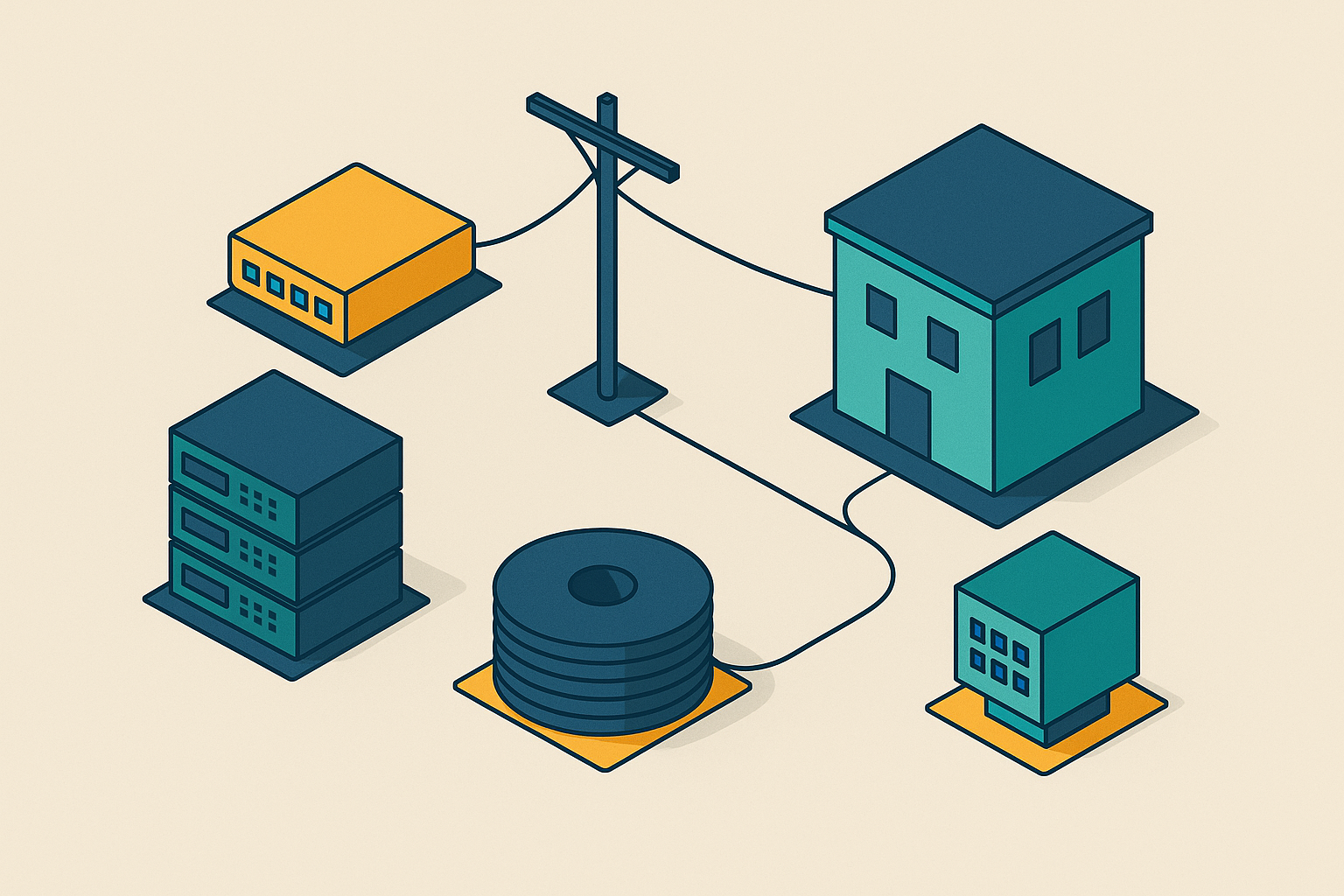
FTTH runs on shared passive infrastructure. One feeder fiber leaves the central office and fans out through splitters until it reaches individual homes. The split ratio picked at design time, 1:32, 1:64, 1:128, whatever the engineer landed on, sets the bandwidth headroom for every subscriber downstream of that split. Nobody revisits that number casually, since it's in the glass and in the ground.
Cascaded splitting, where a signal passes through multiple splitter stages before reaching a customer, produces a messier inventory picture than flat splitting does. The OSS has to track intermediate nodes that never terminate a service themselves; they just pass capacity along. Get those nodes wrong in inventory and qualification against them turns into a coin flip pretty quick.
Segmentation of the distribution plant, how fiber routes break up between the central office, distribution hubs, and drop points, decides how precise a qualification result can actually be. Coarse segmentation tells you a feeder exists somewhere in the neighborhood; it can't tell you whether capacity is free at 214 Elm Street. Fine-grained segmentation, with intermediate nodes named and tracked individually, costs more to build and document up front. What it buys is a qualification record the OSS can actually trust, instead of a truck roll to go check what the system was supposed to know already.
Speed tiers are climbing fast enough to make this urgent, not academic. A network designed five years ago around lower per-subscriber throughput assumptions is going to cap what the OSS can offer today, no matter how good that OSS is, unless someone goes back and reworks the physical plant. The qualification engine only sees what the network model hands it. Skip the segmented, queryable inventory record at design time, and qualification stops being a database lookup. It turns into guesswork wearing a system's clothing.
Where Carrier Ethernet design diverges from FTTH, and why the OSS treats them differently
Carrier Ethernet uses point-to-point or point-to-multipoint layer-2 service, with capacity allocated to a specific customer rather than shared across a splitter tree. That's the opposite of FTTH's contended, passive medium, and the difference changes nearly everything about how the OSS has to model it.
MEF gives the industry formal vocabulary for the logical service boundary: E-Line, E-LAN, E-Tree. Whether an OSS can actually operate against those definitions comes down to how the underlying Ethernet fabric got built in the first place. VLAN architecture set at design time decides how the OSS segments customer traffic, enforces quality of service, and marks off individual service instances. A flat or poorly documented VLAN space doesn't stay an engineering footnote; it becomes an inventory problem the OSS inherits and has to live with. Provisioning a new service on top of that mess often means someone manually checking which VLAN IDs are already spoken for, which defeats half the point of running an OSS.
Carrier Ethernet also demands explicit bandwidth commitments, committed information rate and excess information rate. Those numbers get set at design time, and they need to land in a network inventory record the provisioning workflow can read and enforce, not sit buried in a spec sheet in someone's project folder.
Demarcation point design carries more weight here than in FTTH. Where the network interface device or customer premises equipment sits, and whether the OSS documents that service boundary at the right level of detail, decides whether activation runs on its own or needs a human confirming the service edge by hand, every single time. Operators running both FTTH and Carrier Ethernet get a compounded version of this headache when the OSS uses separate data models for each. Context doesn't cross the boundary, and a qualification result for one service type can't inform design on the other, even when both run over the same fiber in the same trench.
Service demarcation as an OSS boundary, not just a physical handoff point
Demarcation used to mean a location, full stop: the point where the carrier's plant ends and the customer's premises start. That's not enough for how a modern OSS needs to treat it.
Inside the OSS, demarcation is a data object. It carries service identity, endpoint attributes, access method, and the specific parameters activation workflows need to bring a service up. Skip a structured demarcation record at design time, with fields populated at the right level of specificity, and the OSS can't automate activation. It falls back on a technician confirming by hand what should already be sitting in the system, and that's a design failure, even though it shows up on the books as an operations cost.
For FTTH, the demarcation point is the optical network terminal. Serial number, port mapping, service profile association, all of it needs capturing in inventory at the moment of install, not reconstructed later from a truck roll and a technician's scribbled notes. For Carrier Ethernet, demarcation is the user-network interface, and its attributes, port, speed, encapsulation type, VLAN tagging mode, function as direct provisioning inputs. Miss one, or record it wrong, and the service just sits there until somebody steps in.
Design teams that push demarcation documentation to "clean up later" build themselves a provisioning bottleneck. That bottleneck doesn't hold steady either, and it grows with the subscriber base, because every service stacked on an undocumented foundation is one more record somebody eventually has to go verify by hand.
Why siloed OSS data breaks when the design model is complex
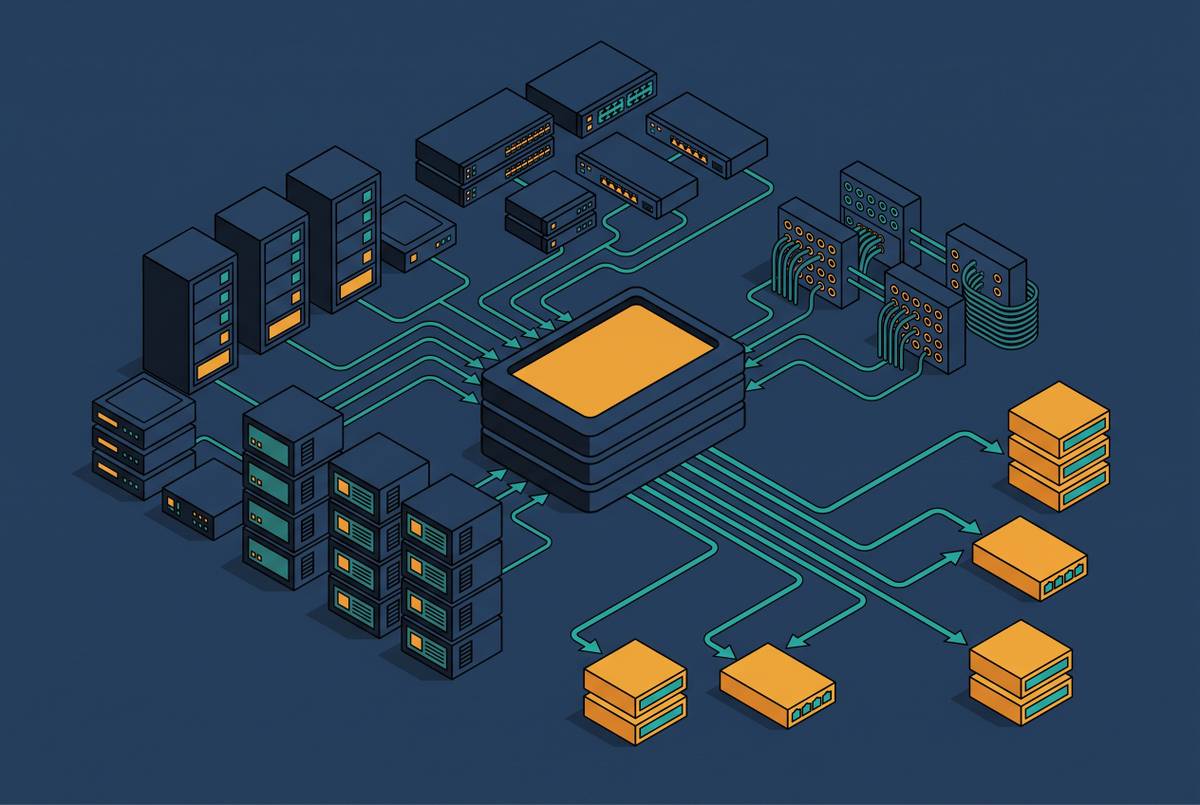
Traditional OSS stacks split functions across separate systems: a GIS or planning tool for design, a separate inventory system for physical assets, an order management system for provisioning, another platform entirely for activation. Every boundary between those systems is a seam. At every seam, something or someone has to translate, map, or reconcile the data crossing it.
Errors pile up at those seams because context doesn't survive the crossing. An AI system working upstream of a seam has no reliable way to know what happened downstream of it, and it keeps going anyway, at whatever speed it runs. That's the uncomfortable part. Complex network designs make it worse, not better: cascaded FTTH splits, multi-segment Carrier Ethernet paths, dual-homed demarcation setups each generate more intermediate records that need to stay consistent across systems that were never built to talk to each other cleanly.
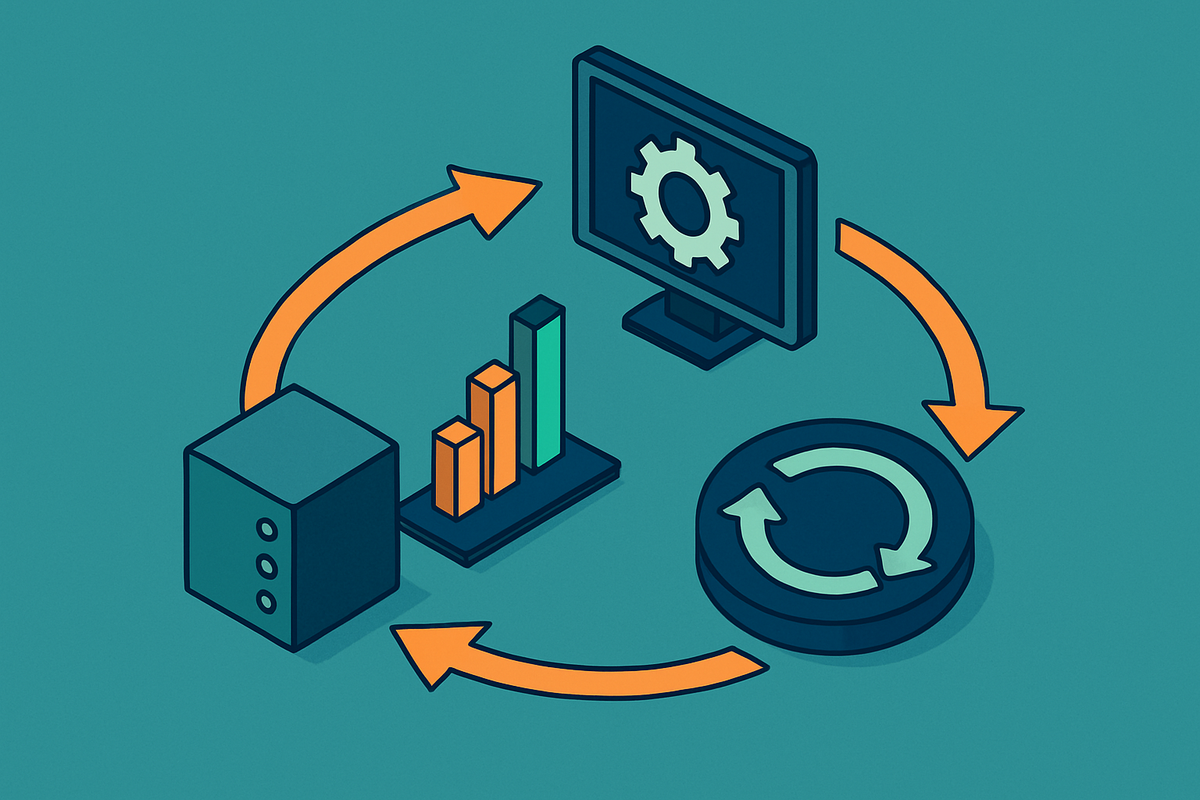
A unified data model changes the flow. Qualification output moves into design, design into provisioning, provisioning into activation, with no translation layer in between because there's nothing separate left to translate. Just one operational record moving through stages, the way it should have worked all along.
Operators are pouring money into automation faster than they're pouring it into OSS/BSS generally, which tells you something about where the industry thinks the real problem sits. Fragmented data is what stands between that bet and the payoff. The cost isn't abstract. It's the provisioning delay a customer calls in about, the failed activation somebody has to retry by hand, the truck roll dispatched because a record the OSS was holding turned out not to be trustworthy after all.
How ungoverned automation against a complex network model becomes a liability
Once operators put AI to work on qualification, provisioning, and activation, that AI is only as good as the network model feeding it. Hand it incomplete or inconsistently structured inventory records, and it forms a distorted picture of the network, then acts on that picture anyway, at machine speed, without the pause a human operator might take when something looks off.
Deloitte research found that only one in five companies has a mature model for governing autonomous AI agents, even as agentic AI moves into provisioning and network operations faster than governance in the sector can keep pace. An AI agent provisioning and activating services in telecom OSS needs the same audit trail, the same permission structure, the same approval workflow a human operator would follow doing the same task. Skip that, and automation-driven changes can't be traced, reviewed, or rolled back. Under the EU AI Act, that's a real compliance exposure: penalties for failing high-risk AI obligations run up to 35 million euros or 7% of global annual turnover, whichever number is bigger.
Gartner predicts guardian agents, AI systems built specifically to govern other AI systems, will capture 10 to 15% of the agentic AI market by 2030. That's the industry starting to formalize what governed automation actually takes, treating governance as a foundational requirement instead of a bolt-on. And the design implication follows directly: governance can't get added after deployment. The network model and the OSS architecture need building together, from day one, so every automated action traces back to a specific record, a specific network state, a specific authorization.
What design-aware OSS architecture actually requires operators to do differently
Engineering and OSS teams need to sit down and define the network data model together, before the first strand of fiber gets pulled. Every topology element, every segmentation boundary, every demarcation attribute the OSS will eventually query or provision against has to get named and structured at design time. Reconstructing that structure later from field notes, after the network's already live, is slower, costlier, and less accurate than doing it up front, and it really isn't close.
Inventory discipline stops being optional once a network hits real scale. US fiber is already passing roughly 60% of households, multi-gig tiers keep climbing, and the sheer volume of service records that need to stay accurate makes manual reconciliation an approach that simply can't keep up.
The OSS itself needs one data model spanning the full service lifecycle, qualification, design, provisioning, activation, so AI agents and human operators are looking at the same record, acting on the same state, and leaving the same audit trail behind them. Purpose-built tooling for FTTH and Carrier Ethernet matters here specifically, because generic network management software forces operators to jam their service models into structures that were never built for them. That brings back exactly the seams a unified model was supposed to eliminate.
Operators who build governance into their network models and OSS architecture from day one will activate and assure services faster than the ones trying to bolt governance on after the fact. There's a simple test that cuts through most of the noise: can the OSS return a reliable qualification result for any address on the network, feed that result straight into a design workflow, and activate the resulting service without a human stepping in to sort out some data discrepancy along the way? If the answer's no, design and OSS architecture aren't functioning as one system yet, and that gap gets a little wider every time another service stacks on top of it.