Dark Fiber vs Lit Fiber for Service Providers
Dark fiber gives up service revenue for operational simplicity and scale.
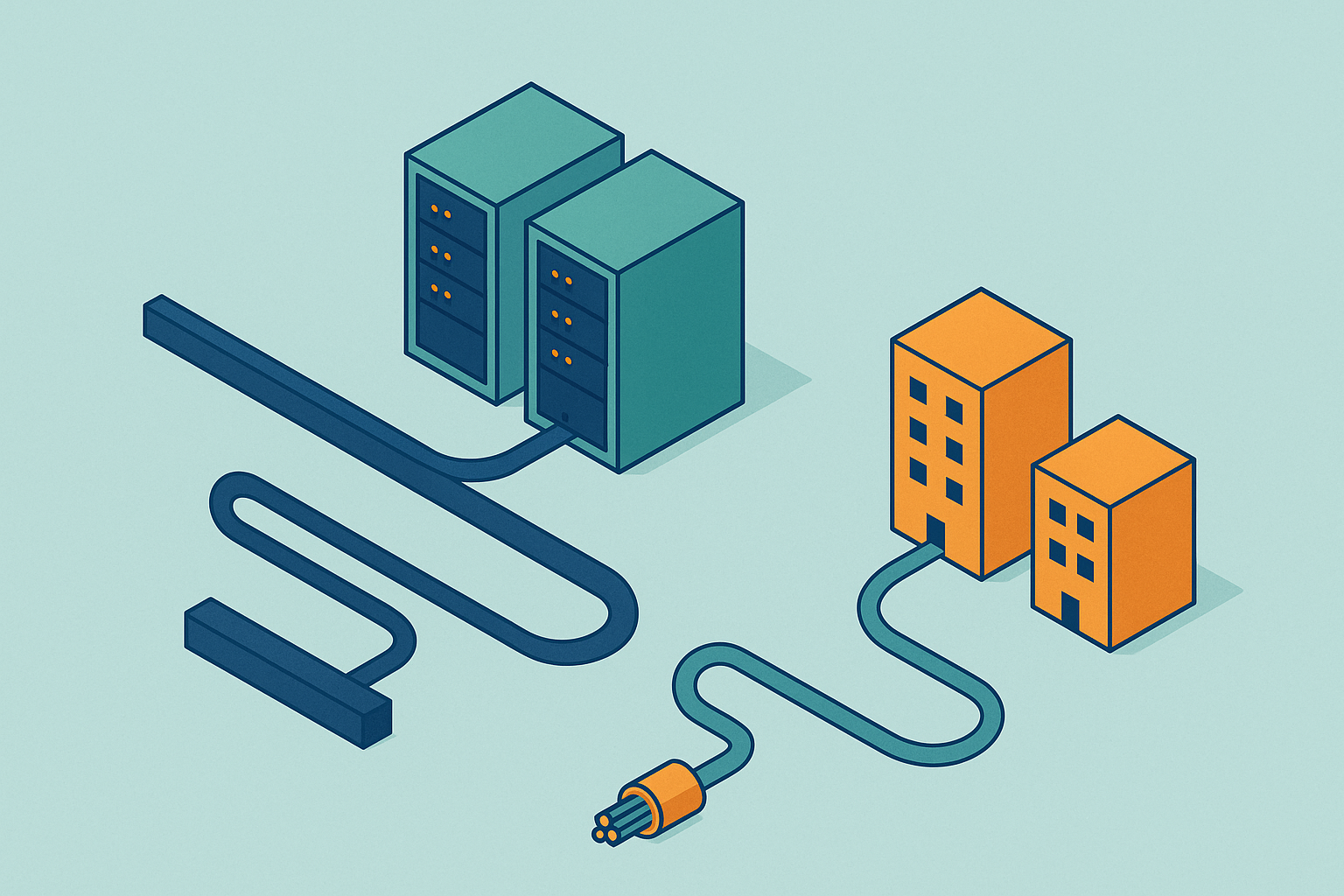
Dark fiber and lit fiber look like two flavors of the same procurement decision, but they occupy different operational territory. They put a service provider on opposite sides of a line that determines who owns the active equipment, who answers when something breaks, and how the whole operation is built to scale. Get that line wrong, and running the business becomes a mismatch between what the team was built to do and what the model actually demands.
Start with the line itself. Dark fiber is passive: strand, conduit, splice points. The provider hands over glass and physical access, and the customer brings their own optics, their own electronics, and their own headache when a wavelength misbehaves. Lit fiber sits on the other side of that line. The provider owns the whole outcome, active equipment included, monitoring included, an SLA attached to a bandwidth tier the customer picked off a menu. Some providers try to run both at once. That's fine in principle. In practice, treating them as the same business with two SKUs is where the operational trouble starts, and it's worth understanding why before deciding which side of the line to stand on, or whether to straddle it at all.
Why the dark fiber market is growing fast and who is pulling it
The numbers say this isn't a niche anymore. Grand View Research put the global dark fiber market at $6.9 billion in 2025, on a path to $21.9 billion by 2033, a compound annual growth rate of 15.9%. That's a segment with real momentum behind it, well beyond a rounding error in the broader connectivity market.
Who's buying it, and why, tells you more than the growth rate alone. Hyperscalers are ordering 12 to 48 fiber pairs per route today, where four pairs used to be standard. That reflects a decision to control the infrastructure directly rather than lease a managed tier that caps what they can do with it. AI and machine learning workloads want throughput and latency behavior that's predictable in a way lit fiber's tiered service structure doesn't naturally offer. Edge computing and dense 5G backhaul add routes into markets where existing lit offerings are either absent or priced for a different kind of customer.
Geography backs this up. North America holds roughly 35% of the global dark fiber market in 2025, tracking closely with where hyperscale data center buildouts and established fiber operators already sit. A specific customer profile, one with large and predictable traffic and the technical staff to run their own optics, has operational needs that outgrew what a managed tier was designed to solve. That's a segment shift, not a verdict on the model itself.
The operational obligations a dark fiber lessor takes on — and the ones they shed
A dark fiber lessor runs an infrastructure business, full stop. Their responsibility starts and ends at the physical layer: route management, splice documentation, conduit records, fiber characterization through OTDR traces and attenuation maps. When something breaks, their job is fault isolation to that physical layer, meaning finding the cut, the degraded splice, the failed enclosure, not diagnosing why a customer's signal quality dropped. Add in rights-of-way, permitting, and make-ready coordination whenever a new route gets built, and that's the job description.
What they don't do is just as important. Active equipment, transceivers, ROADMs, amplifiers, all of it belongs to the customer. Bandwidth provisioning and circuit design aren't the lessor's problem. Neither is wavelength management or responding to a fault that lives above the physical layer. That split is clean, and it shapes the entire OSS around one thing: network inventory. Accurate records of what strands exist, where they run, and what's already spoken for.
That inventory accuracy matters more than it sounds like it should, because errors in it don't announce themselves. A bad record doesn't turn into a support ticket the next morning. It surfaces weeks later, when a customer tries to light a circuit and finds the strand already occupied, damaged, or routed somewhere other than the map says. At that point it's not a data problem anymore; it's a customer relationship problem, and a field investigation to sort out whose paperwork was wrong.
Bandwidth scaling, meanwhile, is entirely the customer's concern. Dark fiber can theoretically carry anywhere from 1G to 800G or beyond, depending entirely on the optics the customer chooses to deploy. The lessor's ceiling isn't bandwidth; it's whether they have strand and route capacity left to sell. And on the security side, the physical isolation of a dedicated strand is a real operational fact, not a sales pitch. Compliance-heavy customers in finance and government will ask for documentation proving strand exclusivity, and a lessor with clean physical records can actually produce it.
The operational obligations a lit fiber operator carries across qualification, provisioning, and activation
Lit fiber is a service business from the first phone call to the last invoice. The provider owns every layer of the outcome, starting with qualification: can this address, this endpoint, actually be served, at what speed, over what topology, PON, Active Ethernet, point-to-point. From there it's circuit design, choosing the path, allocating equipment, setting VLANs, configuring MPLS. Then provisioning, which means actually configuring the ONTs, the CPE, the edge devices to match whatever the customer ordered. Only after all of that does activation happen, with testing to confirm the service meets its SLA before anyone calls it done.
The bottleneck here is well documented and it isn't subtle. Every new customer, every service change, every disconnect has to get entered into the element management system by someone. Do that manually at volume and the only lever available is headcount, and headcount is a cost that keeps climbing right alongside customer growth, not something that plateaus.
SLA accountability adds an obligation dark fiber simply doesn't have: the lit fiber operator has to catch active-layer faults before the customer notices them. That's not optional if retention matters, because reactive operations, finding out about a problem from an angry customer, erode both SLA performance and the relationship itself. Catching faults early requires real-time telemetry pulled from active equipment across the network, not just accurate paper records of where the fiber runs.
There's also bandwidth contention to manage on an ongoing basis, since multiple customers' traffic often shares the same strands or the same MPLS backbone. QoS isn't something you set once at design time and forget; it's a live, continuous function. And because DIA, Carrier Ethernet, and FTTH each carry their own equipment footprint and their own configuration and SLA requirements, an operator running all three is really managing three separate operational patterns layered on top of one shared network.
Where the workflows diverge most sharply: inventory models and data requirements
Dark fiber OSS lives and dies on one thing: an authoritative physical inventory, what strands exist, where they run, what condition they're in, what's already committed. The commercial unit of that business is the strand-mile or the fiber pair, not a provisioned service. A dark fiber provider who can't answer, on the spot, which strands on a given route are free and in good shape has no reliable way to sell.
Lit fiber has to carry that same physical layer and then stack a live service layer on top of it. Physical records still answer the qualification question, whether fiber even reaches an address and what its topology looks like. But service records go further, tracking every provisioned circuit's path through the network, the equipment at each end, its current configuration, its SLA terms. And those two layers have to stay in sync; a single fiber cut affecting ten logical circuits needs to show up correctly in both the physical and the service view at the same time, not one after the other.
This is where legacy OSS tends to fall apart, at the seams. When qualification, design, provisioning, and activation each live in their own system, every handoff between them is a spot where data gets translated, remapped, or just quietly lost. In lit fiber operations, that's where provisioning errors, missed activations, and billing mismatches pile up. Dark fiber has a narrower seam, usually just between physical inventory and contract management, but errors there are harder to catch precisely because there's no active monitoring layer to surface them.
A unified data model, where qualification, design, provisioning, and activation all read from and write to the same underlying data, removes the translation step entirely, because there was never a second system to translate into. That's not a minor efficiency gain. Providers running disconnected provisioning, dispatch, and billing tools are the ones absorbing delays, rework, and revenue leakage as they try to grow, and it compounds with every new customer added.
How each model scales — and what breaks first when it does
Dark fiber's scaling pressure is mostly physical and commercial, not operational throughput. Adding a customer means committing more strands and routes, so the limit is what's actually in the ground, not how fast the back office can process a form. The real operational risk is keeping that physical inventory accurate as the network grows, since bad records block sales and trigger expensive field investigations to sort out. Expanding into new routes means permitting, construction, make-ready, all with lead times that no amount of extra staff will shorten.
Lit fiber's scaling pressure sits squarely in operations. Every new customer adds provisioning work, more monitoring surface to watch, more SLA exposure to manage. Without automation, provisioning volume tracks headcount in a straight line, a failure mode that's shown up repeatedly among FTTH operators once they hit real growth. Zero-touch provisioning, where the platform configures an ONT or CPE automatically the moment an order comes in, is the thing that actually breaks that line, decoupling growth from headcount.
There's a trap worth naming for providers who run both models under one operations team: dark fiber wants authoritative physical records, lit fiber wants live service state, and tools built for one tend to serve the other poorly. Force both onto the same legacy, siloed toolset and neither gets served well. Modern fiber OSS platforms that support zero-touch provisioning across PON, Active Ethernet, and Fixed Wireless are the leverage point that lets lit fiber operators grow revenue without growing the team at the same rate.
What AI-native operations look like differently under each fiber model
Applied to dark fiber, AI has a narrow but genuinely useful job. Predictive plant health is one: spotting a fiber segment that's degrading, using OTDR trend data and loss measurements, before it produces a customer-visible fault. Inventory accuracy is another, flagging where the records disagree with what's actually verified in the field, narrowing the gap between what the system claims is available and what's really there. Route optimization is a third, surfacing available strand capacity across a network without someone manually paging through physical records.
Lit fiber gives AI a wider scope, but it needs richer, real-time data to do the job. Anomaly detection across active equipment telemetry can catch degradation before it crosses an SLA threshold. Automated provisioning validation confirms what actually got configured matches what was ordered, without a technician checking every circuit by hand. Closed-loop fault resolution goes further still: detect the fault, identify which services it touches, kick off remediation, log the whole sequence, all inside a process someone can audit later.
The governance rule doesn't change between the two models. AI agents acting on network state need to use the same APIs, the same audit trails, the same permission structures a human operator would use, staying inside the production system rather than a separate automation lane. Shadow automation, AI taking action outside that governed path, opens audit gaps that get expensive fast in regulated environments or enterprise-grade lit fiber contracts. An AI action on a provisioned circuit that isn't logged the same way a human's would be isn't just a process gap; it's a compliance problem waiting to surface at the worst time.
Under either model, the prerequisite is the same: a unified, real-time data surface, not records stitched together after the fact from separate systems on a batch schedule. AI making decisions on stale or partial data produces recommendations operators learn not to trust, and they'll override them, which defeats the entire point of building the automation in the first place.
How to read the operational fit between a provider's capabilities and the right fiber model
The choice between dark and lit hinges less on cost or bandwidth ceilings than on what operational muscle a provider already has, and what they're actually willing to build. Dark fiber demands physical plant discipline: clean inventory, field verification that actually happens, the ability to characterize and document passive infrastructure without guessing. Lit fiber demands depth on the active side: qualification tooling, provisioning automation, real-time monitoring, SLA management that holds up at scale.
A provider moving into dark fiber leasing without mature inventory practices will find their sales team writing checks the physical plant can't cash: strands double-committed, routes misrepresented on paper, customers finding out the hard way when they try to light a circuit that isn't actually available. A provider scaling lit fiber without provisioning automation runs into the headcount trap described earlier, and it's not hypothetical: cost climbs with every customer, margins get squeezed, and SLA performance slips as the team gets stretched thinner than it can bear.
Running both is a legitimate path, but it forces a real decision about OSS architecture. Either build one unified system that handles physical plant records and live service state together, or run two separate toolsets and absorb the integration overhead between them. That second option is the legacy default, and it's exactly what creates the data seams that slow provisioning down and blur the actual state of the network. An AI-native OSS platform built on a single data model, where qualification, design, provisioning, and activation all share the same data, and where AI operates inside the same governance framework a human would, solves the lit fiber operational burden directly and lets a provider manage physical and logical inventory without keeping two systems in sync by hand.
The broader market backs up why this matters now. The OSS/BSS market hit $65.81 billion in 2024 and is projected to reach $148.26 billion by 2033, according to IMARC Group. That kind of investment growing alongside the fiber market itself says something plain: operational architecture has stopped being a back-office line item and started being a strategic decision, one that determines which fiber model a provider can actually run well.