Fiber Operator Competitive Positioning Against Incumbents
Unified data models close the gap between superior fiber networks and slower operational delivery.
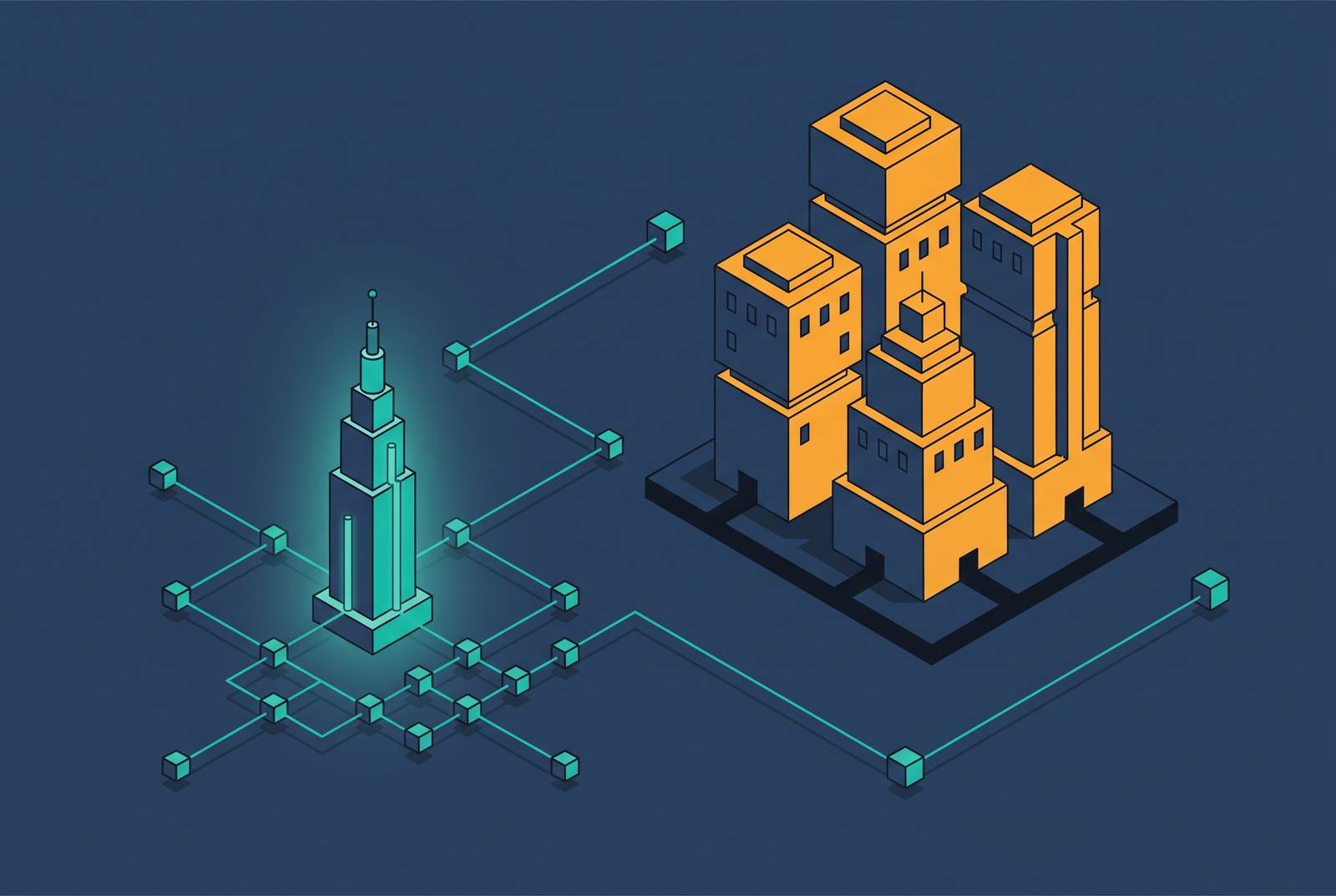
Fiber overbuilders win the technology argument before they even make a sales call. Fiber-to-the-premises delivers lower latency, higher and more consistent speeds, and symmetrical upload and download capacity, three attributes that matter more every year as applications shift toward data-intensive, real-time workloads. That shift is not a projection; it is the direction demand has already moved. Where the incumbent is a regional cable operator with no competing fiber footprint, a condition that describes much of the overbuilder opportunity map, the gap between hybrid coaxial and fiber is about as clean a technical mismatch as exists in telecom.
A better network does not guarantee a won customer, though. Incumbents carry offsetting advantages that have nothing to do with the physical medium: brand recognition built over decades, billing relationships customers have stopped thinking about, bundled services that create switching friction, and operational scale that smooths over rough edges. A superior network that takes weeks longer to provision, or that produces a bruising activation experience, loses to an incumbent whose product is technically inferior but easier to live with. The rest of this piece is about that gap, closing it not by making the fiber better but by making everything that happens after the fiber is in the ground faster and more reliable.
The competitive gap: order acceptance to service activation
The decisive competitive moment for a fiber overbuilder is the interval between order acceptance and service activation, where operational capability can either amplify the network advantage or quietly erode it. A customer who picked the overbuilder over the incumbent made a bet on something better. A slow, opaque provisioning process makes that bet feel wrong before the service even turns on.
Customer expectations are now benchmarked against hyperscaler-grade digital platforms, and the tolerance for friction at order and activation has dropped accordingly. For residential FTTH customers, that friction appears as delay and uncertainty. For enterprise customers on Dedicated Internet Access or Carrier Ethernet, it carries contractual weight: these are SLA-backed services with defined metrics for uptime, latency, jitter, and packet loss, and the clock on those commitments starts at order acceptance, not at activation. A slow provisioning cycle on an enterprise contract is not an inconvenience; it is exposure against obligations the operator already signed.
Every day of delay in this interval does more than damage the customer relationship. It leaks revenue directly, because billing start depends on confirmed activation, and confirmed activation depends on getting multiple systems to agree with each other. In fragmented OSS stacks, that confirmation requires updating qualification, design, provisioning, and activation records independently, and status disagrees across tools until a person reconciles it by hand. Rework caught at provisioning or activation, the two most expensive stages to catch anything, is the predictable output of a data model that does not propagate upstream changes downstream on its own.
Fragmented OSS tooling as an operational liability
Most fiber operator OSS stacks were built through best-of-breed procurement: separate tools from separate vendors handling qualification, design, provisioning, and activation, each with its own data model and no shared source of truth tying them together. Best-of-breed procurement pushed integration to a later date, and that later date arrived in the form of manual reconciliation workflows, the same workflows now producing the delays and errors operators are trying to eliminate.
Every handoff between tools is a place something can go wrong. A design change may never reach the provisioning system. An activation status may sit unrecorded in BSS for days. A qualification record may disagree with the GIS data the field crew is working from. Linking every asset, cables, ducts, nodes, customer endpoints, to its exact physical location keeps planning, maintenance, and fault management grounded in verified data. When that linkage is not unified, field teams and the OSS end up working from two different versions of the same network.
The result is a provisioning process slower, more error-prone, and more dependent on manual reconciliation than the underlying network technology requires. Billing start is only the trailing indicator: revenue leakage accumulates quietly across every delayed activation, and the delay is built into the architecture as a routine occurrence. Adding headcount or swapping out one tool for a better one does not fix this, because the bottleneck is structural. Legacy OSS platforms were designed for manual workflows and periodic batch updates, not for the real-time, cross-domain data flows that fast provisioning and AI-driven operations now require. Fragmented, siloed data blocks the one thing automation needs to work at all: consistent inputs with context attached.
A unified data model as the prerequisite for faster service delivery
When qualification, design, provisioning, and activation sit on one shared data model, the reconciliation lag at every handoff disappears. A change made at any stage propagates immediately downstream, with no re-keying and no disagreement in status between systems. Qualification accuracy improves right at the front of the process, the stage where mistakes are cheapest to fix, because the qualification engine is working from data that reflects the current state of every other domain. Rework at provisioning and activation falls for the same reason: the data feeding those stages is current. Order-to-activation time shrinks because the handoffs between tools stop needing a person to complete them, not because any single tool got faster.
The TM Forum's Shared Information/Data Model, known as SID, is the standard that underpins this kind of normalized, cross-domain architecture. When data is aggregated to a central normalized information model, it can support analytics, closed-loop assurance, and automation built on AI and machine learning. None of this requires physically consolidating every record into one database. What it requires is unified access, so that staff and systems reason over the same current state no matter which domain they happen to be working in.
AI capability sits entirely downstream of data model quality. An AI agent operating on a unified data model can do real work, anomaly detection, predictive provisioning, capacity planning, because what it reasons over is current and consistent rather than accurate in one system and stale in another. AI that reasons over current, consistent inputs accelerates operations, while AI built on inputs that were never reliable produces unreliable outputs. If operators skip the data model work and bolt AI onto a fragmented legacy OSS, they are not building AI-native operations. They are adding a new layer of complexity on top of a foundation that was already broken.
AI-native OSS and provisioning speed
An AI-native OSS builds intelligence directly into the service delivery workflow instead of running AI as an overlay on top of existing processes. Whether AI speeds up operations or just produces more outputs for humans to sort through depends on that distinction. HCLTech's 2026 analysis defines an AI-native telco as a unified, AI-infused technology fabric where cloud, edge, data, and network operate as one integrated architecture, requiring modernized OSS and BSS systems, data assets built as products, and AI embedded directly into decision flows. In this model, networks self-optimize, data pipelines self-heal, and AI becomes the execution layer connecting engineering, operations, and commercial teams.
The contrast with AI-augmented systems is architectural. AI-augmented systems apply machine learning as an overlay on legacy platforms for things like predictive maintenance or anomaly detection. AI-native systems are built from the ground up with AI as an intrinsic part of how the stack runs. Ericsson's framework states the same distinction: in an AI-native network, AI is embedded across RAN, Core, Transport, and OSS/BSS, not bolted on or isolated as a separate layer.
For FTTH provisioning, the time compression happens when automation spans the full order-to-activation workflow, including lights-out interaction with third-party last-mile infrastructure. Tools that automate FTTH provisioning can cut activation time from days to hours, and the condition that makes that possible is accurate, unified data available at every step of the process. Agentic AI extends this further: instead of automating individual tasks in isolation, it coordinates decisions and actions across domains, orchestrating customer provisioning across IT systems, network domains, and field operations without manual handoffs or fragmented accountability along the way.
Industry analysis found that most OSS/BSS environments remain fragmented, limiting how much AI capability can actually reach the customer experience layer. Data silos, batch-oriented processing, and loosely coupled workflows constrain real-time, cross-domain orchestration, and closing that gap is what AI-native architecture is for. The operative standard here is industrialized intelligence: AI scaled across the enterprise with consistency, governance, and measurable outcomes, not isolated automation scripts or proof-of-concept pilots that never leave the lab. HCLTech's analysis draws a sharp line between reusable AI models that keep learning and improving, and one-off automation scripts that deliver a single efficiency gain and then plateau. Operators making real progress run AI adoption, core system modernization, and data productization in parallel, with AI as the connective tissue between them, instead of treating these as a sequence of separate projects.
Governing AI to the same standards as human operators
Ungoverned AI automation in network operations is a liability. An AI agent operating outside the audit logs, permission structures, and approval tiers that apply to human operators opens accountability gaps, and those gaps surface as compliance risk, operational errors, and loss of control at the moments an operator can least afford them. Ericsson's framework makes the fix concrete, with autonomous networks needing explicit guardrails, policy constraints, approval tiers for high-impact actions, and continuous KPI verification, with network digital twins providing a safe space to test actions before they execute for real. The question for an operator is how efficient and trustworthy that autonomous network actually is, not simply how autonomous the network can become.
When AI agents operate inside the same governance framework as human operators, using the same APIs, the same audit trails, the same permission structures, their actions become explainable and reversible. That is the condition under which operations teams are willing to hand AI more autonomy over time. Shadow automation, AI tooling running outside formal governance, produces the opposite result: operators stop trusting it, constrain it, and eventually override it, erasing whatever speed it was supposed to deliver.
Governance is also a regulatory matter now, not just an operational preference. The EU AI Act's transparency provisions are already in effect, and telecom may fall within scope as a high-risk deployment environment for certain use cases, such as AI safety components in critical digital infrastructure, but the Act's high-risk system obligations do not apply until December 2027, and telecom is not named explicitly as a sector. Organizations that add explainability onto AI after building it, rather than building it into the architecture from the start, end up with shallow explanations that regulators can pick apart. The same shortcut that produces unreliable AI outputs in day-to-day operations also produces compliance exposure when an audit comes. The practical implication for fiber operators building or buying AI-native OSS: access control, observability, and explainability belong in the architecture itself, not added as a layer once the system is already running.
Service delivery requirements across FTTH, Dedicated Internet Access, and Carrier Ethernet
FTTH, Dedicated Internet Access, and Carrier Ethernet each carry their own provisioning requirements, SLA structures, and competitive pressures. An OSS that handles one service well and the others poorly keeps the operator stuck with the fragmentation it was trying to eliminate. FTTH provisioning needs end-to-end automation across the entire order-to-activation workflow, including seamless interaction with third-party last-mile infrastructure providers, and GIS integration has to tie every asset to its exact physical location, so field operations and the OSS agree on what the network actually looks like.
DIA is the leading Ethernet service in the U.S. by both ports and revenue, and its defining characteristic is that it is SLA-backed, with defined metrics for uptime, latency, jitter, and packet loss. Shared broadband slows under contention, so DIA is the answer wherever performance has to be predictable and guaranteed. Carrier Ethernet is a market with its own established hierarchy: the mid-2026 U.S. Fiber overbuilders competing for enterprise Carrier Ethernet business are up against operators who already have deep operational scale built. Speed and precision of service delivery is how a challenger in that tier actually differentiates itself.
Purpose-built tooling for these three service types looks meaningfully different from generic network management software stretched to cover them. Qualification logic, design rules, provisioning workflows, and SLA tracking for fiber-delivered enterprise services demand domain-specific data models, not a horizontal IT platform adapted after the fact for telecom. A unified OSS that covers all three service lines on one data model means a change in network capacity or topology becomes visible, at the same time, to the qualification engine, the design tool, the provisioning workflow, and the activation confirmation, across every service type the operator sells.
What operational execution looks like as a competitive strategy
The fiber operators who take durable market share from incumbents will be the ones who treat OSS as a strategic platform, the system that turns network advantage into customer experience, rather than a back-office function managed down to the lowest possible cost. Operational complexity is a competitive disadvantage in its own right: every manual reconciliation, every delayed activation, every billing lag is a moment where a customer's decision to leave the incumbent starts to look like a mistake, and the incumbent's operational inertia starts to look, by comparison, like reliability. Collapsing multiple workflows onto a single data model removes the friction that slows provisioning, generates rework, and delays billing, producing outputs a CFO can check directly against prior-quarter numbers: mean time from order acceptance to billing start, and the value of shaving even one day off that figure across a full year of order volume.
HCLTech's 2026 analysis frames this kind of success as structural, not isolated. The operators making real progress run AI adoption at scale, core system modernization, data productization, customer-centric design, platform revenue models, faster time to market, and talent transformation together, with AI as the thread connecting all of it, and commercial partnerships are increasingly structured to tie performance to measurable outcomes like faster provisioning and revenue uplift. Operators who move first on AI-native, governed OSS architecture build a compounding effect that gets harder for incumbents, or other overbuilders, to catch up to over time: faster provisioning improves customer experience, which reduces churn, which funds the next round of modernization.
None of this makes AI-native mean AI-only. It means AI and human operators work inside the same governed, transparent system, where automation handles what repeats and human judgment is reserved for what is complex or consequential. The operators that get this right do not just provision faster today. They build the data foundation that lets capacity planning, predictive maintenance, and new service design keep improving, compounding the advantage over time. Fiber's structural technology edge is where the competition starts. If you win it, every customer has to experience that edge as fast activation, reliable service, and accurate billing from day one.