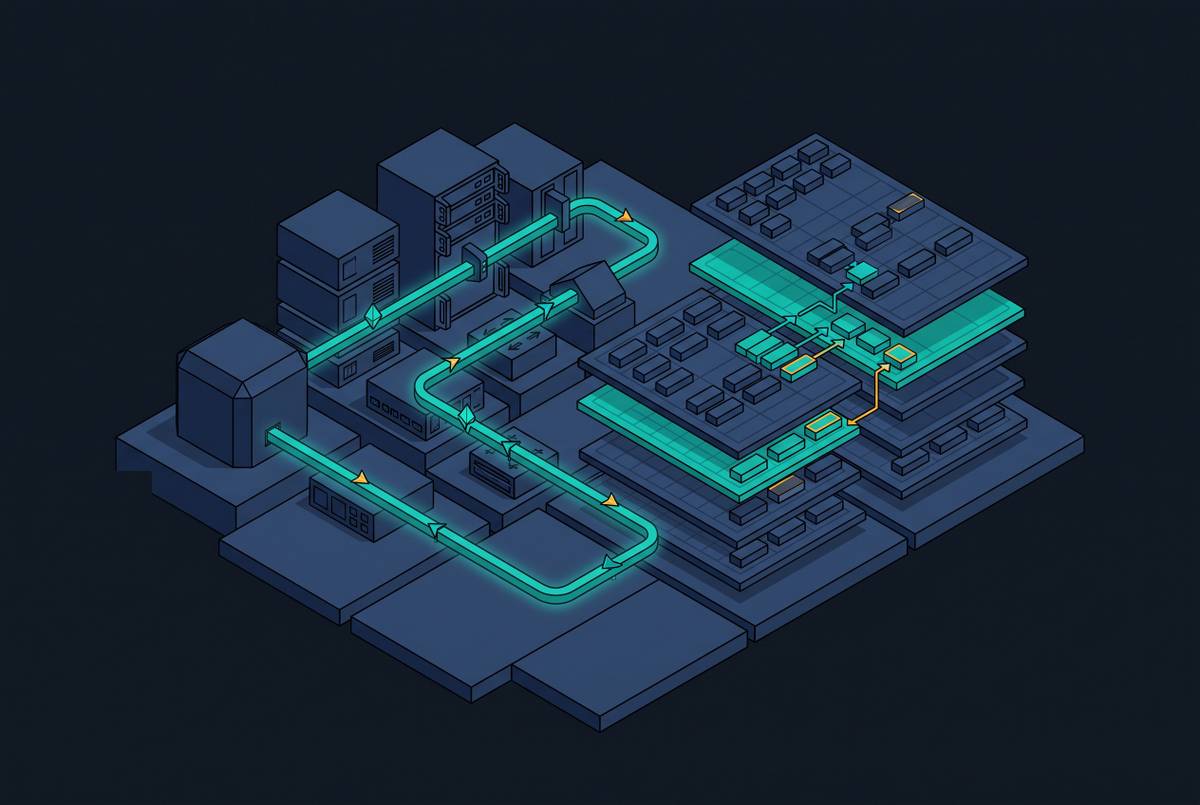
Order-to-Activate Workflow Stages for FTTH Services
FTTH service delays cluster at handoffs between separate systems, not within them.
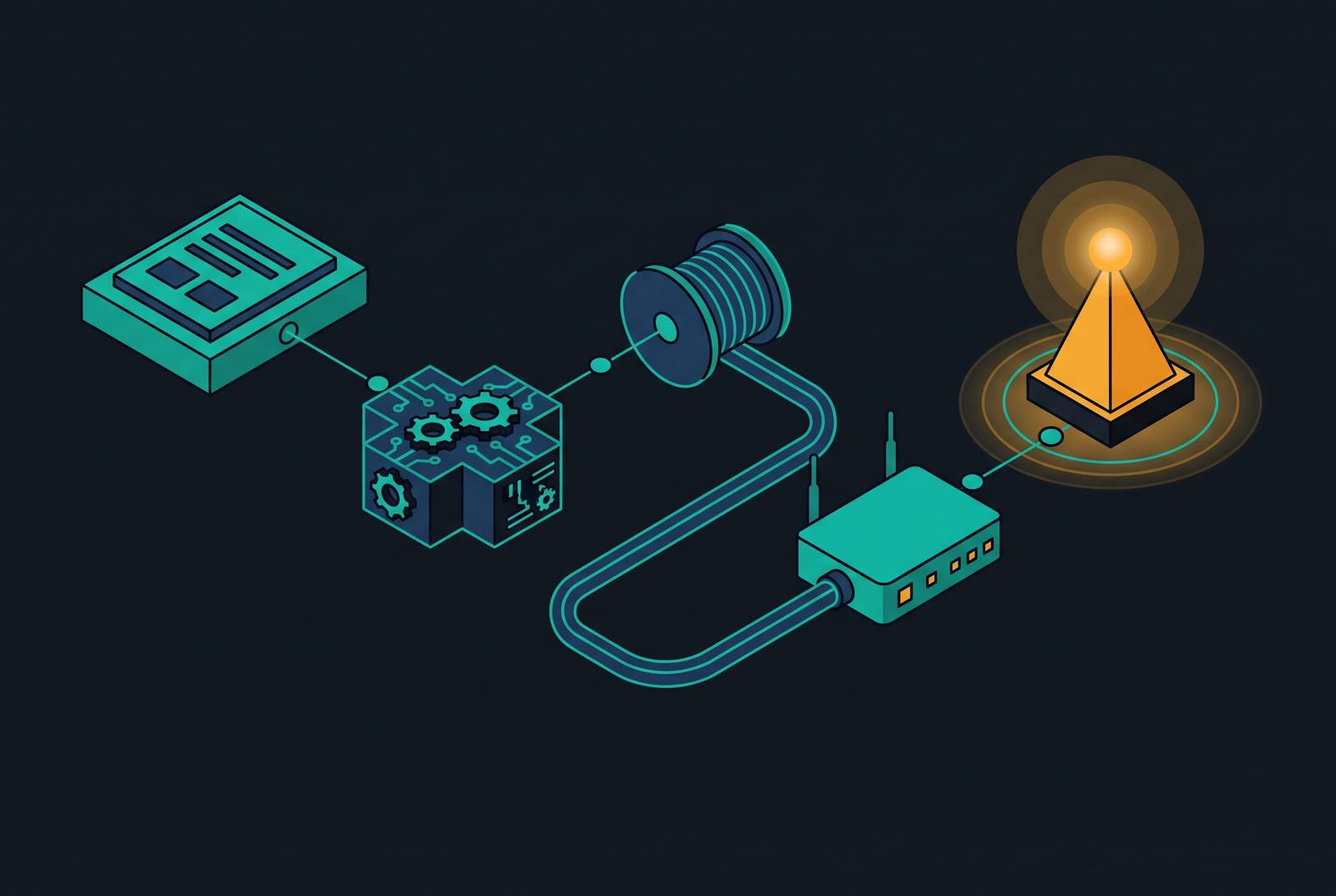
FTTH service delivery rarely fails because an operator misunderstands a single step in the process. It fails at the points where one stage hands off to the next, where qualification, design, provisioning, and activation live in separate systems, maintained by separate teams, running on separate data stores built to separate conventions. Where the handoff between systems is still a manual step, small errors compound: a closed order doesn't automatically trigger a field dispatch, a completed installation doesn't automatically provision the device, and a provisioned service doesn't automatically bill on the day it goes live.
Revenue loss, customer escalations, and SLA penalties cluster at these stage transitions, not inside the stages themselves. An engineer who understands splitter configuration or VLAN tagging will rarely be the reason a service ships late. Usually the record describing what happened in one system failed to reach the next system in time, or never reached it. The six stages that follow are each straightforward on their own terms. What breaks the lifecycle is the seam between them.
What the six stages of order-to-activate cover
The order-to-activate sequence groups into three operational bands. A fourth band, Run, begins once activation completes and covers monitoring, ticketing, support, and the ongoing service relationship. Run is the destination the first three bands have to reach cleanly: a service that activates with inconsistent records doesn't just create a one-time correction, it hands the Run band a customer record that monitoring and support tools will keep tripping over.
Each band contains its own internal handoffs, and each of those handoffs is a seam where delay and error accumulate: sell-to-install, install-to-activate, activate-to-run. On the physical layer, a parallel sequence runs underneath these commercial bands. Each step in that physical sequence depends on an OSS record that either clears the way for the next step or blocks it. The sections that follow walk through each of the six stages in order, tracing what each one requires and what happens when the record supporting it is wrong, stale, or missing.
Stage 1: Address qualification and the consequences of wrong serviceability data
Address qualification sits at the front door of the entire lifecycle, and it is the stage where a bad answer costs the least to give and the most to fix later. An address qualifies for service based on whether the OSS holds a current, complete plant record: fiber routes, active ports, splitter configurations, and serviceable address ranges all need to be correct before a sales team can legitimately offer a product at that location.
The trouble starts when that plant record lives in an inventory system separate from the order management layer, updated only on its own periodic schedule. An order gets accepted for an address that can't actually support the promised tier or timeline, because the system that said yes was looking at a copy of reality. The failure isn't visible at the qualification stage itself; it surfaces later, at provisioning and activation, which are the two most expensive points in the lifecycle to discover that the front door gave a wrong answer. A unified data model across inventory and qualification closes the lag between network state and what sales can promise: when qualification, design, provisioning, and activation all run on the same data foundation instead of periodically synced copies, serviceability reflects actual plant state as it currently stands. A correctly qualified address is only the first requirement. It still has to become a captured order with a design behind it before any work order reaches the field.
Stage 2: Order capture and the design step operators often undercount
Order capture takes a customer's product selection and turns it into a service record: circuit parameters, VLAN assignments, ONT model, speed tier, and whatever CPE needs to be staged for install. Most operators treat this as the whole of stage two, but it is not. Between a captured order and a dispatched field crew sits a design step that converts the service record into an actual work order, complete with a bill of materials and a network configuration, and this step is where many operators lose time without realizing it.
Design is where OSS and inventory have to agree with each other, because a work order built against a stale inventory record sends the wrong equipment to a job site or reserves a port that's already occupied by another service. Where design is handled manually, an engineer pulling data from a separate inventory tool and assembling a configuration document by hand, the step introduces days of latency that then compound once the work order reaches scheduling. The exposure is sharpest for CLEC operators selling dedicated internet to enterprise accounts, where a single B2B order can require VLAN design, bandwidth profiles, and handoff configurations across several locations at once, each with its own port and splitter state to track. It follows the order into scheduling.
Stage 3: Scheduling and dispatch as an OSS problem
Install delays get blamed on crew availability far more often than the data deserves. Scheduling a field crew requires knowing three things at once: whether the ONT and CPE are staged and available, whether the outside plant at the address is drop-ready, and whether any permit or access coordination is still pending. In a fragmented OSS, those three answers typically live in three different systems, none of which talks to the scheduling tool in real time.
When scheduling pulls from a static work order rather than a live operational record, crews show up at sites where the plant isn't ready, the equipment hasn't arrived, or access was never actually confirmed. Route optimization and dispatch efficiency run on the same dependency: grouping installs by zone, matching crew skill to job type, and sequencing drops efficiently all require the OSS to know the current state of each job, not the state it had when the order was first created. A dispatch system is only as good as the freshness of what it's reading, and in most fragmented architectures, what it's reading is already a few steps behind the plant.
Stage 4: Physical commissioning and the OSS record dependencies that gate each step
Physical commissioning is where the order-to-activate lifecycle leaves the realm of records and becomes work performed on actual fiber, splitters, and electronics, and it runs as a strict sequence where each step gates the next. OLT installation and backbone connectivity get confirmed first. The splitter is then configured, typically at a 1:32 or 1:64 split ratio, with port assignments recorded against specific addresses. Real-time performance monitoring comes online last.
At every transition in that sequence, the OSS has to hold an accurate record of what's been physically completed before the next step can be configured against it. A splitter port assigned in the OSS to one ONT but physically connected to a different one produces an activation failure that can only be resolved by sending a technician back to the field, a return trip that a correct record would have prevented. Provisioning is the separate stage that tells the network what service to carry.
Stage 5: Provisioning and unified OSS data
Provisioning is where most operators make their first serious attempt at automation, and it's also where that attempt tends to fail most visibly. Auto-provisioning requires the OSS, the BSS, and the asset management system to agree on the current state of a service, and in a fragmented architecture, getting three separate systems to agree on anything in real time is rare.
Provisioning configures the service inside the network itself: device profiles, bandwidth policies, QoS markings, authentication credentials. Doing that correctly requires the physical layer record from commissioning, the service design record from order capture, and the customer record from billing to all be consistent and current at the moment provisioning runs. Where those three records live in separate systems joined by scheduled synchronization rather than a shared data model, a provisioning attempt that happens to run between sync cycles operates on data that's already stale. All three support systems, OSS, BSS, and asset management, have to carry their share of the provisioning process correctly, and a lack of integration between them is what directly blocks auto-provisioning and Zero Touch Provisioning from working as intended. Carrier Ethernet and dedicated internet services raise the stakes further, since bandwidth profiles, CoS markings, and handoff configurations all have to apply consistently across the access, aggregation, and core layers, and a single manual provisioning step at any one of those layers breaks the chain for the whole service.
The distinction that matters here is between operators attempting automation on top of a fragmented stack and an architecture built so that automation has no seam to fall through. Optinet's platform runs provisioning on the same unified data model as qualification and design, with no synchronization step standing between the service record and the provisioning action itself. That architectural choice, rather than any particular automation feature, is the prerequisite that makes reliable auto-provisioning possible.
Stage 6: Activation, billing alignment, and the revenue gap that opens when they don't happen together
Activation is a network event and a billing event at the same time, and treating it as only the former is how operators end up activating services that don't bill on the day they go live. Connectivity verification, confirming the ONT is online, traffic is passing, and the service meets its provisioned parameters, should be the signal that triggers billing directly. In fragmented architectures, activation gets confirmed in the OSS and billing gets updated on its own separate track, often through a manual ticket or a batch process that runs on its own clock.
Same-day billing only happens when the activation confirmation from the OSS writes directly into the BSS record, and that's only achievable when OSS and BSS share a data model or a live, low-latency integration between them. For enterprise accounts carrying SLA commitments tied to specific activation dates, a delayed activation record is also a delayed SLA clock: when provisioning delays push the real activation date past the committed window, the operator faces financial penalties, contract renegotiation, and reputational damage with accounts it can least afford to lose. CLEC operators make their pitch to enterprise customers on speed and customization, and that pitch collapses the moment a multi-week provisioning and activation cycle, built on manual handoffs, undercuts what sales promised in the room.
How AI governance fits into the handoff problem
Applying AI to order-to-activate handoffs without governance doesn't remove the failure modes traced through the six stages above. It hides them, making errors harder to catch and slower to correct once they surface. In a fragmented OSS, AI tools typically get bolted on as external integrations that work around the platform. They can spot a pattern inside one system perfectly well, but they can't act reliably across the seam into the next one, which produces integrations that are just as fragile as the manual processes they replaced, with far less visibility into what went wrong.
The industry's own standards body is moving in the opposite direction. At DTW Ignite 2026, TM Forum's member alliance announced AI-native extensions to its Open Digital Architecture specification, adding a governed execution layer that lets autonomous AI agents run natively inside the existing ODA component architecture and its Open APIs. That announcement establishes governed AI, operating within standard API and audit structures, as the direction the industry is actually heading. TM Forum's definition of Level 4+ autonomy sets a specific bar: composable components that can be updated and orchestrated independently, strong API coverage across provisioning, assurance, inventory, and billing, and a governance layer that controls how agents act, escalate, and get audited. Most legacy OSS architectures can't meet that bar without either a full replacement or a long, expensive series of point integrations.
AI is not inherently risky and manual processes are not inherently safe. AI reduces handoff risk only when it operates inside the same governed system that the rest of the lifecycle runs on, reading and writing against one data model instead of being patched into the gaps between several.
What a well-functioning order-to-activate lifecycle looks like
When qualification, design, provisioning, and activation all run on a single data model with governed automation at each handoff, the lifecycle stops behaving like a chain of manual handoffs passed from team to team and starts behaving like a flow-through process. A closed order schedules field work on its own, because dispatch has live visibility into plant readiness, equipment staging, and access status without needing to query a separate system first. A completed installation provisions the device directly, since the physical commissioning record writes straight into the provisioning layer without a manual trigger, which is what makes Zero Touch Provisioning possible wherever the network supports it. A provisioned service bills the same day it goes live, because activation confirmation flows to billing without waiting on a batch cycle or a manual ticket.
Within this kind of architecture, AI agents can take on the routine decisions at each stage, qualification lookups, VLAN assignment, ONT configuration, while human operators keep authority over anything that touches a live service or carries SLA consequences, with every action logged to a shared audit trail. The practical outcome for a CLEC or a fiber operator running this way is a shorter mean time to provision, far fewer failed truck rolls, no billing lag on new activations, and an audit trail detailed enough that SLA disputes get settled by pulling system records. Optinet was built around this premise, that qualification, design, provisioning, and activation belong on one data model rather than four, and that governed automation at each handoff is what finally lets the order-to-activate lifecycle behave the way it was always supposed to.