Wavelength Service Design and OSS Record Requirements
Wavelength services demand OSS records that match physics, not just paperwork.
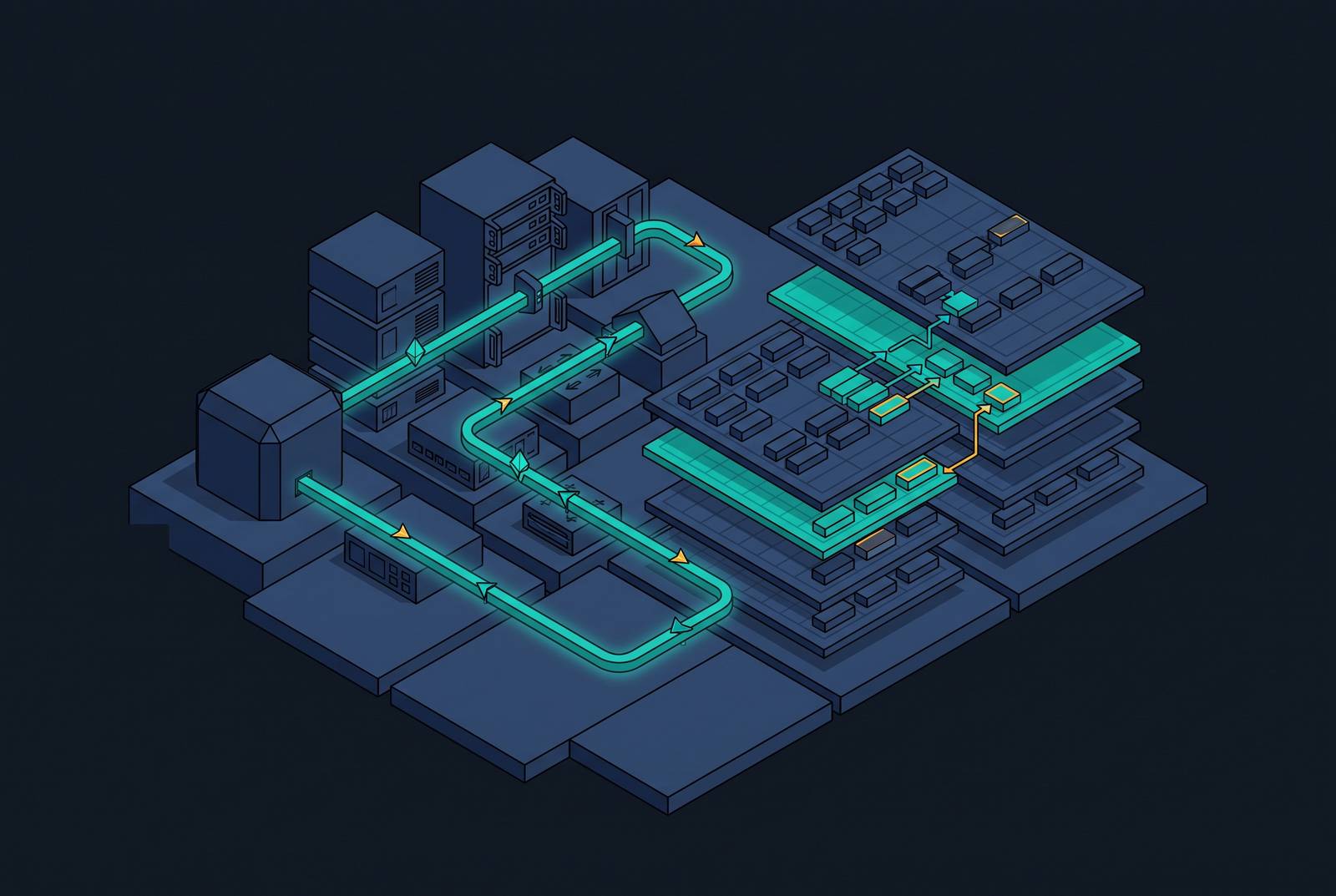
A wavelength service is a single beam of light tuned to a specific frequency and carried across a fiber path engineered to keep it alive end to end. This article maps what an OSS must record, at every stage of that service's life, to keep the physics and the paperwork in agreement.
Why wavelength services impose stricter OSS record requirements
Light does not negotiate. A wavelength assigned to the wrong frequency slot, paired with the wrong modulation format, or launched at the wrong power level does not degrade gracefully: it fails to establish a usable signal across the fiber path. That is the condition that separates wavelength services from the Ethernet and IP services most OSS platforms were originally built to track. An Ethernet circuit with a slightly stale configuration record can often still pass traffic while someone reconciles the paperwork later, because the logical layer has room to absorb drift between what the record says and what the network does. A wavelength service has no such cushion. Frequency, modulation, transmit power, reach, and protection are not descriptive metadata sitting on top of the service. They are the service, and an OSS record that misstates any one of them is not a clerical error but a latent outage.
The stakes have grown because the volume of high-capacity wavelength procurement has grown. U.S. customer purchasing of high-capacity wavelengths rose significantly in 2025, pushed by hyperscalers, AI companies, data center operators, and large enterprises building out interconnects at a pace the industry has not previously sustained. A wavelength serving an AI training cluster or a hyperscale data center interconnect is often the single highest-capacity, highest-visibility link an operator carries on a given route, and a provisioning failure on that link does not merely delay one order. It stalls a customer relationship that the operator has every incentive to protect.
Given that, complete and accurate OSS records are not an administrative nicety layered on top of wavelength service delivery. They are the functional prerequisite that makes the service deliverable, restorable, and auditable. The sections that follow map exactly which records the OSS must carry, in what form, at each stage of the wavelength service lifecycle: the optical parameters that define the channel, the path and topology that carry it, the interfaces and demarcation points that bound it, the protection scheme that preserves it, and the lifecycle discipline and data architecture that keep all of it accurate over time.
The optical layer parameters every wavelength service record must carry
The first layer of the record map is the optical signature of the channel itself, and it has to be complete before anything else can be trusted. A wavelength service record must state the assigned frequency or wavelength in nanometers, the channel spacing plan it follows (an ITU-T DWDM grid assignment, for instance), the transmit power level, and the modulation format in use. These four values are what the ROADM and transponder nodes are physically configured against, so any gap between what the OSS record says and what is actually configured on the equipment is an undetected fault sitting in wait.
Forward error correction mode and OSNR budget belong in the same record, and they carry real engineering weight at 400G and above, where the FEC scheme chosen directly affects how far the signal can travel and how much margin the path retains. The record has to reflect what was engineered for that specific path, not simply what was ordered on a service request form.
Chromatic dispersion and polarization mode dispersion compensation settings are path-specific, and they belong in the service record. Two wavelengths riding the same physical fiber span can carry entirely different compensation values, because their frequency placement and transponder type differ, so compensation data recorded against the fiber instead of against the individual service loses the distinction that actually matters for each channel.
Optical amplifier configuration along the path, gain settings and noise figure parameters included, is part of the service design on any long-haul wavelength, and it has to appear in the record so that a re-route or restoration event can reproduce the same amplification profile.
Path and topology records: modeling the route a wavelength takes
Once the channel's optical signature is recorded, the OSS has to capture where that channel actually goes. The wavelength's path belongs in the record as an ordered sequence of nodes and spans, not as a pair of endpoints with everything in between left implicit. Intermediate ROADM sites, amplifier locations, and any optical bypass configurations all need to appear explicitly, so that a fault on any single segment can be localized without someone tracing the route by hand across multiple systems.
Path constraints applied at design time have to survive into the operational record. Maximum hop count, geographic diversity requirements, latency budget, and specific node exclusions were decisions made for a reason, and when a re-route becomes necessary, the OSS has to be able to tell which of those constraints are still contractually binding and which were engineering preferences that can be relaxed under pressure. Losing that distinction after provisioning turns every future re-route into a guess.
Shared risk link group membership is where operators most often carry a gap in the record, and it is one of the costliest gaps to carry. Two wavelengths that cross the same fiber duct or conduit segment share a common failure mode whether or not anyone recorded that fact, and an OSS has no way to enforce path diversity or judge whether a protection scheme is actually adequate unless SRLG membership is an explicit, queryable attribute of the path record rather than something inferred after an outage reveals it.
Latency deserves its own line in the record, separate from the latency estimate used during design. The actual measured one-way propagation delay of the provisioned path has to be recorded as a service attribute in its own right, because data center interconnect customers increasingly buy wavelengths against managed latency commitments, and a contract is met or breached depending on how far the measured path reality strays from the engineered latency estimate.
Client interface and demarcation records: what sits at each end of the wavelength
The optical core of the service is only half the record. Every wavelength terminates somewhere, and what sits at each end has to be documented with the same rigor as the path between them. The OSS record must state the client-side interface type and rate at each endpoint, whether that handoff is 100GE, 400GE, OTU4, OTUCn/FlexO, or another framing, because the transponder configuration, the FEC interoperability between endpoints, and the OTN mapping all follow from that interface choice. A record that misstates the interface and an installation that doesn't match it will not come up without manual intervention, intervention that a correct record would have made unnecessary.
Transponder and line-card inventory has to be linked directly to the service record, not parked separately as an asset management entry. Vendor, model, firmware version, and slot or port identity are live service attributes in this context, because a transponder swap that updates the inventory system but never reaches the service record leaves the OSS blind to a changed optical characteristic that may now be riding on a different box.
Demarcation point documentation, the line marking where the operator's responsibility ends and the customer's begins, has to be explicit in the service record: the physical handoff location down to rack, panel, and port, and the test point used at acceptance. Wavelength service SLA frameworks that specify monitoring and reporting against defined attributes depend on that demarcation point being recorded, because performance can only be measured against a boundary that both parties have agreed on in writing.
For wavelength services that cross operator boundaries, the inter-carrier handoff interface, the specific optical interconnect point, its frequency assignment, and the agreed power level at that interconnect, has to be recorded in the OSS of each party involved. End-to-end service assurance across a multi-operator path depends on each operator knowing precisely what it received at the hand-off and precisely what it is responsible for past that point, and that only works if the handoff itself is a recorded, structured attribute rather than a line in a contract that never made it into either party's systems.
Protection scheme records: what the OSS must know to restore a wavelength correctly
A protection scheme does nothing on its own. It restores a service correctly only if the OSS record tells the restoration system, whether human or automated, what it is actually looking at. The protection scheme selected at design time, 1+1 optical path protection, shared mesh protection, unprotected with restoration, or some combination of these, has to be recorded as an explicit attribute of the service rather than something inferred from the shape of the route after the fact. A restoration system that does not know the contracted protection type has no way to judge whether a rerouted path satisfies the SLA the customer is paying for or merely restores some connectivity and calls it done.
Protection switching time is itself an SLA attribute, not a network characteristic to be discovered later. Commercial wavelength services increasingly offer flexible protection options that are contractually specific about the restoration interval they commit to, and the OSS has to record which option applies to a given service so that assurance systems can actually enforce it rather than simply observe whatever switching time the network happens to deliver.
Consider a path that fails over to its protect route during a fiber cut. If the OSS record never specified which path was the designated protect path, or recorded it incorrectly, the restoration system has no reliable basis for confirming that the path it switched to is the one engineered to carry that traffic under the contracted SLA. The service may come back up, but nobody can say with confidence that it came back up correctly.
Reversion behavior closes out this part of the record: whether the service reverts to its original working path once that path is restored, and under what conditions it does so. An OSS that cannot tell a revertive scheme from a non-revertive one will make one of two mistakes. It will either leave live traffic sitting on the protect path indefinitely when it should have reverted, or it will trigger an unnecessary switch-back that disrupts a service a second time just as it had stabilized.
The service record's evolution through the wavelength lifecycle: qualification, provisioning, and ongoing management
Every record described so far has to be treated as a living attribute, not a one-time entry made at turn-up and left untouched. At qualification, the OSS has to validate that the requested optical parameters are actually achievable on the candidate path before anyone commits to the order: frequency availability on the DWDM grid, OSNR margin against that path's loss budget, and latency against the customer's stated requirement. Qualification run against stale or incomplete inventory produces a commitment that looks sound on paper and then fails at provisioning, generating exactly the kind of expensive rework the record was supposed to prevent.
At provisioning, the OSS record has to function as the source of truth that drives configuration, rather than a documentation exercise that follows manual configuration after the fact. When the record and the live network are built from the same transaction, the gap between what was provisioned and what the OSS believes was provisioned is closed by construction rather than reconciled after someone notices a discrepancy.
Ongoing management is where most OSS platforms quietly lose the thread. The system has to detect and record configuration drift as it happens: a transponder gets replaced, an amplifier gets retuned, a fiber gets re-routed around planned maintenance, and the service record has to update to match. An OSS that treats the service record as fixed once a service activates tends to become unreliable as a source of truth within months of that activation, because the network it describes keeps changing while the record describing it does not.
At end-of-life or modification, what matters is the history of the record, not only its current state. A wavelength service upgraded from 100G to 400G needs a traceable account of what changed, when it changed, and under whose authorization, both to maintain SLA continuity through the transition and to satisfy an audit later. Qualification, provisioning, and ongoing management are not three separate tools handing a record off between them. They are three stages acting on one continuously maintained record, and the lifecycle only holds together if that record is never allowed to fork.
What an OSS data model must hold to represent wavelength service records correctly
Everything described above only works if the underlying data model is built to hold it together. A wavelength service record is a graph of related entities: the channel, the path, the nodes and spans along it, the client interfaces at each end, the protection resources assigned to it, and the SLA terms governing it. An OSS data model that stores each of these as a separate record in a separate domain, linked only by identifiers that may quietly disagree with one another over time, cannot reliably reconstruct the full service picture that qualification, restoration, and change management all depend on.
The model has to support traceability in both directions. From a physical resource, a specific fiber span, a ROADM port, a transponder slot, it has to be possible to trace every service that depends on it, and from any service record it has to be possible to trace every physical resource that service relies on. That bi-directional link is the foundation of impact analysis: it is what tells an operator, before a maintenance window opens or a component fails, exactly which services and which customers sit downstream of the change.
Inventory, service, and assurance records have to operate on that same underlying model. When an assurance system detects a live performance event, an OSNR degradation or a latency increase, it has to be able to locate the affected service record and its protection scheme directly, without a translation step across system boundaries that introduces delay or introduces error at exactly the moment precision matters most.
The same requirement extends to AI-driven operations. Automated qualification, intent-based provisioning, and predictive fault detection all depend on the same complete, accurate service record that a human operator needs to do the job correctly. An AI agent working against a fragmented data model will produce the same qualification errors and provisioning conflicts a human operator would, at far greater speed and scale, and with far less opportunity for someone to catch the mistake before it propagates. Governing AI operations within the same data model and the same permission structure used for human operators is what makes AI-driven wavelength management auditable.
Standardized network resource and service data modeling, paired with well-defined API interfaces, is what makes both internal automation and multi-operator coordination possible. An OSS data model built to satisfy the record requirements described throughout this article is the same model that supports on-demand service delivery and partner interconnect at scale. Operators who build that model will be positioned to qualify, provision, and assure wavelength services with the speed the current demand environment calls for. Operators who continue to manage wavelength records as a fragmented, after-the-fact documentation exercise will keep qualifying manually, provisioning slowly, and assuring reactively, while the market in front of them keeps moving faster than their systems can follow.
Sources
- Networx Unit Pricer: Service Guides: Optical Wavelength Service (OWS)
- 1 Application note A new view on wavelength services A new view on
- Wavelength Solutions
- Wavelength Networking Services Meet the Growing ...
- Optical network topology databases based on a set of connectivity constraints
- QoT Assessment of the Optical Spectrum as a Service in Disaggregated Network Scenarios
- draft-ietf-ccamp-optical-impairment-topology-yang-24 - A YANG Data Model for Optical Impairment-aware Topology
- Path computation element protocol (PCEP) operations to support wavelength switched optical network routing, wavelength assignment, and impairment validation